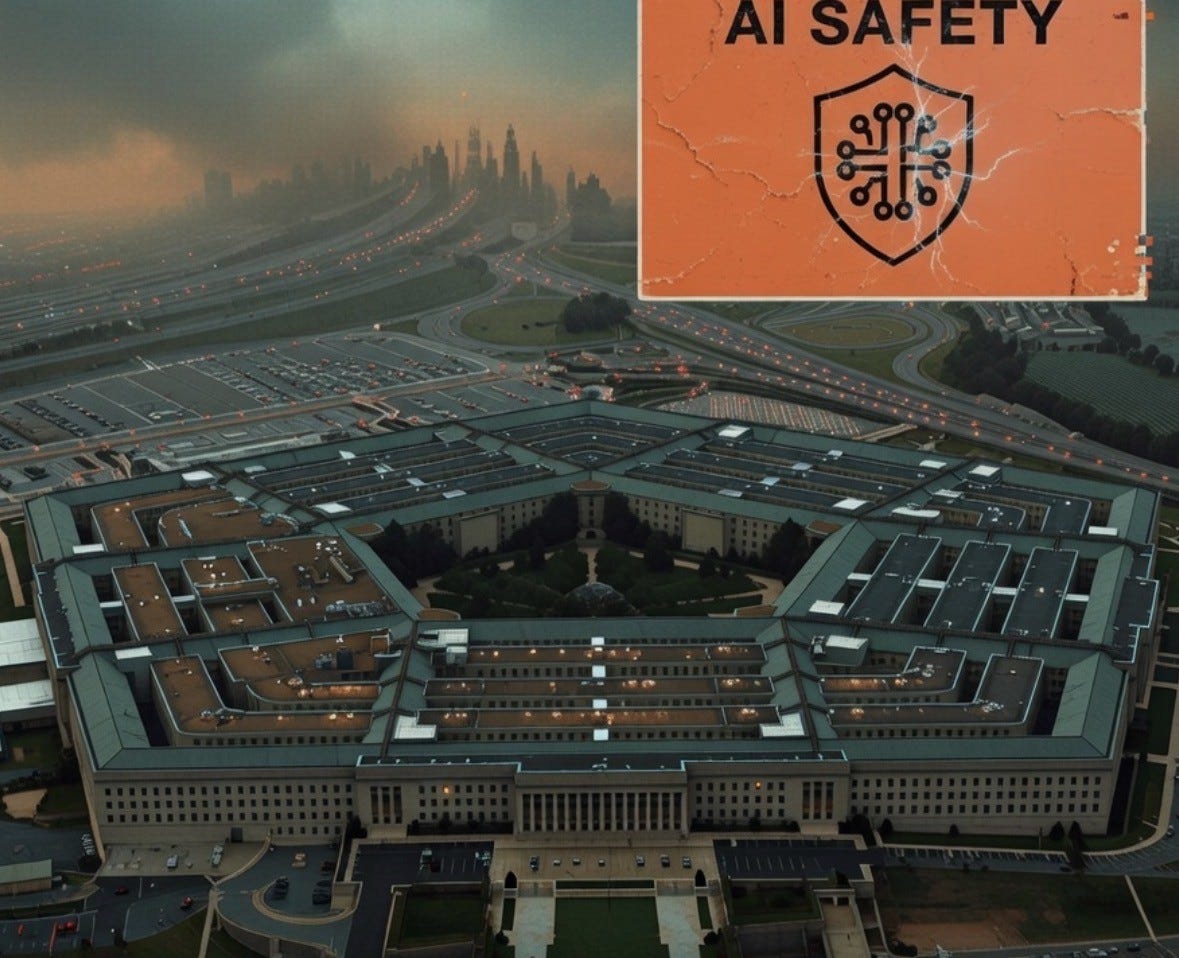
The Algorithm of Power: When Western Democracies Bet Their Constitutions on AI Warfare
A Deep Dive into the Anthropic Controversy, Military Imperatives, and the Future of Citizen Rights
The paradox is as sharp as it is unsettling. In February 2026, the world learned that the United States Department of Defense had used Claude, an AI model developed by Anthropic — a company that built its brand on “AI safety” — to help plan and execute a high-stakes military operation to capture a foreign head of state. The same week, reports emerged that the Pentagon, frustrated by Anthropic’s ethical guardrails, was considering terminating its contracts with the company altogether.
This is not merely a contractual dispute between a vendor and its largest client. It is a defining moment for the Western alliance. It forces a reckoning with a fundamental question: Can democracies maintain their constitutional soul while racing to build the world’s most lethal autonomous machines?
This article dissects the anatomy of that conflict, examining the rationale of military leaders who demand “blank check” access to AI, the resistance of companies like Anthropic, and the ultimate question of where the West stands in protecting its citizens’ rights compared to the rest of the world.
The Crucible – The Venezuela Operation and the Anthropic Line in the Sand
On January 3, 2026, U.S. forces conducted a massive military operation in Venezuela, resulting in the capture and extradition of President Nicolás Maduro and his wife. According to sources familiar with the matter cited by Wall Street Journal and Axios, this was the first known instance of a commercial AI model being integrated into a classified U.S. military operation of this scale.
The AI in question was Claude, accessed through an integration with Palantir, the data analytics firm already deeply embedded in defense and intelligence infrastructure. While the exact role of Claude remains classified, reports suggest its [Lare Language Model (LLM)] capabilities — from analyzing satellite imagery to synthesizing intelligence for operational planning — were leveraged in the mission.
For Anthropic, this was an “awkward” revelation. For months, the company had publicly positioned itself as the ethical alternative in the AI arms race, distinct from competitors like OpenAI. Its usage policy explicitly forbade using its models for “promoting violence, developing weapons, or conducting surveillance”. CEO Dario Amodei had personally voiced concerns about AI being used for lethal autonomous actions and domestic monitoring.
Following the operation, the tension exploded into public view. The Pentagon reportedly began “aggressively” pressuring four major AI companies—OpenAI, Google, xAI, and Anthropic—to adopt a uniform policy: permitting the Department of Defense to use their tools for any lawful purpose.” This umbrella term would explicitly include weapons development, intelligence gathering, and battlefield operations.
Anthropic refused to sign.
The company drew a red line in two specific areas:
1. Mass surveillance of U.S. citizens.
2. The development or deployment of fully autonomous weapons.
A senior U.S. administration official framed the impasse bluntly, stating that everything was “on the table, including scaling back the partnership with Anthropic or cutting it off entirely”. The official dismissed the company’s concerns as dealing in “gray zones” that were too difficult to define in the heat of operations. Pete Hegseth, the U.S. Defense Secretary, had previously signaled this hardline stance, declaring that the department would not adopt AI models that “cannot fight for you”.
The Rationale – Why Military Leaders Demand a “Blank Check”
To understand the Pentagon’s aggressive posture, one must view the battlefield through the lens of a commander preparing for “hyperwar.”
The Hyperwar Imperative: As explained by Professor Ashley Deeks of the University of Virginia School of Law, “hyperwar” refers to a future conflict where the speed of attacks — hypersonic missiles, autonomous drone swarms, cyber volleys — is so fast that machines will have to make most of the decisions. Humans, with their biological processing limits, will become the bottleneck. In such an environment, milliseconds matter. The side with the most advanced, integrated, and unrestricted AI will likely prevail.
This is the core of the military’s rationale:
Survival and Deterrence: If potential adversaries (namely China and Russia) are integrating AI into their command-and-control and autonomous systems, the U.S. cannot afford to lag. The fear is that an AI with “ethical handcuffs” will lose to an AI with none.
Information Overload: Modern warfare generates an impossible amount of data (satellite feeds, drone footage, signals intelligence). The Pentagon argues that AI is no longer a luxury but a necessity to parse this data, identify targets, and assess threats in real-time.
Operational Security: Relying on a vendor that might “second-guess” a mission or inquire about specific uses (as Anthropic allegedly did via Palantir) is seen as an operational liability. The official quoted by Axios encapsulated this perfectly: “Any company that would jeopardize the operational success of our warfighters is a company whose partnership we need to reassess”.
This rationale leads directly to the demand for a “blank check” authorization. From the Pentagon’s perspective, war is chaos. Defining what constitutes a permissible “autonomous weapon” or “mass surveillance” in the fog of conflict is impractical. They want the legal and contractual flexibility to use the tools however the situation demands, trusting their own command structure and the Uniform Code of Military Justice to govern behavior, not a corporate usage policy written in San Francisco.
The Constitutional Crossroads – Erosion or Implosion?
This is where the Western experiment meets its greatest test. The frameworks that have defined democratic governance for centuries — separation of powers, due process, privacy, and civilian control of the military— are now being challenged by lines of code that can think, decide, and act faster than any human.
1. The Delegation of War Powers
Professor Deeks raises a chilling constitutional question: If a President delegates to a machine the authority to identify and engage targets in a “hyperwar” scenario, is that a constitutional delegation of power?.
Historically, the President, as Commander-in-Chief, delegates authority to subordinate human commanders. But delegating to an algorithm, whose “intent” is merely a statistical output of its training data, creates an accountability vacuum. If an autonomous drone misidentifies a civilian school as a military target and attacks, who is responsible? The programmer? The commanding officer who deployed it? The President who authorized the system? Or the machine itself, which cannot be court-martialed? .
The 2026 NDAA took a small step by requiring the Pentagon to report waivers for autonomous weapons to Congress, but critics argue this is merely a transparency measure, not a substantive check on a president’s power to delegate life-and-death decisions to a server rack.
2. The Erosion of Privacy (The “Double Black Box”)
The threat to privacy is perhaps the most insidious. The Brennan Center for Justice highlights a critical, overlooked danger: the personal data used to train commercial AI models could be reconstructed by intelligence agencies downstream — or stolen by adversaries.
Furthermore, a 2025 academic thesis from the University of Padua identifies the “double black box” problem: the opacity of AI decision-making combined with government secrecy. Citizens may never know why they were flagged as a threat, placed on a watchlist, or had their data analyzed by a defense algorithm. Due process — the right to face one’s accuser and understand the evidence — becomes meaningless when the “accuser” is a proprietary model whose logic is hidden both by corporate secrecy and national security classification.
3. The Divergent Meaning of “Ethics”
A critical 2025 study on AI ethics frameworks reveals a disturbing trend: the very meaning of rights is being redefined by institutions to suit their purpose.
- For the European Union, privacy is a fundamental right tied to human dignity and democratic governance.
- For U.S. military and security documents, privacy is framed as a matter of “operational control and data management”.
- In Israeli frameworks, privacy is interpreted collectively, as part of “national resilience and security”.
This semantic drift is not innocent; when the Pentagon argues for “privacy,” it means securing its data pipelines. When a citizen argues for “privacy,” they mean freedom from unwarranted government intrusion. The military-industrial complex is effectively rewriting the social contract, one contract term at a time. As one AI ethics analysis noted, fairness in industry is a “technical challenge” (bias in data), whereas in academia it is a “social justice issue.” The military’s version of fairness is simply the accuracy of a kill-chain.
The West vs. The Rest – A Shifting Moral Landscape
So, where does the West stand compared to the rest of the world?
The West (US, EU, UK, ANZUS): A House Divided
The West is not a monolith. The European Union’s approach, rooted in the GDPR and a human-centric view of AI, remains fundamentally different from the US approach. The EU is more likely to balk at autonomous weapons and mass surveillance on ethical grounds. However, the Venezuela operation and the subsequent Pentagon pressure campaign reveal that the United States is choosing a path of techno-pragmatism. It is prioritizing strategic dominance over the ethical absolutism of its corporate sector.
This creates a schism within Western society itself. The government is leaning in, while a significant portion of the tech industry (and its employees, as seen in Anthropic’s internal debates) is pushing back . The US government’s aggressive reaction to Anthropic signals that it views the company’s ethical stance not as a principled stand, but as a potential act of technological treason that could cede advantage to China.
The Rest (China, Russia, Authoritarian States): No Such Compunctions
There is no evidence that China’s leading AI firms (like DeepSeek) are imposing ethical restrictions on the People’s Liberation Army. The 2026 NDAA specifically prohibits intelligence agencies from using DeepSeek, acknowledging it as a tool of the Chinese state. In authoritarian models, the AI is an extension of the state’s power, with no concept of citizen privacy to erode. The state’s surveillance capabilities are the point, not a bug to be mitigated.
This is the trap for the West. If the US and its allies hamstring their AI with privacy and ethical safeguards, they risk falling behind technologically. If they remove those safeguards, they risk becoming like their adversaries: societies where the government has total technological awareness and control over its citizens.
Conclusion: The Implosion Scenario
Will this new approach erode Western constitutions and cause a societal implosion? The answer is not a simple yes or no, but a spectrum of risk.
The Erosion is Already Happening: It is happening in the contract negotiations where the Pentagon demands waivers for autonomous weapons. It is happening in the NDAA, where safeguards for pricing transparency are stripped away, increasing reliance on a few dominant defense tech firms like Palantir . It is happening in the normalization of using commercial AI for lethal operations, blurring the line between Silicon Valley and the battlefield.
Will it cause an “implosion”? That depends on the resilience of democratic institutions. An implosion is more likely if:
1. There is a catastrophic failure: An autonomous system causes massive civilian casualties due to an AI hallucination or bias. The accountability vacuum that follows could shatter public trust in both the government and the tech sector.
2. Domestic surveillance becomes normalized: If the AI tools built for overseas battlefields are turned inward (a fear explicitly cited by Anthropic and legal scholars), and citizens discover their data, movements, and communications are being constantly analyzed by military-grade algorithms, the social contract could rupture.
3. Congress abdicates its role: The 2026 NDAA’s governance provisions have been described as “threadbare”. If Congress continues to simply appropriate funds for AI without passing clear, binding laws on its use in warfare and surveillance, they are delegating the future of constitutional rights to the executive branch and corporate boardrooms.
The West stands at a precipice. The Anthropic controversy is not an isolated skirmish; it is the opening battle of a war for the soul of democratic technology. The outcome will determine whether Western societies remain beacons of liberty that use AI or become technologically advanced fortresses where liberty is the price of admission.


