The Answers Left Blank
On April 9, 2026, Israeli forces killed nine-year-old Ritaj Abdulrahman Rihan at her desk in a tent school in Beit Lahia.
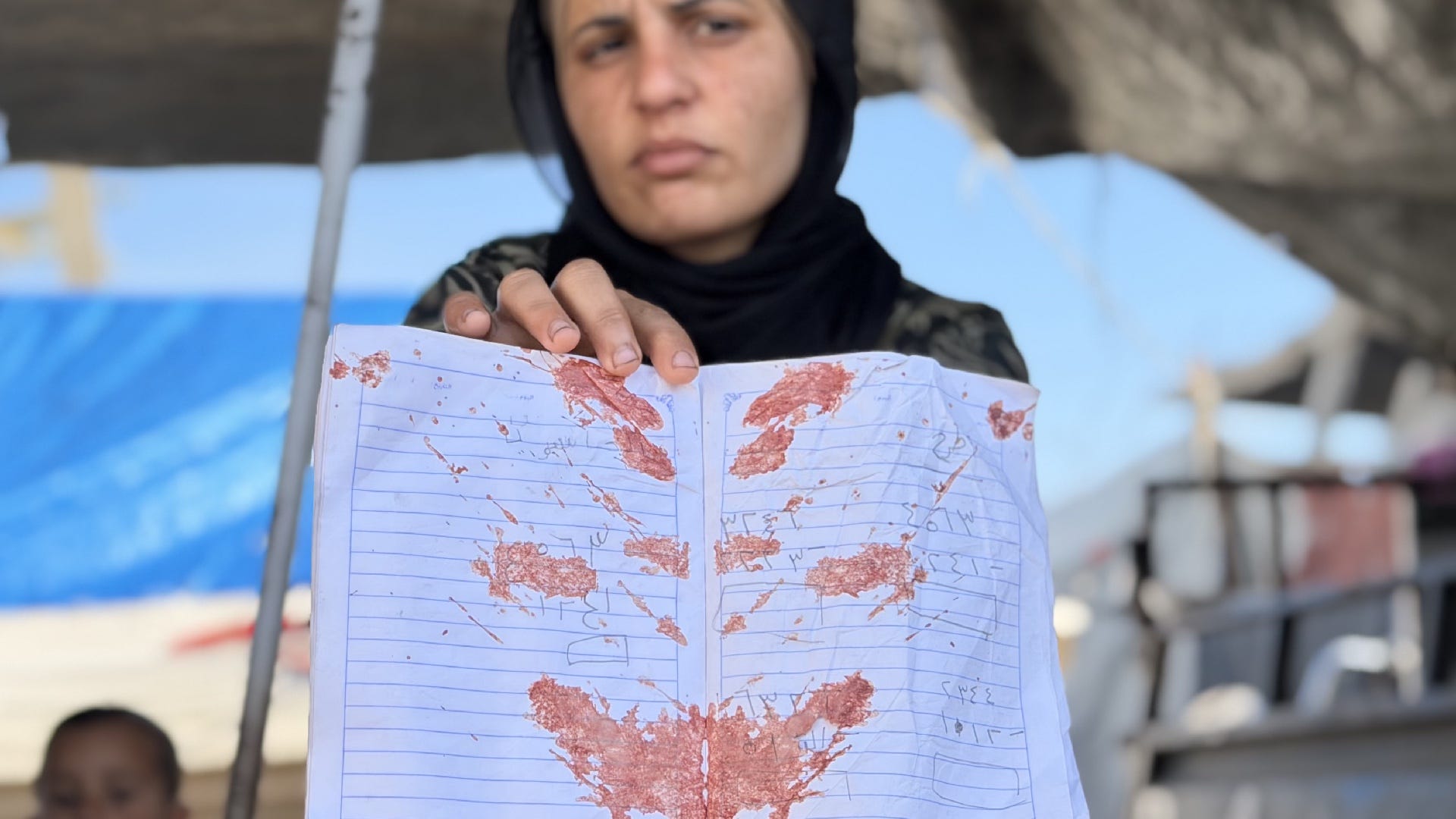
The Abu Ubaida Bin al-Jarrah School in Beit Lahia, northern Gaza, is not a building. It is a tent, erected in the ruins of a neighbourhood that no longer has buildings, and on the morning of Thursday, April 9, 2026, approximately forty children were seated inside it working through a mathematics exercise. The lesson was on the subtraction of four-digit numbers. Ritaj Abdulrahman Rihan, nine years old, in the third grade, had written down the problems her teacher set. She left the answer spaces blank. A bullet fired from an Israeli military position struck her in the head while she worked, and she was pronounced dead at Al-Shifa Hospital before her parents arrived.
Her teacher, Ayman Rihan, was in the adjacent section of the tent when the children began to scream. He ran in and found Ritaj lying face down, blood coming from her mouth, and he was still holding her notebook when he described the scene to reporters from Xinhua later that day. There was no medical transport available in Beit Lahia. Her body was carried through the streets on foot toward the hospital, and the images from those streets have since circulated to every part of the world that has internet access and the capacity to feel something upon seeing them, which is, in practical terms, a different population from the one capable of stopping what produced them.
Ola Rihan had dressed her daughter that morning, combed her hair and tied it before sending her out. The family’s house had been destroyed in an earlier phase of Israeli bombardment and they had been living since then in a makeshift tent, displaced among tens of thousands of displaced families across northern Gaza. Ritaj walked approximately one kilometre to the school and back each day, a distance her parents considered acceptable, a calculation they made each morning against the conditions of the neighbourhood and the location of the school relative to the Israeli military’s so-called Yellow Line. For two years before October 2025, the family had moved continuously, driven from one part of the enclave to another by successive rounds of Israeli operations, and Ritaj had been out of school for the entirety of that period. When the ceasefire framework was announced and her father, Abdulrahman, re-enrolled her, she was his firstborn child starting school again at nine as if for the first time.
“We were happy she had grown up enough and remained alive and healthy after two years of genocide to carry a school bag and notebooks,” Abdulrahman said in the days after her death. “She was finally back at school. She was clever and loved school.” He had watched his daughter survive long enough to do something ordinary. The ceasefire had made ordinary things feel possible again, or nearly so, and the family had acted on that feeling by sending her one kilometre down the road each morning.
Ola Rihan was handed the bloodstained notebook at the hospital. She held the pages and looked at what her daughter had been doing in the last minutes of her life, the written questions and the empty spaces where the answers should have been. “This is not ink,” she said. “This is my daughter’s blood. This notebook is the greatest proof of Israel’s crimes against our children.” What she said next does not require a frame to carry its weight: the family had bought Ritaj a dress and a pair of shoes that week, intended for her uncle’s wedding the following Saturday. Ritaj had been excited about them, had wanted to wear them. She was buried in a shroud instead, and the dress is still wherever Ola keeps it now.
Before Ritaj, Ola had already lost her mother, her sister, her sister’s children, and her uncle in Israeli attacks across the preceding two years of the war. “Shock after shock, we are exhausted,” she said at the funeral. “Our children are killed all the time. Even after they finally managed to attend school.”
The Yellow Line is not a border in any recognised legal sense. It is a boundary unilaterally imposed and marked by the Israeli military inside the Gaza Strip since the October 2025 ceasefire, designating large sections of the territory as no-go zones and barring Palestinians, under threat of lethal force, from accessing land to the north, south, and east of its shifting coordinates. Its positions are not consistently published or reliably communicated to civilian populations. Israeli artillery units and snipers stationed along its eastern edge have, according to documentation compiled by the UN Office for the Coordination of Humanitarian Affairs, routinely opened fire into neighbourhoods that fall on the western side of the line, within the zone that the ceasefire agreement classifies as safe for civilians.
School principal Mohamed al-Attar confirmed after Ritaj’s death that the shot had come from the eastern side of the school, the side that faces the Yellow Line. Ola Rihan had done her own assessment before sending her daughter that morning: “The school is supposed to be in a safe area. It is not close to the Yellow Line, and this is why we felt comfortable enough to send her there to learn.” Her calculation was careful, reasonable, and fatal. When CBC News contacted the Israeli Defence Forces for comment on Ritaj’s death, the IDF said it was working to “dismantle Hamas’s military capabilities” and that it could not provide specific details about what had happened on April 9. “In stark contrast to Hamas’ intentional attacks on Israeli men, women and children,” the statement read, “the IDF follows international law and takes feasible precautions to mitigate civilian harm.” These two statements, Ola’s and the IDF’s, now occupy the same factual record.
Ritaj Rihan died on April 9. The day before, April 8, an Israeli military drone killed Al Jazeera journalist Mohamed Washah in Gaza City, and the Israeli military subsequently identified him as a Hamas operative. On April 6, Israeli forces fired on a vehicle transporting World Health Organisation personnel, killing the driver. By the first week of April 2026, 589 aid workers had been killed in Gaza since October 7, 2023, of whom 397 were UN staff or attached team members. Israel had carried out attacks on Gaza on 36 of the 40 days immediately preceding Ritaj’s death.
UN High Commissioner for Human Rights Volker Türk issued a statement on April 11, two days after the killing, observing that at least 32 Palestinians had died at the hands of Israeli forces in the first ten days of the month. “For the past 10 days, Palestinians are still being killed and injured in what is left of their homes, shelters and tents of displaced families, on the streets, in vehicles, at a medical facility and a classroom,” he said. The statement was published, distributed to media organisations, and filed. No Security Council emergency session followed. No government that votes on such sessions publicly named Ritaj Rihan’s death as a cause for convening one.
The ceasefire between Israel and Hamas had been in effect since October 10, 2025, and from that date through April 9, the day Ritaj died, 738 Palestinians had been killed and 2,036 wounded inside Gaza, with Israel conducting attacks on most of the days in between, under an agreement whose name no longer describes what it governs.
The war itself, in its full dimensions, had by April 2026 killed more than 72,300 Palestinians by direct fire, according to the Gaza Ministry of Health, with 172,000 recorded injuries. An independent population survey published in The Lancet Global Health in February drew on household data from across the strip and estimated 75,200 violent deaths between October 2023 and early January 2025 alone, a figure 34.7 percent higher than the Ministry’s administrative count for the same period. The study’s authors concluded that Ministry of Health figures, rather than being inflated as Israeli officials have consistently claimed, function as a conservative floor, constrained by the disintegration of the documentary systems required to record death at its actual pace. Among the consequences that do not appear in the death toll: Gaza has, as of this writing, the highest number of child amputees per capita of any territory on earth, a figure produced by two years of explosive ordnance in densely populated residential zones and the near-total collapse of the surgical infrastructure needed to treat blast injuries.
UNRWA, the UN agency that has operated schools and clinics for Palestinian refugees since 1949, has been blocked by Israeli authorities from delivering international humanitarian personnel into Gaza since January 2025 and from bringing in aid supplies since March 2025. The tent at Abu Ubaida Bin al-Jarrah School, where Ritaj sat at her desk with her notebook, existed as a substitute for the institution that should have been present and has been legally excluded. The tent was UNRWA’s proxy. The lesson inside it was a form of insistence.
The week Ritaj Rihan was killed, the dominant editorial framing for the Middle East across Western news organisations concerned Operation Epic Fury, the US-Israeli military campaign against Iran that began in late February 2026, and the question of whether the Islamic Republic’s response would involve its full ballistic missile capacity or something calibrated to preserve negotiating space. The UN High Commissioner’s statement about Gaza, about Ritaj and the 31 other Palestinians killed in the first ten days of April, occupied the press release queue alongside briefings on the Strait of Hormuz and assessments of Israeli strike packages against Iranian nuclear infrastructure. This is not a statement about editorial negligence. It is a description of how catastrophe competes with catastrophe for the attention of people who are not experiencing either one, and of what is normalised when the competition runs long enough.
Ola Rihan is still in Beit Lahia. The dress bought for the wedding is still wherever she keeps it. Her daughter’s notebook, bloodstained, with the maths questions written out and the answers missing, is the only document from April 9 that will not be filed and forgotten.


