The Architecture of Mourning: Inside the Six Days Iran Buries Ali Khamenei
Iran buries its second supreme leader inside a six-day procession built from older griefs
There is a particular kind of silence that falls over a country attempting to bury a man twice: once in fact, in February, when the strike came before dawn and left almost nothing of the ceremony that should have followed, and once in public, months later, when the state finally has the theater it wants and the war has quieted enough to let it use it. Iran has spent four months waiting for that second silence. This week it got it, and filled it with twenty million people.
Persia has buried its rulers before under circumstances designed by someone else. Nader Shah died at the hand of his own officers in 1747, in a tent on the road to Khorasan, and the empire he had spent a lifetime assembling came apart within the year. The Safavids lost Isfahan to an Afghan siege in 1722 and never recovered the throne room where the shah once received ambassadors beneath a ceiling of mirrored glass. Cyrus is buried at Pasargadae in a tomb that Alexander’s soldiers, arriving two centuries later, found already half forgotten by the people who lived around it. A civilization this old does not experience the death of a leader as a single event. It experiences it as the latest entry in a ledger that has been kept, with interruptions, for twenty-five hundred years. Ali Khamenei’s funeral belongs to that ledger whether the men organizing it in Tehran this week intended the comparison or not.
He was eighty-six, and he died on February 28th at his residence in central Tehran, in the opening strike of the war the United States and Israel launched against Iran that morning. The strike killed him alongside his daughter, his son-in-law, his fourteen-month-old granddaughter, and the wife of his son Mojtaba, who was severely wounded in the same attack and has not been seen in public since. Weeks later Mojtaba Khamenei was named his father’s successor, becoming the third man in the history of the Islamic Republic to hold the title of supreme leader, and the first to inherit it without having spent decades first building the religious and political standing the office was designed to require. The funeral that should have taken place in March was postponed instead, the war too active, the risk of another strike too real. It resumed this week under a truce neither side calls a ceasefire, four months late, timed to the first ten days of Muharram, the month in which Shia Islam remembers the betrayal and killing of Hussein ibn Ali at Karbala in the year 680. Analysts in Tehran have noted, without needing to elaborate for a domestic audience already fluent in the reference, that the dates also span the American Fourth of July. A leader killed by American and Israeli ordnance, buried during the very weeks his tradition sets aside to mourn a martyr betrayed by an overwhelming and corrupt power, is not an accident of scheduling. It is the entire argument, delivered without a single line of text.
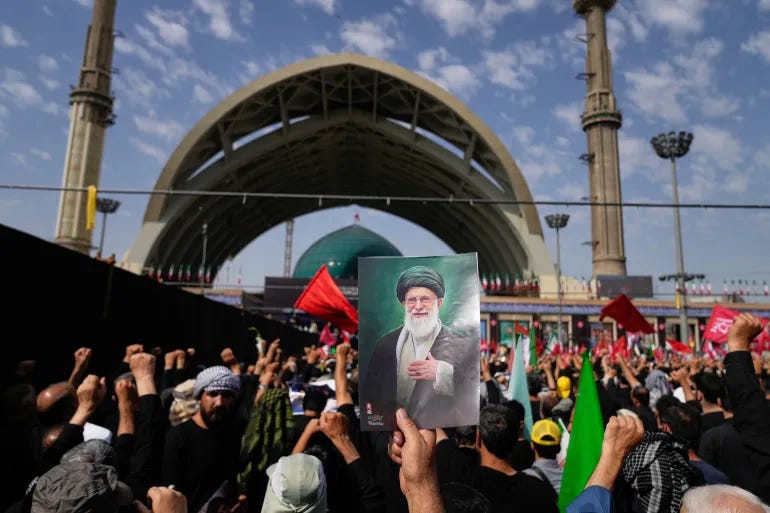
The body arrived at Tehran’s Grand Mosalla before dawn on July 3rd, and the first mourners let inside found a room built for a different funeral altogether. The Grand Mosalla, a prayer complex vast enough to be visible from the ring roads that circle it, was constructed to honor Ruhollah Khomeini, the founder of the Islamic Republic and Khamenei’s predecessor, and it has served every major state occasion since his death in 1989 as though the building itself insists on continuity. Khamenei’s coffin sat beneath its canopy alongside three smaller caskets, those of his family, wrapped in black mourning cloth and red flags marked with the words “Ya Hussein,” while a fifth banner, draped directly over Khamenei’s own casket, had previously flown over the shrine of Imam Hussein in Karbala before being brought to Tehran for this purpose. Mourners identified by state broadcasters as relatives of those killed in the war, and in the twelve-day conflict with Israel the previous year, were given the ceremonial role of touching scarves and cloths to the coffin, a gesture of blessing Iranian mourning ritual reserves for its heaviest losses. None of it needed announcing. The room had already been built to receive it.
Outside, the state had converted the approach roads into parking fields for buses that had driven through the night from Isfahan, Tabriz, and Mashhad, and no vehicle was permitted within roughly a kilometer of the complex itself. Iranian officials have projected between fifteen and twenty million mourners across the six days of ceremony, a figure that would make this the largest funeral gathering in the country’s history, surpassing even the estimated ten million who turned out for Khomeini in 1989. Businesses, gyms, and the Grand Bazaar were ordered closed for stretches of the mourning period, and reporting from inside Iran describes employers instructing staff that leave requests during funeral week would not be granted. Whether the resulting crowds reflect organized turnout, genuine grief, or the fact that in a country of this size the two have never been easy to separate, is a question Iranians are debating more candidly than the state would prefer. A funeral this large, arriving after four months of war and economic strain, was never going to be purely spontaneous or purely staged. It is, like most things built to last twenty-five centuries, both at once.
At Enghelab Square a statue of Khamenei’s raised fist stands framed against ballistic missiles rendered in flight, and banners reading “We must rise” hang above the boulevards in Arabic, English, and Farsi together, a rare concession to an audience the state usually addresses only in its own language. The fist, the missiles, the red flags of vengeance layered over the black flags of grief: every element argues the same case, that the man being buried was avenged before he was buried, and that the promise of retaliation is itself a part of the funeral rite rather than a separate matter for the generals to handle afterward.
The most conspicuous figure at Ali Khamenei’s funeral is the one who never appeared. Mojtaba Khamenei, elected supreme leader on March 8th, has not been seen in public since the strike that killed his father and wounded him badly in February. Iranian state media indicates he will not attend the main Tehran ceremonies, citing direct Israeli threats against him. His only presence in the proceedings so far has come through a written statement read by a television anchor, in which he described seeing his father’s body after death with its fist still raised, an image the state has since absorbed into the funeral’s broader visual language, the fist at Enghelab Square rendered from the same account the public heard from his son.
There is a version of Persian and Shia history that runs almost entirely through absent or hidden leaders, men whose authority survives their disappearance because the institution built around them insists that it must. The Twelfth Imam, in Twelver Shia theology, is understood not to have died but to have entered occultation, present but unseen, his return awaited rather than mourned. Mojtaba Khamenei is not being asked to fill that role, and no cleric in Tehran would suggest otherwise aloud. But a state built on the visible continuity of religious authority, burying its second supreme leader while its third cannot safely appear at the funeral, is operating for the first time in its history on a kind of borrowed patience, asking a public that has just endured a war to accept that leadership can be real and present in name only. Iran’s military command has stepped into the space his absence leaves. General Ahmad Vahidi, who assumed command of the Revolutionary Guard Corps after his predecessor was killed in the war’s opening strikes, made his first public appearance in months at the coffin. Major General Amir Hatami used the sidelines of the ceremony to pledge retaliation against Washington and Tel Aviv. Ali Abdollahi, commanding Iran’s Khatam al-Anbiya headquarters, warned both governments directly against any strike during the funeral itself, a statement addressed as much outward as inward.
More than a hundred countries sent delegations to Tehran this week, according to Iranian state broadcasters, and the guest list tells its own story through what it excludes as much as what it contains. Pakistan’s prime minister, Shehbaz Sharif, arrived among the most senior foreign leaders present, a reflection of Islamabad’s role brokering the ceasefire and the interim understanding now serving as the basis for wider negotiations between Washington and Tehran. Tajikistan’s president, Emomali Rahmon, and Georgia’s Mikheil Kavelashvili traveled as heads of state. Russia sent Dmitry Medvedev as Vladimir Putin’s personal envoy. China dispatched He Wei, a vice chairman of the National People’s Congress standing committee. India’s delegation included its deputy foreign minister and the governor of Bihar, described by Indian officials as the country’s most senior Shia Muslim currently in public office, alongside opposition figures Salman Khurshid and Mehbooba Mufti. Afghanistan’s Taliban government sent its foreign minister, taking up several thousand visas Iran had issued for the occasion, while a rival Afghan delegation led by the anti-Taliban National Resistance Front made the same trip, an arrangement that would be unthinkable at almost any other funeral on earth. Qatar, Oman, Saudi Arabia, Iraq, Cuba, Serbia, Turkmenistan, and Namibia rounded out a list Iranian officials describe, without much subtlety, as drawn from the right side of history.
The absences carry the weight the presences cannot. Iran’s government has confirmed it did not invite the European states it holds responsible, directly or indirectly, for the American and Israeli campaign, and a foreign ministry spokesman went further, calling those governments’ posture toward the strikes shameful and stating that any country seen as having taken what he called an inappropriate position on the war was left off the list entirely. A funeral for a man killed by American and Israeli munitions has become, by design, a gathering of the governments willing to say so aloud, and a pointed non-gathering of the ones that are not. The guest list is a foreign policy document disguised as an act of mourning, and Tehran has not tried especially hard to disguise it.
By July 9th, Khamenei’s body will have traveled from Tehran’s seat of government through Qom’s seminaries and the Iraqi shrine cities of Najaf and Karbala before its final burial at the shrine of Imam Reza in Mashhad, the city of his birth. The route retraces, in reverse, the geography of Shia religious authority the Islamic Republic has spent nearly half a century positioning itself at the center of, and burial beside Imam Reza is among the highest honors Shia tradition can confer on a leader who was also, in life, the state’s highest religious authority. Analysts in Tehran describe the funeral’s real function without much ambiguity: less a ceremony of comfort for a grieving population than a display of unity and continuity for a domestic and foreign audience alike, an answer to a question the war left open. Can a state that failed to protect its own supreme leader, whose successor cannot appear safely in public, still command the reflexive loyalty and total institutional control a revolutionary theocracy requires simply to keep functioning.
The turnout figures, if they hold, will give Tehran the answer it wants recorded for history. History, in this part of the world, has a long habit of recording the crowd and forgetting to ask what happened after it dispersed. Nader Shah’s army was enormous too, in the years before the tent on the road to Khorasan. What an Islamic Republic led by a hidden man, who inherited a title rather than the decades of accumulated standing that title used to require, actually becomes once the coffins are underground and the banners come down is not a question six days of procession, however vast, were built to answer.


