


Last Saturday a mix of Houthi drones, cruise missiles and ballistic missiles flew more than 1,000 kilometers across Saudi Arabia and came down on King Khalid International Airport in Riyadh. At least a dozen people were killed and more than 300 wounded. Four of the dead were Saudi. The others were from Bangladesh, Egypt, Jordan, Syria, Palestine, Sudan and the United States, the kind of people who work and pass through a Gulf airport on any given afternoon. The airport shut. Riyadh’s schools moved online for a week, and offices in the financial district sent their staff home. On Sunday the Houthis went after the same airport again.
Saudi Arabia spent about $83.2 billion on its armed forces last year, according to SIPRI. Only seven countries spent more. Nobody in the Middle East comes close. The money bought F-15s, Typhoons, Abrams tanks, Patriot batteries and surveillance systems from the best suppliers in Washington, London and Paris. The movement now deciding when Riyadh’s airport can open comes from Yemen, the poorest country in the Arab world.
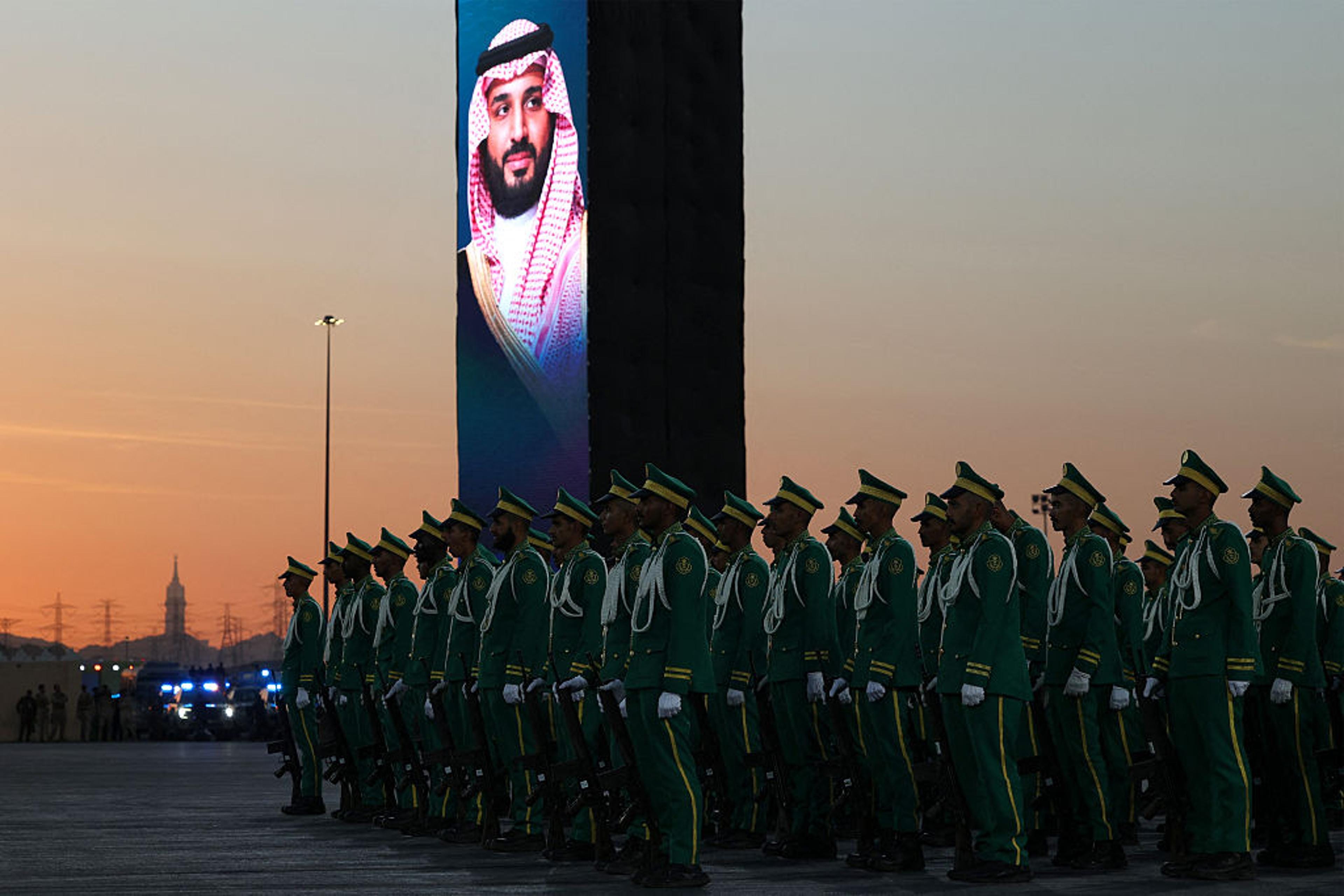
The reason has less to do with Yemen than with how the Saudi royal family has organized its own guns. For sixty years the House of Saud has arranged its armed forces so that no officer could ever turn them on the palace. In that it has been completely successful. No Saudi soldier has ever taken power. But an army designed around that fear has branches that answer to different masters, officers who rise on loyalty, and intelligence that travels up the chain and then stops. Its defeats never get studied, because the study would embarrass somebody. The Houthis have been fighting this army, on and off, since 2009. They know its habits well.
What the money bought
Compare the two sides on paper and the gap is absurd. Saudi GDP is over a trillion dollars. Yemen’s economy has shrunk to a fraction of what it was before 2015. The kingdom has had decades of American training, British maintenance contracts and French technical help. The Houthis put their arsenal together from captured army stockpiles, smuggled Iranian parts and workshops dug into the hills around Saada.
Wars are not decided by inventories, though. An army has to combine intelligence, command, supply, training and a clear political aim, and Saudi Arabia has never managed that combination in Yemen. Its pilots can destroy a launch site. Its government has never built a Yemeni ally capable of holding territory, running it and keeping the Houthis from coming back.
The Sana’a Center made the point in its assessment this month. The anti-Houthi camp has no unified military leadership, and its rival chains of command undermine planning, intelligence sharing, logistics and the use of reserves. Riyadh has paid for this camp for eleven years. It has never turned it into one army.
For the Houthis the arithmetic runs the other way. They have little money and a simple goal: survive, keep the north and make their enemies pay until they give up. A small leadership circle in Saada runs the war. Iranian missiles, drone parts and technicians have extended its range, and that help goes a long way because it lands in a movement with one chain of command and a willingness to take enormous casualties.
So this is a fight between a rich security establishment built mainly to keep watch on itself and a poor movement that has been organized for war its entire life.
Why the princes fear their own officers
Saudi kings watched the region’s other monarchies fall to their own officers. Egypt’s went in 1952. In 1958 Iraqi officers shot their king and most of his family in the palace courtyard. In 1962 army officers overthrew the imam of North Yemen, right on the Saudi border. Gaddafi and his fellow officers removed the Libyan king in 1969. That same year Saudi intelligence found a plot inside the kingdom’s own air force. The conspirators reportedly planned to bomb the royal palaces and declare a republic. Hundreds of officers were arrested.
The royal family’s conclusion was hard to argue with. One strong, professional and independent army might defend the country well, and it might just as easily take it over. The safer choice was to break armed power into several institutions, each with its own recruits, its own commanders and its own protector inside the family.
A RAND analyst named James Quinlivan wrote the standard account of this in 1999, looking at Saudi Arabia, Iraq and Syria. He called it coup-proofing. The methods are familiar: lean on groups with special ties to the ruler, create parallel military forces, multiply the security agencies, and pour money into whichever units the regime trusts most. All of it pulls money and authority away from fighting foreign enemies and toward keeping an eye on the home front.
Saudi Arabia does every one of these things. The regular army, air force and navy sit under the Ministry of Defense. The National Guard is a separate ministry with its own soldiers, bases, hospitals and budget. The Interior Ministry has armed forces of its own, and the Royal Guard protects the king. Each one has a real job to do. Together they make sure no single commander can ever gather enough troops to threaten the palace.
The National Guard holds the whole arrangement together. It descends from the tribal fighters who helped Ibn Saud conquer Arabia, and it still recruits from Najdi tribes bound to the dynasty by marriage and money. A 1970 American government assessment was candid about what it was for. The Guard was a check on the regular army, drawn from loyal tribes and stationed so it could block any army move against the government. Washington understood perfectly well that the Guard was never meant to be a reserve force. It was there to balance the army.
The system suited the family’s internal politics too. After King Saud lost his power struggle with Faisal in the early 1960s, the senior princes divided the armed ministries among themselves. Sultan ran Defense for close to fifty years. Nayef built his base at Interior. Abdullah commanded the National Guard from 1963 to 2010 and then passed it to his son Miteb. Steffen Hertog, who teaches at the LSE, calls these ministries states within the state. Each had its own housing, schools and hospitals. Each patron fought for budget and contracts, and sometimes a prince held up a rival’s arms purchase just to stop him getting ahead.
Underneath the uniforms this was patronage. Contracts went to princely networks and commissions to middlemen. Tribes got salaries and status, and officers got villas. The family stayed stable and the oil money kept circulating among the right people, but nobody could plan a coherent military.
The cost on the battlefield
A successful coup depends on speed, secrecy and quick control of a handful of key sites, and parallel forces make all three hard to achieve. Commanders keep an eye on each other. Units cannot count on troops outside their own chain of command. A colonel who heads for the palace will run into a National Guard brigade whose privileges depend on the king surviving the night.
The numbers bear this out. In studies of counterbalancing, coup attempts succeed about half the time where rulers keep no counterweights. Where they keep three or more, the success rate falls to about a quarter. The House of Saud keeps at least four.
The problem is that modern war asks for exactly the habits coup-proofing suppresses. Services have to share what they know as it happens. A pilot needs to talk to an artillery officer in a different chain of command. A field commander needs the freedom to exploit an opening without waiting for permission, and a lieutenant needs to improvise when the radio goes dead. Every failure needs an honest post-mortem.
In a coup-proofed army each of those habits is treated as a risk. Ministries sit on information because information is power. Officers kick decisions upstairs because initiative looks like independence. The services keep apart because friendships across them could turn into conspiracies. And a talented officer with a loyal following is seen as a danger, so connections end up counting for more than ability.
Zoltan Barany of the University of Texas interviewed Western trainers and Gulf officers for his book on Arabian armies. He found that the National Guard, the regular army and the air force rarely trained together or communicated well until the mid-2010s, which is to say until the kingdom was already at war in Yemen. He also describes exercises scripted to avoid surprises, after-action reviews nobody took seriously and promotions bent by family and tribe. Hertog found procurement and planning just as disjointed across the princely fiefdoms.
What comes out is a force that can carry out a rehearsed plan and stalls when the plan falls apart. Orders go down and reports go up, but almost nothing moves sideways between units. When a strike hits the wrong building, nobody wants to be the one who reports it.
The oil money makes all of this worse. Military jobs work as a form of welfare for citizens. Foreign contractors keep the aircraft flying and the radars running, so there is little pressure to develop Saudi technicians. The palace buys new systems partly to deter enemies and partly to keep Washington and London close, so every big contract is both a political favor to an ally and a profit line for Lockheed Martin, Raytheon or BAE Systems. The new equipment then arrives in an institution that cannot integrate what it already has. Oil revenue flows out to Western shareholders, and real military capability does not flow back.
Training that avoids embarrassment
Western commentators often blame Arab culture for Saudi military weakness. That argument is lazy, and it is wrong. Egyptian and Syrian troops fought hard and competently in 1973, after their governments finally let them train properly. The Houthis are Arabs too. What separates these cases is politics.
Barany’s sources described an air force with capable pilots who did not fly enough training hours. Instructors told him it was hard to wash out a cadet from a well-connected family and that nobody liked discussing poor performance openly. They also described a deep divide between a few elite units and the mass of ordinary formations, where hardly anyone had a reason to excel.
Militaries improve when exercises are hard enough to produce failures, the failures produce criticism, and the criticism changes doctrine, training and who gets promoted. An institution built to protect rank and relationships filters out exactly the information it would need to learn.
Riyadh had its warning six years before it went into Yemen. In November 2009 Houthi fighters crossed the border around Jabal Dukhan. The kingdom sent in the army, the air force and the National Guard against a few thousand irregulars, and the fighting dragged on for three months. By Riyadh’s own count well over a hundred Saudi soldiers were killed, and several were taken prisoner. These were men who had spent five years fighting Saleh’s army in the mountains of Saada, and they embarrassed the best-funded military in the Arab world on its own border. Afterward the kingdom did not reform. It bought more equipment.
The pattern goes back further than that. In November 1979 several hundred armed militants seized the Grand Mosque in Mecca. It took the National Guard and the army two weeks to win back the holiest site in Islam, and they needed French commandos advising them to finish the job. Through the 1980s thousands of Pakistani soldiers were stationed in the kingdom. In 1990, when Saddam’s tanks were in Kuwait, it took half a million American troops before Riyadh felt safe. Each time the danger became real, the monarchy brought in somebody else’s soldiers.
Decisive Storm
When Operation Decisive Storm began in March 2015, the goals were large. Riyadh meant to reverse the Houthi takeover of Sana’a, put Hadi’s government back in power, destroy the heavy weapons the Houthis had captured and keep an Iran-aligned movement from ruling the country next door. Bin Salman, then a 29-year-old defense minister, owned the war from the first night.
The plan was a short air campaign backed by a coalition of Yemeni and regional partners, and it got almost everything wrong. It underestimated how cohesive the Houthis were and overestimated Hadi’s government. It ignored the politics of the south. Above all it assumed that controlling the sky would somehow produce a political order on the ground.
Riyadh could not even put together the coalition it wanted. It asked Pakistan for troops, ships and aircraft, and in April 2015 Pakistan’s parliament voted unanimously to stay out. Egypt sent warships and kept its soldiers at home. So the kingdom went looking for soldiers it could pay. A Times investigation in 2018 found that as many as 14,000 Sudanese militiamen were fighting in Yemen at any one time, many of them recruited in Darfur, some of them children, their families paid in cash. Saudi officers directed them by radio from well behind the lines. The royal family fought its war with the sons of Sudan’s poorest herders and kept its own sons far from the front.
The early air campaign did stop the Houthi push into the south and helped save Aden, and that turned out to be the best moment of the war for Riyadh. The Houthis held on to Sana’a and the north, where most Yemenis live. The recognized government stayed divided and dependent on Saudi money. Southern separatists, tribal militias, Islamists and units sponsored by competing foreign patrons each went their own way. Saudi and Emirati interests slowly drifted apart.
Bruce Riedel at Brookings did the count when the war turned seven in March 2022. The Saudi-led coalition had carried out almost 25,000 airstrikes. The Houthis had fired fewer than 1,300 missiles and drones. That is roughly twenty strikes for every Houthi launch, and the Houthis were still in Sana’a.
The ground war went worse. Barany describes Saudi soldiers on the border who could not close with Houthi units and destroy them. They sat in fixed positions and waited to be attacked. They had no preparation for mountain warfare. They had Abrams tanks and modern artillery and could not use either against mobile fighters who ambushed, slipped through the lines and disappeared. Houthi videos of burning Saudi armor on border tracks became a propaganda genre of their own.
Relying on Yemeni and foreign proxies made political sense in Riyadh. It kept Saudi casualties low and the war off Saudi television. It also handed the outcome to a coalition that agreed on very little besides taking Saudi money. As the years passed, the anti-Houthi side got bigger and weaker at once. The Houthis absorbed pieces of the old state, recruited veterans and kept one authoritarian command. The government side gathered armed groups loyal to local strongmen and foreign paymasters, and the Houthis played them off against one another.
In effect, Riyadh exported its own system. A monarchy that keeps its armed forces divided ended up building a Yemeni coalition that was divided from the start. Every faction had its own patron, its own payroll and its own reasons to keep an eye on the others. It was the National Guard model applied to somebody else’s country.
Eleven years of bombing
For most of the war, destroying targets stood in for having a strategy. Aircraft hit headquarters, depots and launchers. The Houthis scattered, hid their weapons in mountains and cities and rebuilt. Each success called for another strike. The strike totals kept climbing while the Houthis kept getting stronger.
Airpower could stop Houthi columns from massing on open ground. It could not dig out a movement with deep local networks, a secret police and control of state revenue. It could not create a working government in the districts Riyadh’s allies took back, and it could not reconcile the factions supposedly on the Saudi side.
Then there were the civilians. Human Rights Watch documented coalition strikes on homes, markets, hospitals, schools, factories, a funeral hall in Sana’a and a school bus in Dahyan. In January 2022 alone, three coalition attacks killed at least 80 apparent civilians and wounded 156, according to Human Rights Watch and the Yemeni group Mwatana. The blockade helped turn Yemen into the worst humanitarian crisis in the world. The poor of Hodeidah and Saada paid in hunger and cholera for a war that the men in charge in Sana’a and Riyadh both refused to end. Every atrocity brought the Houthis new recruits and a stronger story about national resistance.
Bombing also let Riyadh avoid making hard choices. A government can keep bombing long after its plan has failed, because sorties look like action. Officials can announce targets hit and launchers destroyed, but those numbers say nothing about whether the enemy is getting weaker. In Yemen it was getting stronger.
Holes in the shield
Air and missile defense is where the weakness shows most clearly. The kingdom has Patriot batteries, American radars and a THAAD system on order. It also has to cover a country four times the size of France, scattered with airports, refineries, desalination plants, bases and cities. The attacker gets to pick the target, and the defender has to guess.
Some of the limits are technical. Patriot was designed to shoot down aircraft and ballistic missiles, not swarms of small drones or cruise missiles flying low over the desert. Older Patriot radars cover a sector rather than the whole horizon. An attacker can use terrain, low altitude and the curve of the earth to slip through, and cheap drones can drain a stock of interceptors that cost millions of dollars apiece.
Technical limits do not explain Abqaiq, though. In September 2019 drones and cruise missiles hit the Abqaiq processing plant and the Khurais oil field and knocked out about half of Saudi crude output overnight, roughly five percent of world supply. There were Patriot batteries nearby. Analysts at CSIS and the Washington Institute later found radars pointed in the wrong direction, gaps in coverage, and poor coordination between the competing agencies that each ran part of the kingdom’s air defense. Seven years and billions of dollars later, the gaps are still there.
The initial Saudi investigation into last Saturday’s attack describes what happened. The Houthis sent drones first to saturate the defenses and muddy the radar picture, then followed with cruise and ballistic missiles. Saudi officials say some of the ballistic missiles changed course in flight. All of it crossed more than 1,000 kilometers of Saudi territory, and the government is now trying to work out why nobody raised an earlier warning. A thousand kilometers is a long way to fly unnoticed over the most heavily armed state in the Gulf.
To be fair to the crews, they did shoot down other missiles that week, including one headed for al-Kharj and drones over the Eastern Province. The system can stop a share of what comes at it. What it cannot do is tie detection, decision and interception together well enough to protect the capital’s main airport, and that kind of tight integration across branches is precisely what a coup-proofed military is designed to resist.
How the Houthis became this strong
Most of what makes the Houthis dangerous was in place before Iran got seriously involved. They survived six wars against Saleh’s government between 2004 and 2010. Their founder, Hussein al-Houthi, was killed in the first one, along with thousands of fighters over the years. Those wars also hardened the movement. Its fighters learned the ground, built recruiting networks and came to see themselves as a permanent resistance. When the Yemeni state started cracking after 2011, they were ready to move.
After they took Sana’a in 2014 the Houthis seized ministries and army depots. Their alliance with Saleh brought them parts of the Republican Guard and the security services. They mixed regular units with looser militia structures, and Chatham House found that field command increasingly went to younger men chosen for their record in combat and their standing with their own fighters, not for seniority. Compare that with a Saudi officer corps in which a cadet’s family name can get him through flight school.
In December 2017 Saleh tried to switch sides, and the Houthis killed him. They broke up his networks and tightened their grip on the north. They govern through repression, surveillance, ideological schooling and loyal supervisors placed inside every institution. It is a brutal system, but it is complete, and the north now lives under a security state more coherent than anything Riyadh has managed to build for its Yemeni allies.
Iran is what turned that machine into a regional threat. A UN panel of experts concluded that the volume of weapons, technology, money and training reaching the Houthis from outside was unprecedented. It found the Houthis could not have built many of their systems on their own, including ballistic and cruise missiles, anti-ship weapons, surface-to-air missiles and long-range drones.
Tehran never had to match Saudi spending. It only had to supply the handful of technologies that create strategic effects. A few long-range weapons can close an airport, threaten a refinery, push up shipping insurance across the Red Sea and force Riyadh to burn through interceptors. The Houthis pick the point of pressure, and Saudi Arabia has to defend everything at once.
The two sides also have very different things at stake. Yemen is the Houthis’ home, and control of the north is the foundation of everything they have. Saudi Arabia chose this war. Bin Salman has to weigh casualties against Vision 2030, foreign investors, oil facilities, a World Cup in 2034 and his standing in Washington. The Houthis do not have to beat the Saudi military. They only have to stay dangerous enough that Riyadh can never dictate terms, and they have done that for eleven years.
Bin Salman’s reforms
Bin Salman has recognized at least part of the problem. In February 2018 his father approved a development plan for the defense ministry with 308 initiatives. It promised joint operations, smarter spending, modern equipment, personnel reform and a Joint Forces Command, and it aimed to separate the job of preparing forces from the job of commanding them in battle, which is how serious militaries are organized.
That same month the king fired the chief of staff, the head of air defense and the commander of the land forces. The shake-up had a second purpose. Bin Salman was taking apart the old princely fiefdoms. In June 2017 he had pushed aside his cousin Mohammed bin Nayef and taken over the Interior Ministry’s security apparatus. That November he removed Miteb bin Abdullah from the National Guard and held him at the Ritz-Carlton until Miteb reportedly paid more than a billion dollars to get out. Bin Nayef was arrested in 2020 and has not been seen in public since.
These moves ended the era of competing princes. They did not end coup-proofing. They concentrated it in one man. The National Guard still sits outside the Defense Ministry, and the Royal Guard and the Interior Ministry still keep their own forces. What changed is that all of them now answer to the same office. Officers who once balanced between rival princely patrons now depend on one ruler who has shown he will lock up cousins, ministers and businessmen without charge.
A Joint Forces Command cannot produce honest reporting when bad news is dangerous to deliver, and a new procurement agency cannot create initiative in colonels who are afraid to act without approval from the top. Concentrated fear is worse for an army than the old rivalry was, because an officer who speaks up no longer has a second patron to protect him.
The push to build weapons at home runs into the same wall. Saudi Arabia can assemble armored vehicles, manufacture spare parts, sign joint ventures and announce local-content targets. Fighting a long war without foreign help takes something else: instructors, engineers, intelligence analysts and commanders who can keep complex systems running without a foreign contractor standing beside them. A factory can be built on the crown prince’s say-so. Professional judgment cannot.
Riyadh’s excuses
Riyadh and its defenders usually offer three weak excuses.
The first is Iran. It is true that the Houthis run on Iranian technology. The Saudis run on American, British and French technology, on a far larger scale. Both sides depend on foreign suppliers, and only the Houthis have turned that supply into a strategic advantage. The difference lies in how each side is organized.
The second is terrain. Yemen’s mountains are brutal and have humbled invaders for centuries. But the Houthis are now fighting on coastal plains, in the desert around Marib and along the shores of the Bab el-Mandeb, and the mountains do nothing to explain why the radars around the capital’s airport missed a missile crossing Saudi territory.
The third is physics: no air defense is perfect. Israel’s is not perfect either. Israel also would not take seven years to close the gaps that Abqaiq exposed. Every military springs leaks, and what matters is whether it learns from them. Saudi Arabia does not, because its system punishes the people who would report what went wrong.
None of this means the Saudi forces are useless. They protect the monarchy, they can fly a great many sorties, and on most days they keep the oil flowing. Until now they have never been asked to do anything harder than keep the family in power and ride out a regional crisis with American help. When they have been asked to win a war, they have not.
The truce falls apart
In April 2022 a UN-brokered truce brought four years of relative quiet. Saudi and Houthi delegations visited each other’s capitals in 2023 and sketched out a roadmap to peace. Riyadh wanted out of a war it could not win at a price it could accept. The Houthis used the quiet to rebuild, expand their arsenal and, after the war in Gaza began, turn their missiles on Red Sea shipping.
None of the underlying problems were settled. The front lines froze, the rival institutions survived and the talks stalled. Then the anti-Houthi coalition started tearing itself apart. Late last year the Emirati-backed Southern Transitional Council seized Hadramawt and al-Mahra, two provinces on the Saudi border. Saudi jets struck what Riyadh described as Emirati arms shipments, and by January the UAE had pulled its last forces out of Yemen. The kingdom had lost its most capable partner, the one that had trained the southern forces and the units on the Red Sea coast, after bombing that partner’s weapons.
The American and Israeli war on Iran started this spring. In July the Houthis accused Saudi Arabia of strangling Yemen’s airspace, declared a blockade on Saudi shipping in the Red Sea and started firing missiles and drones at the kingdom again. In August they began shelling Mokha. On September 3 they launched the main ground assault on the coast.
What happened at Mokha is the Saudi problem in small. Tareq Saleh, the late president’s nephew, commanded the government forces there. The Emiratis had built his army, and when they left he turned to Riyadh. He warned weeks in advance that the Houthis were heading for the Bab el-Mandeb. He asked the Saudis for air support and asked the Americans to jam Houthi communications. Washington shared intelligence and declined to fly. The Saudis carried out a few strikes and never committed in force.
The Houthis broke through at Kadaha, a mountain area split between Saleh’s men and another government faction. The two commands did not trust each other, and the Sana’a Center reports that the Houthis had also penetrated government military communications. They found the gap between the two commands and drove through it. Government forces lost about 1,800 square miles overnight. At least 500 of Saleh’s fighters were killed and more than 1,500 wounded. The survivors did not regroup. They fell back to Aden, and Saleh and his circle flew to Riyadh. The Houthis took the whole coast, including Perim island in the strait that carries about a tenth of world trade. More than 180,000 people fled their homes.
Look closely at why Mokha fell: divided command, partners who did not trust each other, and a patron that paid for everything and committed nothing. Riyadh built those same weaknesses into its own armed forces decades ago. The Houthis found them again on the Red Sea coast.
On October 4 Alimi, who chairs the Presidential Leadership Council, launched Operation Dawn of Yemen and promised to take back everything lost in twelve years. Government forces say they have recaptured Mokha and Dhubab. The Houthis say they have not. In the same week the Houthis took al-Turbah, south of Taiz, and tightened their siege of the city. Then they fired on the airports at Jizan, Najran, Abha and Riyadh.
The Saudi response has been more of the same. The coalition has pounded Saada, Hodeidah, al-Jawf and Marib, and the Houthis count 124 strikes in a single day. Houthi officials say one strike on a government compound and a house in al-Jawf killed nine people, five of them children. The bombs are falling in the same places they have fallen for eleven years.
Riyadh has also called for outside help. On October 5 the kingdom invoked, for the first time, the Mecca pact it signed with Pakistan and Turkey in August, and both countries have agreed to send forces. In 2015 Pakistan’s parliament would not send a single soldier to this war. Now Pakistani troops will help guard a kingdom that spends about nine times as much on defense as Pakistan does. Pakistani families will send their sons to protect Saudi airports while the princes who control the kingdom’s arsenal stay in their palaces. The Saudis are also pushing Washington to join the bombing. Trump says he is thinking about it. American officials are already sharing intelligence, picking targets and helping to plan the offensive.
The energy minister, Abdulaziz bin Salman, said last week that the events of recent weeks were serious and that the response had to be equally serious. So far the serious response has been to hand more of the war to foreigners.
What Riyadh can do now
A Saudi ground invasion would send conscripts and Guard units back into the kind of terrain and tactics that beat them in 2009 and again after 2015. More open-ended bombing would use up munitions, kill more Yemeni civilians, draw in the Americans and give the Houthis a reason to shut the Bab el-Mandeb completely. Pulling out would leave the Houthis on the border with a stronger hand and abandon every Yemeni faction Riyadh has paid for a decade. A negotiated deal would mean accepting the Houthis as a permanent power in Sana’a, with missiles aimed at the kingdom.
The one change that might shift the balance is the one the monarchy will never make. It would mean building a single professional military with real joint command, honest training, promotion on merit and officers trusted to think for themselves. It would also mean accepting that such an army might one day have its own views about who should rule. Even if the palace wanted it, that would take a decade.
So the kingdom will keep doing what it knows. It will bomb, buy more interceptors, rent soldiers from poorer Muslim countries, ask Washington to take on the parts of the fight it cannot handle, and keep funding a Yemeni coalition that is at war with itself. Meanwhile the Houthis will keep firing.
The people paying for all of this are not the princes. They are Yemeni children under Saudi bombs, the Sudanese teenagers who fought Riyadh’s war for cash, the Bangladeshi and Sudanese workers killed in a Riyadh terminal last Saturday, and the Pakistani soldiers being sent to stand guard. Washington and London should stop selling weapons to a monarchy that uses them to kill Yemenis and protect itself. The Saudi-Houthi talks have to restart now, with every Yemeni faction at the table, before the Bab el-Mandeb is closed and this war spreads across the region.