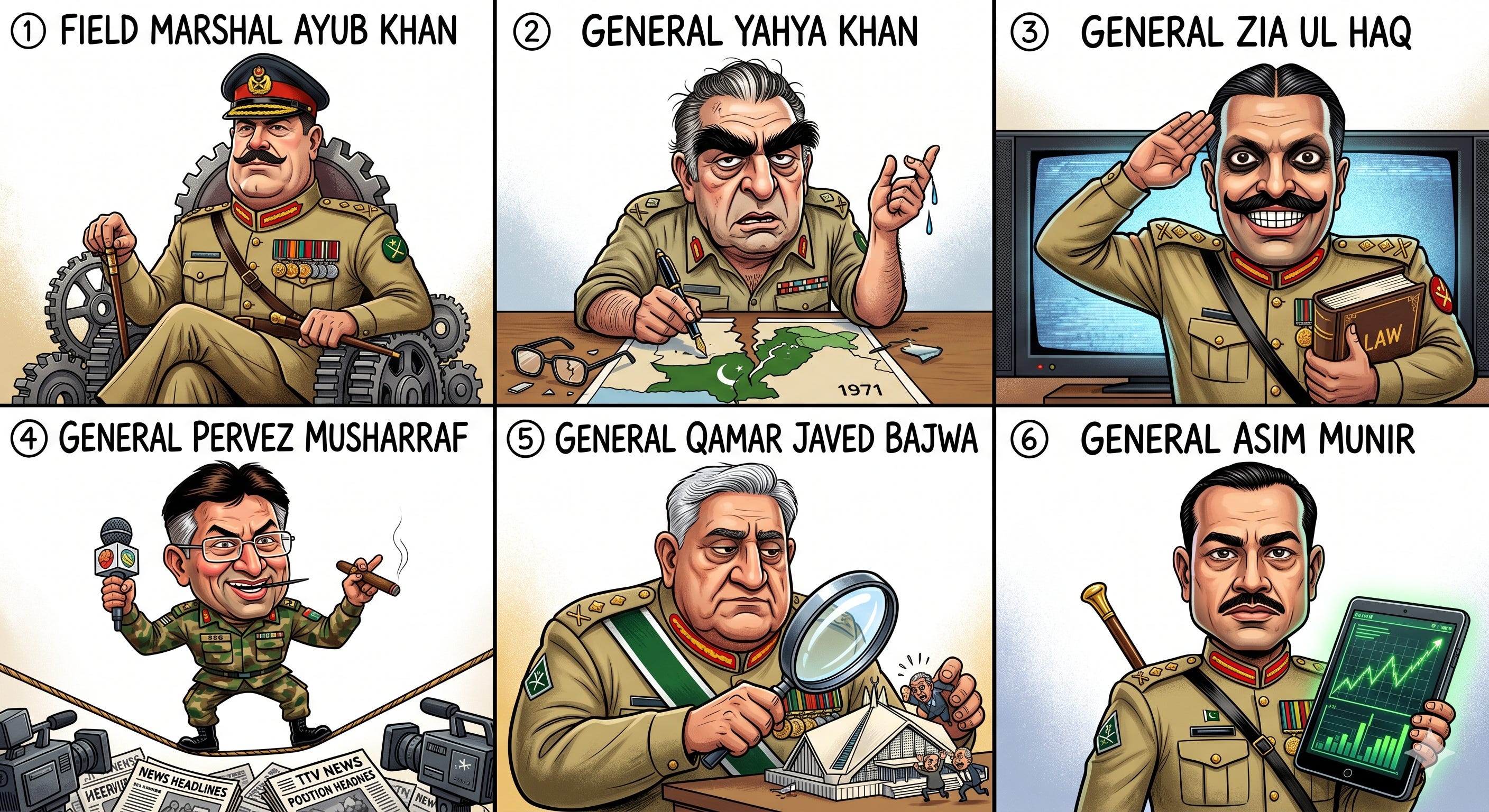
In Order To Understand Pakistan Just Study The Army Chief Role
Every army chief from Ayub Khan to Asim Munir, the current occupant of the chair has worshipped the same one, and the country has been the offering each time.
The Fauji Foundation, Pakistan’s largest military commercial enterprise, owns a cereal mill. It also owns gas terminals, fertilizer plants, a cement company, and a university. Its estimated valuation: approximately $5.9 billion, per the Wealth Perception Index 2025. The institution that runs it controls the nuclear arsenal, chairs the committee managing Chinese investment flows, and currently has its most senior officer making personal trips between Washington and Tehran trying to broker an end to a war neither party invited Pakistan into and neither party needs Pakistan to stop.
None of this is accidental. All of it follows the same institutional logic across eight chiefs and sixty-eight years: the institution comes first, the country funds it, and the gap between those two facts is what ordinary Pakistanis have been living in for their entire lives. Let’s go through the men who built it.
Ayub and Yahya: The Business Plan
Ayub Khan arrived in 1958 with the standard pitch: order, efficiency, an end to the chaos of civilian incompetence. Every chief since has recycled the same speech. The tailoring on the uniforms just gets better.
What he built was an industrial boom for Karachi and Lahore while East Pakistan generated 70% of Pakistan’s export revenue through jute and watched that money fund West Pakistan’s roads, factories, and an entirely new capital at Islamabad. The Fauji Foundation had been operational since 1954 and was expanding under Ayub. The Defence Housing Authority model was being assembled. The institution had understood early that it needed an economy inside the economy: one running on state land, tax exemptions, and no requirement to explain itself to any parliamentary committee.
Then the Bengalis voted. In 1970, the majority elected a party that would have governed from Dhaka. Yahya Khan ran Operation Searchlight in March 1971 rather than accept the result. The civilian death toll ranges from 300,000 to 3 million, a figure never reconciled because nobody with the authority to reconcile it ever found it useful to try. 93,000 Pakistani soldiers surrendered to the Indian Army in Dhaka on December 16, 1971. Largest military capitulation since the Second World War. Half the country was gone.
The institution got larger afterward. The Fauji Foundation kept growing. New welfare trusts were established. The commercial empire expanded. Breaking half a country and returning with a larger balance sheet is, by any institutional standard, a proof of concept.
Zia: The Foreign Contract
Here is what Zia ul-Haq negotiated. Washington needed a logistics and training platform for Afghan resistance against the Soviet occupation. Saudi Arabia needed a Sunni theological counterweight to Khomeini’s revolutionary Iran. Zia supplied both, took $3.2 billion from Washington and matching Saudi financing, and used the arrangement to restructure Pakistani society in ways that served institutional power long after the Soviets went home.
The madrassa network grew from roughly 900 institutions in 1971 to over 8,000 by 1988. The Kalashnikov and heroin economies embedded themselves in the tribal belt directly through the CIA-ISI supply pipeline. Sectarian militias were seeded across Punjab and Sindh with Gulf money and ISI coordination. The blasphemy laws were codified. Ahmadi religious practice was criminalized. Flogging and public execution became regular state events. A state ideology was assembled in which challenging GHQ had been made theologically equivalent to apostasy, which made dissent management considerably more efficient than any formal censorship regime.
Zia died in a plane crash in 1988. Pakistan spent the following four decades counting the dead from the infrastructure he left behind. The terrorism that killed more than 70,000 Pakistanis between 2001 and 2018 ran substantially on networks built in the 1980s under direct institutional cultivation. The institution that built those networks then collected American payments to dismantle them. Both sides of that transaction cleared.
Musharraf: Two paychecks, One Army
September 11, 2001 was, for the institution, a business problem with a clear solution. Pervez Musharraf had taken power by coup in 1999 and was running an internationally isolated government when the towers came down. Washington needed a platform. Musharraf needed a way back in. The deal: cooperate with the American operation in Afghanistan, receive Coalition Support Fund reimbursements, graduate Pakistan from pariah state to “key non-NATO ally.”
CSF payments from 2001 through 2016 totaled approximately $14.6 billion, confirmed by Pentagon data as reported by Dawn. Washington added $5.5 billion in economic assistance and equipment transfers. The institution accepted all of it and simultaneously maintained the Taliban networks it was nominally committed to dismantling. This is documented in American theater commanders’ reports, Congressional oversight findings, and the Abbottabad Commission’s own internal conclusions. Call it a contradiction if you want. The institution called it strategy, and both clients paid their invoices on time.
More than 70,000 Pakistanis were killed in terrorist attacks between 2001 and 2018, per the South Asia Terrorism Portal. The tribal areas became a free-fire zone under drone operators working from Nevada. Swat burned under groups the institution had cultivated, then was cleared by a military campaign that displaced two million people. Lahore’s bazaars were bombed in cycles. The army fought the organizations it had built across years of deliberate cultivation, billed Washington for the cleanup, and called both the construction and the demolition strategic achievement.
From that arrangement, the institution banked a modernized weapons inventory, international rehabilitation, and the operating principle it would apply to every foreign engagement that followed: Pakistan’s geographic position is a product, the price list adjusts to demand, and the institution sets the rate.
Kayani and Raheel: The Continuation
The two chiefs who followed extended the architecture without once examining it.
Kayani institutionalized the ISI political wing, maintained civilian primacy as formal theater, and guided the institution through the Abbottabad episode without answering the central question it raised. On May 2, 2011, American forces killed Osama bin Laden in a compound 800 meters from the Pakistan Military Academy. An internal commission was formed. The question of how he spent nearly a decade there was never answered publicly. From the institution’s perspective, that was considerably more useful than an answer: an unresolved question with people who are still funding your counterterrorism operations is leverage, not a liability.
Raheel Sharif launched Operation Zarb-e-Azb in 2014 and became the most celebrated figure in Pakistani national life in a generation. He had turned the institution against the networks. He was cleaning house. He refused to take an extension when his term ended in 2016, and Pakistanis called it constitutional integrity. He left with his reputation intact, then accepted command of the Saudi-led Islamic Military Alliance and went to Riyadh. The institution had been training its officers for sixty years to understand where the real security was, and Raheel Sharif, the most decorated chief of his generation, turned out to be a very good student.
Bajwa: And Then He Just Stopped Pretending
Qamar Javed Bajwa ran the country openly. Not the way chiefs had always run it, through deniable civilian intermediaries and off-the-record conversations in Rawalpindi drawing rooms. He ran it. Courts received clarity about the outcomes expected of them. Media owners received visits from men in uniform holding no formal broadcast regulatory role. Economic decisions migrated from civilian ministries to GHQ-chaired committees. The SIFC, formally constituted in June 2023 after Bajwa’s departure, codified what his tenure had been building: military gatekeeping of foreign investment flows, CPEC management under army coordination because Beijing preferred the counter-signature, Gulf sovereign wealth negotiations requiring GHQ’s presence at the table because Gulf states refused to commit capital without it.
By the time he left, Pakistan’s external debt exceeded $100 billion. The Fauji Foundation’s valuation had been climbing toward $5.9 billion. The institution spent those years on the boards of banks, bakeries, cement factories, and commercial real estate companies across every major city.
Pakistan spent them acquiring the debt that would eventually determine who issued the institution’s instructions.
Asim Munir: The Postman’s Walk, the Qatari Deal, And The Bill For Pakistani Households
The US-Iran memorandum of understanding, slated for formal signing on Friday, June 19th, is currently based on an established understanding between the parties, yet the impending deal is already being hailed in Rawalpindi as a triumph of Pakistani military diplomacy. The state-adjacent press describes the army chief as the architect of the region’s peace.
Here is what it actually looks like. The diplomatic veneer has been stripped away by statements from Qatari officials at the recent G7 summit and candid remarks from Iranian strategists like Professor Mohammad Marandi. They have made it explicitly clear that Pakistan’s role was confined to that of a messenger. A debt-ridden country lacking an independent foreign policy does not broker regional peace; it serves as a convenient postman delivering envelopes across a militarized border when direct channels are blocked. The actual heavy lifting, the financial guarantees, the sanctions relief logistics, and the political concessions that secured the memorandum, were performed by Qatar.
Then there is the silence from Riyadh. Saudi Arabia, the undisputed regional heavyweight, remained conspicuously quiet throughout the public negotiations. But it was Saudi architecture behind the scenes that ensured Pakistan was utilized appropriately as the diplomatic front. The general in Rawalpindi did not broker a deal; he carried a folder routed through Riyadh and Doha.
The current occupant did not design this assignment. He inherited the institutional condition that made declining it impossible. Pakistan cannot refuse a Washington request because the IMF program depends on Gulf deposit continuity, Saudi Arabia holds $3 billion at the State Bank as a standing program condition, and petrol climbed from Rs270 to Rs415 per litre from the day the war began with no domestic buffer left in the household budget. The messenger does not get to negotiate the message.
The danger is not that the messenger is minor; the danger is the exposure. When this fragile memorandum inevitably goes south, the cost will not be settled by the military commercial empire. It will be settled at the petrol pump by the common Pakistani, whose household budget has been cannibalized to fund the state’s geopolitical bets. If the Taftan gas corridor is cut or energy prices spike again, the country has no reserves and no leverage. The institution has positioned Pakistan on the frontline of a regional conflict without a buffer, because the military’s survival calculus and the country’s survival calculus stopped being the same calculation a long time ago.
At the same time, the institution is suppressing a subsistence protest in Azad Kashmir. Eleven people died in the June 2026 Rawalakot unrest. The Joint Awami Action Committee was proscribed under the Anti-Terrorism Act. An internet blackout sealed the Poonch sector. The movement was demanding subsidized electricity from hydropower projects that generate power at roughly Rs3 per unit and bill it back to the territory at over Rs40. Seventy-two organizers are in detention. In Balochistan, 1,355 enforced disappearances were documented in 2025 alone by HRCP, Paank, and the Baloch Yakjehti Committee. Defense gets 18% of the federal budget. Education gets 2.3%. Healthcare gets 1.2%. The budget says exactly what the institution considers worth funding, and the institution has never once pretended the ranking was an accident.
Let’s Count What They Own
The Fauji Foundation: cereal mills, gas terminals, fertilizer plants, a university. The Army Welfare Trust: insurance, a bank, and real estate across every major city. The Askari Group: construction, travel, and consumer goods. The Frontier Works Organization: national road contracts, funded by the state’s own procurement budget. The National Logistics Cell: the commercial trucking network. The Defence Housing Authority: residential real estate in every city with a military cantonment.
Each piece was built under a different chief with a different rationale: Ayub’s welfare mandate, Zia’s Islamic financing instruments, Musharraf’s deregulation window, Bajwa’s formalization of existing arrangements. Eight tenures, eight justifications, one direction of accumulation for sixty-eight uninterrupted years.
Pakistan is indebted because its largest institution spent sixty-eight years redirecting public resources toward itself, running its own balance sheet at the expense of the state’s, and then requiring foreign creditors to fund the fiscal gap that decades of systematic extraction left behind. Washington holds the reimbursements, the Gulf holds the deposits, and Beijing holds the infrastructure contracts. The institution invited all three in because it needed someone to cover the balance sheet it had spent six decades running into the ground, and what they charged for that service was Pakistan’s strategic autonomy, leaving the institution holding the commercial assets, the Foundation boards, the DHA plots, and the chair at every economic committee that matters.


