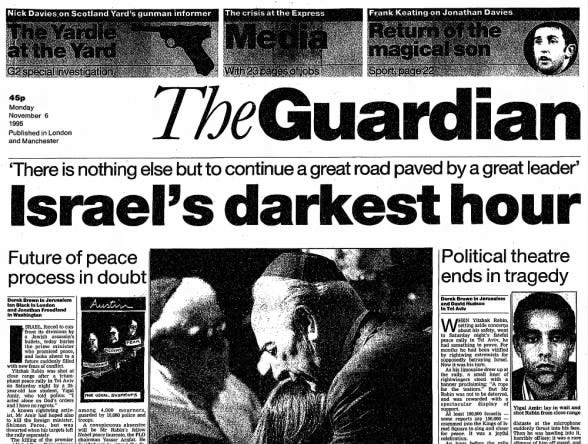
On November 4, 1995, when Yigal Amir fired three bullets into Yitzhak Rabin’s back, he did not kill Israeli democracy. There was no democracy to kill. What died that night in Kings of Israel Square was not the promise of liberal egalitarian governance, but rather the last vestige of calculated restraint in a settler-colonial project that had always depended on Palestinian dispossession and would now accelerate toward systematic elimination. The assassination marked not a deviation from Zionism’s democratic path but rather the removal of tactical limitations on a fundamentally eliminationist enterprise. The three decades since have proven this with devastating clarity: Israel has completed its transformation from a state practicing occupation and ethnic cleansing to one engaged in what United Nations investigators, international legal scholars, and human rights organizations now document as genocide.
To understand this trajectory requires dispensing with the comforting mythology of “the only democracy in the Middle East” that has long obscured clear analysis of Israeli state formation. Israel was never a democracy interrupted by occupation. It was founded through the systematic ethnic cleansing of three-quarters of Palestine’s indigenous population, the destruction of over 500 villages, the theft of land and property on a scale that remade the region’s entire demographic composition. Between 1947 and 1949, Zionist militias and the nascent Israeli army expelled approximately 750,000 Palestinians from a total population of 1.9 million. This was not a tragic byproduct of war but a deliberate campaign to create a Jewish demographic majority on land where Jews constituted one-third of the population and owned less than six percent of the territory.
The mechanisms of this founding violence reveal its character. Plan Dalet, launched in April 1948, constituted a systematic blueprint for conquest and demographic transformation. Villages were not merely captured but destroyed, their populations expelled en masse, their physical structures razed to prevent return. The Deir Yassin massacre of April 9, 1948, served its intended purpose: to terrorize Palestinian communities into flight. This was ethnic cleansing by design, executed with the explicit goal of creating a Jewish-majority state through the violent removal of the indigenous population. The fact that many Palestinians fled in fear of violence rather than at literal gunpoint does not diminish the calculated nature of their expulsion.
Nor did this process end in 1949. The Nakba was not a singular event but an ongoing structure. In 1950, Israel enacted the Law of Return, granting automatic citizenship to Jews worldwide while simultaneously enacting the Absentees’ Property Law that legally confiscated the land and property of Palestinians who had been expelled. The 150,000 Palestinians who remained within Israel’s 1948 borders lived under military rule until 1966, their movement restricted, their political organization suppressed, their status always contingent. This was never a democracy that later became corrupted by occupation. It was a racial state from inception, built on ethnic cleansing and sustained through institutionalized discrimination against its non-Jewish population.
The 1967 war expanded this structure rather than fundamentally altering it. Israel now governed the entire territory of historical Palestine plus additional Syrian and Egyptian lands, ruling over millions of Palestinians who had no citizenship, no right to vote in the state controlling their lives, no legal recourse against military authority. The occupation was never temporary in practice, whatever Israeli officials claimed. Settlement construction began immediately, establishing facts on the ground that would make territorial partition progressively impossible. By 1995, when Rabin was assassinated, over 130,000 Israeli settlers already lived in the West Bank, integrated into Israel proper through road systems, utilities, legal structures that treated them as citizens while treating their Palestinian neighbors as subjects.
The Strategic Function of Rabin’s Restraint
This brings us to the actual significance of Yitzhak Rabin and the meaning of his death. Rabin did not represent a fundamental challenge to the Zionist project. He was a lifelong participant in it, from his role in implementing the expulsion of Palestinians from Lydda and Ramle in 1948 through his service as chief of staff during the 1967 conquests to his tenure as defense minister during the First Intifada. His credentials in Palestinian dispossession were impeccable. The Oslo process he championed was not a pathway to Palestinian self-determination but rather a mechanism for outsourcing occupation’s daily management to a Palestinian Authority that would police its own population on Israel’s behalf while Israel retained security control, settlement expansion rights, and ultimate sovereignty.
Yet within the logic of Israeli state interests as understood by the security establishment, Oslo represented a form of strategic calculation increasingly alien to contemporary Israeli political culture. It recognized that permanent direct rule over millions of disenfranchised Palestinians carried costs in terms of international legitimacy and military manpower allocation that could be reduced through a Bantustan arrangement. It accepted that unlimited settlement expansion might eventually threaten the Jewish demographic majority Israel required to maintain its ethnic character. It understood that some forms of Palestinian autonomy, carefully circumscribed and permanently subordinate, might prove more sustainable than direct military governance.
This was never generosity toward Palestinians. It was calculation about the most efficient architecture for ongoing Palestinian subordination. But even this limited calculation proved intolerable to the maximalist wing of the Zionist movement that had always rejected any constraints on Jewish sovereignty over the entirety of the land. For religious nationalists who viewed every square meter of the West Bank as divinely promised Jewish territory, even the pretense of eventual limited Palestinian autonomy constituted theological and political betrayal. For secular rightists who saw permanent settlement expansion as both strategic imperative and demographic necessity, any agreement that might eventually constrain where Jews could live represented existential threat.
The mobilization against Rabin was not merely political opposition but an attempt to define him as illegitimate, a traitor to the Zionist enterprise worthy of elimination. When rabbis issued religious rulings suggesting he had made himself a rodef, a pursuer whose threat to Jewish life makes him subject to extrajudicial killing under certain interpretations of Jewish law, they provided theological authorization for political assassination. When protesters depicted him in Nazi uniform or PLO regalia, when they circulated posters with his face in crosshairs, when Benjamin Netanyahu addressed rallies where such imagery was prominently displayed, they created the cultural conditions that made murder thinkable.
Yigal Amir did not act alone. He acted as the most committed agent of a political movement that had systematically delegitimized Rabin and the Oslo process. His assassination succeeded not merely in killing an individual but in demonstrating to Israeli political society that the peace process carried lethal domestic risks that no subsequent leader was willing to bear. The immediate collapse of Oslo following Rabin’s death, the election six months later of Netanyahu on an explicitly anti-peace platform, the systematic expansion of settlements under every subsequent government, all vindicated the strategic logic of political assassination.
From Occupation to Genocide
What has emerged in the three decades since is not merely continued occupation but the systematic removal of any pretense that Palestinian political rights might ever be recognized. The distinction is crucial. Occupation, however brutal and illegal, theoretically remains temporary, subject to negotiation and eventual resolution through political means. What Israel has constructed is permanent, a legal and physical architecture designed to make Palestinian self-determination permanently impossible while avoiding the international consequences of formal annexation.
Consider the reality in the West Bank as of early 2026. Over 700,000 Israeli settlers now live in territory universally recognized as occupied, connected to Israel proper through an elaborate infrastructure of highways from which Palestinians are often excluded. These settlers live under civilian Israeli law with full citizenship rights. Their Palestinian neighbors live under military law, tried in military courts with conviction rates exceeding 95 percent, unable to move freely even within the West Bank, subject to arrest without charge, their homes subject to demolition without judicial review. This is not two populations under occupation but one population living with full rights and another living under systematized oppression, in the same territory.
Settler violence has become systematic state policy under the current government. In 2025, Israeli settler attacks against Palestinians rose 27 percent compared to the previous year, with severe attacks classified as terrorism by Israel’s own security services increasing by over 50 percent. Entire Palestinian herding communities have been forcibly displaced through campaigns of violence and intimidation. Between late December 2025 and early January 2026, the United Nations documented 44 settler attacks resulting in casualties or property damage, injuring 33 Palestinians including 11 children. The entire community of Khirbet Yanun was displaced through systematic violence. Over 4,000 Palestinians were forcibly displaced by settler violence in 2025 alone.
This violence is not incidental but instrumental. It serves the explicit goal articulated by Finance Minister Bezalel Smotrich and National Security Minister Itamar Ben-Gvir, whose far-right parties control 20 seats in the governing coalition and shape policy far beyond their electoral weight. These are not marginal figures but government ministers with budgetary and security authority. Smotrich advocates openly for settlement expansion aimed at making Palestinian statehood impossible and has threatened to dismantle the Palestinian Authority by cutting off the banking relationships necessary for Palestinian economic survival. Ben-Gvir has politicized the police force to reduce enforcement against settler violence while increasing repression of Palestinian citizens of Israel and crushing domestic Israeli protests against the government.
Their power derives from Prime Minister Benjamin Netanyahu’s dependence on them to maintain his governing coalition and avoid prosecution on corruption charges. But their ideology has deep roots in the settler movement that produced Rabin’s assassin. They represent not an aberration but the logical endpoint of a political trajectory set in motion when Rabin’s murder demonstrated that maximalism faced no insurmountable obstacles. The extremism once confined to illegal settlement outposts now sits in cabinet meetings and shapes state policy.
The Completion of Genocide in Gaza
If the West Bank demonstrates the architecture of permanent subordination, Gaza reveals the logical conclusion when even subordinated existence proves intolerable to the state’s ideological commitments. The siege of Gaza began in 2007 and converted two million people into captives in what human rights organizations accurately described as an open-air prison. The periodic military assaults, occurring every few years with increasing devastation, established a pattern Israeli officials explicitly described as “mowing the grass,” treating Palestinian life as vegetation to be periodically cut back.
The assault that began in October 2023 was qualitatively different. In September 2025, after two years of investigation, the United Nations Independent International Commission of Inquiry concluded that Israel has committed genocide against Palestinians in Gaza, finding four of the five genocidal acts defined by the 1948 Genocide Convention: killing members of the group, causing serious bodily or mental harm, deliberately inflicting conditions calculated to bring about physical destruction, and imposing measures intended to prevent births. The Commission applied the “only reasonable inference” standard from the International Court of Justice and analyzed both explicit statements by Israeli authorities and the systematic patterns of their conduct. Its conclusion was unambiguous: the State of Israel bears responsibility for the commission of genocide against Palestinians in Gaza.
The evidence is overwhelming. By October 2025, over 67,000 Palestinians had been confirmed killed, including more than 20,000 children and approximately 10,000 women, with an estimated 10,000 additional bodies still buried under rubble. Over 170,000 have been wounded. Approximately 1.9 million people, representing 90 percent of Gaza’s population, have been forcibly displaced, many multiple times as Israeli forces systematically destroyed entire neighborhoods. The assault destroyed 84 percent of Gaza’s health centers, all 12 universities, and 80 percent of schools. Israel has deliberately targeted the infrastructure necessary for human survival.
The use of starvation as a weapon of war is particularly damning. By August 2025, the Integrated Food Security Phase Classification confirmed famine conditions in Gaza Governorate with reasonable evidence, the first confirmed famine in the 21st century. Over half a million people faced catastrophic conditions characterized by starvation and destitution. By October 2025, 461 people, including 157 children, had died directly from hunger. This was not incidental deprivation but deliberate policy. Israeli forces systematically blocked humanitarian aid, destroyed agricultural infrastructure, targeted food distribution systems, and bombed bakeries and water facilities. As of early 2026, approximately 1.6 million people, more than 75 percent of Gaza’s population, face extreme levels of acute food insecurity.
The genocidal intent is evident not merely in actions but in explicit statements by Israeli officials. Political and military leaders described Palestinians as “human animals,” called for Gaza to be “erased,” advocated for the transfer of the entire population, and explicitly rejected limitations on civilian casualties. These were not isolated remarks by fringe figures but systematic patterns of dehumanization by officials at the highest levels of government and military command. Defense officials spoke openly of destroying residential neighborhoods to make them uninhabitable. Cabinet ministers advocated for settlement reconstruction in Gaza. The pattern is unmistakable: the goal is not security but elimination.
The Commission’s findings reinforce earlier legal determinations. The International Court of Justice found plausible risk that Israel’s actions violated the Genocide Convention and issued provisional measures ordering the protection of Palestinian civilians. Rather than complying, Israel intensified its assault. Human rights organizations including Amnesty International documented that Israeli actions created “one of the worst humanitarian crises in the world” through deliberate policy choices that violated explicit international legal obligations.
The International Dimension of Impunity
Israel’s completion of its genocidal project has been possible only because of systematic protection from accountability by the United States. While European nations have begun imposing limited sanctions on individual Israeli officials and restricting some military exports, the Trump administration has provided unprecedented support. This includes direct military participation in strikes against Iran, blocking United Nations Security Council resolutions condemning Israeli actions, threatening secondary sanctions against countries that comply with International Criminal Court arrest warrants, and continuing to provide the weapons systems essential to Gaza’s destruction.
This protection comes at enormous cost to international legal architecture. The spectacle of the world’s most powerful nation shielding a state engaged in documented genocide from any consequences for its actions has devastated the credibility of human rights institutions. When Israel flagrantly violates ICJ orders, blocks humanitarian aid in defiance of international humanitarian law, and continues to receive billions in military assistance from its patron, the message is clear: international law binds only the powerless.
Yet even American protection cannot indefinitely shield Israel from the consequences of its actions. By mid-2025, Israel faced academic, research, art, and trade union boycotts of unprecedented scope. Airlines suspended service due to security concerns. Credit rating agencies downgraded Israeli bonds with negative future outlooks. Multiple European governments warned that continued settlement expansion and rejection of Palestinian rights made normal diplomatic relations untenable. Soldiers and officials faced arrest warrants in multiple jurisdictions. The country that once cultivated its image as a democratic outpost in a hostile region is now globally recognized as a pariah state engaged in systematic atrocities.
This isolation is accelerating. Each new report of starvation deaths in Gaza, each new video of settlers torching Palestinian homes while soldiers stand by, each new statement by Israeli officials advocating ethnic cleansing, further erodes the legitimacy Israel requires to function as a normal state. The propaganda apparatus that once effectively controlled international discourse about the conflict has fractured in the face of social media documentation that makes Israeli violence impossible to ignore or sanitize. Younger generations in Europe and North America view Israel not as a plucky democracy but as an apartheid state engaged in ethnic cleansing.
Rabin and the Path Not Taken
Could different leadership after 1995 have altered this trajectory? The question reveals the limitations of individualist explanations for structural phenomena. Rabin himself was a lifelong participant in Palestinian dispossession. Oslo was never intended to produce genuine Palestinian sovereignty but rather a more sustainable architecture for permanent control. The forces that produced his assassin were not external to Zionism but inherent in a project built on ethnic cleansing that inevitably generated maximalist tendencies rejecting any accommodation.
Yet within these constraints, degrees of brutality matter. The systematic starvation of children in Gaza, the deliberate creation of conditions calculated to destroy a population, the explicit embrace of eliminationist rhetoric by government ministers, these represent qualitative shifts from earlier patterns of oppression. The settler violence that has displaced thousands in the West Bank has intensified precisely because the current government actively encourages it rather than seeing it as a strategic liability. The genocide in Gaza is being conducted by a government whose most powerful coalition members explicitly advocate policies that previous Israeli governments pursued more quietly.
Rabin’s assassination removed the last significant political force within Israeli society advocating even tactical restraint on settlement expansion. His successors faced no domestic constituency for limitation. Every subsequent government has expanded settlements, but the current coalition has moved beyond mere expansion to systematic displacement backed by state-sanctioned violence. The progression from occupation to explicit genocide was not predetermined by Rabin’s death, but his assassination eliminated the political forces that might have slowed this trajectory or maintained the camouflage that disguised eliminationist practice as security necessity.
The Ideological Completion
What Israel has become in 2026 is not a deviation from Zionist principles but their fullest expression under conditions where external constraints have proven insufficient to impose moderation. A state founded through ethnic cleansing, built on the denial of indigenous political rights, sustained through systematic discrimination and periodic massacres, was always structurally vulnerable to the logic of elimination. When partial accommodation proves untenable and international pressure remains manageable, genocide becomes the efficient solution to the “demographic problem” that has always haunted the Zionist project.
The transformation of eliminationist ideology from settlement fringe to government policy reveals this dynamic. Positions once confined to extremists like Meir Kahane, whose Kach party was banned as racist and terrorist in the 1990s, are now articulated by cabinet ministers who shape national policy. The normalization of this discourse within Israeli political culture reflects the exhaustion of liberal Zionism’s contradictions. A state cannot permanently govern millions of disenfranchised people, maintain democratic forms, and preserve ethnic supremacy. Israel has chosen ethnic supremacy and abandoned democratic pretense.
The international community’s failure to impose consequences has enabled this choice. For decades, Israel calculated that it could maintain occupation while sustaining normal diplomatic and economic relations with Western nations. That calculation has been validated. Even genocide in Gaza, documented in real time with overwhelming evidence, has not triggered effective sanctions or military aid cuts from Israel’s patron. The gap between international humanitarian law’s formal requirements and its practical irrelevance for powerful actors has never been more evident.
This is the legacy of Rabin’s assassination: the removal of internal restraint in a system where external restraint proved fictional. The bullet that killed him on November 4, 1995, set in motion not the death of Israeli democracy, which had never existed for Palestinians, but the acceleration of the eliminationist project that was always latent in settler-colonialism’s logic. Thirty years later, that project has reached its genocidal conclusion in Gaza and its increasingly violent intensification in the West Bank. Israel was never the democratic promise its supporters claimed. It was always an occupational and settler-colonial state. After Rabin, it became an explicitly genocidal one.


