The Bill Comes Due
How the Gulf and Pakistan Closed the Trap on Themselves
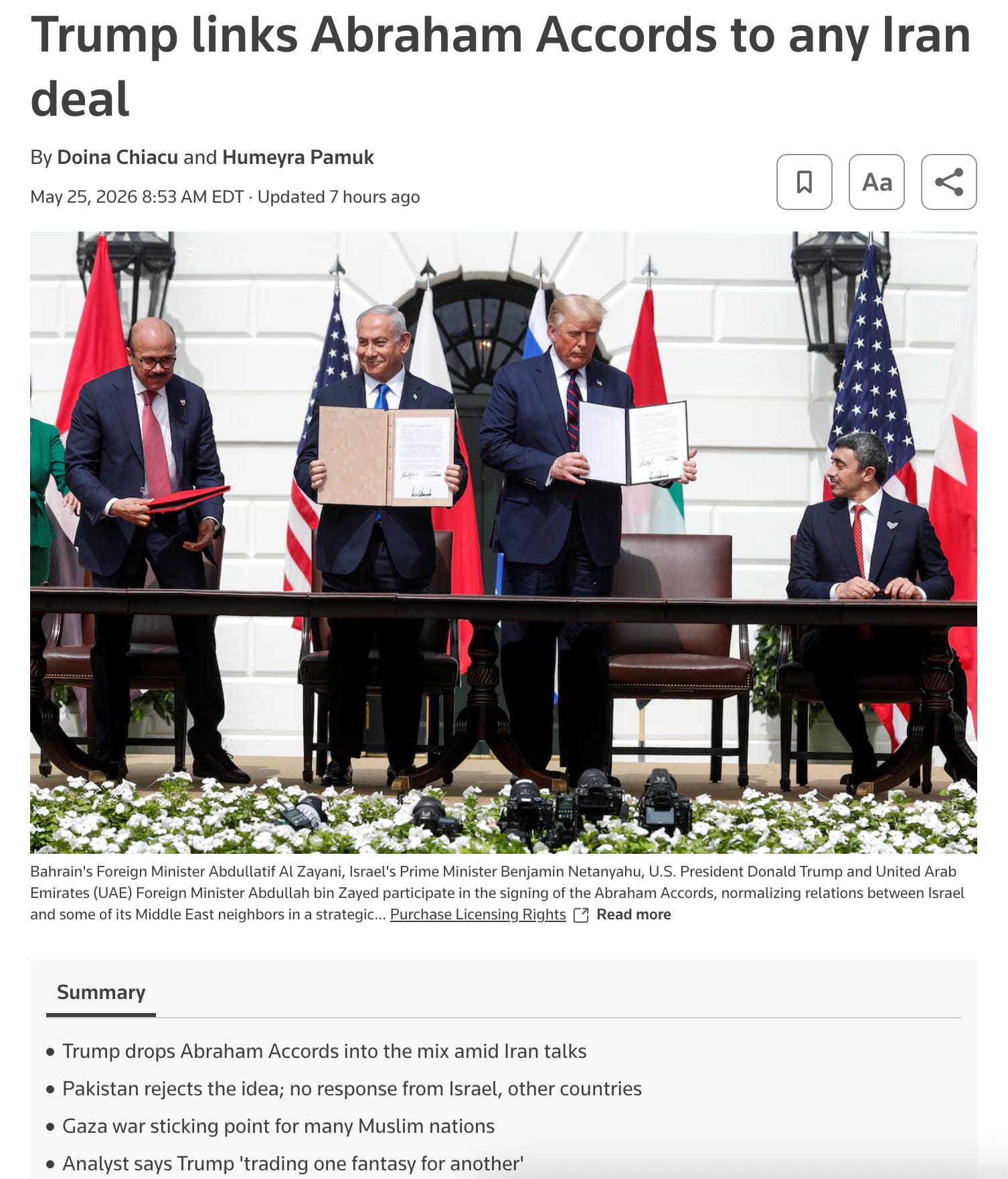
On the morning of February 28, US and Israeli aircraft struck Tehran in a coordinated operation whose stated objective was regime decapitation. Ali Khamenei, supreme leader of the Islamic Republic for thirty-five years, was killed at his office in the capital. Forty other Iranian officials died alongside him. Iran’s response was immediate: it closed the Strait of Hormuz to all foreign shipping, cutting off the passage through which roughly a fifth of the world’s oil supply moves, triggering a global fuel crisis whose inflationary pressure is still being measured. Three months later, with the ceasefire barely holding and US aircraft striking Iranian positions in the strait again as recently as this morning, Donald Trump took to social media to offer Iran membership in the Abraham Accords.


Read that sequence again. The state whose supreme leader Washington helped kill was being invited, in the same breath, to join a normalization framework with Israel and become part of what Trump called an “unparalleled World Coalition.” The offer was not diplomatic tone-deafness. It was the clearest possible statement of what the war was for.
The same post named Field Marshal Syed Asim Munir Ahmed Shah, of Pakistan, among the leaders with whom Trump had consulted. Not Pakistan’s prime minister. Not its foreign minister. The army chief, sitting in a room with Mohammed bin Salman, Mohammed bin Zayed, Qatar’s emir, Turkey’s Erdogan, and the kings of Jordan and Bahrain, as Trump articulated the demand that they all simultaneously sign the Abraham Accords as a minimum condition of the Iran settlement. Within hours of that post, Pakistan’s Defence Minister Khawaja Asif appeared on Samaa TV to say Pakistan would not join any accord that clashed with the country’s fundamental ideologies. “How will you sit down with those people whose word cannot be trusted even for a single day?” he asked. Pakistan became the first of the named states to publicly refuse.
Two men. Two different rooms. Two different positions. And the gap between them is where the real story lives.
What the Accords Were Built to Become
The Abraham Accords were signed at the White House in September 2020, between Israel and the UAE and Bahrain, with Morocco, Sudan, and Kazakhstan joining in subsequent months. The word “peace” dominated the coverage. What the documents actually contained was a set of precisely calibrated transactions, each one releasing something Washington had been holding in reserve for years.
The UAE had wanted F-35 fighter aircraft and advanced drone systems for the better part of a decade. The signature unlocked the sale. Abu Dhabi’s ruling family had also determined, well before the formal ceremony, that the commercial and technological benefits of open alignment with Tel Aviv outweighed the political cost of abandoning the Palestinian cause they had long claimed to champion. The intelligence cooperation between Emirati and Israeli services predated the Accords by years; the public signing formalized a relationship already operational at depth. Bahrain received the continuation of US Fifth Fleet basing on its territory, the security guarantee without which the Al Khalifa monarchy’s survival against internal pressure is not viable. Morocco obtained US recognition of its sovereignty over Western Sahara, a recognition Washington had withheld for decades and delivered as payment. Sudan had its designation as a state sponsor of terrorism removed, unlocking access to international capital markets its economy required to function. Kazakhstan added geographic range to the framework without the strategic stakes of the Gulf signatories.
In each case, Washington held what each state most needed in reserve, and the Accords were the mechanism through which it was released. The Palestinians received nothing and were not consulted. Their leadership watched as states that had spent decades claiming to advocate in their name traded that claim for arms licenses, territorial recognition, and debt relief on questions that had nothing to do with Palestine.
What the Accords established was not a peace framework but a transactional expansion of US-Israeli regional alignment, in which each signatory received something it needed and surrendered the political position it had claimed to hold. The arrangement was designed to grow. Saudi Arabia was identified from the beginning as the prize signature, the one that would confer legitimating weight on the entire project given Riyadh’s custodianship of the two holy cities and its function within Sunni Islam. Saudi normalization required more political cover than the Gulf monarchies had yet provided. It also required the removal of the enforcement mechanisms that had made normalization politically costly for any Arab government willing to consider it.
The Iran war removed those mechanisms.
Iran Reconstitutes: The Coherent Holdout
Mojtaba Khamenei, the son of the assassinated supreme leader, has succeeded his father. The Islamic Republic has not collapsed. The Revolutionary Guard, whose commander was also killed in the February strikes, has reconstituted under new leadership. Iran’s parliament speaker stated publicly that the armed forces have rebuilt capabilities damaged since the start of the conflict. The Strait of Hormuz, while nominally under a ceasefire framework, remains a live pressure point. As of this morning, US forces carried out what the Pentagon described as self-defense strikes against Iranian missile launch sites and boats in the strait, hours after Iranian negotiators had met with Qatari mediators in Doha for talks in coordination with Washington. The deal to formally reopen the passage, which Trump described as “largely negotiated” over the weekend, is being held up by disputes over wording, according to Marco Rubio, who said Washington expects resolution shortly.
Iran’s foreign ministry described the two sides as simultaneously “very far and very close,” and noted that the US had put forth conflicting positions multiple times during negotiations. The Strait remains Iran’s instrument. The US has been unable to reopen it without Tehran’s cooperation, and Tehran is extracting terms. That is not the posture of a broken state.
Trump’s offer of Abraham Accords membership to Iran illuminates the architecture’s logic more clearly than anything else in his Saturday post. You do not offer the Accords to a state you have defeated and occupied. You offer them to a state whose alignment you still need to purchase, because that state retains the capacity to withhold what you want. Iran is being courted. The Gulf states and Pakistan are being billed. The distinction tells us who retained leverage and who surrendered it.
The resistance network that Iran constructed and supported across Lebanon, Gaza, Yemen, and Iraq was not, in the first instance, ideological solidarity with the Palestinian cause, though that framing was always part of its public language. It was a strategic deterrence architecture, built specifically to raise the cost of normalization for any Arab government that might otherwise be willing to sign. Hezbollah’s capacity to threaten northern Israel made Lebanese-adjacent normalization politically unmanageable. Hamas’s control of Gaza made any Palestinian-track agreement incoherent without Palestinian representation. The Houthis’ ability to disrupt Red Sea shipping made Gulf states’ economic integration with Israel a tangible liability rather than a costless benefit. These were instruments of leverage, and they worked for as long as they held. Their degradation is what made Trump’s Saturday demand viable at this moment. Iran’s continued relevance as a negotiating party is what explains why Tehran is being offered a seat rather than presented with a bill.
The Gulf’s Self-Construction of Dependency
The UAE normalized with Israel not because Washington forced Abu Dhabi’s hand but because the Emirati ruling family had made a strategic calculation, executed over years, that the future of Gulf commercial power ran through integration with Western and Israeli technological and security networks rather than through the Arab solidarity frameworks that the OIC represented. Dubai’s emergence as a global financial and logistics hub required proximity to Western financial institutions and technology ecosystems in ways that made ideological neutrality increasingly expensive to maintain. The Accords formalized what the Emirati establishment had decided long before anyone signed anything.
Saudi Arabia’s position has been held not by principle but by the calculation that MBS needed more domestic and Islamic world cover before the normalization he had privately determined upon could be made public. The 2017 fracture with Qatar, the Yemen war, the murder of Jamal Khashoggi in Istanbul in 2018, and the subsequent international management of its fallout: each episode demonstrated that Riyadh was not operating within an Arab solidarity framework but within a narrowly defined family-state interest framework that the language of Islamic leadership covered but did not constrain. The Iran war, by degrading the deterrence network’s capacity and by providing the narrative of a regional threat confronted, gave MBS the cover he required. The Saturday consultation was his enrollment in the final phase.
Qatar’s inclusion is more complex, because Doha has historically maintained relationships that the other Gulf states refused: with Hamas, with Muslim Brotherhood-affiliated movements, with Iran, and with media operations like Al Jazeera that functioned as a political pressure point Washington and Riyadh periodically tried to suppress. The 2017 Gulf blockade of Qatar, organized by Saudi Arabia, the UAE, Bahrain, and Egypt, was punishment for that independent positioning. Qatar survived it because Turkey and Iran provided the logistical support that kept its economy functional. That both Qatar and Turkey now appear in Trump’s consultation list suggests the independent positioning has been renegotiated. The price of Qatar’s survival in 2017 included commitments that are now being collected.
Pakistan’s Institutional Architecture of Self-Entrapment
The Special Investment Facilitation Council was not built under duress. Pakistan’s army designed it, implemented it through a government that answers to that institution, and structured it to fast-track Gulf capital into Pakistani economic assets in agriculture, port infrastructure, and energy, bypassing the regulatory processes and parliamentary oversight that would have introduced friction or public scrutiny. It was built to move quickly and quietly, which it has.
DP World, the UAE state-linked port operator, holds concessions at Karachi’s major container terminal and has been in extended negotiations over Gwadar, the deep-water port at the Arabian Sea’s mouth that China built and that Pakistan nominally administers. Gwadar was designed as the terminus of the China-Pakistan Economic Corridor, the physical point at which Chinese overland connectivity meets the Arabian Sea. DP World’s presence in negotiations over Gwadar is the UAE inserting itself into an asset whose strategic value derives entirely from its relationship with China. The Pakistani military establishment approved this negotiation without external compulsion.
The IMF’s Extended Fund Facility, renewed through Gulf bilateral deposits that provide the bridging liquidity Islamabad needs to maintain its reserve position, has attached Pakistan’s solvency to continued Gulf goodwill. Pakistan’s capacity to avoid default runs through the same capitals that are signing the Accords. When the Saudi or Emirati deposit that stabilizes Pakistan’s reserves comes with an expectation about Pakistan’s diplomatic posture, that expectation does not need to be stated explicitly. The financial structure communicates it without language.
Asim Munir attended Trump’s consultation because Rawalpindi built the financial architecture that made his attendance logical. He is not there as a captive. He is there as a party whose institution made decisions that produced exactly this outcome. The invitation does not go to a decision-maker unless those issuing it are confident the decisions are already moving in their direction.
Two Men, Two Rooms, One Establishment
The most consequential fact surfacing today is not Trump’s demand but Pakistan’s response to it, and the fracture that response exposes. Khawaja Asif, the civilian defence minister, went on television to declare the proposal unacceptable, question Israel’s trustworthiness, and invoke Pakistan’s fundamental ideologies. He cited the passport, the only in the world that does not recognize Israel as a valid destination. He used the language of principle with the confidence of a man performing a position he knows the audience expects. Pakistan has become, in his framing, the first country to openly refuse.
Asim Munir was in the consultation room.
These are not contradictory facts. They are the Pakistani establishment’s operating method, refined across decades of managing the gap between the positions it announces publicly and the commitments it makes privately. The civilian government performs resistance. The army manages the relationship. The civilian performance provides domestic political cover. The army’s management provides Washington with the access it needs. Both sides of the equation serve the establishment’s interests, and neither side requires honesty about what the other is doing.
The question is whether this method is durable at the level of Abraham Accords membership, which is not a quiet financial arrangement but a public diplomatic signature requiring a parliamentary ratification process, a revision of the passport, and the dismantling of a foreign policy position that has been the most consistent element of Pakistan’s international identity since 1947. Asif’s television performance is not evidence that Pakistan will refuse. It is evidence that Pakistan’s civilian institutions will be asked to absorb the domestic political cost of a decision already being shaped elsewhere.
The Seventy-Seven Year Position and What Dismantles It
Pakistan’s refusal to recognize Israel is the one continuous thread in a foreign policy history otherwise marked by reversals dictated by whoever was financing the army at a given moment. The position survived Zia ul-Haq’s decade of CIA-funded collaboration during the Afghan jihad. It survived Musharraf’s post-September 11 realignment with Washington. It survived every IMF program and every Gulf financial dependency that preceded the current one. What it had not previously encountered was a Gulf dependency structured at the level of strategic infrastructure rather than balance-of-payments support alone, combined with the complete degradation of the deterrence network that had enforced the political cost of abandoning it.
For the military establishment, the position on Israel has also carried a specific institutional function. The claim to represent Muslim interests globally, the sword arm of an ideological state, required a posture toward Palestine that no internal policy could replicate. That claim has been quietly evacuated by the same decisions that built the SIFC. An army chief who sits in consultations with Trump and the Gulf monarchies while fast-tracking Emirati capital into national infrastructure is performing a role indistinguishable from those he is meeting with. The institutional self-image and the institutional behavior have diverged to the point where the position on Israel remains the last visible marker of a posture that the actual conduct of the establishment no longer supports anywhere else.
What China Calculates
Beijing will not respond to Pakistan’s inclusion in Trump’s Saturday consultation with an immediate adjustment in CPEC terms. Chinese foreign policy does not operate through single-event reversals. It operates through the accumulation of signals that inform long-term recalibration, and those recalibrations arrive in the form of renegotiated financing terms, slower disbursements, and reduced enthusiasm for new commitments rather than formal declarations.
The signal Pakistan’s presence in that consultation sends to Beijing is the completion of a picture that the SIFC architecture, the DP World negotiations, and Rawalpindi’s sustained engagement with Gulf capitals and Washington had already been composing for two years. China’s management of the CPEC relationship has proceeded on the implicit understanding that Pakistan would not formally integrate itself into the US-led normalization arrangement in the Gulf and Middle East at a level that made the corridor politically incoherent. Pakistan signing the Abraham Accords would be the formal completion of an alignment that has been operational at the financial level for years. Beijing would register this with the precision it applies to all such questions.
The theory being managed in Rawalpindi is that both Washington and Beijing need Pakistan enough to accept its simultaneous presence in both frameworks. The theory has worked, with friction, across the CPEC years. It has never been tested at the level of formal Pakistan-Israel normalization, and the Saturday consultation is the moment that test begins.
The Structure of Willingness
The language of coercion is politically useful to establishments in the process of complying, because it converts a choice into a circumstance. If we were forced, accountability does not apply. Trump’s framing of the demand as “mandatory,” and his presentation of resumed war as the alternative to compliance, is designed precisely to supply this language. The Gulf states and Pakistan will use it, and some of their publics will accept it.
The record does not carry the coercion argument. The UAE normalized because Abu Dhabi’s ruling family calculated that formal alignment with Washington and Tel Aviv served its commercial and security interests better than the political position it had maintained, a calculation made inside the UAE’s own decision-making structure by people who were choosing. Saudi Arabia is moving toward normalization because MBS has determined that the domestic political cost of sustaining non-recognition exceeds the cover the Iran war now provides for signing. Qatar and Turkey are in the consultation because the price of independent positioning was extracted during the 2017 blockade and the years that followed. Pakistan is on the list because its army built the financial dependency that placed it there.
States that are genuinely trapped do not design the mechanisms of their own capture with institutional precision. The SIFC was not built in a moment of crisis by a government with no options. It was built deliberately, with the full authority of the establishment that controls Pakistan’s strategic direction, by people who understood where it was going. The Gulf capital it attracted did not arrive uninvited. It was fast-tracked. The dependency that makes the Accords demand viable today was constructed by the same institution that will, when the signature comes, present it as statesmanship delivered under impossible pressure.
Iran refused to build that dependency. It built a different architecture: militarily degraded, internationally isolated, operating under the leadership of a man whose father was killed by the country it is now being asked to normalize relations with, and strategically coherent enough that Washington still needs to court it. The Gulf states and Pakistan built economically integrated, financially stabilized, institutionally subordinate structures that are now readable in Washington as signatures awaiting collection.
Khawaja Asif is on television. Asim Munir was in the room. The distance between those two facts is the measure of what the establishment built, and what it now owes.


