The Bill Pentagon Won't Show
Iran’s Strike Campaign and the Damage Washington Isn’t Counting
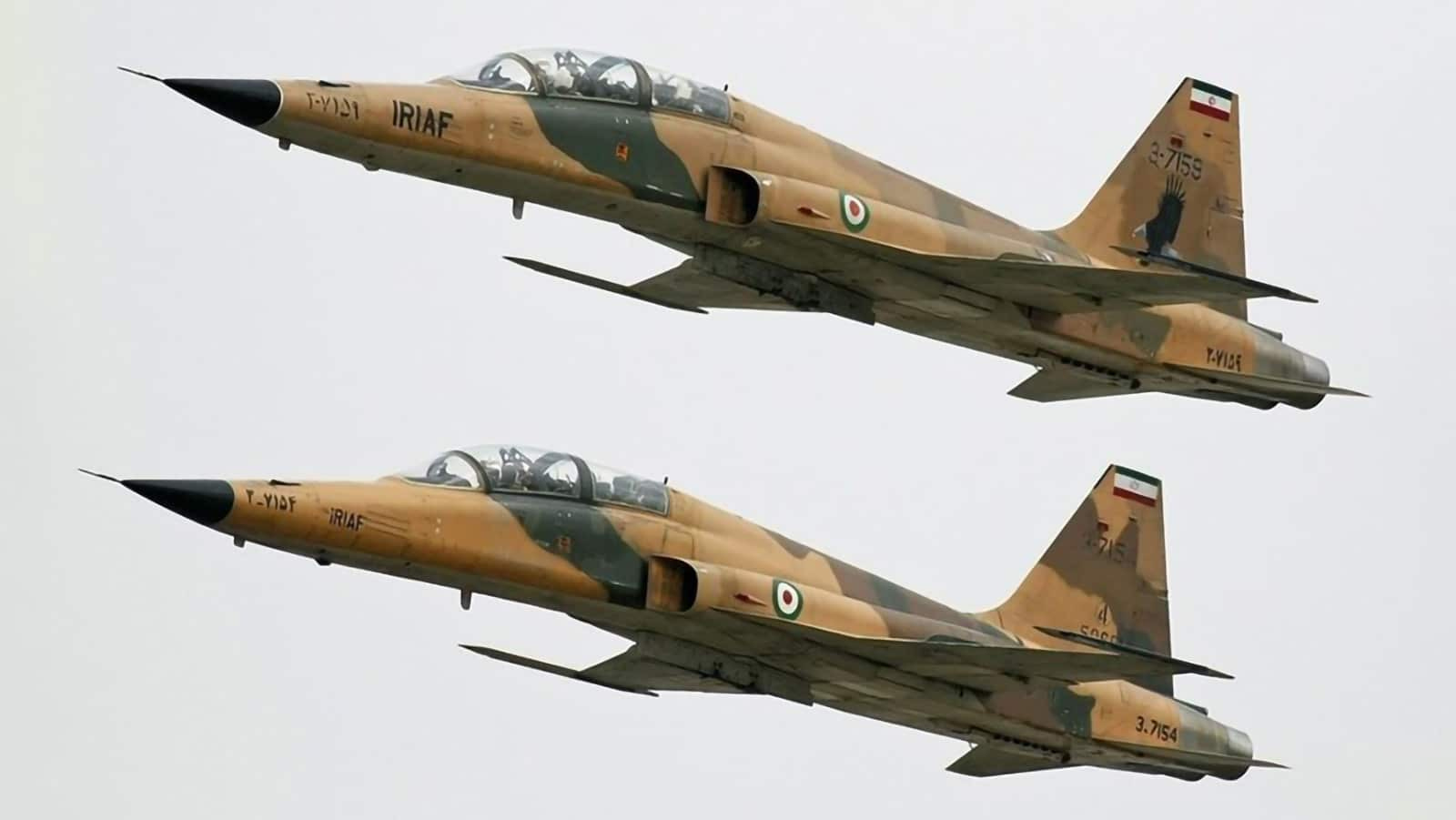
In the opening days of the war, an Iranian F-5 Tiger fighter jet flew a bombing run against Camp Buehring in Kuwait and completed it. The base had active US air defenses in place, including Patriot missile batteries and layered radar coverage. Two US officials told NBC News the attack marked the first time an enemy fixed-wing aircraft had struck an American military installation in years. Military historians placed the last confirmed precedent in the Korean War, where North Korean Po-2 biplanes killed two US soldiers on the island of Chodo in 1953 in nighttime raids American forces called Bed Check Charlie, a record Pacific Air Forces command cited in official documents for decades as evidence of uninterrupted American air dominance over friendly territory. The Pentagon did not disclose the breach at Camp Buehring. It has not explained what failed in the Patriot coverage, whether the F-5 flew below acquisition thresholds, or what the incident demands from the air defense architecture protecting the American forward presence across the Gulf. It has said nothing about any of it.
That silence is one entry in a longer ledger. The American Enterprise Institute reviewed damage across eleven US bases in seven countries and found Iran had struck more than one hundred targets since February 28. Three US officials, two congressional aides, and a person familiar with the damage assessments told NBC News the destruction is far worse than what the Defense Department has publicly acknowledged. The repair bill exceeds five billion dollars, by AEI’s estimate, before accounting for destroyed weapons systems, aircraft, and radar equipment, categories the assessment explicitly excludes from that figure. At Pentagon briefings across the same weeks, Defense Secretary Pete Hegseth told reporters: “Our capabilities continue to build. Iran’s continue to degrade.” Ballistic missile attacks against US forces were down ninety percent since the start of the conflict, he said. He did not mention the runway.
The Record at Juffair
Naval Support Activity Bahrain has been a Western military headquarters for most of the past century, and the Americans who staff it today are, in an institutional sense, the latest tenants of an arrangement that predates the United States’ presence in the Gulf by generations. The Royal Navy established the base at Manama’s Ras al-Jufair in 1935, reinforcing its position in the Gulf at the moment Britain was managing both the early assertion of Persian sovereignty under Reza Shah Pahlavi and the longer deterioration of its imperial position in Asia. The base functioned as a command node for British naval operations across the Gulf through two world wars and the dismantling of the British imperial system in the region. When Bahrain gained independence in 1971, the US Navy took over the installation on December 23 of that year, renaming it Administrative Support Unit Bahrain. The Fifth Fleet was reactivated there in 1995 after nearly five decades of dormancy, reconstituted to manage a theater that had grown in strategic weight faster than American institutional attention. The inherited logic, a fixed naval command node at the geographic center of the Gulf’s most consequential chokepoints, was simply transferred from one maritime power to the next, along with the lease, the pier, and the premise that controlling that installation is what controlling the Gulf operationally means.
What NSA Bahrain actually does is coordinate all US naval activity across approximately 2.5 million square miles of ocean: the Persian Gulf, the Red Sea, the Arabian Sea, and portions of the western Indian Ocean. The satellite communications terminals at the base are how the Fifth Fleet maintains persistent awareness of what is moving in those waters, how it talks to Washington, and how it coordinates with allied navies operating across the same theater. On February 28, an Iranian Shahed attack drone hit the facility. The Shahed costs roughly thirty-five thousand dollars. Satellite imagery obtained by the New York Times showed the strike had destroyed two large radomes or satellite communications terminals and collapsed approximately half of a warehouse complex at the base. Radar-protection structures sustained serious damage in a separate attack. Iran’s Supreme Leader Khamenei stated publicly that the strike had severed US communications at the installation and disrupted the fleet’s ability to operate from it. The satellite images do not confirm that operations were severed; they confirm the radomes are gone, which is a different but related fact. By late March, Iran struck again, this time at Sheikh Isa Air Base in Bahrain, which hosts the P-8 Poseidon, the Navy’s primary long-range maritime patrol and surveillance aircraft. Satellite imagery showed P-8 hangars with their roofs destroyed, a radar maintenance and repair hangar gutted, and a drone hangar torn apart. Defense News reported in late March that Iranian strikes had damaged radar systems, satellite communications infrastructure, and mission-critical aircraft at a minimum of seven US bases since February 28. The administration confirmed none of it at any public briefing.
The Runway and the CAOC
Qatar built Al Udeid Air Base in 1996 at a cost that has since grown, through more than two decades of Qatari investment, to over eight billion dollars. It did not build it as a philanthropic arrangement. The Defense Cooperation Agreement concluded after Desert Storm gave Qatar a formal American military commitment in exchange for infrastructure Washington would need, and the logic held: when the political costs of stationing American forces in Saudi Arabia became unmanageable after the Iraq invasion in 2003, the US moved its Combat Air Operations Center from Prince Sultan Air Base near Riyadh to the backup headquarters Qatar had built a year earlier outside Doha. The original CAOC had been run out of tents in the parking lot behind the Royal Saudi Air Force headquarters during Desert Storm, and by the time it settled at Al Udeid, it had become the permanent command center for all American airpower across a 21-nation theater. Every strike package, every air traffic coordination decision, every command loop between US Air Force, Navy, allied air forces, and coalition partners across the CENTCOM area of responsibility flows through that installation. Al Udeid is not a logistics base with significant real estate; it is the decision architecture for how American airpower in the region is directed, built deliberately over three decades at a cost that now exceeds eight billion dollars in Qatari investment alone.
A runway at that installation is destroyed. In June 2025, Iran launched an operation it designated Glad Tidings of Victory. Qatari air defenses intercepted thirteen Iranian ballistic missiles; one reached the base and impacted. Separately, an Iranian drone struck the geodesic dome at Al Udeid housing the equipment for American secure communications. The Associated Press confirmed the dome strike, reporting that neither US military officials nor Qatari authorities had publicly acknowledged the damage at the time of its reporting. The runway destruction appeared in the AEI assessment and was confirmed to NBC by US government sources. At the March 10 Pentagon briefing, Chairman of the Joint Chiefs General Dan Caine outlined three US military objectives in the conflict: destroying Iranian ballistic missiles and drone capability, striking the Iranian Navy, and dismantling Iran’s defense industrial base. The runway at the base through which all American airpower in the theater is directed was not among the topics addressed. Secretary of State Marco Rubio, speaking on March 1, framed the operation as the elimination of Iran’s missile threat and its naval capabilities, with no reference to what Iran had already done to the infrastructure those capabilities were targeting. What an adversary’s strikes actually cost requires a different kind of accounting than what your own strikes achieved.
A Seventy-Year Gap
The F-5 Tiger was designed by Northrop in the late 1950s as a lightweight export fighter for US allies who could not afford the frontline platforms entering American service at the time. It was cheap, simple, and available in volume. Iran received a large fleet before the 1979 revolution and has kept those aircraft operational through nearly five decades of comprehensive sanctions, spare-parts embargoes, and fleet cannibalization. Iranian engineers reverse-engineered the airframe and developed the Azarakhsh as a domestically modified derivative, then built the Saeqeh, a twin-tailed variant that incorporated smuggled Western components alongside available Russian systems, first presented publicly by then-President Mahmoud Ahmadinejad in 2007. The engineering involved in keeping an Eisenhower-era export fighter flying through five decades of embargo, and producing functional derivatives of it, is a story about Iranian industrial adaptation under sustained pressure that Western capability assessments have consistently underestimated. As of early 2026, Iran operates one of the largest remaining F-5 fleets in the world, distributed across a significant portion of its fighter squadrons. The airframe carries no signature-reduction characteristics, no modern electronic warfare suite, no stealth capability of any kind. It is a product of another era kept airborne by institutional memory and necessity, and at Camp Buehring in Kuwait it completed a bombing run through Patriot coverage over an American base.
The historical baseline for that breach was specific, maintained, and cited. Pacific Air Forces command documented the Korean War record in official publications, noting that no US ground personnel had been killed by an enemy aircraft attack since the Bed Check Charlie raids of 1953, when North Korean Po-2 biplanes struck US positions on Chodo Island in darkness. The Air Force cited that record into the 2010s as an institutional milestone. The aircraft that ended it in 2026 cost a fraction of the interceptors deployed to stop it. Whether the F-5 at Camp Buehring flew below the radar floor, whether the Patriot batteries were tasked elsewhere, or whether the sortie exploited a gap in coverage that existing doctrine had not anticipated as a threat category, the Defense Department has offered no public explanation. Two officials confirmed the breach to NBC News. The administration chose not to.
The Targeting Doctrine
The United States built the theoretical architecture for this war’s targeting logic over decades before the war began. In 1999, after NATO air strikes against Serbian ground forces in Kosovo produced limited results, the alliance escalated to striking civil and military infrastructure: electrical grids, communications networks, fuel systems, production facilities. The sustained pressure on those systems, rather than the initial tactical campaign, brought Milosevic to the table. American planners incorporated those lessons explicitly into targeting doctrine, and the same calculus shaped the 2003 Iraq campaign, where infrastructure strikes were weighed against post-conflict reconstruction costs in pre-war planning documents. By early 2026, Secretary Hegseth was describing plans to strike Iranian “power stations, bridges, and oil and energy infrastructure that Iran cannot rebuild” as a potential next phase of the campaign. The premise that infrastructure pain produces political concession was not incidental to the American approach. It was the approach.
Iran drew from the same curriculum. The targets it selected across seven countries describe a mirror application of that doctrine, directed specifically at the operational layer of American military power in the region. The satellite communications terminals at NSA Bahrain connect the Fifth Fleet to Washington and to every allied navy operating in the same theater. The radomes provide the radar picture that underpins persistent maritime awareness. The geodesic dome at Al Udeid encrypted the secure communications through which the CAOC runs its operations. The P-8 hangars at Sheikh Isa house the aircraft watching the water for submarine activity, mine-laying, and surface movements across the Gulf. The E-3 Sentry destroyed in Saudi Arabia was the airborne command and control platform that provides the full air picture across the theater. These are not symbolic strikes against visible American power for domestic Iranian political effect. They are strikes against the specific infrastructure through which the US military sees, communicates, and coordinates in the region. The AEI’s count of more than one hundred targets across eleven bases, read as a targeting document rather than a damage ledger, is an argument about what American operational capability in the Gulf actually consists of and exactly where it can be degraded without a single target being symbolic.
What Six Sources Said
The damage at specific installations, as described to NBC and confirmed by the AEI assessment, covers the full range of military infrastructure. At Al Dhafra in the UAE, fuel storage, a medical clinic, aircraft hangars, and barracks were hit. In Saudi Arabia, the E-3 Sentry was destroyed. In Kuwait, the F-5 completed its mission. In Qatar, a runway at the installation housing the CAOC is gone. In Bahrain, the naval headquarters for the US command structure in the Gulf had its communications architecture struck twice, in February and March. Mack Eaglen of AEI noted that the five-billion-dollar figure excludes reconstruction costs, system replacements, and the decommissioning of installations too degraded to rebuild in place, categories that will extend the final accounting considerably. The Hill and the Middle East Monitor both reported the AEI findings on April 25 and 26, describing the damage as “far worse than previously disclosed.”
At Pentagon briefings, the official account ran in a different direction. Hegseth told reporters on March 19 that Iran’s ability to manufacture ballistic missiles “has probably taken the hardest hit of all” and that US capabilities “continue to build” as Iran’s “continue to degrade.” On April 8, he described the destruction of Iran’s defense industrial base as complete, stating: “They can no longer build missiles.” Chairman Caine said approximately ninety percent of Iran’s weapons factories had been struck. Those claims may be accurate. They are also the entirety of the public accounting. The destroyed runway at Al Udeid, the gutted radomes at Bahrain, the F-5 that flew through Patriot coverage, the E-3 Sentry: none of it appeared. The satellite images showing the radomes gone at NSA Bahrain were published by the New York Times. The AP confirmed the secure communications dome strike at Al Udeid, and confirmed it had not been publicly acknowledged. The AEI assessment was published by a conservative institution that has spent decades making the case for robust American military capability abroad. Three US officials, two congressional aides, and a person familiar with the damage assessments each told NBC the public record does not reflect what the government knows. None of what those sources described is classified. The radomes are gone in published satellite imagery. The runway is in an AEI report. The F-5 breach is on the record with two US officials. What the administration has chosen is not classification. It is a political decision about what the public accounting of this war should contain, and it is a decision being made against a documented record, assembled without government cooperation, that contradicts it at every specific point.
An administration that built this war on the doctrine that striking infrastructure imposes costs has now absorbed more than five billion dollars in infrastructure damage and attributed none of it publicly, which is not a communications strategy but a debt.


