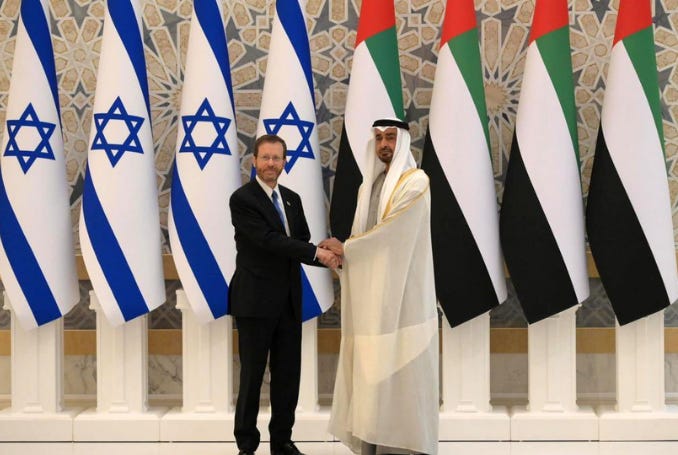
The Billion Dollar Handshake: UAE Money, Israeli Surveillance, and the Remaking of African Geopolitics
How Abraham Accords Transformed a Tiny Gulf State into Israel’s Continental Eyes and Ears
The United Arab Emirates comprises just 83,600 square kilometers, roughly the size of South Carolina. Its total population of approximately 10 million includes only 1 million Emirati citizens, with the remaining 9 million consisting of expatriate workers and foreign laborers. It possesses no significant military tradition, no substantial standing army by regional standards, and faces existential vulnerabilities including dependence on desalination for water, reliance on imported food, and geographic proximity to Iran, which occupies three UAE islands since 1971. By conventional metrics of power, territory, population, or military capacity, the UAE should occupy a marginal position in international affairs.
Yet as of January 18, 2026, this federation of seven emirates controls military bases spanning from eastern Libya to Somaliland, influences civil wars in Sudan and Yemen, operates port facilities across two dozen African nations, coordinates intelligence operations with Israel across the Red Sea and Horn of Africa, and deploys surveillance infrastructure monitoring dissidents, journalists, and political opponents across three continents. UAE sovereign wealth funds collectively manage assets approaching 4 trillion dollars, representing approximately 40 percent of global sovereign wealth fund holdings. The Abu Dhabi Investment Authority alone controls an estimated 1 trillion dollars, rivaling the GDP of entire nations.
This disproportionate influence, wielded by a state with fewer citizens than metropolitan Phoenix, Arizona, represents one of the most remarkable geopolitical phenomena of the 21st century. Understanding how the UAE accomplishes this requires examining mechanisms through which concentrated wealth translates into strategic leverage, how that leverage creates infrastructure serving multiple objectives simultaneously, and critically, how this architecture directly benefits Israeli security and intelligence interests in ways that would be impossible through bilateral Israeli action alone.
Mechanisms of Influence: Money as Strategic Weapon
Lobbying and Think Tank Capture
The UAE has systematically invested in shaping policy environments in Washington, London, and Brussels through direct lobbying expenditures and institutional capture exceeding hundreds of millions of dollars. Since 2016 alone, the UAE spent over 154 million dollars on registered lobbying activities in the United States according to Department of Justice records. This figure represents only legally declared spending subject to Foreign Agents Registration Act requirements and dramatically understates total influence operations.
Think tank funding provides particularly effective leverage. The Middle East Institute received a 20 million dollar contribution from UAE sources. The Center for American Progress accepted at least 1.5 million dollars from UAE entities. Brookings Institution, Carnegie Endowment for International Peace, and Harvard University received substantial multi-year commitments. These investments purchase more than research favorable to UAE positions. They secure access to former government officials who maintain security clearances and relationships with serving policymakers, effectively creating revolving doors between UAE-funded institutions and positions of authority.
A 2022 US intelligence community assessment documented UAE efforts to exploit these relationships, noting that the Emirates had cultivated business ties with political figures, made substantial payments for speaking engagements, and employed former US intelligence and military officials. Three individuals acknowledged in federal court in 2021 that they provided advanced hacking technologies to the UAE, illustrating how financial inducements compromise individuals with access to sensitive capabilities.
This lobbying infrastructure generates tangible policy outcomes. Despite documented UAE arms embargo violations in Libya, support for RSF forces committing atrocities in Sudan, and involvement in Yemen war crimes, Washington continued approving major weapons sales including F-35 fighter jet negotiations. Congressional resistance to some sales demonstrated that lobbying has limits, but the very fact that such sales received serious consideration despite UAE’s record reflects influence far exceeding what a nation of one million citizens should command.
On January 10, 2026, the UAE revealed another dimension of its influence strategy: cutting all British universities from its scholarship eligibility lists. Officials cited concerns about “Islamist radicalization” and “antisemitism” on UK campuses, effectively wielding financial leverage to pressure Western educational institutions. The move demonstrated how UAE deploys money not merely to purchase access, but to discipline institutions that might host critics or cultivate students exposed to perspectives challenging autocratic governance models.
Sovereign Wealth as Geopolitical Instrument
UAE sovereign wealth funds function as strategic instruments rather than purely commercial investment vehicles. Abu Dhabi Investment Authority, Mubadala Investment Company, and Abu Dhabi Developmental Holding Company deployed 82 billion dollars in investments during 2023, with an additional 55 billion dollars in the first nine months of 2024. These investments target critical sectors: technology, defense, infrastructure, agriculture, and natural resources.
Royal Private Offices represent a newer investment vehicle category, now controlling an estimated 500 billion dollars in assets according to 2025 assessments. These entities, managed by individual members of the Al Nahyan ruling family, particularly Sheikh Tahnoon bin Zayed, the president’s brother and national security adviser, operate with even less transparency than traditional sovereign wealth funds. Sheikh Tahnoon chairs International Holding Company, whose market capitalization exceeds 200 billion dollars, and Group 42, better known as G42, the most significant technology company operating at the intersection of UAE state interests and private capital.
G42 exemplifies how UAE deploys technology investments for geopolitical leverage. Founded in 2018, G42 specializes in artificial intelligence, big data, cyberspace, and advanced surveillance technologies. The company operates as an arm of the state: chaired by Sheikh Tahnoon, it routinely markets the UAE as an emerging AI power while facilitating public-private partnerships that blur distinctions between commercial ventures and intelligence operations.
In January 2026, UAE Ministry of Defence announcements confirmed accelerated AI deployments across Middle East and Africa, emphasizing AI-enabled command decision support, intelligence surveillance reconnaissance data fusion, and autonomy-assisted mission planning. These systems, developed through G42 partnerships with Microsoft and Israeli firm Rafael Advanced Defense Systems, provide UAE with surveillance capabilities rivaling far larger powers. Israel Aerospace Industries cited demand for AI-supported mission management in special mission aircraft used by African customers, with sensor fusion and automated target recognition workflows enabling comprehensive monitoring across the continent.
This financial firepower creates dependency. When Egypt faced economic crisis in 2024, ADQ’s 35 billion dollar Ras al-Hikma development deal provided desperately needed foreign currency, securing long-term UAE influence over Egyptian policy regarding Israeli relations and Red Sea security cooperation. Such transactions transform recipients into stakeholders in UAE strategic objectives.
The Technology Transfer Nexus: NSO, Pegasus, and Surveillance Infrastructure
The UAE-Israel relationship extends far beyond diplomatic normalization into integrated surveillance and cyber warfare capabilities that would be politically impossible to acknowledge publicly. Central to this integration stands NSO Group, the Israeli spyware manufacturer whose Pegasus software has been deployed by UAE agencies against journalists, dissidents, human rights defenders, and even foreign heads of state.
Pegasus functions as a zero-click exploit, meaning targets require no interaction for their devices to become compromised. Once installed, the software accesses encrypted communications, activates cameras and microphones, tracks location data, and exfiltrates files. The technology represents Israel’s most sophisticated cyber weapon, and UAE stands among NSO’s most prolific clients despite repeated documented abuses.
Investigations revealed UAE use of Pegasus against Princess Latifa, daughter of Dubai’s ruler who attempted to flee in 2018. UAE targeted Hanan Elatr, fiancée of murdered Saudi journalist Jamal Khashoggi, installing spyware on her device in 2017. When a British court examined Dubai ruler Sheikh Mohammed bin Rashid al-Maktoum’s use of Pegasus to hack phones of his ex-wife Princess Haya and her lawyer, a member of the UK House of Lords, NSO Group finally terminated the contract in October 2021 after years of abuse.
Yet this termination proved temporary. By 2025, evidence suggested UAE had resumed access to NSO capabilities or similar technologies through alternative channels. The pattern reveals a critical dynamic: Israeli technology companies provide capabilities that UAE deploys for domestic repression and regional intelligence gathering, while Israel gains financial returns, field testing data, and crucially, intelligence product derived from UAE’s extensive targeting operations.
On October 28, 2025, Israeli defense firm Controp Precision Technologies received government approval to establish a subsidiary in the UAE focused on sales, maintenance, technical support, and local assembly of surveillance and targeting systems. The Israeli government emphasized strict security supervision by the Defense Security Commissioner to prevent unauthorized technology transfer, but the precedent demonstrates systematic integration of Israeli surveillance capabilities into UAE infrastructure.
This technology transfer operates bidirectionally. Israeli firms gain access to UAE’s vast financial resources and African markets where direct Israeli presence faces political obstacles. UAE acquires cutting-edge capabilities while positioning itself as an AI and surveillance power. African governments purchasing or receiving these systems through UAE channels become nodes in an intelligence collection network serving both Emirati and Israeli requirements.
African Infrastructure: Dual-Use by Design
Port Network as Intelligence and Logistics Platform
DP World and AD Ports Group, both government-owned entities executing UAE’s port acquisition strategy, operate or maintain agreements in Algeria, Angola, Congo, Democratic Republic of Congo, Djibouti, Egypt, Guinea, Kenya, Mozambique, Puntland, Senegal, Somaliland, and Tanzania. These facilities serve multiple functions beyond commercial revenue generation, integrating Israeli surveillance technology into infrastructure presented as purely commercial ventures.
Berbera, Somaliland exemplifies the model. The 442 million dollar initial investment secured 65 percent Emirati ownership under a 30-year concession. Commercial operations generate substantial revenue: Phase 1 delivered a 400,000 TEU container terminal and livestock facilities handling 5 million animals annually, generating 1.5 billion dollars in trade. Yet Berbera simultaneously serves military and intelligence functions through integrated Israeli technology.
UAE engineers expanded the adjacent airfield to accommodate C-17 transports and fighter jets, constructing maintenance hangars and a separate military quay. Over 200 UAE military trainers work with Somaliland’s 8,000-strong defense forces. Port facilities integrate Israeli radar systems tracking maritime traffic across 80 percent of Gulf of Aden approaches. This infrastructure generates commercial returns while enabling surveillance and power projection, the defining characteristic of UAE’s dual-use approach.
Bosaso in Puntland reveals deeper Israeli integration. Satellite imagery analyzed in October 2025 documented construction between January 2024 and January 2025: three helipads, large enclosed hangars accommodating drones, and paved operating areas. The facility hosts an Emirati-operated French-made GM-403 radar system alongside an Israeli-made EL/M-2084 system, the same technology powering Israel’s Iron Dome missile defense network. Both radar types track over one thousand targets at ranges exceeding 400 kilometers, covering the entire Gulf of Aden and Red Sea entrance from Bosaso’s strategic position.
Multiple sources including Sudanese officials, diplomatic personnel, and local witnesses confirmed to Middle East Eye in October 2025 that UAE uses Bosaso to transfer weapons and ammunition to RSF forces in Sudan’s civil war. IL-76 heavy transport aircraft and C-130 Hercules military transports operate from adjacent civilian airport infrastructure. Flight tracking data documented two to three such flights daily in early 2024, decreasing to approximately 15 monthly by mid-2025 as international scrutiny intensified. This dual-use model, commercial port operations masking military logistics and intelligence collection, exemplifies how UAE infrastructure serves Israeli interests while maintaining plausible deniability regarding Israeli technical presence.
Island Bases: The Red Sea Surveillance Arc
UAE construction across Yemeni islands creates comprehensive maritime surveillance spanning the world’s most strategic chokepoint, with Israeli technology and personnel integrated throughout. The Bab el-Mandeb strait, through which 30 percent of global oil shipments transit, separates Yemen from Eritrea and Djibouti. Control of this passage, combined with monitoring capabilities extending into the southern Red Sea and Gulf of Aden, provides leverage over global commerce worth trillions annually.
Abd al-Kuri island, part of Yemen’s Socotra archipelago, underwent transformation beginning in late 2022. Satellite imagery documented construction of an airstrip 2.41 kilometers long with a three-kilometer dirt extension, completed by March 2025. The runway accommodates C-130 Hercules transports, Russian IL-76 heavy cargo aircraft, and crucially, Israeli Hermes 900 unmanned aerial vehicles. In March 2024, satellite images captured “I LOVE UAE” spelled in sand piles beside the runway, a propaganda flourish revealing Emirati control despite nominal Yemeni sovereignty.
Intelligence officers from UAE and Israel arrived on Abd al-Kuri in late August 2020, just before the Abraham Accords formalized relations. In February 2021, dozens of Israeli officers and soldiers arrived on Socotra proper aboard Emirati aircraft, according to regional diplomatic sources and local witnesses. This established the operational pattern: UAE provides facilities and logistics, Israel contributes surveillance technology and technical personnel, and both benefit from intelligence collection impossible through independent action.
Mayun island, occupying the most vital position within Bab el-Mandeb strait proper, features an airstrip extending 1.85 kilometers along the west coast. Hangars measuring up to 660 meters by 100 meters house drones and reconnaissance aircraft equipped with Israeli sensors. Residential facilities accommodate dozens of military and technical personnel. Reports from maritime security analysts indicate the facility operates under joint UAE-Israel command, with Israeli technicians maintaining sophisticated electronic intelligence equipment monitoring all vessel traffic through the strait.
Though Saudi pressure forced UAE evacuation from Socotra in January 2026, the temporary loss of one facility does not eliminate the broader network. UAE retains Assab in Eritrea, Berbera and Bosaso in Somalia, and maintains ongoing construction at alternative sites. The institutional relationships, technical integrations, and operational procedures now exist as persistent capabilities that can be reconstituted at alternative locations.
The Crystal Ball Platform: Institutionalized Intelligence Fusion
The UAE and Israel maintain a joint intelligence platform designated Crystal Ball, launched in Tel Aviv in June 2023 by UAE’s Minister of Cybersecurity. The initiative aims to “design, deploy, and enable regional intelligence enhancement” through partnership with Microsoft, Abu Dhabi-based cybersecurity firm CPX, and Israeli firm Rafael Advanced Defense Systems.
Crystal Ball deploys intelligence platforms, logistical hubs, and advanced air bases across southern Yemen, including islands such as Abd al-Kuri, Mayoun, Samhah, and Zuqar. The system integrates UAE-Israel intelligence sharing on cybersecurity threats, Houthi missile launches, Iranian weapons shipments, and maritime traffic patterns. This represents institutionalized cooperation transcending episodic information exchanges, creating persistent joint operations centers where personnel from both nations analyze data streams in real time.
Israeli radar systems provide the technical foundation. EL/M-2084 arrays, the technology powering Iron Dome missile defense, track threats across 400-kilometer ranges from multiple installations spanning Eritrea to Somaliland. Israeli-made AESA radar systems monitor air and maritime approaches. AI-powered threat analysis software, developed jointly by G42 and Israeli firms, processes vast data volumes identifying patterns and flagging potential threats with unprecedented speed and accuracy.
The intelligence product serves both nations’ requirements while creating capabilities neither could achieve independently. For UAE, tracking Iranian weapons shipments to Houthi forces and monitoring threats to Emirati vessels and facilities represents core security interests. For Israel, the data enables targeting Iranian smuggling networks, assessing Houthi capabilities threatening Israeli territory and shipping, and maintaining awareness of potential threats transiting toward the Mediterranean via the Suez Canal.
On January 16, 2026, just two days before this article’s publication, the United States and Israel announced a strategic partnership on “Protection of Sensitive Research Technologies,” deepening collaboration on research security. While the announcement focused on US-Israel cooperation, UAE’s role as the operational platform enabling Israeli intelligence collection across Africa and the Red Sea provides the infrastructure making such partnerships globally effective. UAE money builds the bases, Israeli technology fills them, and American diplomatic protection shields both from consequences.
The Dubai Finance Nexus: Cryptocurrency, Sanctions Evasion, and Blood Gold
Dubai’s emergence as a global cryptocurrency hub creates financial infrastructure enabling sanctions evasion that serves UAE strategic objectives while providing Israel with alternative financial channels for covert operations. With Binance, Kraken, Crypto.com, and Bybit establishing major presences in Dubai and Abu Dhabi, the UAE has transformed into one of the world’s primary crypto trading centers with deliberately limited transparency and virtually nonexistent beneficial ownership disclosure requirements.
A 2024 George Mason University assessment documented Dubai’s role as “A Global Hub for Illicit Trade and Sanctions Evasion,” noting that crypto exchanges create vulnerabilities due to limited transparency, lacking information about ultimate beneficial owners, and inter-jurisdictional regulatory gaps. These features, presented as bugs in regulatory frameworks, function as features enabling precisely the sanctions circumvention that UAE employs in supporting RSF in Sudan, Haftar in Libya, and other proxies facing international arms embargoes.
Sudan’s gold trade through Dubai exemplifies the nexus between resource extraction, cryptocurrency, and proxy warfare. RSF controls artisanal mining areas producing 80 percent of Sudan’s gold output, estimated at 100 tons annually worth over 5 billion dollars. Dubai serves as the world’s second-largest gold importer, with refineries processing metal whose origin documentation frequently lacks transparency. US Treasury assessments indicate over 90 percent of Democratic Republic of Congo gold is smuggled through regional states to UAE markets. Sudanese gold follows similar routes: RSF extracts from Darfur mines, transports via Chad or Libya, and sells through Dubai gold souks and refineries.
Cryptocurrency provides the conversion mechanism. Gold arrives in Dubai, refineries purchase using crypto to avoid banking system scrutiny, and RSF converts crypto to cash or weapons through networks of brokers operating across multiple jurisdictions. This system, while technically legal under UAE’s deliberately permissive regulations, enables continued warfare despite international pressure for arms embargoes and financial sanctions.
Israeli firms and intelligence services benefit from these same channels. When traditional banking systems block certain transactions due to political sensitivities, Dubai’s crypto infrastructure provides alternatives. Technology transfers, arms deals, and intelligence payments that would trigger scrutiny through conventional financial systems can flow through cryptocurrency exchanges with beneficial ownership obscured. The January 2026 Responsible Statecraft report documented how this financial opacity enables operations both nations conduct but cannot publicly acknowledge.
Direct Benefits to Israeli Strategic Objectives
Red Sea Access and Bab el-Mandeb Control
Israel lost its Red Sea access points in Eritrea during the 1990s as regional relationships deteriorated. The 2020 Abraham Accords created opportunities for renewed presence, but even normalization agreements do not guarantee basing rights in Muslim-majority states facing domestic opposition to Israeli military presence. UAE solves this problem by providing the infrastructure and diplomatic cover while Israeli technology and personnel integrate throughout.
Israel’s December 26, 2025 recognition of Somaliland as an independent state, the first by a UN member, followed UAE facilitation according to Israeli officials. Somaliland pledged to join Abraham Accords normalization and reportedly committed to providing Israeli intelligence and security services with basing rights at Berbera. This grants Israel its first formal Red Sea foothold in decades, positioned at the Gulf of Aden entrance with direct line of sight to Yemen’s coast.
From Berbera, Israeli surveillance aircraft monitor Houthi positions, track Iranian vessels, and collect signals intelligence across the entire southern approach to the Red Sea. Drones equipped with Israeli sensors operating from Berbera reach deep into Yemeni territory, providing targeting data for potential strikes. The facility also positions Israel to observe Chinese activity at Djibouti’s military base, adding intelligence value extending beyond immediate regional conflicts.
Iranian Containment Network
Iran represents Israel’s primary adversary, and containing Iranian influence across the Middle East and Africa drives much Israeli policy. UAE’s network directly serves this objective by monitoring and interdicting Iranian weapons flows, degrading Iranian proxy capabilities, and creating geographic obstacles to Iranian expansion through integrated Israeli technology deployed across multiple nodes.
Houthi forces in Yemen receive Iranian missiles, drones, and technical advisors enabling attacks on Israeli territory and shipping. Crystal Ball intelligence platform tracks these shipments from origin points in Iran, through Gulf waters, into Red Sea transit routes, and to Yemeni ports. UAE facilities host Israeli radar systems and signals intelligence equipment monitoring Iranian communications. Naval assets coordinate to interdict suspicious vessels based on intelligence fusion impossible without UAE’s geographic positioning and Israeli technical capabilities.
On January 13, 2026, media reports citing regional intelligence sources revealed that UAE facilities in the Red Sea region actively aided Israel’s Gaza war efforts throughout 2024-2025 by providing surveillance data, logistics support, and alternative routing for sensitive shipments facing scrutiny through traditional channels. While both governments denied these reports, the infrastructure and intelligence integration documented in this analysis demonstrates the capability exists regardless of official acknowledgments.
Sudan represents another Iranian target. When the Bashir regime maintained ties with Iran, weapons flowed through Port Sudan to Gaza via Sinai smuggling networks, directly threatening Israeli security. UAE’s backing of RSF, despite the humanitarian catastrophe this creates, aligns with Israeli interests in preventing any Sudanese government friendly to Iran from consolidating power. An RSF victory or negotiated settlement installing Hemedti in Khartoum would secure long-term control by a faction dependent on UAE and therefore aligned against Iran.
Technology Field Testing and Intelligence Product
Beyond geographic access, UAE’s African network provides Israeli defense and intelligence companies with field testing environments for emerging technologies under operational conditions impossible to replicate domestically. Surveillance systems, AI-powered threat analysis software, drone capabilities, and cyber warfare tools deployed across UAE’s continental infrastructure generate performance data and lessons learned that Israeli firms incorporate into product refinements.
Israeli defense companies establishing subsidiaries in the UAE, such as Controp’s October 2025 authorization for local operations, gain access to African markets where direct Israeli presence faces political obstacles. These companies sell equipment to African governments through UAE intermediaries, with transactions structured to obscure Israeli origin while providing both nations with intelligence access.
The intelligence product flowing from this integrated network may represent its greatest strategic value. Every device monitored through Pegasus, every radar track from EL/M-2084 systems, every signal intercepted by Crystal Ball platforms, and every communication passing through G42 AI analysis generates data benefiting Israeli intelligence services. This constitutes a continental-scale collection infrastructure that Israel could never construct through bilateral arrangements, making UAE’s money and diplomatic positioning force multipliers for Israeli intelligence capabilities.
The Mechanisms of Tiny State Dominance
Exploiting Fragmentation
A critical UAE advantage derives from operating in fragmented spaces where weak central governments cannot enforce sovereignty. Somalia’s federal structure allows UAE to sign deals with Puntland, Jubaland, and Somaliland that bypass Mogadishu entirely. When Mogadishu attempted to cancel UAE agreements on January 12, 2026, these regions immediately rejected federal authority, demonstrating that UAE has cultivated loyalties superseding national identity.
Yemen’s civil war fragmentation enables UAE to operate across islands and coastal areas nominally under government control but actually administered by local commanders dependent on Emirati support. Libya’s east-west division allows UAE to back Haftar independently of Tripoli. Sudan’s SAF-RSF split provides openings to deepen RSF dependency through weapons, gold monetization, and financial channels. Chad’s military dictatorship trades access for equipment and training.
This fragmentation is not merely opportunistic exploitation. UAE actively cultivates division by providing resources to separatist movements, backing regional strongmen against central authority, and offering financial incentives exceeding what legitimate governments can match. Israeli technology integration throughout these networks creates additional dependencies: once African security forces adopt Israeli radar systems, surveillance platforms, or AI-powered analysis tools, replacing them requires massive investment and loss of operational continuity.
Transactional Diplomacy and Lack of Moral Constraints
UAE foreign policy operates on purely transactional principles unconstrained by democratic accountability, human rights considerations, or international norms. The ruling Al Nahyan family answers to no electorate, faces no free press scrutiny, and maintains absolute control over policy formulation and implementation. This enables rapid decision-making and commitments that democratic governments cannot match.
When Sudan’s RSF requires arms despite committing genocide in Darfur, UAE provides them through Chad and Libya routes, officially denying involvement while flight tracking data and UN investigations document the flows. When Libya’s Haftar needs fuel and Wagner mercenaries, UAE arranges both, regardless of UN embargoes. When Israeli defense companies need market access in Muslim-majority African states, UAE provides the intermediary structure enabling sales that direct transactions would make politically impossible.
This approach contrasts sharply with constraints facing democratic allies. US arms sales require congressional approval and public justification. European weapons exports face parliamentary scrutiny and NGO campaigns. Israel’s actions receive intense international attention and criticism. UAE operates beneath this scrutiny level despite comparable or greater involvement, because its autocratic system generates less domestic opposition and its lobbying infrastructure shapes how Western media and policymakers perceive its activities.
Academic and Cultural Infiltration
UAE’s January 10, 2026 decision to cut British universities from scholarship eligibility lists reveals another dimension of influence operations: using educational access as leverage over Western institutions. By funding thousands of students at premium institutions, UAE created dependency relationships that could be threatened when those institutions hosted perspectives challenging Emirati interests.
Western universities hosting Emirati-funded programs, research centers, and branch campuses face pressure to avoid topics sensitive to UAE leadership. Academics researching UAE human rights abuses, Yemen war crimes, or Sudan RSF support risk losing access or facing pressure from administrators concerned about funding relationships. This creates self-censorship dynamics shaping what research gets conducted and published.
Simultaneously, UAE has established branch campuses of prestigious Western universities in Abu Dhabi and Dubai, including New York University, Georgetown University, and Paris-Sorbonne University. These institutions provide education to Emirati and regional students while maintaining content control ensuring curricula align with UAE political requirements. Students graduating from these programs enter professional careers having never encountered perspectives critical of Gulf autocracies, Israeli policies, or UAE regional conduct.
Israeli academic institutions benefit from parallel arrangements. The Abu Dhabi-based Mohamed bin Zayed University of Artificial Intelligence and Israel’s Weizmann Institute of Science established a Joint Program for Artificial Intelligence Research, creating integrated research capabilities and student exchanges. These programs normalize UAE-Israel cooperation for emerging generations while producing surveillance and AI capabilities serving both states’ intelligence requirements.
The January 2026 Test: Resilience Despite Setbacks
The converging pressures of January 2026 represent the most significant challenges to UAE regional strategy since its inception. Somalia’s federal government cancellation of all agreements on January 12 explicitly cited UAE’s alleged role facilitating Israel’s Somaliland recognition, directly linking the core elements of this analysis. The decision came after months of tension following Israel’s December 26, 2025 recognition, revealing how UAE-Israel coordination creates blowback affecting both partners.
Saudi Arabia’s ultimatum demanding complete UAE withdrawal from Yemen and forced evacuation from Socotra eliminates a key maritime surveillance position and demonstrates the limits of UAE’s ability to operate independently of regional power dynamics. The Southern Transitional Council’s dissolution and attacks on Saudi-backed forces in early January 2026 destroyed a primary proxy that absorbed years of investment, revealing how insufficient control over armed groups creates unpredictable escalations damaging patron interests.
Yet network resilience proves substantial despite these setbacks. Somaliland, Puntland, and Jubaland defied Mogadishu, keeping UAE bases and ports operational despite federal directives. Berbera expansion continues on schedule, with Phase 3 targeting 1 million TEU capacity by 2027. Assab in Eritrea remains fully functional with Israeli radar installations operational. Libya’s eastern facilities support Sudan operations unaffected by Horn developments. RSF continues advancing in Sudan despite international criticism of UAE support.
Most critically for Israeli interests, the intelligence infrastructure persists across multiple redundant nodes. Crystal Ball operations continue from alternative locations. EL/M-2084 radar installations at Bosaso and Berbera remain active regardless of diplomatic disputes with Mogadishu. Data flows maintain uninterrupted through G42 platforms and Microsoft cloud infrastructure. Even if UAE loses individual physical facilities, the institutional relationships, technical integrations, and operational procedures now exist as persistent capabilities that can be reconstituted at alternative locations.
This resilience validates the tiny state strategy. By diversifying investments across multiple territories, cultivating numerous proxy relationships, and integrating capabilities with Israel and the United States, UAE has created a network that withstands individual node failures. No single crisis, whether diplomatic rupture with Somalia, Saudi pressure in Yemen, or international scrutiny of Sudan involvement, can collapse the overall architecture because redundancy and diversification are designed into the system from inception.
Conclusion: The Template of Disproportionate Influence and Israeli Integration
The UAE’s continental strategy demonstrates how a state with just one million citizens projects influence rivaling far larger powers through systematic application of concentrated wealth, exploitation of fragmented political spaces, cultivation of proxy forces, deployment of Israeli surveillance technology, and strategic coordination with technologically superior partners. This model offers sobering lessons for understanding contemporary geopolitics where traditional metrics of population, territory, and military capability explain less than previously assumed.
Israel gains enormously from this arrangement in ways that merit detailed enumeration. Access to Red Sea bases and surveillance networks that would be diplomatically and politically impossible through bilateral agreements becomes available through UAE intermediation. Intelligence on Iranian activities, Houthi capabilities, and regional threats flows from sensors and networks UAE money establishes and maintains across dozens of installations. Israeli radar systems at Bosaso track all Gulf of Aden maritime traffic. Israeli drones operating from Abd al-Kuri monitor Bab el-Mandeb approaches. Israeli Pegasus spyware deployed by UAE agencies generates intelligence product on regional actors, dissidents, and political figures that Israeli services access through information sharing protocols.
Military logistics and potential strike platforms position across strategic chokepoints and adjacent to adversary territories. Israeli defense companies access African markets through UAE intermediaries, generating revenue while positioning both nations to monitor and influence African security forces adopting their technologies. Technology transfers through joint platforms like Crystal Ball and G42 partnerships enhance both nations’ capabilities beyond what either could achieve independently. Academic collaborations produce researchers and technologies serving intelligence requirements under cover of civilian research.
The financial mechanisms enabling this strategy receive insufficient scrutiny relative to their impact on policy outcomes. When a foreign government can spend hundreds of millions shaping research agendas at elite institutions, employing former intelligence officials, maintaining access to serving policymakers, and deploying surveillance technologies against journalists and dissidents globally, traditional distinctions between independent policy analysis and purchased advocacy collapse entirely.
Dubai’s cryptocurrency infrastructure enables sanctions evasion for UAE proxies while providing Israeli operations with financial channels avoiding traditional banking scrutiny. Blood gold from RSF-controlled Sudanese mines finances continued warfare while generating profits for Dubai refineries and traders. This financial opacity, deliberately maintained through weak regulations and beneficial ownership secrecy, serves both nations’ requirements for covert funding flows supporting activities that cannot withstand public scrutiny.
The January 2026 crises test but do not break this system because resilience derives from redundancy and diversification. Somalia’s federal rupture matters less when proxy regions keep infrastructure operational. Yemen facility losses become manageable when Eritrea, Puntland, Somaliland, and Libya installations persist. Each crisis prompts adaptation rather than collapse: UAE shifts resources to alternative locations, cultivates new proxies, and deploys its lobbying infrastructure to shape narratives minimizing political consequences.
As of January 18, 2026, this architecture faces significant challenges but remains fundamentally intact and operationally effective. Understanding its mechanics, recognizing how Israeli interests integrate throughout every dimension of its structure, acknowledging the disproportionate influence a tiny state commands through wealth and strategic acumen, and documenting the specific technologies and financial mechanisms enabling these capabilities becomes essential for anyone seeking to comprehend contemporary African and Middle Eastern geopolitics.
The shadow network endures because it rests on economic foundations generating commercial profits regardless of political outcomes, reinforced by Israeli military and surveillance capabilities that UAE cannot generate independently, protected by lobbying infrastructure shaping policy in Washington and European capitals, and diversified across sufficient nodes that individual failures cannot produce systemic collapse. This is the template of 21st century sub-imperial power projection: not through conventional military conquest, but through systematic investment, proxy cultivation, technology integration, financial opacity, and strategic coordination exploiting the spaces between traditional alliances, international norms, and democratic accountability.


