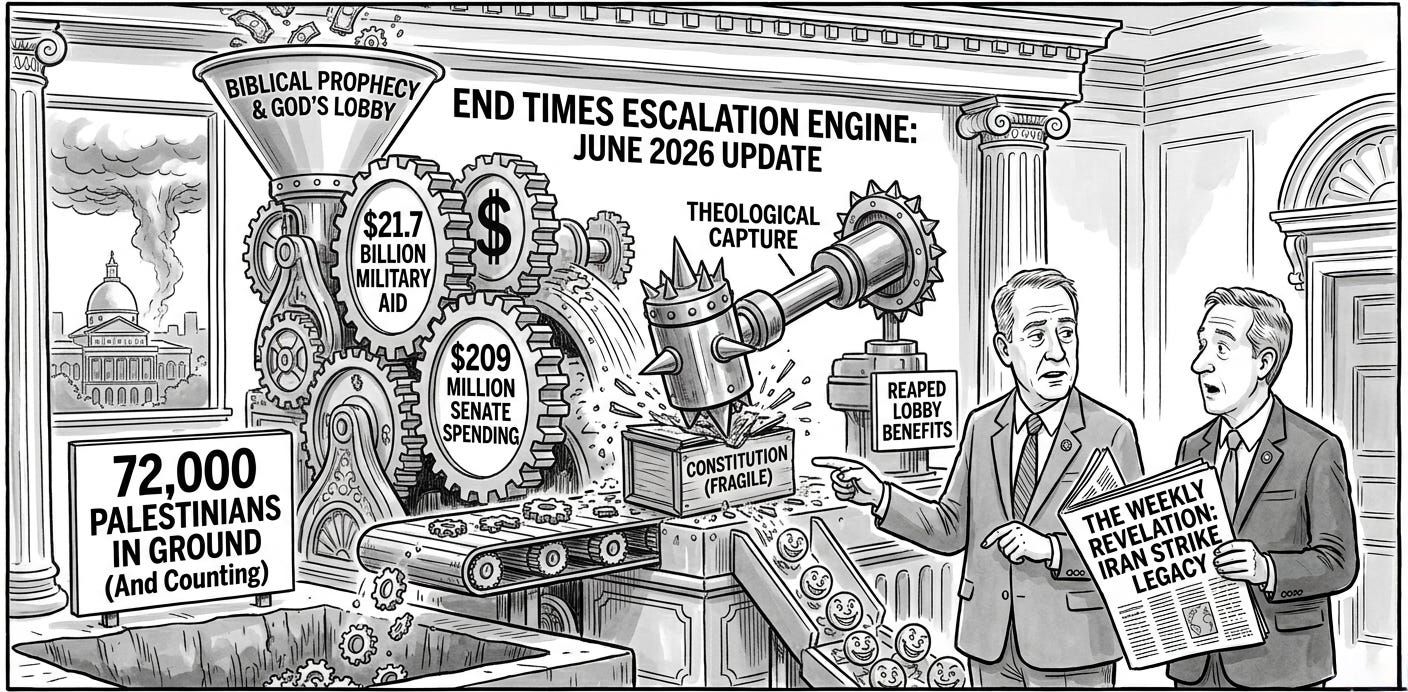
This investigation is the capstone to a six-part series on the theological and institutional origins of American Christian Zionism. The series documents how a four-century-old reading of biblical prophecy became the governing ideology of American foreign policy. Each part is linked in the text below. This article covers the present-tense consequences: the wars, the money, the legislation, and the constitutional betrayal that the capture has produced as of June 2026.
On June 3, 2026, the United States House of Representatives passed a war powers resolution directing Donald Trump to halt military operations against Iran without congressional authorization. The vote was 218 to 208. It was a rebuke, in the constitutional sense, of a president who had launched airstrikes on a sovereign nation on February 28 without a declaration of war, without a formal authorization of military force, and without the legislative consent that Article One of the US Constitution requires before the Republic sends its military to kill people. The resolution was non-binding. The bombs had already fallen. Iran’s supreme leader was already dead. Ninety thousand tons of American military equipment had already been transported to Israel on eight hundred transport planes and one hundred and forty ships. Seventy-two thousand Palestinians were already in the ground.
The vote was remarkable not because it changed anything. It changed nothing. It was remarkable because it happened at all, because a narrow majority of the House of Representatives momentarily remembered that the Constitution exists, before the Senate, saturated with $209 million in pro-Israel lobby spending distributed across 539 members of Congress, ensured that the memory did not translate into law.
This is the state of American governance on the question of Israel and the Middle East in June 2026. The legislature has been purchased. The executive has been captured. The Pentagon has been structurally integrated with a foreign military through legislation buried in a defense authorization bill. And the theological infrastructure that made all of this politically sustainable for a century, the dispensationalist Christian Zionism documented in the six-part series that precedes this investigation, is the domestic lubricant that has kept the machine running without public revolt.
The 6-part series is linked throughout this article. It should be read first. What follows is the present-tense record of what the capture has produced.
Part 1: Christian Zionism: God’s Lobby: How Christian Zionism Captured American Foreign Policy
Part II: Christian Zionism: From the Bible Conference to Truman’s Desk (1875 to 1948)
Part III: Christian Zionism: Armageddon in the White House (1967 to 1992)
Part IV: Christian Zionism: The Lobby Matures, Clinton to Bush (1993 to 2009)
Part V: Christian Zionism: The Institutional Zenith, Obama Through Gaza (2009 to 2024)
Part VI: Christian Zionism: Huckabee and the Destination
What the Founding Documents Said
The founders of the American republic were not naive about the dangers of foreign entanglement. George Washington’s Farewell Address of 1796 warned, with specific force, against “permanent, inveterate antipathies against particular nations and passionate attachments for others.” He described passionate attachment as creating “the illusion of an imaginary common interest” that could “betray” the nation into involvement in “quarrels and wars” that served a foreign party, not the republic’s own interests. James Madison, the primary architect of the Constitution, designed a system in which the power to declare war rested exclusively with Congress, specifically to prevent a single executive from committing the nation to military action for personal, ideological, or externally influenced reasons.
The First Amendment separated church from state precisely because the founders understood that when religious conviction governs political decision-making, the citizens who do not share that conviction are governed by a theology they never consented to. The prohibition on religious tests for public office in Article Six was designed to ensure that a candidate’s theological commitments were constitutionally irrelevant to their fitness to govern. These principles were not decorative. They were structural. They were the specific mechanisms through which the founders intended to prevent the kind of ideological capture that this investigation documents.
Every one of those mechanisms has been effectively neutralised in the domain of Israel policy.
Congress has not declared war on Iran. The executive launched airstrikes anyway. The separation of church and state has not prevented a Baptist minister in the Jerusalem embassy from citing Genesis as the basis for Israeli territorial claims across the Middle East. The prohibition on religious tests has not prevented CUFI’s annual Washington Summit from functioning as a de facto theological vetting ceremony for Republican presidential candidates. And the warning against passionate foreign attachments has not prevented the United States government from spending, by the most conservative accounting, $21.7 billion in military aid to Israel between October 2023 and September 2025, with additional commitments running into the tens of billions more.
The founders built a republic. What their successors have constructed, in the domain of Israel policy, is something closer to a vassal arrangement running in the opposite direction from the one that word usually implies.
The Management Arrangement
The standard critique of American policy toward Israel frames the relationship as Israeli control over American decision-making, foreign money and lobbying influencing a sovereign government, a tail wagging a dog. This framing is imprecise, and its imprecision leads to wrong conclusions about how the arrangement actually functions and how it might be changed.
The more accurate framing is imperial. The United States manages Israel the way empires manage forward operating states: as a regional enforcer, an intelligence platform, a weapons-testing environment, and a strategic anchor in the geography that sits above the largest hydrocarbon reserves on earth. Israel is the most expensive and most capable forward base in the American imperial system. Its air force flies American planes. Its ground forces use American ammunition. Its missile defense systems are American-funded. Its intelligence relationship with the NSA and CIA runs deeper than any comparable bilateral arrangement outside the Five Eyes architecture.
In this arrangement, American public drama about Israeli conduct, the State Department “concerns,” the congressional hand-wringing about civilian casualties, the anonymous leaks calling Israeli officials names, is theater. It is the performance of democratic accountability in a system where accountability has been structurally foreclosed. The hardware keeps shipping. The vetoes at the UN Security Council keep coming. The money, $3.8 billion annually under the current Memorandum of Understanding signed in 2016, never stops. Not during a siege of Gaza. Not during genocide proceedings at The Hague. Not during an active ICJ case in which South Africa has filed a 750-page memorial with four thousand pages of annexes documenting the case that Israel’s conduct in Gaza meets the legal definition of genocide.
The performance of concern is calibrated precisely to the domestic political pressure that the performance is designed to relieve. When American public opinion shifts, the language of concern becomes more urgent. When the political pressure subsides, the language subsides with it. The weapons shipments are not affected either way.
This is not a conspiracy. It is a structure. It was built over decades, documented in the six-part series this article accompanies, and it operates through incentives rather than directives. No one needs to tell a US senator to vote against an arms embargo on Israel. The $209 million that AIPAC and affiliated pro-Israel PACs have distributed across 539 members of Congress has already communicated the incentive structure with adequate clarity.
The Numbers in Gaza
As of late April 2026, the Gaza Ministry of Health reported 72,599 Palestinians killed since October 7, 2023, with 172,411 injured. These are the official figures from the body responsible for documenting deaths in a territory whose health infrastructure has been systematically destroyed. They are, by the assessment of every independent research body that has examined the methodology, conservative.
The Max Planck Institute for Demographic Research published a peer-reviewed study estimating that the violent death toll likely exceeded 100,000 as of early 2026. The Gaza Mortality Survey, a population-representative household study published in The Lancet Global Health, estimated 75,200 violent deaths between October 7, 2023, and January 5, 2025 alone, a figure 34.7 percent higher than the Ministry of Health’s official count for the same period. The demographic composition of casualties, women, children, and the elderly comprising 56.2 percent of those killed, is consistent across methodologies.
Gaza now has the highest number of child amputees per capita in the world. Life expectancy in Gaza fell in 2024 to less than half the level that would have been expected without the war, according to the Max Planck study. Since March 2025, the Israeli authorities have blocked UNRWA from directly bringing humanitarian personnel and aid into Gaza. The first four months of 2026 were, according to UNRWA’s own monitoring, the most violent start to a year in the West Bank since monitoring of settler violence began in 2013.
The United States has not conditioned any military assistance on any of this. Secretary of State Marco Rubio signed a declaration in March 2025 using emergency authority to fast-track approximately $4 billion in additional military aid to Israel. In January 2026, the State Department notified Congress of a proposed $8 billion arms sale including medium-range air-to-air missiles, 155mm artillery shells, Hellfire missiles, and 500-pound bombs. In the same month, the Trump administration approved $6.67 billion in new arms sales to Israel, with a separate $9 billion package for Saudi Arabia announced simultaneously.
The Council on Foreign Relations, in an analysis published on June 3, 2026, the day before this article was written, confirmed that the United States had enacted legislation providing at least $16.3 billion in direct military aid to Israel since October 7, 2023. The Israeli Defence Ministry said in May 2025 that the United States had delivered ninety thousand tons of arms and equipment on eight hundred transport planes and one hundred and forty ships since October 2023.
The Quincy Institute for Responsible Statecraft, in its October 2025 report, assessed that the total US spending on the Gaza war and the wider regional military operations it triggered, including naval operations in Yemen and the broader Middle East, reached between $31 and $33.7 billion. The institute’s conclusion was direct: without this assistance, Israel would not have been able to sustain its campaign.
The United States is not a bystander to what has happened in Gaza. It is the logistics chain.
The Iran War
On February 28, 2026, the United States and Israel launched coordinated airstrikes against Iran. The strikes killed Iran’s supreme leader and destroyed a significant number of military and government installations. They were conducted without a congressional declaration of war. The previous ceasefire, brokered after the June 2025 Twelve-Day War in which Israel had struck Iran’s nuclear facilities and the US had bombed Fordo, Natanz, and Isfahan, had expired on February 28, 2026.
Iran responded with missile and drone strikes targeting US embassies, military installations, and oil infrastructure across the Middle East, including vessels in the Strait of Hormuz. The Strait of Hormuz, through which approximately twenty percent of the world’s oil supply passes, was effectively closed by the Iranian response, disrupting global trade, halting flights across the Middle East, and producing fuel shortages in parts of Asia. Oil prices climbed back toward $100 per barrel.
A ceasefire was agreed on April 7 and 8, 2026, mediated by Pakistan. It was described as temporary. It has been described as temporary ever since. As of June 4, 2026, Kuwait reported that Iranian drones had struck its airport and killed one person. Iran’s Foreign Minister said any ceasefire with the US must also end the war in Lebanon. Trump, on Truth Social, continued demanding Iran’s unconditional surrender. The House passed its war powers resolution on June 3. The Senate was not expected to act on it.
In Lebanon, Israeli airstrikes and ground operations killed more than 2,000 people and displaced over one million by mid-April 2026. A ten-day ceasefire was brokered by the United States on April 16. It has been violated repeatedly. On June 4, 2026, the day this article was filed, Israel and Lebanon agreed to reconvene political and security talks the week of June 22.
The American public was not consulted on any of this. Congress was not asked to authorise it. The House’s war powers resolution, passed by ten votes, is the only formal institutional expression of constitutional accountability that the American legislative branch has managed to produce in response to an executive-directed war launched on a sovereign nation without a vote.
It is non-binding. The bombs have already fallen.
The Money in the Machine
The single largest political action committee in the 2026 United States midterm election cycle is not backed by the pharmaceutical industry or Wall Street. It is the American Israel Political Action Committee’s super PAC, the United Democracy Project.
Pro-Israel PACs entered the 2026 election cycle with more than $100 million to spend, $96 million of it in the United Democracy Project alone, according to a March 2026 analysis by the Jewish News Syndicate of year-end Federal Election Commission reports. A separate tracker maintained by Gen-Us, updated on June 3, 2026, documented $209.3 million in total AIPAC and pro-Israel lobby spending distributed across 539 members of Congress, sourced from FEC filings and TrackAIPAC data.
In 2024, AIPAC spent $100 million across 389 congressional races, including 26 Senate contests and 363 House races. More than 318 AIPAC-backed candidates won their races that cycle.
In 2026, the strategy has become more elaborate and, in response to growing public scrutiny, more opaque. The Intercept documented in May 2026 how AIPAC had created “pop-up” super PACs with anodyne names to conceal its spending in targeted races. In Illinois’s 9th Congressional District, two AIPAC-linked shell PACs called Elect Chicago Women and Affordable Chicago Now spent millions across four Democratic congressional primaries. In Michigan, a group called the Center for Democratic Priorities, incorporated in Delaware seven months before the primary with no previous track record, spent $5 million in television advertising backing AIPAC’s preferred Democratic Senate candidate, Haley Stevens. The Centre used the same consulting firm employed by AIPAC’s super PAC. Al Jazeera documented how AIPAC has systematically exploited post-Citizens United campaign finance law to route money through vehicles that do not have to disclose their donors before election day, in some cases ever.
Patrick Dorton, a spokesperson for the United Democracy Project, described the strategy to the Jerusalem Post without ambiguity: “We are going to have a focus on stopping candidates who are detractors of Israel or who want to put conditions on aid.”
The United Democracy Project is, in legal terms, an American domestic political organization. Its stated purpose, as communicated by its own spokesperson, is to remove from the United States Congress any member who believes that American military aid to a foreign government should be subject to conditions grounded in American law or American values. It is doing this with $96 million. It is doing it in both parties. It is doing it in primary elections, where turnout is low and money’s leverage is highest.
In response, a counter-PAC called American Priorities was filed with the FEC on February 12, 2026, pledging to spend over $10 million to make it safer for candidates to criticise Israel without fear of an AIPAC-backed challenger. The ratio of resources is roughly nine to one.
Section 224 and the Pentagon-IDF Merger
Buried in the House version of the 2027 National Defense Authorization Act is a provision that has received almost no coverage in major American media outlets. Section 224, titled “United States-Israel Defense Technology Cooperation Initiative,” would, if enacted, do more to structurally bind the United States military to the Israeli military than the more than $200 billion in inflation-adjusted military assistance that the United States has provided to Israel since 1948.
The provision would require the Secretary of Defense to designate an executive agent responsible for synchronizing cooperative efforts between the two militaries across bilateral defense technology research, development, testing, evaluation, integration, and industrial cooperation. Israeli-origin or jointly developed technologies could move into US acquisition programs. Israeli firms could gain a structural role inside the US defense industrial base. Joint products could enter formal Pentagon procurement. Manufacturing could occur on US soil. The provision also proposes “network integration” and “data fusion” between the two militaries. It requires annual reports through 2030 covering which technologies have moved into US acquisition programs or already fielded systems, and which partnerships have been established with American and Israeli industry.
Analysts at the Quincy Institute for Responsible Statecraft, writing in June 2026, concluded that if fully enacted, Section 224 would provide a higher level of military-industrial integration than the United States maintains with any other country in the world, including its NATO allies. The Responsible Statecraft analysis noted that “the U.S. military’s data could soon be the Israeli military’s data.”
The provision is not military aid. Military aid requires congressional authorization and creates at least a formal mechanism for debate. Section 224 shifts the relationship into defense procurement and joint corporate ventures, which are governed by opaque bureaucratic processes that do not require a floor vote and that, once established in supply chains, workforce dependencies, and development cycles lasting a decade or more, become effectively irreversible. The next Congress cannot easily undo a joint production line. The next president cannot easily sever a data fusion architecture without degrading American military capability. That is the design.
This is happening as the Pentagon Inspector General reported, in a document released in December 2025, that the Department of Defense had failed to properly track $13.4 billion in military aid sent to Israel since October 7, 2023. As of November 2024, the Pentagon maintained records for only 44 percent of the defense articles subject to enhanced monitoring, down from 69 percent before the war began. Between October 2023 and April 2024, officials were unable to track 42 deliveries of more than four million munitions. The Inspector General warned that without effective accountability, these weapons could be acquired by adversaries in the region. The Trump administration rescinded the National Security Memorandum that had required reports to Congress about weapons provided to Israel.
The United States does not know, with 56 percent certainty, what happened to $13.4 billion in military equipment it sent to a foreign military currently before the International Court of Justice on genocide charges. It is now proposing to structurally merge that foreign military’s technology development and data infrastructure with the Pentagon’s own.
The Theological Engine
None of the above is explicable as rational foreign policy calculation. The United States derives no strategic benefit from funding a genocide that has produced eighty-two years of accumulated resentment toward American power across the Arab and Muslim world, constituting two billion people. It derives no strategic benefit from a war with Iran that closed the Strait of Hormuz and drove oil toward $100 per barrel. It derives no benefit from an electoral funding structure that systematically removes from Congress any member willing to apply existing American law, including the Leahy Law prohibiting arms transfers to military units credibly accused of gross human rights violations, to the management of military aid.
The explanation for why the calculation runs the way it does, why American governance continues to produce these outcomes in defiance of strategic interest, constitutional principle, democratic accountability, and international law, runs back through four centuries of theological infrastructure. That infrastructure is documented in the six-part series that this article accompanies.
[Part Six: Huckabee and the Destination] documents the February 2026 Tucker Carlson interview, the absence of professional consequences for a US ambassador endorsing Israeli territorial control of the entire Middle East, the Christian Nationalist challenge to Christian Zionist dominance, and the structural analysis of what vocabulary capture means as a mechanism of foreign policy.
Christian Zionism did not capture American foreign policy because Israeli money bought it. The money came later. The theology came first. It came from English Puritan ministers in 1607 and 1621, crossed the Atlantic with the first generation of American settlers, hardened in the fundamentalist subculture that Darwinism and the Scopes Trial drove underground in the 1920s, emerged in Hal Lindsey’s paperback and Jerry Falwell’s Moral Majority and John Hagee’s ten-million-member lobby, and arrived at the present moment having embedded its assumptions so deeply into the default vocabulary of American political life that a US senator can say “I stand with Israel” without specifying what he means, and no one in the room will ask him to clarify.
The Israeli state and its American lobby recognized this theological infrastructure and learned to operate through it, with it, and alongside it. They did not create the capture. They inherited it, systematized it, and funded its continuation. The distinction matters because it means the problem cannot be solved by foreign lobbying reform alone, as significant as that reform would be. The roots are domestic, theological, and four centuries deep.
The Constitutional Indictment
The American Constitution was designed to prevent exactly this.
It separated church from state so that no religious conviction could govern citizens who did not share it. It vested the war power in Congress so that no executive could commit the nation to killing without democratic consent. It warned against passionate foreign attachments in the most solemn political document the founders produced outside the constitutional text itself. It built a system of checks specifically calibrated to prevent the concentration of foreign-influenced power in any single branch or faction.
Every one of those mechanisms has been defeated, in the domain of Israel policy, not by a single act of subversion but by a century-long accumulation of institutional work, theological lobbying, electoral money, and vocabulary capture that has made the defeat feel normal.
The United States has spent, by conservative estimate, $31 billion on wars in the Middle East triggered by or conducted in support of Israeli military operations since October 2023 alone. It has done so without a declaration of war, without full congressional authorization, without tracking where $13.4 billion in weapons went after they crossed the ocean, and while simultaneously proposing to merge its military’s technology infrastructure with the military conducting those operations. It has done all of this while the International Court of Justice processes a genocide case, while the Gaza death toll exceeds 72,000 documented and likely 100,000 actual, while Lebanon has been bombed back through its own recent history, while Iran’s supreme leader has been killed and the Strait of Hormuz has been closed and oil prices have approached $100.
And as of June 4, 2026, AIPAC has $100 million to spend on the midterm elections to ensure that the members of Congress who might object to any of this are replaced by members who will not.
The founders built a republic. The question they could not answer, because they could not have imagined the specific form the problem would take, is what a republic does when the mechanisms they designed to prevent capture have been captured themselves.
That question is not rhetorical. It does not yet have an answer. Its absence is the only honest way to close a piece whose evidence has been accumulating for four hundred years.
The Veto Record
Between October 7, 2023, and June 2026, the United States vetoed at least six United Nations Security Council resolutions demanding a ceasefire in Gaza. In every case, the United States was the sole dissenting vote. In every case, the other fourteen members of the Security Council, including Britain, France, and Japan, voted in favor. In every case, the veto was cast while Gaza’s Health Ministry was reporting thousands of additional deaths, while UN agencies were documenting starvation as a weapon of war, and while the International Court of Justice’s January 2024 provisional measures order directing Israel to prevent acts consistent with genocide sat on the record, ignored.
On June 4, 2025, the United States vetoed a resolution calling for an immediate, unconditional, and permanent ceasefire in Gaza, with the International Committee of the Red Cross reporting its highest single-day casualty count of 179 weapon-wounded patients at its Rafah field hospital the previous day. The Red Cross figure was one day’s surgical caseload in one field hospital. The veto passed without congressional debate, without public authorization, and without any mechanism by which the American electorate could register dissent at the Security Council.
By September 2025, the United States had cast its sixth veto on Gaza since the war began, with all 14 other Security Council members voting in favor of a ceasefire resolution and the situation in Gaza described as catastrophic by the entire Council except the American representative.
Each veto was cast by an American official whose position was determined, in part, by the electoral calculus that $209 million in pro-Israel lobby spending across 539 congressional seats has produced. The veto is not a strategic decision, not in any honest analysis of American interests in the region. It is an electoral one. American isolation at the Security Council on the question of Gaza, isolated against fourteen allies including every major European power, is the most visible single expression of the gap between American national interest and the captured policy that governs American behavior.
The Press
As of June 2, 2026, CPJ’s preliminary investigations show that at least 262 journalists and media workers are among those killed across Gaza, Yemen, Lebanon, Israel, and Iran since the Israel-Gaza war began on October 7, 2023. Israel’s disregard for the lives of journalists, and for the international laws designed to protect them, is unparalleled.
The 2024 figure, 124 journalists killed with Israel responsible for the majority, was already a record. The 2025 figure broke it. The 2026 figure, already at 262 cumulative as of June, continues to accumulate. The pattern that these numbers document is not incidental. CPJ documented instances in which journalists targeted by Israel in Gaza were known to have reported at length on apparent Israeli war crimes, such as starvation or attacks on hospitals. The press is not dying in Gaza because Gaza is a dangerous place where journalists happen to be caught in crossfire. The press is dying in Gaza because the documentation of what is happening in Gaza has been identified as a threat to the military operation and has been treated accordingly.
The United States has responded to this by blocking foreign journalists from entering Gaza through diplomatic support for Israeli restrictions, by continuing to supply the aircraft, the drones, and the munitions with which Palestinian journalists have been killed, and by veto-protecting the government conducting the killings from any Security Council accountability. The American constitutional commitment to press freedom, the First Amendment that the founders placed first in the Bill of Rights because they understood that informed democratic deliberation is impossible without a free press, has been extended to the killing of 262 journalists by a foreign military that the United States funds, arms, and diplomatically shields.
The press freedom rankings reflect this. Global press freedom has hit a record low. The United States has dropped to 64th in the world according to Reporters Without Borders. 64th. Behind Namibia. Behind Timor-Leste. Behind Trinidad and Tobago. The country whose First Amendment is the template for press freedom law in every democratic constitution written since 1789 now ranks 64th globally in the practice of press freedom, in the year its government is shielding the world’s most lethal press-killing military from international accountability.
The Bipartisan Architecture
The capture is not a Republican pathology. It is a bipartisan structure, and the distinction matters because it forecloses the analysis that frames the problem as one that a Democratic election victory would solve.
AIPAC began directly funding congressional candidates during the 2022 midterm elections. By 2024, it had spent $100 million across 389 congressional races, 26 in the Senate and 363 in the House. More than 318 AIPAC-backed candidates who received money were elected. Those 318 members are not all Republican. They are not all conservative. They span the Democratic Party’s progressive wing, its moderate establishment, and the full range of the Republican coalition. AIPAC’s United Democracy Project explicitly targets Democratic primaries to remove members who have suggested conditions on military aid, replacing them with members who will not.
The 2025 Gaza ceasefire vote in Congress illustrates the architecture. When a group of Democratic senators introduced legislation conditioning military aid to Israel on compliance with humanitarian law requirements, the bill attracted thirty-one co-sponsors. There are one hundred senators. The other sixty-nine, including the Democratic leadership of both parties, declined to associate themselves with the proposition that American weapons should not be used to starve civilian populations. The Biden administration invoked the national security waiver available under the Foreign Assistance Act to continue arms transfers that its own State Department had assessed as likely inconsistent with American law.
The Democratic Party’s 2024 presidential convention was the site of the sharpest internal conflict over Gaza that a major American party convention had seen in decades. Uncommitted delegates, a protest movement that had won significant primary vote totals in Michigan and other states, forced the issue onto the floor. The party leadership managed the conflict, permitted a brief acknowledgment, and continued the convention. Kamala Harris lost Michigan in November by a margin that the uncommitted movement’s organisers argued was directly attributable to the administration’s Gaza policy. The analysis may or may not be correct. What is not in dispute is that the Democratic Party’s leadership chose, under electoral pressure, to maintain its unconditional support for Israeli military conduct rather than impose the conditions that American law, American values, and the electoral warnings from its own base suggested were both legally required and politically rational.
AIPAC, as it becomes more widely recognized as a politically toxic brand, is increasingly trying to conceal its spending in US elections through shell PACs and front organizations that do not have to reveal their donors until after election day, or in some cases ever. The concealment reflects awareness that the spending itself has become a liability in contested public opinion. But concealment is not withdrawal. The single largest PAC in the 2026 election cycle is AIPAC’s super PAC, with $96 million banked in the United Democracy Project and a total pro-Israel lobby war chest exceeding $100 million entering the midterms. The money has not decreased because public opinion has shifted. It has increased and become less visible, which is a more sophisticated and more effective form of the same operation.
The Leahy Law and the Rule of Law
American law contains, in the Leahy Law, a specific statutory prohibition on providing military assistance to foreign military units that have been credibly implicated in gross violations of human rights. The law requires the State Department to vet units receiving American assistance and to withhold that assistance from units with credible records of such violations. It applies to all countries receiving American military aid without exception.
The Biden administration’s State Department concluded internal assessments that multiple Israeli military units had been credibly implicated in gross human rights violations in Gaza. The administration then invoked a national security waiver to continue arms transfers anyway, reclassified the relevant assessments, and declined to publicly identify which units had been flagged. The Trump administration rescinded the National Security Memorandum that had required reports to Congress on the subject.
The Leahy Law has not been repealed. It has been administered selectively, applied with rigour to African governments and Latin American security forces and quietly set aside for the one country to which it most conspicuously applies. This is not an accident of bureaucratic oversight. It is a deliberate policy choice, and the deliberateness of the choice is documented in the internal assessments that were completed and then set aside.
The rule of law, in the American constitutional framework, means that the law applies equally. It means that the same statute that constrains military aid to a Colombian battalion credibly accused of killing civilians also constrains military aid to an Israeli unit credibly accused of the same. The application of the law to Colombia and its non-application to Israel is not a legal position. It is a political one. And the political calculation that produces it runs directly back through the AIPAC funding architecture, the Christian Zionist electoral infrastructure, and the four-century theological genealogy that the preceding six parts of this series document.
The Academic and Media Capture
The capture is not confined to the legislative and executive branches. It extends, with varying degrees of formality, into the institutional infrastructure that produces the analysis and framing through which American political culture understands the Middle East.
Think tanks that receive significant funding from pro-Israel donors, including some of the largest and most quoted foreign policy institutions in Washington, consistently produce analysis that treats Israeli security requirements as axiomatic constraints rather than political choices subject to scrutiny. The parameters within which “serious” Middle East analysis operates in Washington have been shaped by decades of donor pressure, speaker invitation practices, and the informal professional incentives that determine whose career advances and whose does not.
Major American media organizations have, with notable exceptions, covered the Gaza war through a framework that treats Israeli military statements as factual starting points requiring Palestinian rebuttal, rather than treating both parties’ claims with equal skepticism. The kill ratio of Palestinian to Israeli deaths, which has run at roughly twenty to one throughout the conflict, is not reflected in the proportionality of coverage. The 262 journalists killed in Gaza, many of them deliberately targeted according to CPJ’s investigations, have reduced the independent documentation available from inside the territory, which is a predictable consequence of a policy of targeted press killing and a foreseeable benefit to the military conducting it.
The academic sector has been the site of the most visible public contestation. Student encampment movements at American universities in 2024 and 2025, met in many cases by police response, administrative disciplinary proceedings, and in some institutions direct intervention by donors threatening to withdraw funding, forced the question of institutional complicity onto campuses that had previously managed to contain it. The response of university administrations was, in most cases, the same response that congressional Democrats gave the uncommitted movement: acknowledgment, management, and continuation.
This is what institutional capture looks like in sectors beyond the legislature. It does not require formal control. It requires only that the conditions of professional advancement, funding, and social legitimacy be calibrated in such a way that the institutionally safe path consistently runs in the direction the captured consensus points.
The American Public
American public opinion on Israel has shifted more dramatically since October 2023 than at any previous point in the post-1948 history of the relationship. Surveys conducted through 2024 and into 2025 consistently found that a majority of Americans under the age of forty-five believed Israel was committing genocide in Gaza. Majorities in several polls supported conditioning military aid. The uncommitted movement in the 2024 Democratic primaries demonstrated that this opinion shift had a practical electoral expression available to it.
The captured institutions have not reflected this shift. The Congress that was elected in November 2024 contains a majority of members who received AIPAC funding. The administration that took office in January 2025 has accelerated rather than decelerated military aid, arms sales, and diplomatic shielding. The UN Security Council veto machinery, exercised six times on Gaza since October 2023, has operated against the position of a growing majority of the American public as measured by polling.
This is the specific form of democratic failure that the capture produces. It is not that a majority of Americans support the policy. It is that the institutional architecture, built over decades through the mechanisms documented in this series, has insulated the policy from the democratic accountability that would otherwise constrain it. The majority of Americans under forty-five can believe Israel is committing genocide in Gaza, and the policy does not change, because the institutional mechanisms that translate public opinion into policy have been successfully captured at every relevant node.
The counter-PAC that entered the 2026 cycle with $10 million to make it safer for candidates to criticise Israel has nine dollars competing against every dollar of its own. The shift in American public opinion is real. The institutional expression of that shift is nine to one outgunned.
What Accountability Would Look Like
The accountability question is not rhetorical. It has specific legal and institutional answers, and the gap between those answers and current American governance is the measure of how complete the capture is.
Congress could pass a clean application of the Leahy Law to Israel, removing the national security waiver and requiring the same unit-level vetting applied to every other country receiving American military assistance. It would be consistent with existing law. It would require no new legislation. It would halt arms transfers to units that the State Department’s own assessments have already flagged. It has not happened.
Congress could invoke the War Powers Resolution to require a withdrawal of American military forces from operations in support of the Iran war and Lebanon war within sixty days of the June 3 House resolution. The resolution passed. The Senate has not acted on it.
The executive could comply with the ICJ’s January 2024 provisional measures order, which directed Israel to take all measures within its power to prevent acts consistent with genocide in Gaza and required Israel to submit compliance reports to the Court. The United States, as a signatory to the Genocide Convention and as a permanent Security Council member with specific obligations under the convention, has legal obligations in relation to that order that it has not discharged. The Trump administration rescinded the National Security Memorandum that would have generated the reporting to Congress that might have forced the compliance question into the public record.
The Federal Election Commission could enforce the existing coordination prohibition between super PACs and campaigns with rigour sufficient to disrupt the shell PAC architecture through which AIPAC is routing money in the 2026 cycle. The FEC has not done so.
None of these accountability mechanisms is exotic or constitutionally novel. They are existing law applied consistently. The gap between their availability and their application is the operational definition of capture.
The World the Founders Could Not Have Imagined
George Washington’s Farewell Address warned against permanent alliances and passionate foreign attachments. The First Congress prohibited religious tests for public office. The framers of the Constitution separated the war power from the executive precisely because they had read enough history to know that executives who could make war unilaterally would eventually make wars that served personal, ideological, and factional interests rather than national ones.
They could not have imagined an annotated Bible published by Oxford University Press, written by a convicted fraudster from Michigan, training tens of millions of Protestant readers to understand American foreign policy obligations through a prophetic lens that made unconditional support for a foreign government a matter of divine covenant. They could not have imagined a ten-million-member lobbying organization founded by a pastor who believed God sent Hitler as a driver of Jewish migration. They could not have imagined a foreign policy apparatus in which a $96-million super PAC systematically removes from Congress any member who applies existing American law to the management of military aid.
But the mechanisms they designed to prevent the problem were structural and general, not specific to any particular theology or any particular foreign government. They separated church from state as a principle, not as a rule about any specific denomination. They vested the war power in Congress as a structural constraint on the executive, not as a constraint contingent on the specific character of the war being contemplated. They warned against passionate foreign attachments as a category of national danger, not as a warning about any particular nation.
Those mechanisms have been defeated. The defeat was not sudden and it was not secret. It was incremental, institutional, and thoroughly documented in the public record, in FEC filings and Senate lobbying disclosures and Pentagon Inspector General reports and ICJ dockets and CPJ casualty counts and congressional voting records.
The question the founders could not answer, because the specific form of the problem did not exist when they designed the system, is this: what does a constitutional republic do when the mechanisms designed to prevent ideological capture have themselves been captured by the ideology they were designed to contain?
The question is not abstract. It is the governing condition of American foreign policy on June 4, 2026. It does not yet have an institutional answer. The House war powers resolution passed by ten votes. The Senate will not act. The bombs continue to fall. The money continues to flow. The ICJ continues to process its case. The CPJ continues to count its journalists. The dispensationalist framework that Darby built in the 1840s and Scofield printed in 1909 continues to govern the vocabulary through which American politicians discuss their obligations to a foreign government conducting operations that their own law prohibits them from funding.
The constitutional republic the founders designed has not been abolished. It has been operated, in the domain of Israel policy, as if the Constitution applies to everything except this.
The Scofield Reference Bible was published in 1909. One hundred and seventeen years later, its margins govern the behavior of the United States Senate.
References
Congressional and Legislative Records
US House of Representatives, War Powers Resolution on Iran, Vote 218-208, June 3, 2026
Section 224, United States-Israel Defense Technology Cooperation Initiative, House National Defense Authorization Act, FY2027
US Congress, Foreign Assistance Act, Leahy Law, 22 U.S.C. 2378d
National Security Memorandum on Arms Transfers to Israel, rescinded by Trump administration, 2025
Pentagon and Executive Branch
Pentagon Inspector General, Report on Department of Defense Oversight of Security Assistance Provided to Israel, December 2025
Israeli Defense Ministry, Statement on US Arms Deliveries, 90,000 tons, 800 transport planes, 140 ships, May 2025
Secretary of State Marco Rubio, Emergency Arms Transfer Declaration, $4 billion, March 2025
State Department, Proposed Arms Sale Notification to Congress, $8 billion package, January 2026
Trump Administration, $6.67 billion arms sale approval to Israel, January 2026
United Nations and International Law
International Court of Justice, Application of the Convention on the Prevention and Punishment of the Crime of Genocide in the Gaza Strip, South Africa v. Israel, Provisional Measures Order, January 26, 2024
UN Security Council, Gaza Ceasefire Resolutions vetoed by the United States, October 2023 to June 2026
US Veto, UN Security Council Gaza Ceasefire Resolution, June 4, 2025
US Veto, UN Security Council Gaza Ceasefire Resolution, September 18, 2025
American Society of International Law, US Vetoes UN Security Council Gaza Ceasefire Resolution, June 2025
Casualty and Humanitarian Data
Gaza Ministry of Health, Casualty Reports, April 2026, 72,599 killed
Helleringer S. et al., Estimating the Death Toll of the War in Gaza, Max Planck Institute for Demographic Research, 2026
Khatib et al., Mortality in the Gaza Strip, October 7, 2023 to January 5, 2025, The Lancet Global Health, 2025
UNRWA, Situation Reports, Gaza Strip, 2024 to 2026
Integrated Food Security Phase Classification, Gaza Famine Assessment, 2025
International Committee of the Red Cross, Rafah Field Hospital Casualty Reports, June 2025
Press Freedom
Committee to Protect Journalists, Journalist Casualties in the Israel-Gaza War, updated June 2, 2026
Committee to Protect Journalists, Record 129 Journalists Killed in 2025, Israel Responsible for Two-Thirds of Deaths, February 25, 2026
Committee to Protect Journalists, 2024 Annual Report, 124 Journalists Killed, February 2025
Reporters Without Borders, World Press Freedom Index 2026, United States ranked 64th
Campaign Finance and Lobbying
Federal Election Commission, United Democracy Project Super PAC Filings, 2024 to 2026
Gen-Us, TrackAIPAC Database, $209.3 million distributed across 539 members of Congress, updated June 3, 2026
Jewish News Syndicate, AIPAC Year-End FEC Report Analysis, March 2026
The Intercept, AIPAC Shell PAC Spending in Illinois 9th Congressional District and Michigan Senate Race, May 2026
Al Jazeera Investigations, AIPAC Campaign Finance Concealment Strategy, 2026
Patrick Dorton, United Democracy Project Spokesperson, Statement to Jerusalem Post, 2026
Military Aid and War Costs
Quincy Institute for Responsible Statecraft, Total US Spending on Gaza War and Regional Operations, $31 to $33.7 billion, October 2025
Quincy Institute for Responsible Statecraft, Section 224 NDAA Analysis, June 2026
Council on Foreign Relations, US Military Aid to Israel, $16.3 billion enacted since October 7, 2023, June 3, 2026
Iran War and Lebanon
George Washington University, Iran War Timeline, February 28 to April 2026
Kuwait Civil Aviation Authority, Iranian Drone Strike Report, June 2026
House War Powers Resolution, Iran Military Operations, June 3, 2026
Foundational Documents
George Washington, Farewell Address, September 19, 1796
US Constitution, Article One, War Powers Clause
US Constitution, First Amendment
US Constitution, Article Six, Religious Test Prohibition


