


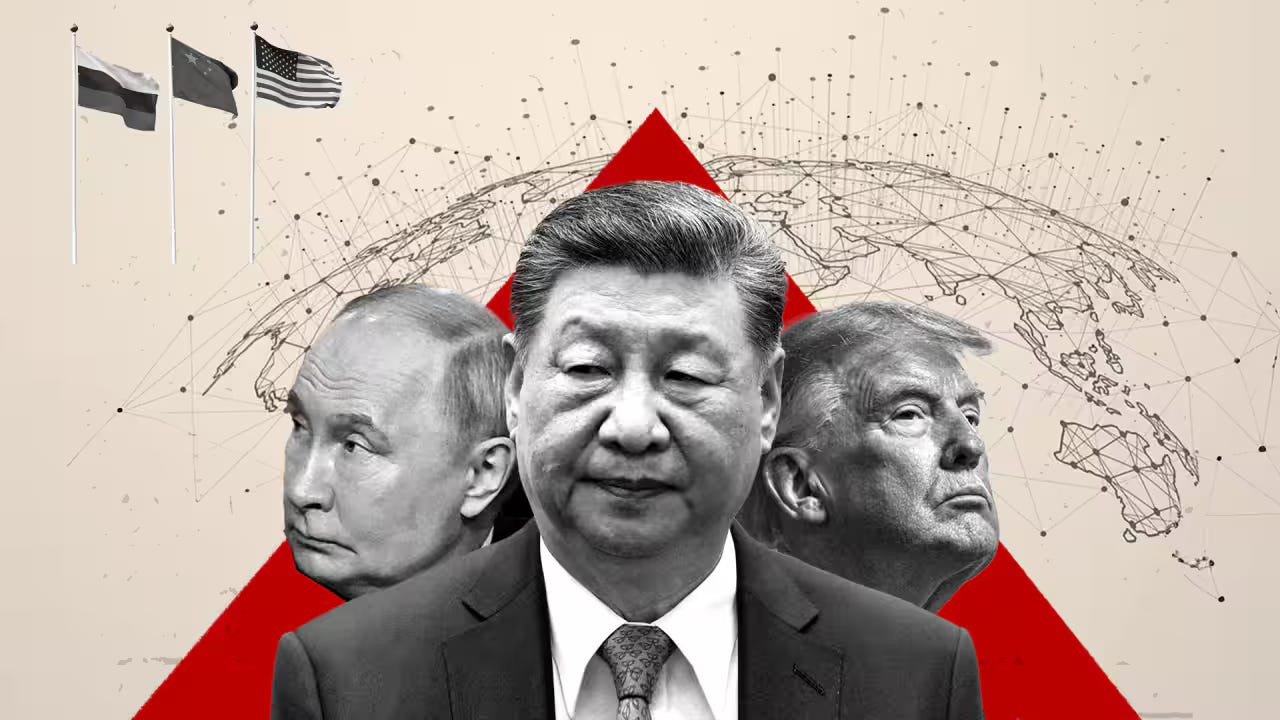
From the marshy northwestern edge of Hong Kong, across the narrow gray water of Shenzhen Bay, the glass towers of Nanshan district rise out of a haze of subtropical humidity and container-port exhaust. Just inland from that skyline, tucked against the wooded shore of Xili Lake, sits Kylin Villa, a thirty-eight-hectare walled state guesthouse that Beijing built in 1997 to lodge the senior Communist Party cadres managing Britain’s departure from Hong Kong. Years earlier, Xi Jinping’s father, Xi Zhongxun, had walked these same Guangdong lowlands while helping sketch out the country’s first Special Economic Zone. On Thursday afternoon, November 19, 2026, three presidents stepped onto a stone pavilion on the villa’s manicured grounds to pose for a photograph. Xi Jinping took the center mark. Donald Trump stepped to his right, and Vladimir Putin stepped to his left.
Inside the main reception hall, flanked by Communist Party General Office Director Cai Qi and Foreign Minister Wang Yi, Xi chaired an eighty-to-ninety-minute meeting with his American and Russian counterparts. No three presidents of the United States, Russia, and China had ever sat together in a formal trilateral summit. By Friday afternoon, White House aides were pushing the stopover across cable television as a triumph of personal statecraft, while Trump called the visit “one of the most successful presidential visits to Asia in American history” and told traveling correspondents that the three men were “really making history.”
Even the title of the four-paragraph communique they released afterward betrayed a petty tug-of-war over precedence. The White House distributed the document as the U.S.-Russia-China Heads of State Declaration toward Peace, while China’s Ministry of Foreign Affairs wired the identical text to world newsrooms as the China-Russia-U.S. Heads of State Declaration toward Peace.
Read past the header, and the prose dissolves into carefully engineered air. Speaking as permanent members of the United Nations Security Council, the three leaders pledged to reform the United Nations without naming a single charter revision, veto curb, or candidate for a permanent seat. They promised to expand the production and supply of refined petroleum products and safeguard energy corridors without committing a single refinery, tanker lane, or national export quota. They dusted off the Reagan-era maxim that a nuclear war cannot be won and must never be fought, pairing it with a vague nod toward non-binding talks on nuclear risk reduction. Only in the third paragraph did the document suddenly grow teeth: the three presidents declared that state consent and the immunities of state officials stand above external judicial reach, warning the International Criminal Court and similar bodies to stop abusing their jurisdiction.
Ukraine never appeared in the four paragraphs, though Chinese Foreign Ministry officials later confirmed the leaders discussed the war behind closed doors. America’s nine-month war against Iran never appeared in the text. Semiconductor export controls and artificial intelligence were omitted altogether.
No binding treaty came out of Kylin Villa because the photograph did the work of a treaty. Washington arrived politically bruised by an electoral blowout at home, militarily bogged down in the Persian Gulf, and visibly eager for outside diplomatic help. Moscow walked back into the inner circle of global superpowers without yielding a trench in eastern Ukraine. Beijing sat in the middle chair, inside a compound erected to mark the end of British imperial rule over Hong Kong, running the schedule with the unhurried ease of a host whose guests needed his drawing room far more than he needed their blessing.
Sixteen days before Air Force One touched down in Guangdong, voters in northern Maine sent a former logging truck driver named Troy Jackson to the United States Senate, ending thirty years of Susan Collins with 53.1 percent of the vote. That same Tuesday night, November 3, a Methodist pastor in Kansas, Reverend Adam Hamilton, pulled thousands of exhausted rural and suburban Republicans across the ballot line to unseat Roger Marshall at 51.2 percent. Those two races set the tone for a national routing that stripped Republicans of both chambers of Congress ahead of the January 3, 2027 swearing-in.
By the time the counting slowed, Democrats had turned a 53-to-47 Republican Senate into a 56-to-44 Democratic caucus, winning fifty-four Democratic seats outright alongside two allied independents and flipping nine Republican states without losing an incumbent of their own. In Texas, James Talarico defeated Attorney General Ken Paxton with 55.1 percent of the vote. Ohio voters returned Sherrod Brown to Washington over appointed incumbent Jon Husted, while additional Senate seats fell in Iowa, North Carolina, South Carolina, Mississippi, and Alaska. The House floor caved in at the same pace, stranding Republicans near 173 seats as challengers cleared out incumbents from Pennsylvania to Michigan: Janelle Stelson ousting Scott Perry in Pennsylvania’s tenth district, Cait Conley beating Mike Lawler in New York’s seventeenth, Christina Bohannan overtaking Mariannette Miller-Meeks in Iowa’s first, Elaine Luria reclaiming Virginia’s second from Jen Kiggans, and Christina Hines flipping Michigan’s tenth.
Nobody in Beijing or Moscow had to squint at the exit polls to read what had happened. Eighteen months of historic Medicaid cuts, sweeping tariffs that pushed up grocery and appliance bills, and a Department of Government Efficiency purge that threw more than 260,000 federal civil servants out of work had collided with four-dollar gasoline brought on by a naval war in the Persian Gulf.
The morning after Election Day, Vice President JD Vance said out loud what every Republican strategist was muttering privately: the war against Iran had cost them Congress. When Xi Jinping and Vladimir Putin shook Trump’s hand at Kylin Villa two weeks later, they were greeting a lame-duck executive staring down hostile Democratic subpoena dockets seven weeks away.
Even the unilateral trade hammer Trump had swung across 2025 was gone from his briefcase. Nine months earlier, on February 20, 2026, the United States Supreme Court had ruled six-to-three in Learning Resources v. Trump that the International Emergency Economic Powers Act gives the president zero authority to levy tariffs. That verdict wiped out both the fentanyl-linked duties placed on China, Canada, and Mexico and the reciprocal tariffs slapped across global trading partners. Four days later, U.S. Customs and Border Protection halted collections entirely, opening an estimated $166 billion customs refund pool for corporate importers and sending Treasury lawyers scrambling into narrower, slower trade statutes.
All that remained on the U.S.-China trade docket by November was a fragile truce cobbled together after earlier talks in Busan, carrying an expiration date of January 10, 2027. Look closely at the administrative filings both capitals issued in the run-up to Shenzhen, and the asymmetry jumps off the page. On November 6, the Office of the United States Trade Representative formally extended 178 Section 301 product exclusions alongside the suspension of Section 301 maritime logistics and shipbuilding port fees under Section 307(a)(2) of the Trade Act of 1974 through January 9, 2027. Three days later, the Bureau of Industry and Security published a final rule in the Federal Register extending the suspension of its export-control affiliates rule through January 10, 2027. Washington put every piece of its forbearance into binding domestic law before the president boarded his plane.
Beijing played a quieter hand. On November 9, China’s State Council Tariff Commission announced that it would keep suspending its 24 percent additional retaliatory tariff on American goods while leaving its baseline 10 percent duty intact for two months. Yet Chinese regulators deliberately declined to amend the domestic legal texts governing their sharpest industrial chokepoints. Announcement 70, covering Beijing’s October 2025 export controls over rare-earth minerals vital to American defense contractors and electric-vehicle motors, and Announcement 72, governing end-user reviews on graphite shipments, kept their original November 10 and November 27, 2026 dates on paper. China renewed the truce in diplomatic statements while leaving its mineral levers legally cocked, ensuring that American manufacturers and Treasury officials walked into Kylin Villa knowing Beijing could tighten the vise without drafting a fresh decree.
Four thousand miles west of Shenzhen, twenty-one United States Navy warships have been steaming in punishing circles since direct American and Israeli hostilities against Iran opened on February 28, 2026. Their assignment is a maritime blockade of Iranian ports while commercial oil tankers and container vessels inch through a contested Strait of Hormuz corridor under Islamic Revolutionary Guard Corps Navy coordination. Before the February strikes, roughly a quarter of the world’s seaborne crude and a fifth of global liquefied natural gas passed through that narrow neck of water. Within weeks, Iranian coastal batteries, drones, and boarding teams turned the strait into a live-fire lane, damaging or seizing dozens of merchant hulls and driving marine war-risk insurance premiums sharply higher in London and Singapore.
Efforts to locate an exit ramp broke down over Washington’s own red lines. On April 11 and 12, Pakistani mediators convened emergency indirect talks at the Serena Hotel in Islamabad, putting Vice President JD Vance and Iranian Foreign Minister Abbas Araghchi in separate wings while Pakistani diplomats walked drafts of a ten-point regional stability plan back and forth down the carpeted corridors. Tehran insisted that any durable truce cover Israeli military operations in Lebanon. Washington refused, protecting Israel’s operational freedom along its northern front, and the delegates flew home empty-handed.
Sixteen days later, the Gulf energy order cracked in public. On April 28, the United Arab Emirates stunned oil traders by announcing its withdrawal from both OPEC and OPEC+ effective May 1, ending nearly sixty years inside the cartel. Friction between Abu Dhabi and Riyadh had been building for years: the Emirates had poured $145 billion into expanding crude production capacity toward five million barrels a day by 2027 while OPEC quotas held output near 3.2 million barrels. The Iran war snapped whatever patience remained. After Iranian missiles and drones struck Abu Dhabi’s export facilities at Fujairah on the Gulf of Oman, injuring civilians and setting a refinery ablaze, UAE Energy Minister Suhail Al Mazrouei walked the Emirates out of an organization it still shared with Tehran. Within weeks, refined diesel stockpiles tightened across South and Southeast Asia, freight surcharges rose across the Indian Ocean, and regional commercial ports began absorbing chaotic cargo rerouting.
Nine months into the bombardment and blockade, the White House still had no way out of the Persian Gulf. Stepping away from Kylin Villa to speak with NBC News, Trump volunteered that Xi and Putin “would like to see it end with Iran, and they’re letting Iran know that in the strongest of terms.”
In February, Washington launched unilateral strikes across the Persian Gulf without consulting Beijing or Moscow. In November, the American president flew to southern China and looked to his two chief rivals to lean on Tehran for relief.
Washington’s strongest commercial hold over China, its grip on frontier artificial-intelligence semiconductors, arrived in Guangdong battered by counterintelligence leaks and corporate governance farce. Seven days before the trilateral summit, on November 12, Nvidia co-founder and chief executive Jensen Huang abruptly resigned from the four-trillion-dollar chipmaker. His exit followed an October 29 New York Times investigation detailing classified counterintelligence surveillance of his relationship with an executive tied to Megaspeed, a Singapore data-center intermediary suspected by U.S. officials of diverting $4 billion worth of restricted Nvidia processors toward Chinese cloud clients. Markets erased nearly half a trillion dollars from Nvidia’s valuation in five trading days. Chief Financial Officer Colette Kress took over as interim chief executive, and longtime director Harvey C. Jones stepped into the newly created post of board chair.
The calendar behind that leak pointed straight to bureaucratic knife-fighting inside Washington’s own national-security agencies. The Times story dropped five days before the November 3 midterms and twenty days before APEC convened in Shenzhen. Speaking on The Daily on November 10 and Hard Fork on November 12, the paper’s reporters noted that their original October 2025 coverage of Megaspeed had grown out of a tip from a tech-industry source, even though the Commerce Department’s own export-control probe had been running for a full twelve months before that article ever appeared. Executive-branch officials had sat quietly on classified surveillance of Huang for more than a year while he walked in and out of the White House negotiating chip-licensing terms, then handed the file to national-security reporters the moment the political calendar turned.
Twenty-four hours after Huang resigned, federal ethics disclosures landed with another jolt: Trump had executed fifty-three personal Nvidia stock trades across 2025 and 2026, while Nvidia had chipped in $25 million toward his White House ballroom renovation. Incoming Democratic committee chairs received a ready-made subpoena roadmap for January, and House Foreign Affairs Committee Chairman Brian Mast warned publicly that Huang faced closed-door congressional testimony over export controls. Trump touched down in Shenzhen deprived of his chief corporate intermediary with Beijing, presiding over an openly divided cabinet, and holding no coherent negotiating brief on silicon exports.
Then came the reversal that made Washington’s industrial strategy look like improv theater. Back at the White House on November 20, Trump mused aloud during a press conference that Nvidia, “if they were smart,” would accept an apology from Huang and bring him back. Three days later, on Monday morning, November 23, Nvidia’s board did a complete about-face. Having rejected Huang’s earlier pitch to return, board chair Harvey C. Jones announced that directors had unanimously reinstated Huang as president, chief executive, and board member, sending Kress back to finance after senior U.S. officials signaled that his return posed no national-security threat. Purging the architect of America’s computing monopoly via leaked intelligence a week before a summit with China, absorbing a half-trillion-dollar equity wipeout, and undoing the whole episode four days after the president flew home told every trade minister in Asia how steady American policy had become.
Inside Kylin Villa, Trump’s personal bearing matched the drift back home. Greeting Putin ahead of their bilateral talk, their first face-to-face meeting since August 2025, Trump beamed for the lenses and said, “Who’s he? He’s my friend,” promising that “a lot of wonderful things can come of this.” Turning to Xi, he offered a personal pledge pitched for television rather than diplomacy: “As long as you and I are in charge of things, we’re never going to have a problem.” Back in Washington on November 20, he casually informed reporters that he had not known the Shenzhen gathering was the first trilateral meeting of American, Russian, and Chinese presidents until journalists reported it.
On November 18, the afternoon before the three presidents sat down together, Evgeny Popov, a Rossiya 1 host and State Duma lawmaker, pointed a camera at a uniformed Russian naval aide striding briskly through the Shenzhen summit complex. In the officer’s hand swung a heavy black leather case: Putin’s Cheget nuclear launch terminal. Asked on camera whether he was carrying the button wired to Russia’s strategic arsenal, the officer grinned and confirmed it. Popov posted the clip to Telegram under a dry one-liner: “The nuclear button is on a business trip, too.”
That same week, Moscow flew two nuclear-capable strategic bombers into Vietnam, forcing Japanese and South Korean air-defense commands to scramble interceptor squadrons over international waters bordering the South China Sea.
For four years, Western strategy toward Russia had hinged on a single bet: treat Moscow as a permanent quarantine zone, bleed its army across the Ukrainian steppe, lock its president out of major economic forums, and let the March 2023 International Criminal Court arrest warrant shadow his every step abroad. Putin had not attended an APEC leaders’ summit since 2017. Ninety minutes inside Kylin Villa erased four years of isolation.
Washington think tanks have spent years describing Russia as a sanctions-hollowed petrostate overshadowed by American capital markets and Chinese factories. Federation of American Scientists tallies tell a blunter story: Moscow holds 5,420 nuclear warheads, compared to 5,042 in the United States arsenal and roughly 620 in China’s stockpile. Walking the Cheget across a Guangdong resort while flying strategic bombers along the South China Sea rim reminded every defense ministry from Tokyo to Warsaw that military endurance and nuclear parity still purchase an equal chair beside Washington and Beijing.
Putin’s richest prize sat in black and white inside the third paragraph of the Shenzhen declaration. All three presidents endorsed state consent and the official immunities of state leaders, joining together to warn that the International Criminal Court and similar tribunals must stop abusing their jurisdiction.
Rewind three years to appreciate the wreckage buried inside that single sentence. In March 2023, officials across Washington hailed the Hague’s warrant for Putin as proof that international criminal law could reach the Kremlin. Months later, when the exact same court moved to prosecute Israeli officials over the siege and bombardment of Gaza, both parties in Washington turned on the tribunal in fury, threatening ICC judges, prosecutors, and their families with financial sanctions and visa bans to shield Prime Minister Benjamin Netanyahu. In Shenzhen, Putin stepped straight through the crater Washington itself had blasted through the Rome Statute. Persuading a sitting American president to co-sign a trilateral condemnation of the ICC beside the very Russian leader the court seeks to arrest gave Moscow a formal superpower seal of official impunity.
And Putin traded nothing on the ground to get it. While American envoys Jared Kushner and Steve Witkoff flew to Berlin, where German Chancellor Friedrich Merz hosted Ukrainian President Volodymyr Zelenskyy and European governments inside the “Coalition of the Willing” to pledge seventy billion euros in continued backing, Putin sat across from Trump for forty-two minutes in Shenzhen and turned down a ceasefire on the spot. Asked by reporters in Guangdong about a third Ukrainian strike in a single week against the Kerch Bridge linking Crimea to Russia, Putin promised a “far more painful” response and declared that Moscow was dropping any moratorium on strikes against Ukrainian energy grids and maritime shipping. Ukraine disappeared from the Shenzhen communique completely.
Hours after Putin’s Ilyushin jet climbed out of southern China, Russian drones and ballistic missiles slammed into bridges across Kyiv and Zaporizhzhia. Even as smoke drifted over the Ukrainian capital on Thursday afternoon, Trump placed an unscheduled call from the air to European leaders, insisting Putin was serious about negotiating peace, blaming the bloodshed on “tremendous hatred” between Zelenskyy and Putin, and urging Europe to shut off its financial lifeline to Kyiv.
Europe’s capitals watched the footage from Guangdong without illusions. Looking at video of Putin smiling beside Trump, Danish Prime Minister Mette Frederiksen said flatly, “He looks happy,” calling the encounter “very incomprehensible” and warning that it would embolden Russian military operations. Polish Prime Minister Donald Tusk answered Trump’s warm greeting word for word, stating that “Mr. Putin is not our friend and will never be,” before posting four words on X: “God, protect us from such friends.” Ukrainian Foreign Minister Andrii Sybiha offered the wry consolation that “Shenzhen is not the Yalta of Putin’s dreams,” echoing commentators in Washington who pointed out that no signed map divided Eastern Europe into spheres of influence. Moscow needed no partition map drafted in Guangdong. Sitting as a co-equal inside a three-power directorate while NATO allies waited outside the courtyard restored Russia to the superpower circle on Russian terms.
Forty-five years ago, Shenzhen was a scatter of Bao’an County rice paddies, oyster beds, and fishing jetties looking across the guarded water of the Sham Chun River at British Hong Kong. When Deng Xiaoping designated those coastal flats China’s first Special Economic Zone in 1980, backed in Guangdong by Xi Zhongxun, Western bankers dismissed the venture as a provincial curiosity. Today the corporate headquarters of BYD, Huawei, DJI, and Tencent sit within forty minutes of Kylin Villa, anchoring global supply chains for electric vehicles, fifth-generation telecoms, commercial drones, and industrial robotics inside a metropolitan corridor whose economic output rivals major European countries. Summoning the American and Russian presidents to sit on either side of Xi Jinping inside a guesthouse built for Britain’s 1997 retreat from Hong Kong required no lecture about the century of humiliation. The skyline outside the glass did the talking.
Over forty-eight hours, Xi ran a clinic in diplomatic arbitrage. On Wednesday, November 18, he spent two private hours with Putin, roughly their fiftieth bilateral meeting since 2013, aligning their speeches around a multipolar order and denouncing unilateral Western sanctions as relics of fading hegemony. Twenty-four hours later, during the official APEC leaders’ photograph and state banquet, Xi placed Trump directly at his right hand in the seat of highest ceremonial honor while placing Putin at a separate table. Then, the moment the Kylin Villa trilateral broke up, Kremlin pool cameras caught Xi walking Putin down the pavilion steps to his waiting limousine, clasping his hand beside the car door as Putin beamed and said, “I don’t think anyone even expected things to go so well.”
Conservative commentators in Washington, among them Heritage Foundation vice president Victoria Coates, seized on the banquet seating chart as evidence that Xi had treated Putin as a “junior person.” That reading confused seating cards with strategy. Xi managed both visitors on separate tracks at once. He gave Trump televised deference to keep the bilateral trade pause breathing past January 10, while handing Putin private alignment, visible personal warmth at the limousine door, and a trilateral platform that shattered four years of Western quarantine. Any lingering dream in Washington of pulling off a “reverse Nixon” maneuver to wedge Moscow away from Beijing expired on the driveway of Kylin Villa.
What Beijing kept off the agenda mattered just as much as the choreography. Since 2019, successive American administrations have tried to haul China into trilateral arms-control negotiations meant to freeze Beijing’s nuclear arsenal far below American and Russian ceilings. With New START dead since February 2026 and Pentagon assessments projecting that China could grow toward 1,500 warheads by 2035, Beijing refused every inspection rule, warhead cap, and calendar deadline. Xi handed Trump the harmless phrase “dialogue on reducing nuclear risks,” carrying zero enforceable limits and zero verification machinery. As Council on Foreign Relations analysts noted after the talks, Beijing and Moscow share a concrete interest in keeping non-binding risk talks alive: discouraging American allies such as Germany, Japan, Poland, and South Korea from building independent nuclear weapons as faith in Washington’s security umbrella wears thin.
The energy clause worked with the same quiet economy. Signing onto a general promise to boost refined fuel supply and keep maritime lanes open calmed acute diesel jitters across Southeast Asia triggered by Washington’s Gulf blockade, reassured ASEAN capitals that they need not pick a military camp, and left China’s state refining export quotas for 2027 untouched under Beijing’s sovereign control. On Ukraine and Iran, Xi declined to spend Chinese diplomatic capital brokering settlements for wars Beijing never started. He offered four polite principles of mutual respect, peaceful coexistence, mutually beneficial cooperation, and dialogue, left Washington and Moscow to carry their own wars of attrition, and kept China’s commercial ties with Europe, the Gulf, and Russia intact.
Step outside Kylin Villa onto the main APEC floor, and Beijing’s command of regional institutions comes into sharper focus. While cable panels in New York dissected Trump’s jokes and handshakes, Chinese diplomats guided twenty-one Pacific economies into adopting the Shenzhen Outlook along with three annexes covering trade, connectivity, and innovation. Those agreements locked in the APEC Trade Digitalization Framework running from 2027 to 2030 and an upgraded APEC Connectivity Blueprint tying cross-border power grids, pipelines, and submarine telecommunications cables directly to Asia’s surging artificial-intelligence compute demand. Beijing backed the institutional buildout with a $20 million pledge, opened the Center for Asia-Pacific Community Studies in Shenzhen, launched the World Association for Bay Areas, and handed the 2027 APEC chairmanship smoothly to Vietnam under President To Lam.
Along the conference corridors, bilateral business moved briskly while Washington argued over leaked chip probes back home. South Korean President Lee Jae-myung met Xi and substantially wrapped up follow-up Free Trade Agreement talks on services and investment. Delegations from Canada, Chile, and the Philippines signed fresh trade accords on the sidelines. Japanese Prime Minister Sanae Takaichi used her Shenzhen trip to publicly reaffirm that Tokyo’s policy on Taiwan remains unchanged and consistent with the 1972 Japan-China Joint Communique, seven days after Xi stood at a Beijing ceremony marking the 160th anniversary of Dr. Sun Yat-sen and declared that China’s complete reunification with Taiwan cannot be stopped.
Even Washington’s loudest decoupling hawks run headlong into the customs ledger. Bilateral goods trade between the United States and China reached $473.7 billion over the first three quarters of 2026, while American direct investment inside China climbed 7.7 percent year-on-year. Beijing avoids foreign wars to reorganize the Pacific basin. It runs the factories, finances the ports, refines the diesel, drafts the digital customs rules, and chairs the room.
The diplomatic calendar now turns toward South Florida, where Trump plans to host the G20 leaders’ summit at his Miami Doral resort on December 14 and 15. Xi Jinping is expected to fly in, and Putin told reporters in Shenzhen that Trump reiterated his invitation twice during their Guangdong talks, once during their bilateral session and again as the trilateral adjourned. Nineteen days after Doral wraps up, the 120th Congress takes the oath under Democratic majorities on January 3, 2027. Seven days later, on January 10, the U.S.-China trade truce expires.
Across Washington’s foreign-policy establishment, columnists and former cabinet officials are already comforting themselves with the belief that incoming Democratic control of Congress will steady the ship, rebuild transatlantic nerve, and restore American primacy.
That hope ignores how thoroughly Washington’s own bipartisan cartel built the exhaustion on display at Kylin Villa. Weeks before a single midterm ballot was cast, incoming House Intelligence Committee Chairman Jim Himes stood before European defense officials at the Warsaw Security Forum on October 13 and promised that Democratic majorities would attach tens of billions of dollars in fresh weaponry for Ukraine to must-pass government funding bills, locking Washington deeper into an unwinnable European war of attrition. In the same breath, Himes offered Europeans a candid reality check, warning that American voters were poised to punish Trump over groceries and the Middle Eastern war rather than over Russia.
Even inside the incoming fifty-six-seat Senate Democratic caucus, the institutional guardians of America’s permanent war economy hold the levers tight. Ahead of a December 1 secret-ballot leadership vote pitting longtime Senate leader Chuck Schumer against challenger Chris Van Hollen of Maryland, incoming progressives such as Abdul El-Sayed of Michigan and Peggy Flanagan of Minnesota lined up behind Van Hollen, while Kansas Senator-elect Adam Hamilton signaled he would withhold support from Schumer. Yet Schumer walks into that closed-door ballot backed by returning Ohio Senator-elect Sherrod Brown and armed with command over the Senate Democrats’ national campaign spending apparatus, which recruited and financed much of the incoming class.
Alongside House Democratic leader Hakeem Jeffries, Schumer protects the $900 billion Pentagon budget, corporate defense donor networks, and unconditional munitions pipelines to Tel Aviv. Roughly half of American midterm voters now tell exit pollsters that U.S. military and diplomatic support for Israel is too strong, a jump of nearly twenty percentage points since 2024. Even after AIPAC’s super PAC, the United Democracy Project, burned through $42 million in Michigan alone trying unsuccessfully to stop Abdul El-Sayed’s Senate victory, congressional Democratic leadership holds neither the unity nor the desire to defund the twenty-one Navy warships policing Iranian ports or to attach conditions to weapons bound for Israel.
Washington’s two parties divide imperial labor smoothly across election cycles. Republicans swing the battering ram, launching unilateral strikes in the Persian Gulf, smashing international courts, and opening new theaters of conflict. Democrats arrive as the institutional shock absorber, wrapping the inherited wreckage in the language of deterrence and folding tens of billions in war appropriations into domestic spending bills so the machinery never cools down. Whether red or blue majorities hold the congressional gavel, the American state keeps burning its treasury, industrial base, and naval bandwidth across two simultaneous theaters while domestic infrastructure and public consent fray at home.
Both Xi Jinping and Vladimir Putin read that structural trap far more accurately than Washington’s ruling class does. Moscow discovered that a nuclear power willing to absorb sanctions and battlefield attrition can outwait Western quarantine, fly strategic bombers along the South China Sea, and watch an exhausted American president co-sign a joint repudiation of the Hague. Beijing discovered something even more durable: an overextended rival fighting maritime blockades in the Persian Gulf, bankrolling attrition warfare across Eastern Europe, and tearing itself apart in biennial midterm purges will eventually fly across the Pacific to Guangdong, take the guest seat beside the Chinese chairman, and ask for help containing the fires.
When historians reconstruct that humid afternoon inside Kylin Villa, they will spend very little effort parsing the four paragraphs of diplomatic prose, because the photograph settled the century’s ledger: all three signatories buried the post-1945 legal order together in paragraph three, Russia reclaimed its chair among the great powers by refusing to fold, China took the geometric center of the board solvent and unhurried, and the United States sat politely to the host’s right without the gavel.