


Palantir accelerated the target list, Anthropic placed Claude inside the system, and American officials removed the safeguards before approving the coordinates of a primary school.
Two days before the missiles, Hamed turned seven. His aunt, Safoora Pari Taghinejad, had bought him and his ten-year-old brother Hani matching Real Madrid shirts because both boys loved football. On the morning of February 28, she bathed them, helped them into new clothes and watched them run out of the house in such a hurry that neither child stopped to say goodbye. Hamed’s body was recovered that night. It took three days to find Hani.
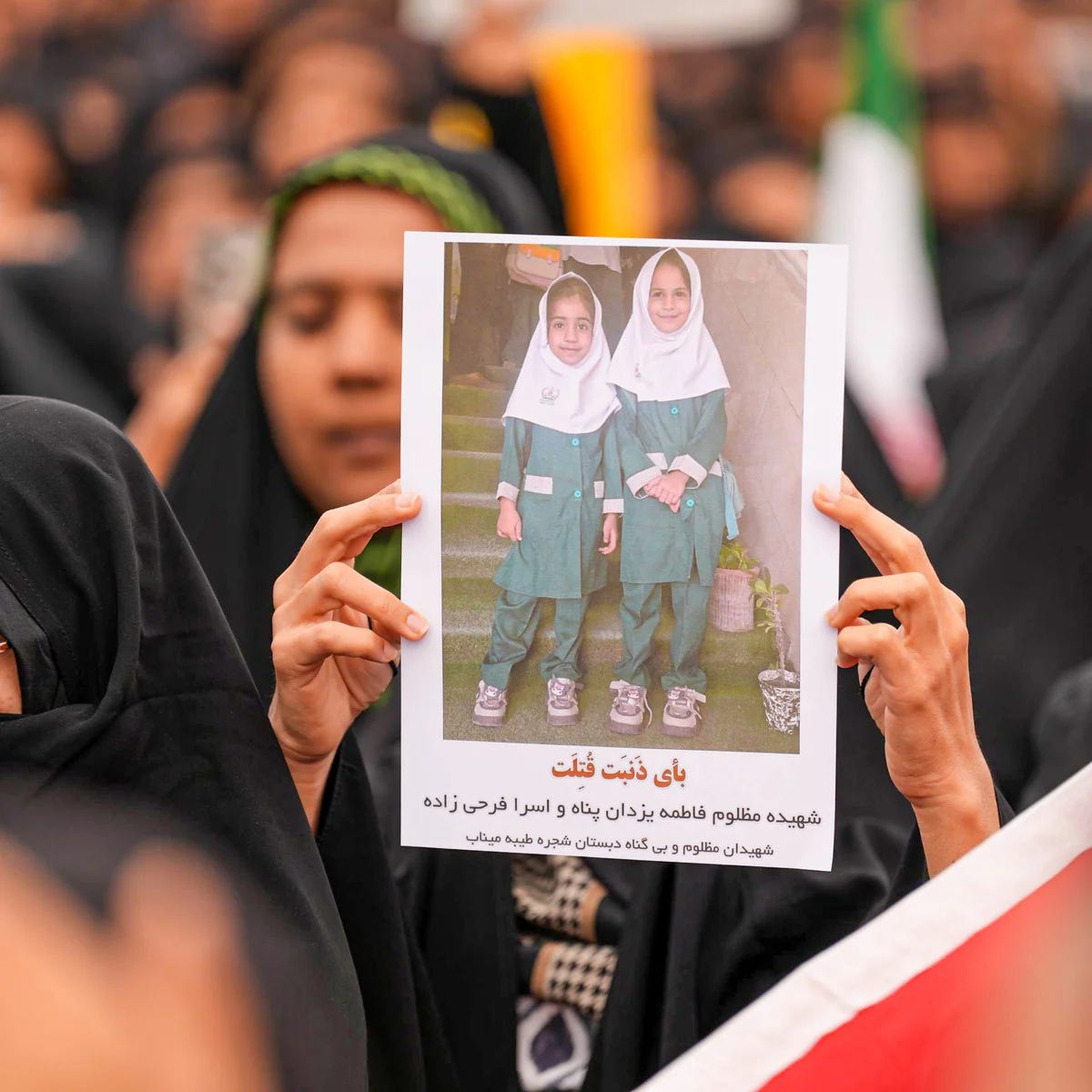
The boys were among the children killed at Shajareh Tayyebeh Primary School in Minab, a southern Iranian city close to the Strait of Hormuz. El País reported that Hani wanted to become a famous footballer. The detail belongs here because the Pentagon file did not contain it. The target list had a military classification, a location, an operational value and a recommendation generated through a system built to move faster than the people reviewing it. It had no field for a boy who wanted to play for Real Madrid.
At about 10 a.m., staff began calling families to collect their children after word spread that the United States and Israel had opened their attack on Iran. Some parents lived in Minab and could move quickly. Others had sent their children from nearby villages, where a car had to be found and the drive took longer. Teachers stayed with the pupils whose families had not arrived. Most of those teachers were killed.
One of the survivors, first-grade teacher Amaineh Nademi, had five children left in her upstairs classroom when the school was hit. The blast threw the teacher and pupils across the room. Smoke covered the corridor. Nademi told the BBC that when she could see again, she passed injured children down to people below and climbed through fire and rubble towards the gate. Parents were running towards her, some without shoes. In the confusion she thought everyone else had escaped, and only later understood that most of the school was under the concrete.
Eleven-year-old Reyhandeh Mehdi Khah escaped from the second floor through an opening in the wreckage. Her face had been cut open. Hours later, she learned that her younger sister, a first-year pupil, had died. When PBS NewsHour visited Minab, Reyhandeh said she hated what the American government had done but did not hate the American people. She assumed ordinary Americans would know that killing children in a school was wrong. That is the faith the rest of this article asks you to deserve.
Two Tomahawk missiles hit the school building and its grounds. More than 150 people were killed, including at least 123 children, according to the Pentagon investigation described by Bloomberg. The United Nations fact-finding mission worked from a separate body of evidence and confirmed at least 157 deaths, including 120 children and 26 members of staff, with 95 people wounded. The exact count remains disputed because the bodies, records and investigations do not align neatly after a school has been reduced to rubble. Every credible count establishes the central fact: the United States sent precision weapons into a primary school on the first morning of a war it had designed for speed.
Washington would now like you to look at the software, so look closely. Demand to know what Palantir’s Maven showed the targeters and what Anthropic’s Claude processed inside the platform, but do not let a technical inquiry perform a moral disappearance. A model did not decide to attack Iran, discard years of visible evidence, remove the civilian-harm staff, approve Minab, or launch the missiles. People made each decision, and those people have names, ranks, offices, salaries and security clearances.
The school was visible for eight years
On February 4, 2018, a commercial satellite photographed the Minab compound. The image showed brightly painted walls, a football pitch, lines for school assemblies and markings where children played. Separate walls and entrances divided the school from the adjoining property associated with the Islamic Revolutionary Guard Corps. Construction of the separation appears to have been completed by 2017. The school operated openly. Its address appeared on public websites. Parents knew where to take their children each morning, and delivery drivers, teachers and local officials knew what stood behind the gate, but the primary American military database still described the site as an IRGC facility.
An intelligence analyst noticed physical changes as early as 2019 and entered remarks into another system, according to officials interviewed by Bloomberg. That system was not connected to the main military intelligence database used for targeting. The observation existed and yet it could not reach the people who needed it, which is the kind of bureaucratic failure that sounds dull until two missiles are moving towards the consequences. Six years passed between the analyst’s warning and the strike. During those years, children entered the school, changed grades and moved through classrooms whose physical existence was visible to commercial satellites, while the American record stayed fixed on the military use that had preceded them.
As the United States prepared its opening attack on Iran, the old classification entered the Maven Smart System. Minab appeared as a recommended target for the first day. The target then passed through the American military’s kill chain, the sequence in which analysts, imagery specialists, targeteers, lawyers, commanders and weapons crews turn a place on a map into an approved act of violence. Each stage existed because killing the wrong people is easy when intelligence is incomplete. At Minab, all those stages produced approval.
The location beside an IRGC naval property will become the preferred escape route for everyone involved. Iran should answer for placing or maintaining a school next to a military installation, and people in Minab have said so themselves. Mostafa Salari, whose sister Mandana taught at the school and died there with her seven-year-old daughter Liana, told El País that he was furious with the United States for the strike and with Iranian authorities for allowing a school to operate in such a location. Both judgments can occupy the same sentence.
Proximity did not turn the school into a military target. Walls had separated the school from the IRGC property for almost a decade, recent images showed its civilian use, its address was public, children were inside during school hours, and yet the American process carried an obsolete label forward as if nothing on the ground could change once a database had spoken. The laws of war required the United States to verify the target with every feasible precaution, but the old file, which should have triggered a fresh review, was allowed to settle the question.
Maven compressed the error into minutes
Project Maven began in April 2017 as a Pentagon effort to use machine learning to process surveillance video. The military was collecting more images than human analysts could review, and software promised to find vehicles, objects and activity across that expanding field of vision. Thousands of Google employees objected to their company’s role and Google declined to pursue a follow-on contract, but the project moved deeper into the defence establishment and, under Palantir, grew into a system for fusing intelligence, coordinating operations and supporting target development.
Maven now draws from more than 150 data inputs. It can place satellite images, surveillance feeds, signals, locations, intelligence reports, legal material and operational plans into a common interface. A commander looking at the screen sees coherence where the underlying agencies and databases remain fragmented. That appearance is the product. It saves time, reduces staff work and makes a sprawling military bureaucracy feel as responsive as the software companies selling to it.
In its investor material, Palantir celebrated an Army targeting cell that used Maven to match the performance of an Operation Iraqi Freedom cell with about twenty people instead of more than two thousand. The company also cited the Army’s ambition to make one thousand “high-quality decisions” in one hour. The Pentagon raised Maven’s contract ceiling to nearly $1.3 billion through 2029 because demand across the services was growing.
One thousand decisions in an hour sounds impressive until you place one school inside the number. Real target work is distributed across people and processes rather than completed one decision at a time, but the boast still states the ambition: Palantir was selling a military that could move at software speed, and the Pentagon wanted the volume.
Before the Iran attack, staff work on proposed target lists that once took hours was compressed into minutes through Maven, officials involved in the Pentagon review told Bloomberg. Some Central Command personnel expected the platform to identify stale information or contradictions in the underlying intelligence. Bloomberg could not establish why they believed it would perform that task. Palantir later said identifying intelligence deficiencies was not its responsibility.
The military relied on Maven to bring scattered intelligence into one place, some personnel assumed it would warn them when the intelligence was old, Palantir says the system had no responsibility to do that, and the target list moved from hours to minutes. An officer did not need a direct order to ignore the 2018 satellite image because the process delivered the old answer cleanly, quickly and with the authority of a billion-dollar interface.
Anthropic’s Claude provided language-model functions inside Maven. We do not know what Claude did with the Minab file. Anthropic chief executive Dario Amodei has said he does not know how the model was used in the strike, and no public document shows Claude identifying the school, selecting coordinates or recommending a munition. Anyone claiming that Claude independently chose Minab is moving beyond the available evidence.
Anthropic remains responsible for putting its model inside a classified military system that supports targeting and accepting payment for the access. The company has built its identity around safety, model control and a willingness to refuse dangerous uses. Those promises must be tested inside Maven during a live war, where the risk is greatest, rather than on a public chatbot declining a violent request in front of a user.
Anthropic cannot enforce limits on a use it cannot see, while any access the company does retain should place the relevant inputs, outputs, warnings and contract terms within reach of Congress. Amodei’s professed lack of knowledge describes a commercial arrangement in which a company supplies intelligence to a kill chain and loses sight of what happens next.
The question is larger than whether Claude produced a sentence that mentioned Minab. Automation changes human behaviour before it replaces a human decision. A clean interface encourages confidence. A ranked list creates an order that feels assessed even when the data beneath it is old. A recommendation acquires weight because reversing it requires someone to slow the process, find the source material, challenge colleagues and explain why a system purchased to accelerate operations should be distrusted at the precise moment its speed is most valued.
“Human in the loop” becomes a slogan when the institution removes the time, staff and incentives required for independent judgment. By the time an officer clicks approve, the target has already arrived with a military classification, an operational rationale, software support and the pressure of an opening attack in which surprise depends on volume. The person remains inside a loop built to keep moving.
Minab therefore requires more than a screenshot of the final approval. Investigators need to reconstruct what each person saw, how long they had to review it, which source records were available, whether Maven displayed the age of the underlying classification, whether anyone opened the recent imagery and which warnings the system was designed to produce. They also need the audit trail showing who changed, endorsed or passed the target. Without that record, “human control” gives the military a convenient last person to blame while the institutional choices that shaped the decision remain untouched.
Hegseth fired the people paid to question targets
The Pentagon knew that target databases become stale. It knew that civilians move, buildings change use, intelligence agencies fail to share information and commanders working under time pressure miss what looks obvious afterwards. Two decades of American strikes in Afghanistan, Iraq, Syria, Somalia and Yemen had supplied enough dead families to make the lesson impossible to plead as new.
In December 2023, the Defence Department issued Instruction 3000.17, which placed civilian-harm mitigation inside planning and operations. Specialist teams were supposed to examine assumptions, study civilian activity around proposed targets, advise commanders and investigate harm after a strike. The system was limited and it could not reverse the larger politics of American air power, but it created an office whose purpose was to ask the question an accelerated kill chain would prefer to skip.
Pete Hegseth cut most of it. Staffing across several civilian-harm teams fell by about 90 per cent to fewer than twenty people, according to officials with direct knowledge who spoke to Bloomberg. Central Command’s team went from ten people to one. The cuts were accompanied by a decision to keep the remaining specialists out of planning and operations. No civilian-harm specialist reviewed Minab before the strike.
Hegseth had spent years telling his audience that lawyers, restraint and rules of engagement prevented the American military from being lethal enough. Once in office, he converted the performance into policy. He weakened the staff trained to notice civilians and then presided over an opening attack whose target work had been compressed from hours into minutes. The database was old and the review was thin, and yet those conditions did not fall from the sky. They were built.
The arithmetic was always fraudulent. Cutting nine people from a ten-person team saves salaries and removes delay from a target process, but the saved minutes return as the hours Mohammadreza Ahmadi spent searching the ruins for his ten-year-old son Sobhan and seven-year-old daughter Hanieh, the three days Safoora’s family waited for searchers to find Hani, and the nights Red Crescent worker Reza Besharati could not sleep because he kept seeing the bodies he had lifted from the school.
Hegseth later promised a thorough investigation, and six months after the strike the Pentagon had not released the report. Washington advertised lethality, removed the staff associated with restraint, denied responsibility when children died and announced an inquiry whose answer remains secret, allowing the public to see the missile launch while accountability disappears behind national security.
The missile hit the coordinates it received
On September 17, the Independent International Fact-Finding Mission on Iran reported reasonable grounds to believe that the United States committed war crimes in two attacks on February 28: the strike on Shajareh Tayyebeh in Minab and another on a sports centre in Lamerd. The mission counted at least 177 civilian deaths across the two attacks.
For Minab, the investigators found that the school building was the intended point of impact. An American officer was not shown choosing children from a live image, but the missile reached the building it had been directed to hit. It did not veer away from the adjoining IRGC property and cause accidental collateral damage. The United States placed the school’s coordinates inside the weapon.
The mission found that American forces failed to take every feasible precaution to confirm that the target was military. Reliance on outdated information went beyond negligence. The attack on a civilian object without adequate verification, followed by the civilian deaths it caused, met the mission’s standard for the war crime of launching an indiscriminate attack.
“Reasonable grounds to believe” is the mission’s evidentiary standard. A criminal court would apply a higher standard and determine the guilt of named individuals. The mission found verified and corroborated information supporting the conclusion that a war crime occurred, which requires an investigation of the decision-makers, preservation of the material and independent scrutiny. Washington has answered by attacking the institution and withholding its own review, leaving the state accused of the crime in sole possession of much of the evidence required to test the accusation.
The compound was hit more than once. Associated Press analysis found that multiple munitions struck at least five buildings. The published Bloomberg and UN evidence does not establish the “triple tap” account circulating online, in which a timed third strike killed rescuers after two earlier impacts. That allegation needs evidence before publication. The verified account is already an indictment: multiple American munitions hit the compound, the school was an intended point of impact, and at least 120 children died there under the UN count.
Washington answered the UN with contempt. A State Department official said the United States gave the findings no credibility. White House spokesperson Anna Kelly called the Human Rights Council unserious and accused Iran of being the only party in the conflict that had committed war crimes. Neither statement addressed the satellite record, the analyst’s stranded warning, Maven’s role, the missing civilian-harm review, the multiple impacts or the Pentagon report that the administration continues to withhold.
Trump’s explanation moved before the evidence settled. He first blamed “Iran or somebody else,” although open-source work by the Associated Press, CNN, The New York Times and Bellingcat pointed to the United States, and later said “nobody” purposefully attacked the school. By naming nobody, Trump supplied a defendant who cannot be subpoenaed or ordered to produce emails, command records or contracts, turning an operation conducted by institutions full of paid adults into an event without an author.
International law refuses that trick. Responsibility attaches to the people who validate targets, approve strikes, issue orders and create conditions in which required precautions are discarded. Software can make the chain faster and more opaque. It can encourage automation bias and conceal the origin of an assessment behind an interface. Every one of those risks increases the duty of the human decision-maker. None transfers the duty to the machine.
The AI explanation is attractive because it distributes blame until nobody holds enough to face consequences. The Pentagon points to deficient data, Central Command to the interface, Palantir to government input and Anthropic to its lack of visibility, while the political leadership promises a software fix and praises the operation as a military success. Every participant keeps a small piece of the chain, and the families receive a story in which 123 children died through the accumulated action of systems without an accountable person anywhere inside them.
Palantir collected the contract and rejected the blame
Palantir told Bloomberg that it “is not responsible for the underlying data nor identifying intelligence deficiencies” and that no evidence showed Maven was at fault. The United States did control the target data and retained the final authority to strike. Palantir’s contractual defence still collides with its sales pitch.
The company markets Maven as the system that joins fragmented intelligence, improves decisions and allows forces to operate at greater speed. When the fragmentation produced a lethal contradiction, Palantir called the contradiction an input problem outside its responsibility. The company claims the value created by bringing the data together and disclaims the harm when the data should never have been trusted.
After Minab, Palantir added functions that recheck intelligence for facts that could disqualify a target and flag inconsistencies missed by human reviewers, Bloomberg reported. The change identifies a protection the earlier process lacked without proving that the software caused the strike. Palantir denied a duty to find intelligence deficiencies and then built a feature to find them after children had been killed, which is how the defence technology business converts a preventable death into the next capability sold to the government.
Alex Karp has spent years presenting Palantir as the technological brain of Western power. He told Time that advanced algorithmic warfare systems could provide an advantage comparable to tactical nuclear weapons against an adversary with conventional arms. In May 2025, he said American power should make adversaries wake in “moderate to extreme fear” and go to bed in the same condition. Karp has fashioned himself as a real-world Dr. Evil, except the performance ends whenever the bodies might enter the contract discussion.
Palantir tells investors and television audiences that its technology can transform war, then describes itself after Minab as a passive container for government data. Karp wants the strategic credit, the fear, the contract and the mythology of omniscience, and yet responsibility stops at the moment his product reaches the people it helped place on a target list.
Palantir chose to enter the kill chain, hired former senior military officials, built its software into classified environments and collected contracts on the promise that its platform would help the United States find, understand and strike its enemies faster. Legal responsibility will depend on evidence the Pentagon has withheld, while political and moral responsibility arrived with the cheque.
Anthropic fought the Pentagon over proposed limits on autonomous weapons and mass domestic surveillance, and those limits were worth defending. Their value now depends on whether the company can establish how Claude operated inside Maven during the first day of the Iran war. Safety must survive the customer, the contract and the moment a commander wants an answer in minutes.
The names missing from the target file
In September, Associated Press photographer Vahid Salemi returned to Shajareh Tayyebeh, which had become a place of mourning. Desks and chairs remained inside exposed classrooms, colourful trees and flowers still covered parts of the walls, and volunteers held up a child’s notebook and drawing stencil recovered from the debris. In a dim corridor, one small chair stood by itself.
At the cemetery, Fatemeh Barani mourned her daughter, Nasim Neyestani, a second-grade teacher killed in the strike. A separate part of the cemetery had been set aside for the school dead, where families arrived with photographs and women cleaned children’s graves. Months had passed, but volunteers were still searching the school because one child, Macan Nassari, had not been fully recovered. Each night, according to PBS, they sifted concrete and torn notebook pages for something his family could bury.
Calling Minab a “targeting error” removes the relationships that made each death a private catastrophe. Hamed was Safoora’s seven-year-old nephew and Hani wanted to play football; Zahra Behroozi was eight and filled her home with paper crafts; Arya Bahadori watched his mother bake and wrote the ingredients on notes so he could try the recipes himself. Sobhan Ahmadi had learned to speak after years of language therapy and attended school with his younger sister Hanieh, while Nasim Neyestani taught second grade and Amaineh Nademi had taught some of the dead when they were learning the alphabet. A target list placed all of them under one obsolete military label.
Their lives make the political argument exact. The United States built a system in which a school visible from space remained a military facility inside a database, a warning remained trapped in a separate network, a private platform compressed hours of review into minutes, civilian specialists were removed, and commanders approved the strike. The missiles did not know Hamed had just turned seven and the database did not know about the Real Madrid shirt, and yet the people responsible for verifying the target had every reason to know children were inside.
The Pentagon must release its review with only narrow redactions for current operational methods. Congress must obtain the February 28 target list, the complete Minab target package, every version of the site’s classification, the analyst’s 2019 remarks, the legal review, civilian-casualty estimates, strike authorisations, post-strike assessments and Maven audit logs. Hegseth must testify under oath about the staff cuts and the exclusion of the remaining civilian-harm specialists. Palantir and Anthropic executives must explain what their systems did, what their contracts allowed them to see and what changed after the strike.
The families must not be forced to accept an American administrative remedy in place of justice. They are owed the names of the officials who approved the target, compensation that does not require them to endorse Washington’s account, preservation of the evidence and American cooperation with the UN inquiry. If an official lied under oath, destroyed evidence or unlawfully withheld material, that official should be prosecuted.
Blame AI for making the chain faster, Palantir for selling the speed and Anthropic for placing Claude inside it, and then keep going: Trump ordered the war, Hegseth removed the staff paid to protect civilians, Central Command developed and approved the target, and American personnel launched the missiles. Human beings built the process, trusted it and used it against a school.