The Chokepoint Doctrine
How Washington Administers Global Subordination Through Controlled Energy Shocks
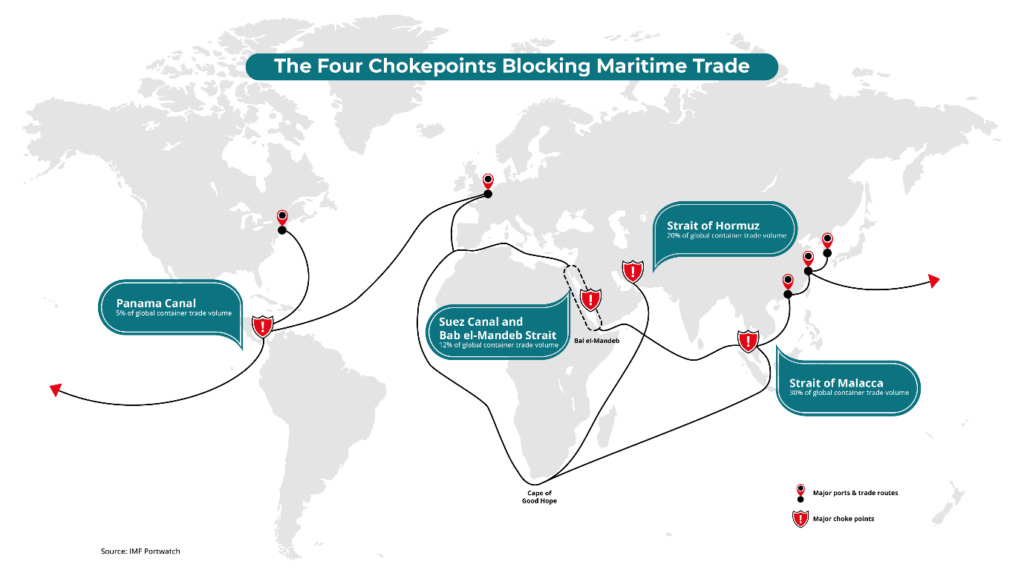
The Strait of Hormuz runs twenty-one miles at its narrowest, and through it, before February 2026, moved approximately 20 percent of the world’s seaborne oil, 20 percent of its liquefied natural gas, and more than 30 percent of its urea exports. China was receiving 37.7 percent of all crude and condensate that transited the strait. The United States was receiving 2.5 percent. A war that closes that passage is not the same war for both countries, and no serious analysis of Operation Epic Fury, launched on February 28, 2026, can begin without that arithmetic fixed in place.
Washington’s declared purpose was Iran’s nuclear and ballistic missile program, and its supreme leader’s life. What the war produces, in the energy markets that do not observe declarations of intent, is a different reckoning. It falls on Beijing, on Delhi, on Seoul, on Manila, on Colombo, and on every debt-distressed economy in the Global South that depends on Gulf oil it cannot store, cannot replace quickly, and cannot pay for in anything other than the dollars Washington issues. That distribution of consequence is not incidental to the strategy. Understanding why requires going back further than February 2026, and further than Ukraine in 2022. It requires reading what American strategists wrote down when they thought they were speaking among themselves.
The Foundational Text
Zbigniew Brzezinski published The Grand Chessboard in 1997, a decade after the Soviet collapse, and it remains the clearest statement of what American primacy actually requires once you strip away the democratic teleology. Eurasia, Brzezinski argued, carries approximately 75 percent of the world’s population, 60 percent of its gross national product, and 75 percent of its energy resources. Any power, or combination of powers, that consolidated control over that landmass would displace American primacy automatically, without firing a shot at the United States directly. The task of American strategy was therefore to prevent that consolidation, not through conquest, which is geographically impossible, but through control of the chokepoints, the financial architecture, and the alliance structures that determine how Eurasian energy moves and who profits from its movement.
The doctrine produces the disruption
Brzezinski was explicit about the threat scenario. “If the middle space rebuffs the West,” he wrote, “becomes an assertive single entity, and either gains control over the South or forms an alliance with the major Eastern actor, then America’s primacy in Eurasia shrinks dramatically.” Russia is the middle space. China is the major Eastern actor. The fear was precisely the alignment that has since materialized: a Sino-Russian axis managing the Eurasian landmass, with Iran as a connecting node between Russian resource networks in the north and Chinese energy dependency in the Gulf to the south. The playbook for preventing that alignment was already in the book: keep the chokepoints under American naval authority, keep European energy dependency oriented toward American suppliers rather than Russian ones, and ensure that no country integrating with the Russia-China economic space can do so without paying a price in energy security.
The Strait of Hormuz is the most consequential chokepoint in that architecture. The United States has maintained decisive naval dominance over it for half a century, justifying that dominance publicly as a guarantee of freedom of navigation for all parties, a global public good. What the 2026 crisis documents, with a clarity that previous administrations managed to avoid, is the difference between maintaining a chokepoint and deploying it, and the question of who decides when deployment serves a strategic interest that has nothing to do with the countries absorbing the cost.
The European Precedent
Before February 2022, Germany ran the most sophisticated industrial economy in the European Union on the back of cheap Russian pipeline gas. Nord Stream 1 and Nord Stream 2 were the physical embodiment of a European calculation made over two decades: proximity to Russian reserves was a structural competitive advantage, and that advantage was worth cultivating through infrastructure. Chemical manufacturers, steelmakers, auto suppliers, and fertilizer producers had organized production around gas prices that reflected geography rather than geopolitics.
Washington opposed Nord Stream 2 consistently and without diplomatic subtlety. In 2021, Secretary of State Antony Blinken described the pipeline as a threat to European energy security. The framing inverted the economic reality. Cheap, reliable pipeline gas is energy security; expensive imported LNG shipped across the Atlantic at spot market prices is dependency with a marketing rebranding. When Washington threatened German financial institutions with sanctions over their involvement in completing the project, the demand was not concealed. German firms understood it precisely.
The Russian invasion of Ukraine in February 2022 supplied the legitimating crisis that American pressure had not. Europe’s political class reframed its energy calculation overnight. The Nord Stream 2 debate, which had run for years as a nuanced dispute about diversification and geopolitical risk, became a moral position. Germany committed to ending its dependence on Russian fossil fuels. The commitment was framed as a response to aggression in eastern Ukraine. Its economic consequences had nothing to do with eastern Ukraine and everything to do with the competitive structure of European industry relative to the American one.
By September 2022, three of the four Nord Stream pipeline strands had been destroyed in underwater explosions in the Baltic Sea, in Danish and Swedish territorial waters. Investigators from both countries confirmed deliberate sabotage, finding explosive residue at the blast sites. The institutional chain of responsibility remains publicly unresolved. Germany’s own federal prosecution produced a suspect in August 2024, a Ukrainian national arrested in Italy, but the question of who authorized the operation at a state level has not been answered in any forum that compels disclosure.
What is documented is the redistribution that followed. American LNG exports to Europe grew by 141 percent in 2022 compared to 2021, with the United States surpassing Russia as a European gas supplier for the first time. By 2023, the European Union had become the primary destination for American LNG, absorbing more than half of the EU’s total import market. Oxford researchers estimated in 2023 that replacing Russian gas with alternatives by 2028 would cost the EU approximately 811 billion euros, a figure that does not include industrial losses already recorded.
Germany absorbed those losses in the production data. Industrial output declined for four consecutive years, with a 4.5 percent contraction in 2024 alone. The country recorded negative GDP growth in both 2023 and 2024. Automakers shed 46,000 jobs since 2019, with suppliers losing another 11,000 in a single year. BASF, the chemical company that had anchored Germany’s industrial export model on feedstock from Russian gas, announced production relocations to the United States, where energy costs were a fraction of what German plants now paid. At their late-2024 peak, German wholesale electricity prices reached 820 euros per megawatt hour. France, which had retained its nuclear fleet, paid between 100 and 150 euros per megawatt hour for the same period. The European Central Bank warned by early 2026 that a prolonged Hormuz disruption would push both Germany and Italy into technical recession before year’s end.
The Nord Stream episode established a template. Military conflict in which American strategic interests are engaged produces energy disruption that falls hardest on the economies most integrated with the competitor Washington is seeking to contain. Europe’s deindustrialization and its structural shift toward American LNG dependency are the economic outcome of the Ukraine war, running in exactly the direction Brzezinski’s framework required: away from Eurasian energy integration, toward American supplier relationships. Whether that outcome was designed in advance or recognized and exploited as it materialized is a question about intent. The structural result is the same either way.
The Asian Theater
The Hormuz disruption is the same operation at a larger scale, targeting a larger economy, through a more direct chokepoint.
Operation Epic Fury destroyed Iranian command infrastructure, IRGC headquarters, ballistic missile sites, naval assets, and air defense capabilities in its opening strikes. Ali Khamenei was killed. The IRGC’s response was to close the strait by March 4, blocking vessel transits, boarding merchant ships, and laying sea mines across the narrow passage. By March 27, the IRGC declared the strait closed to any vessel bound for the ports of the United States, Israel, or their allies. By April 13, the United States had imposed its own counter-blockade of Iranian ports. Vessel traffic fell to approximately five percent of pre-war levels. Shipping firms including Maersk, CMA CGM, and Hapag-Lloyd suspended transits entirely.
The International Energy Agency called it the greatest global energy security challenge in history and the largest supply disruption ever recorded in the global oil market. Brent crude surpassed 100 dollars per barrel on March 8 for the first time in four years, reaching a peak of 126 dollars per barrel. The largest monthly oil price increase ever recorded occurred in March 2026. Oxford Economics cut its world GDP growth forecast by 0.4 percentage points in April, to 2.4 percent, warning that even under a maintained ceasefire the shipping disruption would extend far beyond any formal truce date.
The distribution of that damage follows the EIA’s tanker tracking data precisely. China absorbed 37.7 percent of Hormuz crude flows. India absorbed 14.7 percent. South Korea, Japan, and other Asian economies together absorbed another 37 percent. Asian markets as a whole received 84 percent of Hormuz crude and 83 percent of its LNG. The United States, at 2.5 percent of crude flows, was exposed to the disruption primarily through rising domestic gasoline prices rather than supply shortage.
China’s specific exposure warrants close examination, because the scale of pre-crisis preparation is itself a measure of how seriously Beijing had already assessed this vulnerability. By end-2025, China held between 1.2 and 1.47 billion barrels of crude in strategic and commercial storage, covering an estimated 110 to 180 days of net import demand, far exceeding the IEA’s 90-day safety threshold. The Columbia University Center on Global Energy Policy noted in March 2026 that China had roughly 46 million barrels of Iranian crude in floating storage across Asian waters, with additional bonded stocks in the ports of Dalian and Zhoushan. In 2025, China imported approximately half its crude from the Middle East, including 1.38 million barrels per day of Iranian crude that arrived relabeled as Malaysian or Indonesian, according to Kpler tanker tracking data.
Despite those buffers, the disruption cut through. The Oxford Institute for Energy Studies identified China’s independent teapot refiners in Shandong province as the most exposed single constituency: heavily reliant on discounted Iranian barrels, competing in a domestic market where demand growth was slowing, and now forced to bid against Indian refiners for Russian crude to replace Iranian volumes they had lost. LNG exposure was harder to hedge. China imported approximately 31 percent of its LNG from the Middle East, primarily Qatar, with no rapid substitute available at comparable cost. Nomura’s chief China economist Ting Lu calculated that Hormuz oil shipments accounted for only 6.6 percent of China’s total energy consumption, reflecting a decade of deliberate diversification through overland pipelines, renewable build-out, and electric vehicle penetration. The shock was real but not fatal, which is itself a measure of how seriously Beijing had taken the threat.
Beijing’s accelerated response points toward the medium-term failure embedded in the doctrine. The Power of Siberia 2 pipeline from Russia, which would move Siberian gas overland to northern China and eliminate a substantial portion of Beijing’s LNG import exposure, became more attractive after the Hormuz closure, not less. The Columbia analysis noted that if Qatari LNG continued to prove unreliable because of US military operations in the Gulf, Beijing’s concerns about overreliance on Moscow would recede relative to its concerns about supply security. The chokepoint deployment is accelerating the Sino-Russian energy integration that the Grand Chessboard framework identified as the foundational threat to American primacy.
The Invoice for Everyone Else
The countries paying the steepest price for the Hormuz closure are not the ones with strategic reserves, IMF credit lines, or the technical capacity to pivot their refining infrastructure within weeks.
UNCTAD’s March 2026 assessment of the disruption’s implications for global trade made the transmission chain explicit. The strait carries not only crude oil and LNG but more than 30 percent of global urea exports, the primary nitrogen fertilizer derived from natural gas. Gulf LNG disruption reaches food production in the northern hemisphere within weeks because fertilizer costs move directly into planting decisions before the spring agricultural season. The Food Policy Institute in London warned in late March 2026 of sustained global food price increases extending into 2027. Unlike the IEA’s oil reserve coordination, the fertilizer sector has no internationally managed strategic buffer; there is no institution positioned between the strait closure and the price a farmer in Punjab or the Mekong Delta pays for inputs.
Nepal began rationing LPG cylinder refills to half-capacity in March 2026. The Philippines entered an energy crisis as domestic refining capacity proved insufficient to compensate for the supply loss. Myanmar, already under severe economic strain from a civil war running since 2021, restricted private vehicle use to alternate days. India raised export duties on diesel and aviation fuel to protect domestic availability, a measure that pushed Indian refiners more aggressively toward Russian crude and thereby increased competition in a market where Shandong’s teapot refiners had been counting on price stability.
None of these countries chose this disruption. None of them were consulted about Operation Epic Fury. None of them have access to the coordination mechanisms that allowed the IEA’s 32 member states, almost all European or North American economies, to release 400 million barrels of strategic reserves in a coordinated response. The architecture of relief runs in the same direction as the architecture of consequence: toward the countries already insulated, away from the ones that are not.
The Financial Architecture Behind the Chokepoint
Behind the military chokepoint is a financial one, and understanding the second makes the first legible as something other than crisis management.
The petrodollar system, constructed through American agreements with Saudi Arabia in the 1970s, locked global oil pricing to dollar settlement. Every oil-importing economy, regardless of its domestic currency or its trading relationships, must maintain dollar reserves sufficient to pay for its energy. When oil prices rise, dollar demand rises with them. The United States, as the sole issuer of the dollar, captures a structural benefit from every energy shock it either produces or fails to prevent: the more expensive oil becomes, the more the world’s central banks need the currency Washington controls. The financial pain of the Hormuz closure is denominated in dollars flowing toward American financial institutions even as the physical supply moves away from Gulf loading terminals.
SWIFT, the payment messaging system through which the overwhelming majority of international financial transactions travel, operates under American legal jurisdiction in practice, regardless of its formal international governance structure. Sanctions imposed through dollar correspondent banking and enforced through SWIFT exclusion have been Washington’s primary coercive instrument for countries that cannot be reached by military means. Iran has operated under comprehensive American sanctions since 1979, with escalating layers added in 2012 and 2018. Those sanctions kept Iranian oil production below its geological potential, prevented Iran from accessing international capital markets, and created the economic conditions, with inflation exceeding 40 percent annually by 2025, that hollowed out the state’s capacity to withstand a military campaign of the kind that arrived in February 2026. The sanctions did not prevent the war. They reduced the cost of initiating it.
For the countries that attempted to maintain independent energy relationships with Russia or Iran, the dollar system’s enforcement produced consistent consequences. China routed Iranian crude through Malaysian and Indonesian intermediaries because direct purchases would expose Chinese financial institutions with dollar correspondent banking relationships to Treasury Department secondary sanctions. India’s pivot to Russian crude after 2022, which gave Delhi genuine cost relief during the Ukraine-driven price spike, was tolerated within the framework of sanctions waivers that Washington managed and could revoke at a time of its choosing. Every economy attempting to operate outside Washington’s preferred energy alignment did so knowing that its access to dollar clearing, to SWIFT, and to American capital markets was conditional on behavior remaining within a range Washington defined unilaterally.
The sovereignty of the nation-state, as formalized in the UN Charter and the legal architecture of the post-1945 order, is in practice contingent on dollar system access. Align with China or Russia in ways Washington identifies as threatening, and the cost of the next energy disruption is yours without recourse to the institutions that cushion American-aligned economies. The UN Security Council’s April 7, 2026 draft resolution calling for an end to Iranian attacks on shipping was vetoed by China and Russia, with Beijing framing freedom of navigation as the shared call of the international community. The framing positioned China as the defender of international norms rather than their challenger, and it has traction in every capital in the Global South watching its food and fuel costs rise because of a war it did not choose.
What the Doctrine Does Not Control
Brzezinski’s prescription assumed that hegemony exercised through financial architecture and chokepoint control would be invisible enough to be sustainable. The world organized around American dollar pricing, American naval dominance, and American-aligned institutional coordination would not need to visibly coerce anyone; the costs of non-alignment would be absorbed into the normal operation of markets.
Two energy shocks in four years have strained that concealment. Europe has been weakened and shifted toward American LNG dependency, but it is also a smaller industrial economy, a more resentful political constituency, and a less reliable strategic partner than it was before 2022. China has absorbed real losses, with its Shandong refiners squeezed, its chemical producers paying higher feedstock costs, and its LNG import assumptions upended, but Beijing has responded by accelerating precisely the diversification that reduces Washington’s leverage: overland pipelines from Russia, domestic renewable buildout, electric vehicle penetration that reduces crude demand per unit of GDP. The chokepoint deployment is functioning as intended in the short term and producing the opposite of the intended outcome in the medium one.
For the Global South, the political reckoning is already visible. The countries that cannot absorb an energy shock they did not cause, do not have the reserves to buffer, and cannot access the coordination mechanisms that relieve American-aligned economies are drawing a conclusion about the international order. It does not announce itself as a formal political position in most capitals. It accumulates in which blocs countries join, which currencies they settle in, which infrastructure partners they sign with, and which UN resolutions they choose to abstain on.
Brzezinski’s text was written at the peak of the unipolar moment, when those conclusions had nowhere to aggregate. In 2026, they do.


