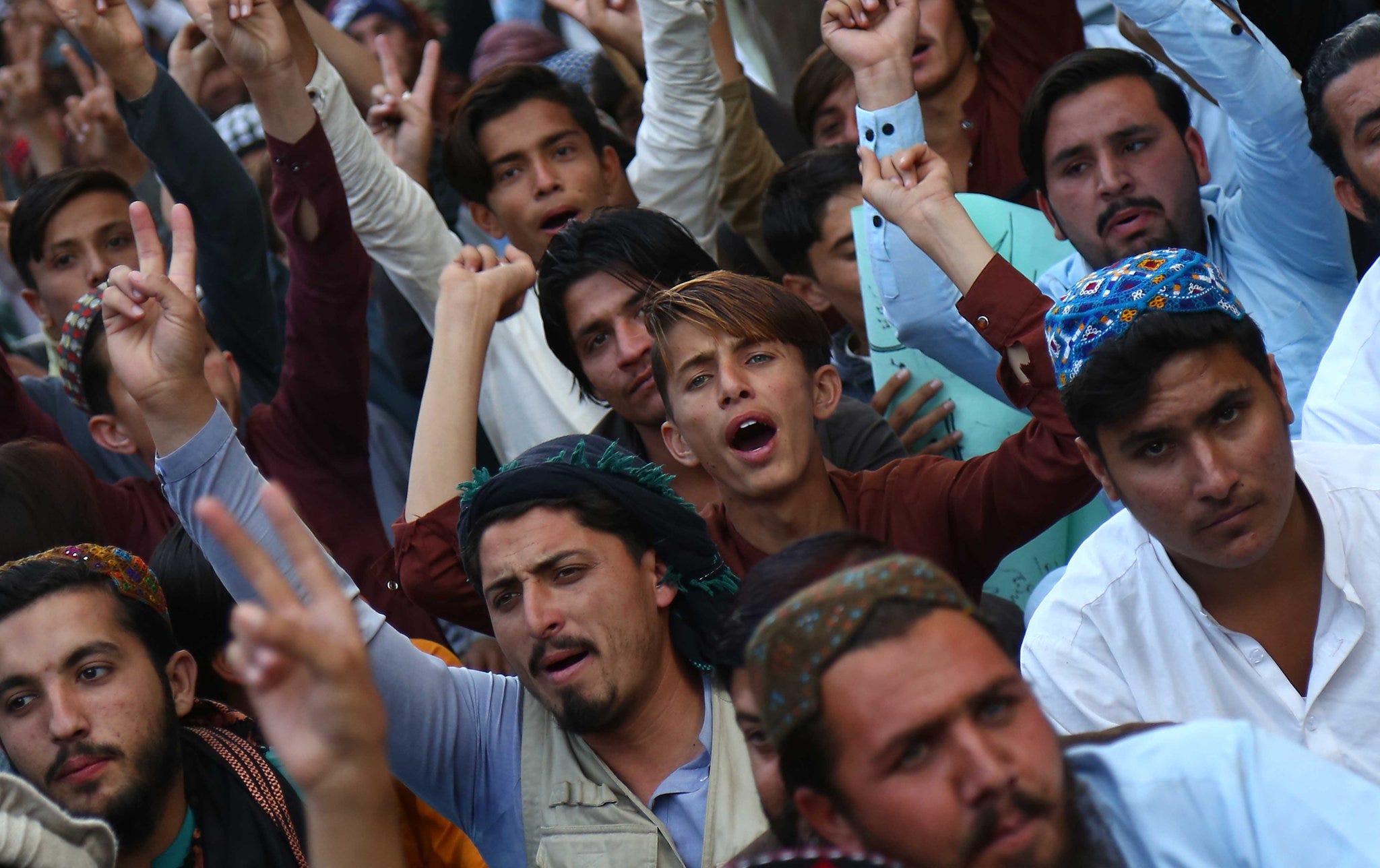
The Citizens Nobody Protects
Pashtuns carry the passports of both states. In the war between them, both states agree on one thing: Pashtun lives are the price.
In the Bihsud district of Nangarhar province, on the night of February 21, a family of twenty-three people had gathered beneath one roof. Eighteen of them did not survive. The bodies that rescuers pulled from the rubble in the pre-dawn hours were wrapped in the white cotton that Islam prescribes.
Forty kilometers east, in Paktika province that same night, a religious seminary and a guesthouse were struck. Afghan authorities reported the buildings were empty at the time. The craters were not empty.
This is one side of the ledger.
The other side runs back further and runs deeper. In December 2014, a Pakistani Taliban gunman walked into the Army Public School in Peshawar and killed one hundred and thirty-two children. They were Pashtun children, in a Pashtun city, killed by a Pashtun armed group that Pakistan’s own intelligence apparatus had helped build and then lost control of. In Bajaur, in Swat, in Waziristan, in Kurram, in Bannu, Pakistan’s military fought a counter-insurgency across two decades that displaced millions of its own Pashtun citizens, flattened villages, and produced a generation of internally displaced families who returned to find their homes rubble and their young men radicalized by the experience of watching the state bomb their own neighborhoods. Pakistan counts eighty thousand dead in its war on terror. The overwhelming majority of those dead, soldiers, police, and civilians alike, were Pashtun. They were Pakistani citizens.
Four days after the Nangarhar strikes, on February 26, the Afghan government documented nineteen civilians killed and twenty-six injured by Pakistani strikes in Khost and Paktika. Deputy Spokesman Hamdullah Fitrat said the majority of the dead and wounded were women and children. On the Pakistani side of the border, in the weeks prior, a suicide bombing at a Shia mosque in Islamabad killed thirty-one worshippers. An attack on a checkpoint in Bajaur killed eleven soldiers and a child. Another attack followed in Bannu. The TTP claimed or was linked to all of it. The TTP draws its fighters predominantly from the Pashtun tribal belt. Its victims are predominantly the same.
Go back further still, to October 2025, during the previous escalation cycle at Spin Boldak. Local sources in Kandahar reported twenty-nine civilians killed and one hundred and twenty-two wounded in a single week of border fighting. At least eighty of the wounded were women and children, according to a district hospital official whose name does not appear in any international wire report.
The UN Assistance Mission in Afghanistan confirmed at least seventy civilians killed and four hundred and seventy-eight injured across the border provinces between October and December 2025 alone. These provinces, Paktia, Paktika, Khost, Kunar, Kandahar, Helmand, are not random coordinates on a military map. They are the Pashtun heartland. They are always the Pashtun heartland.
Pakistan’s Information Minister Attaullah Tarar told the world the strikes were “intelligence-based” and “selective.” The rubble in Nangarhar was not selective. The madrassa in Paktika was not selective. The children in the Army Public School in Peshawar were not selective. The women and children in Khost were not selective. The pattern, running across both sides of the Durand Line, across decades, across multiple governments and multiple military operations and multiple rounds of a war that never actually ended, is what is consistent: it consistently kills Pashtun people.
That is the ledger that preceded the war Pakistan’s Defence Minister Khawaja Asif formally declared on February 27, 2026, posting on X that Pakistan’s “patience has run out” and that the two countries were now in a state of “open war.” Pakistani warplanes struck Kabul, Kandahar, Paktia, and Jalalabad. Afghanistan struck back, destroying nineteen Pakistani military posts and claiming fifty-five Pakistani soldiers killed. Two countries bombed each other’s capital cities during the holy month of Ramadan.
The following morning, February 28, the United States and Israel launched Operation Epic Fury against Iran, filling the skies over Tehran with fire.
These events are not coincidental. They are sequential. They are structural. And the people who will absorb the cost of all of it, as they have absorbed it for twenty-five years without pause, are Pashtun. On both sides of a border that was never theirs to draw.
The Simultaneity Nobody Will Name
The most important political fact of this week is the one that no mainstream commentator in Pakistan will say plainly: Pakistan declared open war on Afghanistan the same night the United States and Israel opened a military campaign against Iran.
That simultaneity is not an accident of timing. It is the architecture.
The US-Pakistan relationship has been reconstructed rapidly since Trump returned to office. Trump personally mediated the India-Pakistan military confrontation of May 2025, and in doing so handed General Asim Munir’s establishment something it had been searching for since 2022: renewed American validation, renewed American patronage, and renewed American strategic cover. The military-financial machinery that undergirds the relationship between Washington and Rawalpindi did not disappear during the Biden years. It waited.
What did Washington need in the weeks before it bombed Tehran? It needed the regional architecture locked down. It needed its most nuclear-capable Muslim ally not wavering, not publicly expressing sympathy for Iran, not becoming a political liability in front of the cameras. The most effective way to ensure Pakistan was looking inward, or westward toward Kabul rather than toward Tehran, was to give Pakistan’s military establishment something to shoot at.
The Taliban government in Kabul had already given Washington one grievance by doing what sovereign governments are supposed to do: refusing to host American troops. When Trump demanded Bagram Air Base back in September 2025, Taliban Foreign Minister Amir Khan Muttaqi replied that “not even one meter of land will be given to the US.” When Trump posted on Truth Social that “BAD THINGS ARE GOING TO HAPPEN,” the Taliban did not flinch.
Pakistan’s willingness to escalate the cross-border conflict against the Taliban government can, in this context, be read as a service rendered. Soften the Taliban. Bleed them. Give Trump leverage for a negotiated Bagram deal or, failing that, demonstrate to the Afghan government the cost of continuing to refuse. The National Interest, citing multiple regional analysts, wrote in October 2025 that the Pakistan-Taliban conflict was giving “a real opportunity for the Trump administration to throw its diplomatic weight around to achieve its own goals for the region: restoring Bagram Air Base to US control.”
That article was written before the open war declaration. It reads, in retrospect, like a preview.
What Bagram Is Actually For
Trump has been unusually candid about why he wants Bagram. “It’s an hour away from where China makes its nuclear weapons,” he said. This is geopolitical language, direct enough to be almost embarrassing in its honesty. The base sits at the intersection of South and Central Asia, within reach of western China, within surveillance range of Iranian territory, positioned astride the supply corridors that China has been building through Afghanistan under the Taliban’s relative economic cooperation.
In 2025, the Taliban signed a series of agreements with Chinese companies for the development of rare earth deposits, copper, and lithium. Approximately one hundred Chinese companies had registered with the Taliban Ministry of Mines and Petroleum. Afghanistan was not becoming a Chinese client state in the ideological sense, but it was becoming a site of Chinese economic penetration that Washington found intolerable.
The Bagram angle carries a second dimension that receives far less analysis. Pakistan’s airbases in Khyber Pakhtunkhwa and Punjab are, as Afghanistan’s former ambassador to Italy Helena Malikyar has pointed out, actually closer to China than Bagram itself, and the US has had access to Pakistani airspace since 1959. Pakistan has been, in this structural sense, already serving as a forward platform for American strategic ambitions toward China and now toward Iran. The question of whether Pakistani military leadership understands itself as an autonomous actor or as a contract fulfillment mechanism for Washington is not a question that Pakistan’s establishment media will pose. The Taliban in Kabul, who have no such media constraints, have posed it directly. A Taliban spokesperson said Pakistan is “tasked with implementing US projects in the region and in Afghanistan.”
The Internal Logic of a Cornered Establishment
There is a second explanation for Pakistan’s willingness to escalate, and it operates independently of the American variable, though it is not separate from it. Pakistan’s current political configuration is deeply and structurally unpopular.
The post-2022 arrangement that removed Imran Khan from power and imprisoned him, that suppressed the PTM across Pashtun belt constituencies, that ran elections whose results the independent press and the human rights community treated as predetermined, has produced a government that rules through institutional force rather than consent. The Pashtun Tahaffuz Movement, which has documented enforced disappearances, extrajudicial killings, and collective punishment in the tribal districts for years, has been systematically silenced. Its leaders have been detained, its gatherings dispersed, its coverage restricted. The populations it represents, overwhelmingly Pashtun, are the same populations that live along the border, who are bombed when the Pakistani Air Force strikes what it calls terrorist camps in Afghanistan and who absorb the TTP’s retaliation inside Pakistan when it comes.
A government that rules without consent has a reliable instrument in nationalist war. When the Defence Minister declares “open war” and Prime Minister Shehbaz Sharif’s office says the whole country is “united behind Pakistan’s armed forces,” the political logic is straightforward. A population that cannot freely discuss the terms of its governance is invited to submerge its grievances inside the patriotic emergency. This is not new. Every Pakistani military establishment since Ayub Khan has known how to generate this submersion. The formula has been used so many times that it no longer requires novelty. It requires only a credible external enemy and a compliant media ecosystem willing to report body counts without asking whose body counts are missing from the official tally.
The body counts that are missing are Pashtun.
The People the Bombs Fall On
Nangarhar. Paktika. Khost. Kandahar. Jalalabad. These are not random coordinates on a military map. They are the Pashtun heartland, on both sides of a colonial border that Pashtuns never accepted and that Afghanistan has never formally recognized. The Durand Line, which Pakistan treats as an international frontier and Afghanistan treats as a British imposition, cuts directly through Pashtun ethnic territory, separating families, dividing tribes, creating the legal fiction that the people who live on one side of an arbitrary line drawn by Mortimer Durand in 1893 are Pakistani citizens and the people who live on the other side are Afghan citizens, when in reality they are, in many cases, the same people with the same lineage who happened to be standing in different fields on the day the empire drew its map.
When Pakistani jets bomb Nangarhar, they bomb Pashtun civilians. When the TTP detonates a suicide vest in Bajaur or Bannu, it kills Pashtun security forces and Pashtun civilians. When the Taliban retaliates by striking Pakistani military positions along the Durand Line, the fighting takes place in terrain that Pashtun communities on both sides of the line have farmed and grazed and built shrines in for generations. The war’s geography is Pashtun geography. The war’s casualties are Pashtun casualties.
For twenty-five years, since the first American bombs fell on Kandahar and Jalalabad in October 2001, the Pashtun have been the ground zero of every military doctrine deployed in this region. American drone campaigns in the FATA killed thousands. The Bureau of Investigative Journalism’s documentation of Pakistani civilian casualties remains the most detailed accounting of a war whose victims never received obituaries in Western papers. Pakistani military operations in Waziristan, in Swat, in Bajaur drove millions from their homes. The Afghan war’s entire southern and eastern theater ran through Pashtun territory. And now, in 2026, with American bombs falling on Tehran and Pakistani warplanes over Kabul, the Pashtun are being asked once again to serve as the geography on which other peoples’ wars are fought.
The War That Never Ended: Eighty Thousand Dead and Counting
Before this war had a declaration, before Khawaja Asif posted on X and Pakistani jets crossed into Afghan airspace, there was another war. It ran for twenty-three years. It killed eighty thousand Pakistanis. It has never formally ended and it never produced a reckoning. Ask whose eighty thousand they were and the answer is the same as it always is: overwhelmingly Pashtun.
The Pakistan that declared open war on Afghanistan on February 27, 2026 is the same Pakistan that spent two decades bombing its own Pashtun citizens in Waziristan, in Bajaur, in Swat, in Kurram, in Mohmand, calling each operation by a different name while producing the same result. Operation Rah-e-Haq. Operation Sherdil. Operation Rah-e-Nijat. Operation Zarb-e-Azb. The names changed. The geography did not. The geography was always Pashtun.
The displacement those operations produced was among the largest internal population movements in South Asian history outside of partition. At the peak of military operations in the tribal belt, over three million Pakistani citizens were driven from their homes. They were Pashtun. They were Pakistani nationals. They were moved into camps and told the operation would be temporary. Many waited years before returning to find their homes demolished, their orchards destroyed, their land reassigned. The economic collapse of those communities, the destruction of the informal cross-border trade that had sustained the tribal belt for generations, the removal of any functional governance or justice system during the years of military administration, created the precise conditions in which the TTP could recruit. The military operation that was supposed to eliminate the insurgency reproduced it in the next generation.
On December 16, 2014, a Pakistani Taliban unit entered the Army Public School in Peshawar and killed one hundred and thirty-two children. The children were Pashtun. The killers were Pashtun. The soldiers who died trying to stop them were Pashtun. Pakistan wept and called it a national tragedy. It was a national tragedy. It was also the logical endpoint of a policy that had been treating Pashtun communities as a security problem to be managed rather than a citizenry to be governed, for so long that armed groups operating inside those communities had become indistinguishable from the communities themselves.
The suicide bombing at a Shia mosque in Islamabad on February 6, 2026, which killed thirty-one worshippers and which Pakistan cited as one of the triggers for its February airstrikes on Afghanistan, was itself part of this same unbroken chain. The attack in Bajaur that killed eleven Pakistani soldiers and a child. The attack in Bannu that followed days later. The TTP claimed or was linked to all of it. These are not Afghan attacks on Pakistan. They are the Pakistani war on terror returning to collect what it is owed, in Pakistani cities, from Pakistani citizens, twenty-three years after a Pakistani military establishment agreed to serve as the forward operating base for an American campaign whose costs it agreed to absorb and whose bills are still coming due.
Pakistan went into that arrangement believing it could control the variable it had helped create. It could not. The Afghan Taliban it had housed, funded, and directed for a decade returned to Kabul in 2021 with its own agenda. The TTP it had tolerated as a useful pressure instrument turned on the state that tolerated it. The Pashtun communities it had displaced and dispossessed produced the fighters that now fill TTP ranks. Every strategic miscalculation compounded the previous one. The eighty thousand dead are not a tragedy that happened to Pakistan. They are the accumulated cost of decisions the Pakistani military made and has never been held accountable for, paid in Pashtun lives on both sides of the Durand Line.
That is the inheritance of the current war. Not a fresh conflict between two neighboring states but the latest chapter of a war on Pashtun communities that has been running continuously since 2001, rebranded periodically, handed new justifications, assigned new enemies, but never fundamentally reconsidered. The Pashtun on the Pakistani side lost eighty thousand. The Pashtun on the Afghan side lost a generation to occupation, civil war, and Taliban governance. Now both populations are being asked to pay again, in a war whose architects will not be in the rubble when it is over.
The 1971 Analogy and Why This Time Is Worse
The comparison to 1971 is being raised in cautious analytical circles and should be raised loudly in public ones. In 1971, the Pakistani state’s systematic military violence against the Bengali population, the denial of elected results, the suppression of political identity, produced a guerrilla war that India’s military intervention converted into the creation of Bangladesh. Pakistani military historians frame 1971 as a consequence of Indian interference. The more honest accounting is that the Pakistani military’s violence against its own eastern population created the conditions in which intervention became possible and, from the perspective of the Bengalis, welcome.
The structural parallel to the Pashtun situation is not complete, but it is not dismissible either. The Pashtun population in Pakistan’s tribal belt and Khyber Pakhtunkhwa has faced documented collective punishment, enforced disappearances, economic marginalization, and the selective application of military force for two decades. The PTM’s entire political existence is a documentation of this accumulation of grievance. Its founders came not from ideology but from the experience of watching their communities’ men disappear and their villages’ infrastructure destroyed by an institution that claimed to be defending the Pakistani state while generating conditions that would eventually threaten it.
What is different from 1971 is the geography. East Pakistan was separated from West Pakistan by a thousand miles of Indian territory. The Pashtun belt is not separated from anything. It is contiguous. It runs from inside Pakistan’s most militarized provinces directly into Afghanistan. The border is porous by nature, by ethnicity, and by economics. When a war is fought in this geography against a population that has been systematically excluded from political power, the result is not a separatist movement that can be geographically contained. The result is a guerrilla insurgency that has no front line because the front line is the entire society.
The TTP already demonstrated this. It emerged not from foreign instruction but from local experience, local grievance, and a local population that had been given no political alternative to armed resistance. Pakistan’s response to the TTP has been to bomb Afghanistan and demand that the Taliban suppress it. The Taliban’s response is that the TTP is Pakistan’s internal matter. Both positions contain elements of accuracy. Neither contains a solution. The escalation to open war does not produce a solution either. It produces more Pashtun dead on both sides of the Durand Line and more young Pashtun men who now have a family reason, not just an ideological one, to pick up a weapon.
This is a population that has been fighting asymmetric warfare, on one side or another, for forty-five years. They are very good at it. CNN analyst Abdul Basit put it plainly: “Any retaliation by the Afghans will be in Pakistan’s urban centers. This is a recipe for chaos and chaos is what terrorist networks seek to flourish.” He was speaking about the Afghan Taliban’s tactical options. The deeper point is about the Pashtun population on both sides, who now have every reason to see the Pakistani military as an occupying force, just as the Bengalis eventually saw it in 1971, but with no ocean between them and the cities they can reach.
The Iran Connection and the Regional Fire
On February 28, 2026, the United States and Israel launched Operation Epic Fury. Explosions shook Tehran, Isfahan, Qom, Karaj, and Kermanshah. Trump announced “major combat operations” against Iran with the stated objective of eliminating its nuclear and missile capabilities and toppling the regime. Iran responded immediately with strikes across the region, hitting US military installations in Bahrain, targeting positions in Saudi Arabia, Qatar, and the UAE, and launching missiles toward Israel, which declared a state of emergency.
This is the Middle East fire that the Pashtun border war was lit partly to manage.
Pakistan shares a border with Iran. The Iran-Pakistan relationship has historically been one of careful diplomatic balance, with Islamabad maintaining formal friendship with both Tehran and Riyadh despite the latter two being in sustained regional competition. Pakistan entered a mutual defence pact with Saudi Arabia in September 2025. Saudi Arabia is part of the American-aligned regional architecture that backed the Iran campaign. Pakistan is now, through that pact and through its renewed American partnership, formally positioned on one side of the most serious regional military confrontation since the 2003 invasion of Iraq.
The Taliban government in Kabul, which has managed a relationship of pragmatic coexistence with Tehran, including receiving Iranian financial flows and enjoying relative border calm on the Afghan-Iranian frontier, was not going to serve as a forward base for any American campaign directed at Iran or as a transit point for American power projection. Muttaqi had said so explicitly. Not one meter.
For Washington, a destabilized Taliban government, weakened by a Pakistani air campaign and facing internal military pressure along its eastern frontier, is a Taliban government with fewer options and more incentives to negotiate on Bagram. A Taliban government sitting on Chinese mining contracts and a functional relationship with Tehran would never hand Bagram to the United States. A Taliban government that has just had its capital bombed and its border posts overrun by Pakistan might reassess its options, particularly if the Americans arrive with an offer: recognition, sanctions relief, unfrozen assets, and a small, limited American presence at one airfield.
Trump’s transactional diplomacy is built precisely on this sequencing. Break first, negotiate later. Apply pressure through proxies when direct pressure is politically expensive. The National Interest’s October 2025 analysis was explicit about this: “the Taliban might need American help to end a conflict that would surely destroy their hold on power.” The help America would offer would come with a price.
The Architecture of Regional Conflagration
What is now in motion is not a bilateral border dispute between Pakistan and Afghanistan. It is a multi-layered regional conflagration whose separate components are feeding into each other.
Iran is at war with the United States and Israel. Iran’s response has included strikes on Gulf Arab states that host American bases. Those Gulf Arab states are part of the same American alliance architecture that Pakistan is now more firmly integrated into. The Strait of Hormuz has been militarized, which affects Pakistan’s energy import routes and its trade access to the Gulf. Pakistani workers in the Gulf, numbering in the millions and sending remittances that are structurally indispensable to Pakistan’s foreign exchange reserves, are now living inside a war zone.
Pakistan is in open war with Afghanistan. The Afghan border in the east is being bombed. The Afghan government, which was managing careful relationships with both China and Iran, is now being pushed toward a crisis that could collapse it, radicalize its population further, or produce internal fractures within the Taliban movement between those who want to fight and those who understand what open war with a nuclear-armed state means for a country that has been at war continuously since 1978.
China, which has invested in Afghan rare earth extraction and whose nationals have been killed in Afghanistan by IS-K attacks throughout 2025 and 2026, is watching a scenario in which both its Afghan investments and its Pakistani strategic relationship are simultaneously under stress. Beijing’s Ministry of Foreign Affairs said it was “deeply concerned” about the Pakistan-Afghanistan escalation. That is diplomatic language for: we are watching our assets burn.
India, which has been improving its relationship with the Taliban government and which expressed “strong condemnation” of Pakistan’s airstrikes on Afghan territory, is positioned to exploit any Pakistani overextension. India and Afghanistan have been developing enhanced bilateral trade arrangements. An Afghan government under Pakistani military pressure has every incentive to deepen the Indian connection, which is exactly what Pakistan accuses Kabul of doing and exactly what Pakistan’s military escalation is accelerating.
Russia, which formally recognized the Taliban government and has been expanding its security engagement in Afghanistan, has its own interest in a stable Afghan state that is not an American base. A destabilized Afghanistan puts Russian influence at risk and creates migration pressures toward Central Asian states within Russia’s political orbit.
Every regional power has an interest in the outcome of what Pakistan’s Defence Minister announced as “open war.” None of their interests align. The Pashtun have no state to advance their interest at any of these tables.
What Comes Next
Military analysts have noted the asymmetry of the forces. Pakistan has a nuclear-armed military with air force superiority, an air defence network, heavy artillery, and armored formations. The Taliban has a guerrilla army, ideological cohesion, intimate knowledge of the terrain, drones, suicide bombers, and forty-five years of experience fighting superior conventional forces to effective standoffs. Abdul Basit of the S. Rajaratnam School of International Studies said flatly: “There are dangerous times ahead.”
There have been previous flare-ups. There was the October 2025 confrontation, the worst cross-border fighting since 2021, mediated by Qatar after a ceasefire. There were peace talks in Istanbul in November 2025 that produced nothing. There was the Qatari-mediated pause, then the February airstrikes that began this current cycle, then the declaration of open war. Each cycle has been more intense than the last. Each ceasefire has held for a shorter period. The escalation trajectory is visible and it points in one direction.
If Pakistan’s military believes it can replicate against the Taliban what it believes it accomplished against the TTP through a combination of air power and border pressure, it is operating on a deeply flawed assessment. The Taliban are not a terrorist organization hiding in camps. They are the government of Afghanistan. They are the state. They have the loyalty, the arms, the ideology, and the territorial control that no amount of Pakistani airpower can eliminate without a full-scale invasion and occupation that Pakistan cannot sustain, cannot fund, and cannot politically survive domestically, given the populations that would be required to fight it. The soldiers in Pakistan’s frontier corps are overwhelmingly Pashtun. They will be ordered to fight Pashtuns across the border. This is not a stable military proposition.
On the Pakistani side of the border, in Khyber Pakhtunkhwa, in the districts that were once FATA, the families who have relatives in Afghanistan, who cross the border for weddings and funerals and trade, who speak the same language and worship at the same shrines, will now be watching Pakistani jets bombing their cousins. The political consequence of that is not nationalism. The political consequence of that is rage, in a population that has already been denied political expression, already been subjected to enforced disappearances, already watched its representatives silenced, and that now has a material, familial, blood-level reason to turn against the state that bombed their kin.
That is the 1971 dynamic, running in real time, on terrain that offers no exit route and no ocean of separation. The Bengalis had Bangladesh. The Pashtun have nowhere to go and everywhere to fight from.
The Bodies in the Rubble Are a Policy Outcome
Before this piece closes, it is worth returning to where it began.
Eighteen of twenty-three members of one family in Nangarhar, killed in their home on the night of February 21. A madrassa and a guesthouse in Paktika, struck the same night. Nineteen more civilians documented dead in Khost and Paktika on February 26, the majority of them women and children. Twenty-nine killed and one hundred and twenty-two wounded in Kandahar during the October 2025 cycle, eighty of the wounded being women and children. Seventy confirmed dead and four hundred and seventy-eight injured across the Pashtun border provinces in the final quarter of 2025 alone.
Pakistan said the strikes were intelligence-based and selective. UNAMA said the strikes killed civilians. The families in those provinces were not terrorist camps. They were farmers, students, and women in their homes during Ramadan.
The word “collateral” damage was invented to make this kind of killing administratively legible, to provide a bureaucratic category that separates the policy from its consequences, so that a minister in Islamabad can post on X about patience running out without having to look at the photographs from Bihsud district. The language of counter-terrorism has been doing this work for twenty-five years across the entire Pashtun belt, on both sides of the Durand Line and, before that, in the American drone campaigns whose Pakistani civilian victims are still waiting for acknowledgment from a government that signed the permission slips for those strikes and then denied it publicly.
This is the moment to say what the evidence supports without retreating from it: the Pashtun population is being used as a battlefield by forces that have never asked their consent, have never extended them equal political representation, and have never been held accountable for what their wars have done to Pashtun communities. Washington wants a base. Rawalpindi wants distraction and domestic legitimacy. Tel Aviv and Washington want Tehran’s nuclear program destroyed. The TTP wants a theocratic emirate. The Taliban wants its government to survive. China wants its mining contracts honored. Russia wants buffer states it can influence. India wants Pakistan weakened.
The Pashtun want to bury their dead and plant their fields in peace. They have not been permitted to do either for a generation.
When the next escalation comes, and the structural conditions make a next escalation near-certain, the bodies in the rubble will again be Pashtun. The ministers who declare war from social media posts and the generals who brief from air-conditioned rooms and the analysts who write papers about strategic depth and forward basing and counter-terrorism doctrine will not be in the rubble. They are never in the rubble.
The rubble is where the Pashtun are.
And from the rubble, in this landscape that every empire since Alexander has found ungovernable once it has made it ungovernable, what grows is not surrender. What grows is the kind of resistance that cannot be bombed from the air because it lives inside the population itself, that cannot be disrupted by sealing borders because the border was never real, and that does not end until the underlying conditions are addressed, which requires the political will to share power with the people you have been treating as a battlefield.
No government currently involved in this conflict has demonstrated that political will. That is why this is not a crisis. A crisis implies resolution is available. This is a catastrophe in formation, and the only people who have understood what it will cost them are the ones in the rubble in Nangarhar and Paktika and Khost and Kandahar who already paid.


