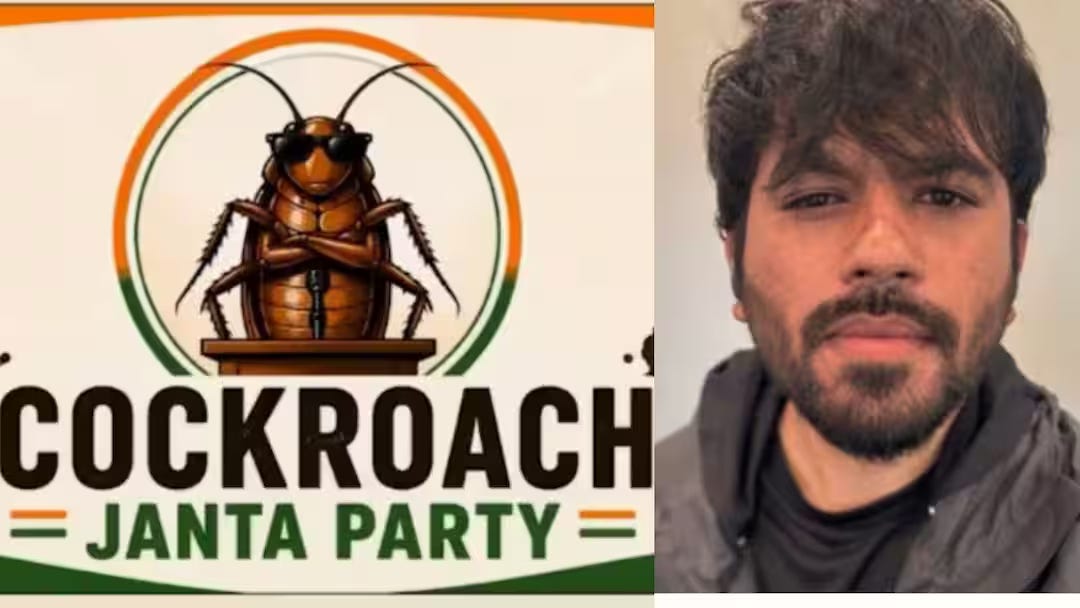
The Cockroach Problem
Twenty-One Million Followers and the State That Flinched
Just last week a political communications student at Boston University named Abhijeet Dipke launched a Google form. The form asked people to sign up for a satirical political party he called the Cockroach Janta Party, a deliberate parody of the Bharatiya Janata Party, the ruling organization of a nation of 1.4 billion people. The occasion was a remark attributed to India’s Chief Justice Surya Kant, who had been widely reported to have described the country’s unemployed young people as “cockroaches” and “parasites” during a court hearing. Kant later attempted to clarify that he had meant only those who obtain jobs through forged degrees. By that point, the clarification had already told twenty million people exactly what the state thought of them.
Within four days, the Cockroach Janta Party’s Instagram account had accumulated more followers than the BJP’s. Within six days, it had nearly 21 million. The BJP, governing party of the world’s most populous democracy, running sixteen of its twenty-eight states and commanding the largest paramilitary volunteer network in human history, was being outrun on social media by a joke account with an AI-generated cockroach mascot. On May 21, the CJP’s account on X was withheld in India in response to a legal request. Dipke alleged that attempts had been made to hack his Instagram account before the legal move was executed. The CJP came back on X within hours under a new handle. Its first post read: “You thought you can get rid of us? Lol.”
The government of Narendra Modi, which has imprisoned journalists under anti-terrorism statutes, expelled Bengali-speaking Muslims to Bangladesh, rewritten school textbooks, renamed cities, and demolished the homes of people accused of crimes before any trial, moved against a cockroach meme account. The sequence describes the government accurately.
Chief Justice Surya Kant made his cockroach remark during a hearing on fake degree holders obtaining government employment. The precise phrasing became disputed almost immediately; Kant insisted he had been referring to fraudulent applicants specifically. Whether or not the direct quote holds exactly, the remark’s context was plain: a senior state official, in the highest court in the land, describing a category of Indian youth in terms of vermin. What gave the insult its charge was not the word itself but what it disclosed about the official relationship between the Indian state and the generation it had failed to employ.
India’s youth unemployment rate for ages fifteen to twenty-nine reached 15.2 percent in March 2026, up from 13.8 percent the previous April. For young women the figure ran higher, approximately 16.3 percent against 13.4 percent for young men. These are the headline numbers. Below them sits a structural condition that the numbers compress: India’s economy has been producing educated graduates faster than jobs for over a decade. In 2025, Tata Consultancy Services announced cuts to approximately two percent of its workforce, affecting more than 12,000 positions concentrated in middle and senior management. TCS is not a marginal firm. For millions of Indian families, the IT sector symbolized the stable, upwardly mobile professional life that education was supposed to unlock. When that sector begins shedding people at scale, it signals something about the durability of every promise made in its name.
The BJP’s economic narrative since 2014 has rested on the demographic dividend: India’s median age of twenty-nine as an asset, a young workforce that would drive consumption and productivity as the country industrialized. Modi campaigned in 2014 on a promise of two crore new jobs per year, twenty million annually. The Centre for Monitoring Indian Economy estimated, in its 2024 assessment, that formal sector job creation across the Modi years had consistently fallen short of that target by a significant margin. The gap between the promised dividend and the lived reality of unemployment is the economic condition the Chief Justice put a name to in court.
Dipke called the CJP a joke at its launch. What it produced in seven days was not. The Cockroach Janta Party called for a ban on post-retirement Rajya Sabha appointments for Chief Justices, addressing the documented practice of judges receiving political appointments after retiring from the bench, a mechanism that creates financial incentives for judicial deference to the executive during active service. It called for Election Commission officials to face UAPA charges if legitimate votes are deleted during electoral roll revisions, a demand that points directly at the Special Intensive Revision process deployed in West Bengal before the 2026 state elections, in which Bengali-speaking Muslims were systematically struck from voter rolls before a BJP landslide of 207 seats. It called for fifty percent reservation for women in Parliament and Cabinet positions. It demanded a twenty-year ban on politicians switching parties, targeting a practice BJP-governed states have used to peel opposition legislators away from their parties using financial inducements that are rarely investigated. And it called for the cancellation of media licences held by Mukesh Ambani and Gautam Adani, naming the two men who now own most of what India watches for news.
A twenty-three-year-old student named the precise instruments of democratic erosion in India more directly, in a manifesto attached to a cockroach meme, than the Indian parliament’s formal opposition has managed in the same period. Every item has a documented case file behind it.
Shashi Tharoor, a senior Congress leader, described the CJP’s rise as “unprecedented” and called the X ban “deeply unwise.” His framing was tactical. The 21 million people who followed a cockroach account in six days did not do so because they trust the Congress. They followed it because they trust no one in the existing field. Rahul Gandhi noted five years ago that nobody was ready to speak up against Modi or the government. The CJP founder cited that observation by name. The account that outgrew the BJP’s social media footprint before it was banned came back the same day with a cockroach poster and a dismissive laugh.
Mukesh Ambani’s Reliance Industries controls more than seventy media outlets followed by at least 800 million Indians. In November 2024, Reliance completed an $8.5 billion joint venture merging Viacom18’s media assets and JioCinema with Disney’s Star India, producing a combined entity of over a hundred television channels and unified streaming platforms generating $3.1 billion in annual revenue. Network18, which Ambani acquired in 2014, runs CNN-News18, CNBC Awaaz, Firstpost, and MoneyControl among others. Reporters Without Borders describes Ambani as a “close friend” of the prime minister. Reliance has not been the subject of any significant tax investigation or Enforcement Directorate action during twelve years of BJP government. The correlation between proximity to Modi and freedom from regulatory harassment has been consistent enough, and long enough, to constitute policy.
Gautam Adani completed a hostile takeover of NDTV in late 2022, acquiring a controlling stake of 64.71 percent by March 2023. NDTV, founded by Prannoy Roy and Radhika Roy and run by working journalists for decades, had been one of the last broadcast outlets willing to report critically on the Modi government. It had faced money-laundering and tax-evasion charges from the Enforcement Directorate and the CBI during precisely the years it maintained editorial independence. The Roys resigned from the board following the takeover. Several of NDTV’s most prominent anchors and correspondents left. The editors who remained inherited a newsroom whose new owner is photographed regularly with the prime minister.
The consolidation did not begin with the Adani acquisition. It began in 2014, when Modi’s first government started withdrawing government advertising from critical outlets, a financially devastating form of pressure requiring no statute and leaving no paper trail. Outlets lost advertising, owners became amenable, and editors adjusted. Zee Entertainment’s controlling shareholder Subhash Chandra received the BJP’s backing for a Rajya Sabha nomination from Haryana in 2019. India TV’s owner and editor-in-chief Rajat Sharma has documented personal relationships with Modi, Home Minister Amit Shah, and former Finance Minister Arun Jaitley dating to the early 2000s. By the time Adani took NDTV, there was nothing left to take. The result is the information environment that Reporters Without Borders assessed in 2026: Hindu nationalist ideology dominant, numerous outlets openly advocating hatred of Muslims, a press ranked 157th out of 180 countries in freedom. The state does not run the press. It does not need to.
The CJP’s manifesto demand to cancel Ambani and Adani licences is the generation’s forensic description of what happened to Indian journalism in their lifetime. The cockroach account named it more precisely than most surviving independent journalists in India can afford to.
Half of India’s population has grown up knowing no prime minister other than Narendra Modi. For anyone now between eighteen and twenty-four, the entire arc of conscious political life has taken place inside a BJP-administered state. Schools in BJP-governed states have revised textbooks to reduce or eliminate coverage of the Mughal period, rehabilitate Savarkar, and construct a version of Indian history organized around civilizational Hindu identity. The news they consumed came overwhelmingly through platforms owned by Ambani and Adani. The political strategists who built the BJP’s social media dominance over a decade watched a satirical cockroach account surpass the party’s follower count in less than a week. They had built an information architecture for a generation. The generation built a Google form and broke through it in four days.
The ban itself confirmed what the manifesto had claimed. A government that moves against a meme account under the same legal architecture it uses to jail journalists under anti-terrorism statutes, demolish Muslim homes before trial, and remove Bengali-speaking citizens from electoral rolls has indicated, clearly, that it does not distinguish the categories. The UAPA was written for organizations the state defines as existential threats. The CJP X ban was issued in response to a legal request. The legal request came from a government that had found an Instagram account with fifty-nine posts more threatening than it could tolerate.
Dipke’s question in a video statement after the ban was direct: “What kind of democracy is this?”
The state’s capacity to suppress runs well below the visibility of a high-profile meme ban. India has led the world in government-ordered social media content takedowns across YouTube and X for several years. During the May 2025 India-Pakistan confrontation following the Pahalgam attack, at least 125 people were arrested for “anti-national” social media posts within weeks. Sixteen Pakistani YouTube channels were blocked. More than 8,000 X accounts were silenced. The legal instrument enabling all of this is Section 69A of the Information Technology Act, which allows the government to issue blocking orders to platforms without any public disclosure requirement and without judicial oversight prior to the block.
The CJP ban ran through this architecture. X complied, as it has consistently complied with Indian government requests, as every platform with a commercial interest in the Indian market has complied. Elon Musk sued India’s censorship authority in 2024 over content blocking orders, a legal challenge that articulated the same structural complaint the CJP would make a year and a half later: that the Indian state’s digital censorship apparatus operates outside any democratic accountability. The lawsuit did not stop the government issuing blocking orders. The CJP ban came through the same pipe.
What the government could not block was the prior six days. The account had already put twenty-one million people into a movement before the legal request was filed. The party came back on X the same afternoon. The manifesto kept circulating. A system that can hold journalists for 180 days under the UAPA without charge, demolish homes without trial, and expel citizens across an international border found itself unable to kill a joke that had already left the room.
Narendra Modi does not fear the Cockroach Janta Party as a political organization. His government moved against the X account because an executive that has spent twelve years removing every institution capable of checking it now moves against everything that exceeds a tolerable level of visibility and criticism. The institutional reflex no longer distinguishes between a threat and an insult. A meme account demanding Election Commission accountability gets the same legal treatment as a news organization reporting on Muslim demolitions.
The 21 million followers are not a political party. They are a measure of the BJP’s most consequential failure: the conversion of India’s demographic dividend into a permanent majority never happened. The young workforce that was supposed to validate Modi’s economic narrative has spent its politically formative years unemployed, underemployed, or absorbed into a gig economy the government counts as formal employment. It grew up watching NDTV change owners, watching school textbooks change, watching the Chief Justice of the Supreme Court use the word cockroach in open court to describe people who went to school, took the exams, and could not find work.
A student with a Google form turned that into twenty-one million followers in six days, a manifesto that named every mechanism of BJP consolidation with forensic accuracy, and a return to X the same afternoon the government banned him, with a cockroach poster and the word “Lol.”
The BJP blocked the account. The cockroach came back. That is the political condition of India today.


