The Combustion Mandate
Washington’s War for the World’s Energy Supply and Why It May Break Before It Holds
On the morning of February 28, 2026, the official story began: the United States and Israel launched Operation Epic Fury against Iran, assassinating Supreme Leader Ali Khamenei, targeting nuclear sites, and expecting the Islamic Republic to fracture from within. It didn’t. Iran closed the Strait of Hormuz, struck US bases from Bahrain to the UAE, disabled tankers from Oman to Kuwait, and sent Dubai crude prices toward $166 per barrel. By April, with a fragile ceasefire in place and the strait running at roughly 5 percent of pre-war traffic, the Western press had agreed on the frame: strategic blunder, militarist overreach, humiliation.
That frame is accurate as far as the military theater goes, and it is precisely why it is being promoted so energetically. The energy theater tells a different story.
In the ninety days between the first strike and the ceasefire announcement, the United States executed the most comprehensive seizure of global hydrocarbon supply infrastructure since the construction of the postwar petrodollar system. The military outcome was inconclusive. The economic outcome was not.
The Document Nobody Discussed
The White House released “America’s Maritime Action Plan” in February 2026, the same month the bombs fell on Tehran. The document, bearing the seal of the Executive Office of the President, arrived without fanfare in the shadow of the war coverage. Paired with S.1541, the Shipbuilding and Harbor Infrastructure for Prosperity and Security for America Act introduced in the Senate in April 2025 with bipartisan support, it completes a legislative and executive picture that turns out to be the infrastructure of exactly the system the Iran war was designed to accelerate.
The SHIPS Act is a document of extraordinary ambition stated in dry bureaucratic language. Its findings state that there are currently just 80 US-flagged vessels engaged in international commerce, against China’s fleet of 5,500. It notes that in World War II, the United States Merchant Marine powered the Allied war effort with more than 10,000 oceangoing vessels. The bill’s target is to expand the US-flagged international fleet by 250 ships within 10 years through a Strategic Commercial Fleet Program, to impose a $5 per net-ton penalty fee on vessels owned or operated by entities linked to China, Russia, Iran, or North Korea at every US port call, and to require that an increasing proportion of US LNG exports be carried exclusively on US-built LNG tankers. Vessel owners who order 50 percent or more of their newbuild fleet from designated Chinese shipyards face the full $5 per net-ton surcharge. The fees flow directly into a Maritime Security Trust Fund that subsidizes the domestic shipbuilding industry through a 25 percent investment tax credit. From 2030, a portion of all imports from China must travel on US-flagged vessels.
In a March 2025 address to Congress, Trump declared his intention to “resurrect the American shipbuilding industry.” In April 2025, Executive Order 14269, “Restoring America’s Maritime Dominance,” formalized the interagency structure. The United States Trade Representative’s Section 301 investigation into China’s targeting of the maritime and shipbuilding sectors for dominance had already generated sweeping new port fee regimes that took effect in October 2025. Chinese shipyards currently secure approximately 75 percent of global new ship orders. South Korea and Japan, between them, hold roughly 20 percent. The United States builds fewer than one large commercial vessel per year.
The legislative architecture is not a response to the Iran war. The Iran war is the event that makes the legislative architecture commercially viable. The SHIPS Act’s requirement that LNG exports travel on US-built tankers only becomes enforceable and profitable when US LNG is the dominant global supply, when Qatari and Russian competition has been removed from the market, and when buyers have no alternative vessels to call. The war created those conditions in ninety days.
How the Architecture Was Built
Ukraine was the first phase and its function was supply destruction in the European theater. The US militarily built up Ukraine across nearly a decade, providing the intelligence, weapons systems, and training that made eventual Russian escalation both predictable and strategically useful. The 2022 full-scale invasion provided the sanctions architecture Washington needed. In late 2025, the New York Times reported that the CIA had been actively coordinating Ukrainian drone strikes on Russian oil refineries and tankers in the Black and Mediterranean Seas, with the drones jointly developed using CIA funds and the authorization extending directly to tankers carrying Russian energy exports. Nord Stream was destroyed in September 2022. By 2025, the US share of European LNG imports had risen from approximately 9 percent to the single largest supplier position on the continent. In July 2025, the EU signed a $750 billion energy pact committing to $250 billion per year in US LNG, oil, and nuclear fuel through 2028. Cheniere Energy, whose Corpus Christi expansion had been pre-planned for exactly this market, saw its stock rise significantly as the contracts transferred from destroyed Russian infrastructure to American terminals.
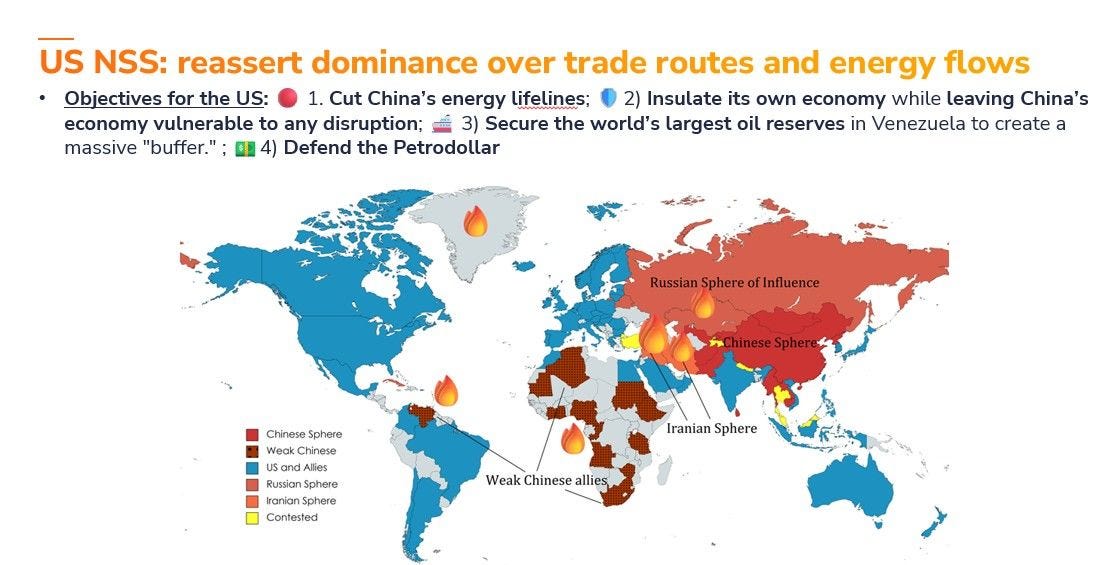
Venezuela was the second phase, executed before the first strike on Iran. In early 2026, the Trump administration moved against Caracas. The Venezuelan president was taken into custody. Oil exports to China, which had constituted a significant pillar of Beijing’s non-Western supply, were severed almost immediately. The sequencing was not coincidental: China’s supply from Venezuela, Russia, and Iran together formed the core of its energy independence from US-controlled corridors, and stripping one before the Gulf operation opened reduced the buffer Beijing could call on when the larger disruption arrived. The Joint Chiefs of Staff had warned Trump before February 28 that striking Iran would almost certainly close the Strait of Hormuz. He dismissed the assessment. When the closure came within hours of the strikes, the US Navy spent six weeks attempting and failing to reopen it. On April 13, Washington abandoned the pretense and launched a counter-blockade of Iranian ports instead, producing what analysts called a dual blockade, with Iran controlling passage through the strait and the US Navy interdicting all vessels attempting to reach Iranian territory. US Central Command confirmed it had intercepted or escorted back 31 vessels in the operation.
The Refinery Map
What happened to the Gulf’s physical energy infrastructure constitutes the most concentrated destruction of hydrocarbon production capacity since the Second World War. The International Energy Agency’s executive director Fatih Birol confirmed that more than 80 energy facilities had been struck across the theater by early April, with over a third severely damaged. Restoration to prewar production levels, he said, would take up to two years. The consultancy Rystad estimated the repair bill at between $34 billion and $58 billion including secondary damage.
The ledger is specific. Saudi Aramco’s Ras Tanura complex, the kingdom’s largest crude processing plant at 550,000 barrels per day of capacity, was struck by a drone in the first days of the war and halted operations. The Samref refinery, half-owned by Exxon Mobil Corporation, was hit on March 19. The 460,000-barrel-per-day Satorp facility, 62.5 percent owned by Aramco and 37.5 percent by TotalEnergies, halted production after strikes on April 7 and 8. The Saudi Press Agency’s April 9 statement confirmed damage to the Satorp and Riyadh refineries, the Ju’aymah gas-processing complex, the Manifa and Khurais oil-production fields, and the East-West pipeline. Ruwais in the UAE, one of the largest refineries in the world, suffered multiple fires from air-defense debris on April 5. Kuwait Petroleum Corporation declared force majeure and cut output. Bahrain’s Bapco Energies declared force majeure. Production at Iraq’s three main southern oil fields dropped 70 percent by March 8, from 4.3 million barrels per day to 1.3 million. Saudi Arabia cut production 20 percent, from 10 million barrels per day to 8 million, after the shutdown of two offshore fields including Safaniya, whose medium and heavy crude grades cannot be replaced by lighter substitutes without refinery reconfiguration. Collective Gulf Arab production had fallen by at least 10 million barrels per day by March 12.
In Qatar, the destruction was surgical in its financial consequences. QatarEnergy stopped gas liquefaction on March 2 and declared force majeure on all contracts on March 4. On March 18, Israel bombed Iran’s South Pars complex. Iran struck Ras Laffan the following day. Two production lines responsible for 17 percent of Qatar’s total LNG output were damaged. QatarEnergy valued the damage at $20 billion and estimated five years to full recovery. Satellite imagery analyzed by Bloomberg and the Energy Economics and Society Research Institute in Tokyo confirmed the assessment. The long-term contracts through which China, Japan, South Korea, and European buyers had secured Qatari LNG at pre-crisis prices were voided by force majeure. Those buyers were now competing for spot cargoes on a market that the war had deliberately tightened. In March 2026, the United States shipped approximately 11.7 million tons of LNG, reaching record export levels. In April, US crude and petroleum product exports rose to nearly 12.9 million barrels per day, also a record.
The most telling data point in the entire commercial record of the war belongs to ExxonMobil and QatarEnergy. The two companies are partners in Ras Laffan, the refinery struck in March. On April 22, three weeks after the ceasefire, they jointly celebrated the first LNG shipment from Golden Pass, Texas, where QatarEnergy holds a 70 percent majority stake. The ceremony was conducted at wartime LNG prices. Whatever the partnership lost in the Gulf it was recovering several times over in the Gulf of Mexico, on infrastructure it owns, in a country where no drone can reach it.
The Deindustrialization Cascade
The energy shock the war exported to Europe and Asia was not simply a humanitarian or economic cost. It was a mechanism for the next phase of the strategy, one that transfers not just energy revenue but the industrial base that consumes energy.
The logic was demonstrated during Ukraine. When Russian pipeline gas was cut from Europe in 2022 and US LNG became the primary substitute at spot-market prices, German steel producers, French glass manufacturers, and chemical companies across the continent faced energy input costs that made continued European production economically irrational. Some closed. Some relocated. The industrial migration that followed moved capital, assets, and operational headquarters into the American economy, where domestic energy prices remained lower and subsidies from the Inflation Reduction Act were available. The Iran war is that dynamic scaled and accelerated across every major importing economy simultaneously.
When energy costs make industrial production uncompetitive in Germany, Japan, South Korea, and Southeast Asia, the executives responsible for those facilities face a binary: reduce operations or find a lower-cost jurisdiction. The United States, with its domestic energy buffer, its accelerated LNG permitting, its Strategic Commercial Fleet program, and its tax credits for companies entering the American industrial circuit, is positioned as the destination jurisdiction by design. Each company that relocates brings its capital, its credit facilities, its dollar-denominated contracts, and its future procurement decisions into the US economic circuit. Companies rarely relocate twice.
The capital flow data makes the strategy visible in real time. US Treasury International Capital data for January 2026 showed net capital outflows from the United States of $25 billion, a standard figure for the period. In February 2026, the month the war began, net capital inflows into the United States reached $184.5 billion, a surplus swing of $209.5 billion in a single month. According to the US Bureau of Economic Analysis, total American exports jumped 4.2 percent to a record high of $314.8 billion in February 2026, driven almost entirely by industrial supplies and materials, with natural gas exports alone increasing by $1.3 billion in a single month. Within the February inflow, net private foreign investor capital reached $166.5 billion, meaning that the capital entering the US came primarily from private actors choosing to park assets in America, not from foreign governments or central bank reserve management. Private capital moves toward perceived safety and away from chaos. When Washington is the source of the chaos, and simultaneously the only economy shielded from it, private capital has nowhere else to go. That is not coincidence. It is the intended architecture of the system.
The global capital circuit that results from this dynamic has a self-reinforcing structure. European and Asian companies that relocate to the United States will, by the nature of their operating environment, denominate their transactions in dollars, purchase their energy inputs in dollars from US suppliers, and anchor their credit facilities in dollar-denominated instruments. Each relocation is a structural addition to dollar demand that does not reverse when geopolitical conditions normalize, because companies do not move back. The dollar strengthens not because the United States has created something the world wants, but because the United States has made everywhere else too dangerous to operate in.
The Maritime Chokehold Completed
The Combustion Mandate requires physical control of the sea lanes through which energy and industrial goods move, not only financial control of the pricing mechanisms. Washington has been building this capability through legislation and military posture for years, and the Iran war consolidated what the paperwork described.
At the start of the war, there were 80 US-flagged vessels in international commerce. China had 5,500. The SHIPS Act’s ten-year target of 250 new US-flagged vessels is not the endgame. It is the floor from which a much larger fleet is projected once the Trust Fund mechanism is capitalized by fees collected from Chinese-built vessels at US ports. The USTR’s Section 301 fees, which took effect in October 2025, impose costs on Chinese-linked operators with every port call. Those fees, flowing into the Maritime Security Trust Fund, subsidize the American shipbuilding expansion. Chinese shipbuilding dominance is being taxed to finance its own displacement. The requirement that US LNG exports travel on US-built LNG tankers ties the energy export revenue to domestic shipbuilding demand in a single clause.
The White House Maritime Action Plan released in February 2026 formalized the interagency framework for what Trump had announced in Congress in March 2025. A Maritime Security Advisor resident in the Executive Office of the President coordinates the Maritime Security Board, giving the US for the first time in decades a unified command structure over commercial maritime policy, naval force projection, and energy export logistics. The plan explicitly targets the replacement of Chinese-built infrastructure in ports and shipping lanes with domestic and allied-built alternatives. The phrase used in the SHIPS Act’s findings is “hardening critical maritime infrastructure and networks.” What it describes in practice is the construction of a supply chain over which no Chinese-built vessel, no Chinese-owned terminal equipment, and no Chinese-flagged carrier can transit without paying a toll that funds the system designed to replace it.
Control of the sea lanes matters for the Combustion Mandate because energy trade, unlike pipeline gas, is seaborne. LNG moves on ships. The country that controls the flag, the insurance, the terminal, and the routing of LNG carriers controls the fuel supply of every importing nation. This is what the petrodollar arrangement achieved through currency denomination. The Combustion Mandate achieves it through physical dominance of the maritime supply chain, with the currency denomination as a secondary reinforcing mechanism rather than the primary one. In the old system, Saudi Arabia could, in principle, have chosen to price oil in a different currency. In the new system, a buyer who needs US LNG carried on a US-flagged vessel, processed through a US-permitted terminal, financed through dollar-denominated instruments, and insured through Lloyd’s has fewer degrees of freedom.
Syria completes the picture at the other end of the supply chain. When the Assad government fell and US-aligned forces took Damascus, the Latakia and Tartous ports came under new management. Those ports had been Russia’s only Mediterranean naval facility and the Mediterranean terminus of the New Silk Road’s western extension. Chevron subsequently secured gas exploration rights in the Levantine basin. US companies obtained offshore agreements in Syria, Greece, and Cyprus. The Eastern Mediterranean gas corridor that emerges from these arrangements is the replacement for Nord Stream at the supply end: an artery running from Levantine fields through allied terminals to European markets, denominated in dollars, shipped through US-aligned infrastructure. Washington did not only destroy the existing energy architecture. It placed its own plumbing in the walls before the rubble was cleared.
What the Plan Gets Right, and Where It Breaks
The Combustion Mandate’s internal logic is coherent. The sequencing across theaters, Ukraine then Venezuela then the Gulf, removed supply pillars systematically. The legislative infrastructure, the SHIPS Act, the Maritime Action Plan, the USTR port fees, the LNG export requirements, was in place before the military operations created the market conditions that made it profitable. The commercial footprint, Chevron in Israel and the Levant, ExxonMobil and QatarEnergy at Golden Pass, Cheniere’s Corpus Christi contracts replacing Russian pipeline supply to Europe, was signed before the guns were fired. The capital flow data confirms the harvest was real. A $209.5 billion swing in a single month is not a market anomaly. It is a plan working.
The plan also has structural failure modes, and they accumulate in ways that Washington’s analysts appear to have priced as acceptable costs rather than terminal risks. Several of those assessments may prove wrong.
The first is the timeline problem. The US LNG capacity doubling is projected for the early 2030s. Power of Siberia 2, the overland gas pipeline from Russia’s western Siberian fields through Mongolia to China, has a preliminary agreement dating from Putin’s September 2025 Beijing visit and a construction timeline in the same range. If the pipeline completes before US LNG capacity reaches its projected levels, China will have a land-based energy supply that no carrier strike group can interdict and no USTR port fee can reach. Power of Siberia 1 already flows at its contracted 38 billion cubic meters per year and is being expanded to 44 billion. China’s domestic oil production has been raised from 3.8 million barrels per day to 4.4 million through state-directed investment. Beijing invested a record $625 billion in renewable energy in 2024. China’s own analysts frame the renewable buildout explicitly as a strategy to reduce the share of hydrocarbon imports in the economy and therefore the leverage that any external energy supplier can exercise over Chinese industrial competitiveness. The faster China electrifies its industrial base and transport network, the smaller the window during which the Combustion Mandate’s coercive logic applies to Chinese behavior. That window is a decade at most, perhaps less, and China is spending record capital to close it.
The second failure mode is the ally cannibalization problem. The strategy works by making energy expensive everywhere except the United States. Germany and Italy, per the ECB’s own assessment, face technical recession if the Iran war’s energy shock persists. Shell warned of European fuel shortages by April. European gas storage entered the spring injection season at 30 percent capacity, a five-year low, requiring 60 billion cubic meters of injection to meet the December regulatory target. The buyers scrambling to replace Qatari supply are not adversaries. They are the transatlantic alliance that Washington requires for sanctions enforcement, diplomatic backing, and forward basing rights. A European Union in stagflation, paying record prices for American gas while watching its industrial base erode toward relocation across the Atlantic, is not a stable partner. It is a resentful dependent, and resentful dependents find ways to create optionality over time. The EU’s political tolerance for a strategy that systematically destroys European industry while enriching American corporations is not unlimited, and Washington’s NATO naughty-and-nice list, sorting allies by their support for the Iran war, has identified which governments are already looking for exits.
The third failure mode is the dollar credibility problem. The weaponization of the dollar payment system, the seizure of Russian sovereign assets frozen in Western banks, the secondary sanctions threatening India and China for transacting with Moscow, the use of financial infrastructure as coercive blockade rather than neutral settlement mechanism, has accelerated every country that holds dollar reserves into some form of hedging. Russia has shifted to yuan, rupee, and ruble settlements for energy transactions. Iran is charging Hormuz transit tolls in yuan. China’s yuan-denominated oil purchasing mechanism through the Shanghai exchange continues to process transactions. The BRICS payment architecture under development, spanning CIPS, SPFS, and SEPAM across the Moscow-Tehran-Caracas-Beijing axis, is not a parallel system that exists in the future. It is infrastructure already carrying traffic. De-dollarization, as an observable trend in reserve composition, central bank purchasing behavior, and bilateral trade settlement, was accelerating before the Iran war and is accelerating faster afterward. The dollar’s share of global foreign exchange reserves had already fallen below 60 percent from over 70 percent at the turn of the century. The Combustion Mandate’s financial reinforcement mechanism, the recycling of energy revenues through dollar-denominated instruments, requires a dollar whose global reserve status is intact. If the reserve status continues to erode, the mechanism weakens even as the physical energy control intensifies.
The fourth failure mode is the most structurally interesting, and it is the one that the analyst framing of resistance-versus-empire most consistently understates. The Combustion Mandate depends on the permanent suppression of physical alternatives through military force and maritime interdiction at a cost that grows with every theater it expands into. Ukraine cost the United States an ongoing commitment that the Trump administration has attempted to monetize through mineral rights extraction from Kyiv. The Iran war has cost over $200 billion in direct expenditure and is ongoing. Venezuela required operational resources. Syria required backing a transition that is still contested. The Arctic Transpolar route is already being surveilled and pressured before the ice has fully retreated. Each new theater requires naval assets, diplomatic capital, and domestic political tolerance for costs that are distributed across American consumers and taxpayers even when prices are buffered at the margin. The gasoline price rises of 5 to 10 cents per gallon daily during the peak of the Iran crisis were felt in the United States. Fertilizer shortages caused by the LNG disruption, which will reduce corn yields through 2026 and into 2027, will be felt on American grocery shelves. The empire that cannot fight wars at home is nonetheless running the inflation and the debt service of its wars through its own fiscal system.
The history of the strategy being attempted is not encouraging for its architects. Vietnam did not break American power. Afghanistan did not break it. The Iran humiliation, as the military outcome is being correctly described, did not break it. But none of those failures accelerated a competitor’s infrastructure buildout the way the current campaign is accelerating China’s. Beijing is not fighting Washington’s military. It is building the infrastructure that makes the military coercion irrelevant: overland pipelines, domestic renewable capacity, alternative payment systems, and a shipbuilding industry that already holds 75 percent of global new vessel orders, against which the SHIPS Act’s target of 250 vessels over ten years is a rounding error. China’s CSSC builds more ships in a quarter than the United States has built in a decade. The race between Washington’s capacity to lock buyers into dollar-denominated LNG contracts before the alternatives arrive, and China and Russia’s capacity to make those alternatives operational, is not a race Washington is winning.
The deeper limit of the Combustion Mandate is not military or financial. It is political. The Global South watched the Iran war produce a global energy emergency, watched the world’s largest economy refuse to help any of the countries caught in the crossfire, and watched American energy companies break export records during the weeks that Nepal was delivering half-cylinders of gas to consumers and Myanmar was rationing fuel on alternate days. Philippines, Bangladesh, Zimbabwe, Pakistan, and Nigeria did not conclude from that experience that Washington was a reliable guarantor of their energy security. They concluded the opposite, and the infrastructure contracts they sign over the next decade will reflect that conclusion.
In the past, Washington toppled governments to take their oil. The innovation of the current period is that Washington uses its own oil to topple governments. The template was tested in Ukraine, where the US did not need to seize Russian reserves at the source. Through sanctions, infrastructure sabotage, and market displacement, it locked Russia out of the European market and transferred the revenue stream to American exporters. The Iran war scales that template globally. If the template holds, Washington will have engineered the most durable structural advantage in energy markets since 1974, without firing a shot at home, while its competitors bleed in distant theaters.
Whether it holds depends on three variables that no energy projection can capture. The first is whether China completes its overland energy independence infrastructure before the US LNG doubling locks Asian buyers into long-term contracts. The second is whether the European industrial migration to America produces enough political resentment inside the transatlantic alliance to fracture the sanctions architecture that makes Russian energy permanently uncompetitive. The third is whether the cost of running the global blockade, in dollars, in diplomatic capital, in domestic political tolerance, exceeds the revenue the energy monopoly generates before the alternatives arrive.
All three of those races are in progress. None of them is decided. The Combustion Mandate is a plan that works perfectly in its own logic. Whether the world it assumes will hold long enough for the plan to fully execute is the question its architects cannot answer, because the answer depends on the choices of people in Beijing, Moscow, Brussels, and across the Global South who watched what was done and are now deciding, quietly and through infrastructure contracts rather than press releases, what they intend to do about it.


