The Controlled Burn
How India’s State Made Manipur Ungovernable, Then Blamed the Fire
A forensic laboratory in India analyzed an audio recording submitted to the Supreme Court by a Kuki civil society body. The recording featured a voice identified as belonging to N. Biren Singh, the Chief Minister of Manipur from 2017 to February 2025. In the recording, the speaker claims to have personally instigated the ethnic violence that began in Manipur on May 3, 2023. The laboratory assigned that voice a 93 percent probability of belonging to Singh. Singh denied the recording was authentic. He had been denying things in Manipur for twenty months. In February 2025, facing an imminent no-confidence vote in the state assembly, he resigned. No senior official or militia commander was prosecuted. The accountability clock in New Delhi does not run on Manipur time.
That recording is not the beginning of this story. It is closer to the middle.
The Petition That Became a Pretext
In March 2023, the Manipur High Court issued a recommendation asking the state government to forward a request to the central government that the Meitei community be included in the Scheduled Tribes category. Scheduled Tribe status in India carries significant entitlements: reservation quotas in government employment and education, and, crucially, the right to own land in designated tribal hill areas of Manipur. The Meitei constitute roughly 53 percent of the state’s population but are concentrated in the Imphal Valley, which accounts for only ten percent of Manipur’s geographic area. The surrounding hills, comprising 90 percent of the territory, are the homeland of 34 tribal groups broadly categorized as Nagas and Kukis, who already hold Scheduled Tribe status and, through that status, a degree of legal protection over their ancestral land.
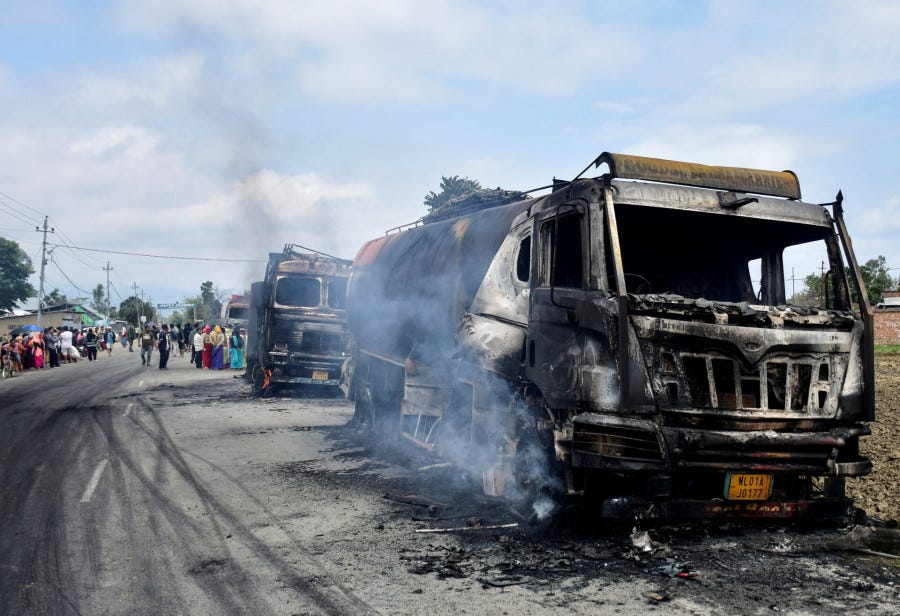
The tribal communities understood the court’s recommendation precisely. An ST classification for the Meitei would not simply reclassify an ethnic group. It would, over time, dissolve the legal barrier separating Meitei capital and political power from tribal land. On May 3, the All Tribal Student Union of Manipur organized a solidarity march across the ten hill districts to protest the recommendation. The march turned violent in Churachandpur district. Within days the violence spread to Imphal East, Imphal West, Bishnupur, Tengnoupal, and Kangpokpi. By the end of May, an estimated 67,000 people had been displaced, a figure that accounted for 97 percent of all conflict-driven displacement across the entirety of South Asia in 2023, according to the Geneva-based Internal Displacement Monitoring Centre. The highest number, the Centre noted, since 2018.
The official line from Singh’s government, faithfully carried in central government public communication, was that the violence was spontaneous, driven by long-accumulated ethnic grievance, and that state forces were working to restore order. Each element of that formulation was false.
The Architecture of the Militia State
The principal Meitei armed organizations that led attacks on Kuki-Zo communities after May 3 were Arambai Tenggol and Meitei Leepun. Arambai Tenggol formally announced its dissolution on May 26, 2023. In September 2023, its cadres were photographed in police commando uniforms, operating at the Pallel security checkpoint. The dissolution was administrative theater.
Human Rights Watch documented that Singh’s administration, including the Manipur Police, actively protected both organizations. They participated in the counter-rallies on May 3 and continued operations throughout the months that followed without meaningful prosecution. Indian Army intelligence assessed that approximately 100 active cadres of the Valley-based Insurgent Groups, formally classified as banned organizations, crossed from Myanmar to fight alongside Meitei armed groups. Surrendered cadres of those same groups were assessed to have trained civilian mobs in the use of looted military arms.
The looting of state armouries was not a secondary symptom. It was a structural fact. By October 2023, an estimated 6,000 weapons and 600,000 rounds of ammunition had been taken from police facilities, along with mortars, grenades, bulletproof vests, and police uniforms. Only approximately one quarter had been recovered by the time assessments were last made public. Governor Ajay Kumar Bhalla was still issuing public appeals for voluntary weapon surrender in late February 2025, extending the deadline as late as March 6 of that year. The state had spent twenty months politely asking armed men to return state property.
Singh’s framing of the Kuki-Zo community in the period before the violence was systematic and specific. He characterized Kuki villages as centers of poppy cultivation, narco-terrorism, forest encroachment, and harboring of illegal immigrants from Myanmar. Investigative reporting by The Caravan demonstrated that his “war on drugs” was operationally concentrated against Kuki villages. The substantial Meitei stakeholders in Manipur’s narcotics economy faced no equivalent state action. Security forces destroyed more than 2,618 acres of poppy cultivation between November 2025 and February 2026 in drives concentrated almost exclusively in Kuki-dominated hill districts. Independent scholars and human rights monitors described Singh’s rhetoric as racially coded and deliberately designed to manufacture consent for organized violence against a minority community.
The Indian Supreme Court’s eventual assessment was unambiguous. It described the situation in Manipur as an “absolute breakdown of law and order.”
Seventy-Six Days
On May 4, 2023, one day after the violence began, a Meitei mob in B. Phainom village in Kangpokpi district stripped two Kuki-Zo women, marched them naked toward a paddy field, and gang-raped them. Two men accompanying the women were beaten to death. The Indigenous Tribal Leaders’ Forum issued a statement documenting the attack. A media blackout, enforced through internet shutdowns and restricted press access to the conflict zones, ensured no national coverage followed.
The video circulated on social media on July 19, 2023. Seventy-six days had passed since the assault. Narendra Modi spoke publicly about Manipur for the first time on July 20, the opening day of Parliament’s Monsoon Session, in response to a question he could no longer avoid. He called the incident shameful and said perpetrators would not be spared. He mentioned Rajasthan and Chhattisgarh in the same breath, a rhetorical move designed to distribute responsibility across opposition-governed states and away from the BJP administration in Imphal. One suspect, Heradas, 32, was arrested the same afternoon, identified through his green shirt in the viral footage.
Modi did not visit Manipur at any point during the violence. Singh, who admitted in a prime-time television interview that he had been aware of hundreds of rapes and murders since the conflict began, remained in office for another nineteen months.
One of the two gang-rape survivors, a 20-year-old Kuki-Zo woman, died in January 2026 from injuries and trauma sustained in the May 4 attack. She waited two and a half years for compensation that never came and an acknowledgement that was never formally issued. She was not named in the new Chief Minister’s March 21, 2026 peace address. She was not named anywhere official.
The History They Do Not Teach in Imphal
Manipur’s incorporation into India was not negotiated. It was administered. The Kingdom of Manipur, which had maintained sovereignty for centuries and resisted British annexation in the Anglo-Manipur War of 1891, signed an Instrument of Accession in August 1947 under the terms available to Indian princely states at the moment of British departure. Two years later, in October 1949, the Indian government merged Manipur into the union as a centrally-administered territory over the objections of its elected assembly. The Meitei refer to that annexation as the Merger. Armed resistance began almost immediately. The People’s Liberation Army of Manipur, the United National Liberation Front, and a series of successor organizations have maintained some form of insurgent presence since 1949. The state was placed under the Armed Forces (Special Powers) Act in 1980, a law granting security forces the authority to arrest, search, and shoot without civilian judicial oversight and with near-total immunity from prosecution. AFSPA remained in force in much of the Imphal Valley until 2004 and continues in the hill districts today. There has been no comprehensive accountability for the abuses committed under it. The demand for its repeal has been on the table at every formal negotiation since it was enacted.
The 1997 ceasefire with the National Socialist Council of Nagalim (Isak-Muivah), the principal Naga insurgent organization active across both Nagaland and Manipur, produced peace talks with New Delhi that have continued for nearly three decades without resolution. The territorial demands underpinning those talks, a unified Nagaland that would absorb Manipur’s northern districts, have never been withdrawn. The Meitei, aware simultaneously of the NSCN talks and the Kuki-Zo demands for a separate administration, understand their community to be a Hindu majority squeezed between two sets of Christian tribal territorial claims and a central government that has spent 75 years managing, rather than resolving, every question of sovereignty in the northeast. That reading of their situation is not without basis. It has also been consistently instrumentalized by Meitei ethnic nationalist organizations, and from 2017 onward, by the state government.
The Scheduled Tribe petition of March 2023 was not the cause of what followed. It was the ignition point for a structure that had been built, beam by beam, across decades.
What the Camps Look Like
Amnesty International’s May 2025 report, published on the second anniversary of the violence, found that more than 50,000 internally displaced persons from both communities remained in relief camps across Manipur. The camps had inadequate food, insufficient medical access, poor sanitation, and no formal rehabilitation timeline attached to them. Journalists who reached the camps documented severe overcrowding. Women who had survived sexual violence were living in the same open facilities as communities that had expelled them. There was no separation, no counseling provision, and no security arrangement that acknowledged what had happened to them.
The state itself had, by the end of 2023, divided along a line of armed checkpoints and buffer zones. Both communities held armed positions on their respective sides. The buffer zone was patrolled by central forces, creating the operational geography of partition without the political acknowledgement that would force a constitutional response. A physical and demographic separation that should have triggered emergency legislative intervention had instead been allowed to calcify into administrative fact. New Delhi called it a security arrangement. The people living behind the checkpoints called it a border.
In December 2025, 97 Meitei families totaling 389 individuals were resettled in Torbung village in Bishnupur district under a government-managed return program. The Kuki civil body immediately objected, calling the move unilateral and unsafe. There was no equivalent resettlement program for Kuki-Zo displaced persons, who constituted the far larger share of those still in camps. Over 220 churches had been officially recorded as destroyed across the conflict zone. The United Christian Forum placed the actual figure above 500.
The gap between those two numbers is a measure of the state’s relationship to the communities it governs.
The Political Arithmetic of Ruin
In the 2024 general election, Singh’s BJP lost both of Manipur’s parliamentary seats to the Indian National Congress. The result was specific and deliberate. Voters in a state governed at every level by the BJP used the first available national ballot to record a verdict on twenty months of ethnic crisis management. In October 2024, the National People’s Party, a coalition partner, withdrew its support from the Singh government. Nineteen BJP legislators sent Modi a letter demanding Singh’s removal.
Singh resigned on February 9, 2025. His resignation letter thanked the central government for its timely interventions. On the same night, unidentified gunmen raided the India Reserve Battalion outpost in Thoubal district and left with six SLRs and three AK rifles. The state produced its replacement chief minister and a new arms theft in the same twenty-four hours.
President’s Rule was imposed on February 13, 2025. It was not peace. It was inventory management. Yumnam Khemchand Singh, a BJP politician and known internal critic of his predecessor, was sworn in as Chief Minister on February 4, 2026, after the NPP reversed its position and extended support to another BJP-led formation. On March 21, 2026, he convened what was described in the press as the first direct dialogue between Meitei and Kuki-Zo representatives in three years. Analysts who observed the meeting noted, with varying degrees of tactfulness, that the agenda contained no item on accountability for specific atrocities, no mechanism for the return of displaced persons, no framework for resolving tribal land protections, and no constitutional language on the Kuki-Zo demand for a separate administration. What the meeting produced was a photograph.
Thirteen days later, at 1:00 a.m. on April 7, a bomb struck a civilian house in Tronglaobi village in Bishnupur district. Two children died in their sleep. Their father is a BSF jawan. Their mother was critically injured. The National Investigation Agency opened an inquiry. The Bishnupur-Churachandpur Highway had been blocked for twelve days by the time this piece was filed, hampering the probe to the point where investigators had not yet secured any CCTV footage from the area. Five people have been killed across Manipur since April 7 in separate incidents. No arrests have been made in any of the cases.
On the evening of April 20, 2026, thousands of people took to the streets across the Imphal Valley under the All Manipur United Clubs Organisation and COCOMI banners, demanding arrests in the bombing and immediate action against Kuki militant groups in the hill districts. Night rallies ran simultaneously in Koirengei and Hatta Golpati in Imphal East, across Kakching district, and at Mayai Lambi in Imphal West. Security forces used tear gas to disperse crowds. The new Chief Minister’s peace meeting was seventeen days old.
The Accountability That Did Not Come
The forensic laboratory finding was submitted to India’s Supreme Court: a 93 percent probability that the voice on the tape, the voice claiming to have personally instigated the May 2023 violence, belonged to Biren Singh. Singh denied the tape’s authenticity. His party transferred him out of office rather than prosecute him. As of April 2026, the recording has not triggered a formal criminal investigation. The Supreme Court, which itself described Manipur as an “absolute breakdown of law and order,” has issued no accountability directive carrying the force of a prosecution order.
The Arambai Tenggol cadres who operated in police uniforms, the India Reserve Battalion personnel whose armouries were emptied and whose weapons are still circulating in the conflict zone, the officials who ran an ethnically targeted narcotics campaign while protecting Meitei drug operators, the officers who pressured a Kuki victim’s family to withdraw a complaint against militia members who had detained and assaulted them: none of them have faced trial. Amnesty International noted Singh’s resignation did not constitute justice.
The Question the New Government Will Not Answer
India’s constitutional framework contains provisions for the reorganization of states. The Union Territory status that Kuki-Zo leaders have demanded for their hill districts would require an act of Parliament. The Meitei political position, hardened across three years of armed ethnic conflict, is that any territorial reorganization rewards violence. The Kuki-Zo position, stated plainly by their political organizations, is that three years of shared governance with a state government that documented evidence implicates in their persecution has settled the question of whether the existing administrative arrangement can protect them.
Both positions are, from within their own logic, coherent. Neither produces a state.
The new chief minister’s March 21 meeting was attended. It was described. It was then followed by a bombing that killed two sleeping children in Bishnupur, five subsequent deaths, a highway blockade that is blocking its own investigation, and street protests demanding action from a government that has not yet demonstrated it knows what action means in constitutional terms. Whether New Delhi possesses the political will to offer the Kuki-Zo communities any arrangement short of separation that they would find credible is the question that every peace meeting, every new chief minister, and every President’s Rule has so far deferred.
Manipur has been deferring since 1949.


