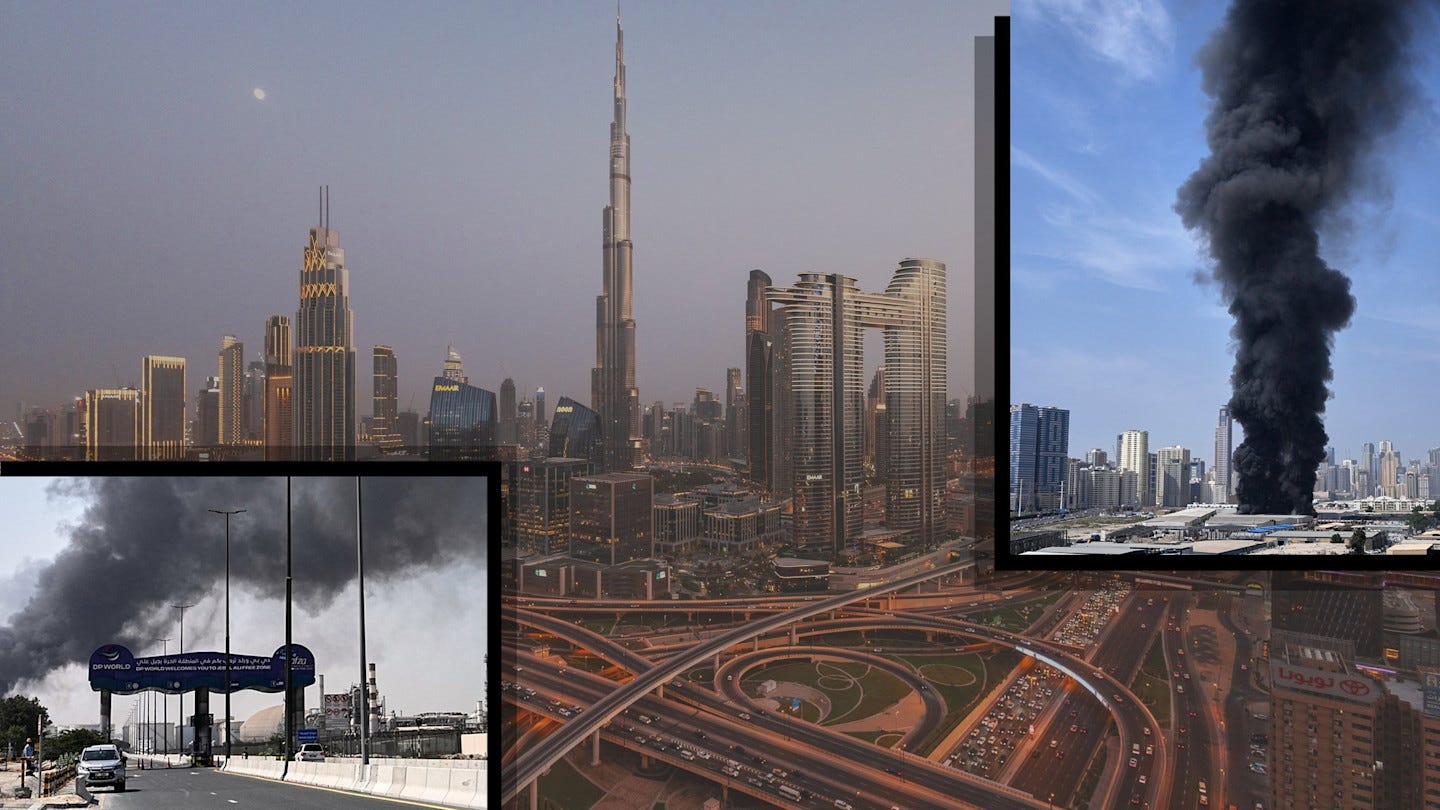
The Cranes at Jebel Ali
A document signed on a White House lawn in 2020 is now a fuel depot fire near Terminal 3. Dubai is paying the price of a bad choice
At 1:30 on Monday morning, a drone found the fuel tank near Terminal 3 at Dubai International Airport and lit it. The fire burned for fifteen hours. Black smoke rose over the concourses in the dark, visible from the city’s skyline, which is to say visible from nearly everywhere, because Dubai built its skyline to be seen from everywhere. All flights suspended. Emirates halted. flydubai halted. Passengers on approach from Rome were diverted to Al Ain, 130 kilometers across the desert, and bused back.
This was the third attack on the airport in seventeen days. The first injured four workers: two Ghanaians, one Bangladeshi, one Indian. The departures board has been showing red letters long enough now that the airlines have stopped expressing surprise in their statements.
Nobody built a city like this expecting it to burn. That is the point. That is the only point.
Dubai was not built as a city. It was built as a proof.
The proof was this: that an Arab Gulf emirate could take the money from the ground beneath it, leverage that capital into the world’s largest artificial harbor, the world’s busiest international airport, the world’s tallest building, and position itself permanently beyond the reach of the conflict surrounding it on every side. The towers were not decorative. They were the argument. We have made ourselves too connected to punish, too useful to target, too valuable to touch.
In 2025, 9,800 millionaires moved to Dubai, bringing an estimated $63 billion. Tax-free. Skyline-magnificent. Legally clean. The city was running at the peak of its own thesis: a stateless global capital for stateless global capital, 92 million passengers a year transiting through an airport that connected every city on earth to every other city, with Dubai as the hinge. Indispensability, the city argued in glass and steel, is the only security that lasts.
The fuel depot near Terminal 3, burning at 1:30 in the morning, is the answer to that argument. Not a counterargument. An answer.
The Abraham Accords were signed on the White House lawn on September 15, 2020. The phrase used most often in the weeks that followed was “new architecture.” It was architecture, in the sense that it was deliberately constructed. But it was not new. It was the political expression of the same thesis that built the towers and the port: align with power, buy into the dominant security order, make yourself so embedded in the structure of the winning side that the losing side cannot touch you without touching the winning side too.
The UAE did not drift into this. Confident men made confident choices. Abu Dhabi got F-35 negotiations and the political adjacency to Washington and Jerusalem that five decades of American hegemony had made extremely valuable. Israel got the Gulf. Washington got the photograph. And what followed was systematic: Crystal Ball, the joint UAE-Israel intelligence platform; the Hermes 900 drone negotiations; nine rounds of the US-UAE Joint Military Dialogue on integrated air and missile defense before the war began. Each agreement was rational. Each agreement was a brick in the same building.
Al-Dhafra Air Base sits forty kilometers south of Abu Dhabi and had hosted American military personnel since the 1990s. After the accords it became something structurally different: the visible, operational, daily confirmation that the UAE’s thesis about security through alignment was not rhetorical. By February 2026 it was part of the infrastructure for strikes inside Iran. The IRGC built a full-scale replica of Al-Dhafra months before the war began and practiced on it. The replica was not secret. The UAE government read the same reports every analyst read.
This is the detail the city’s promotional materials never addressed: the Abraham Accords were the glamour by other means. The modernism, the F-35s, the White House lawn ceremony, the intelligence platform named like a technology product — they were the same argument the towers made, extended into foreign policy. We have bought our place in the future. We are too modern to be punished. Then the US struck Kharg Island, which processes 90 percent of Iran’s oil exports, from UAE territory. Iran announced that every non-American asset in the UAE was now a legitimate target. At 1:30 in the morning on the seventeenth day of the war, a drone found the fuel tank near Terminal 3.
The city was not attacked despite the glamour. It was attacked because the glamour and the choices were the same building.
Since February 28, the UAE Ministry of Defense has confirmed 304 ballistic missiles, 15 cruise missiles, and 1,627 drones launched toward UAE territory. Of those, 65 drones fell inside the country’s borders in the first week alone after evasion or failed intercept. The cumulative count across all Gulf states now exceeds 2,000.
The UAE did not go to war. It hosted a war, participated in its operational infrastructure, and is now absorbing its arithmetic. The Patriot batteries and THAAD installations are doing their work and mostly holding. But the intercept systems address the missiles. They do not address the premise.
Fujairah, on the Gulf of Oman, is the UAE’s only significant oil export route outside the Strait of Hormuz — the door that stays open when the strait is functionally closed. On March 14, Iranian drones struck the Fujairah Oil Industry Zone. Satellite imagery showed two storage tanks still burning by morning. Ship-to-ship transfers halted. On March 16, Fujairah was hit again. ADNOC crude oil loadings remained suspended as of Monday evening. Iran had pre-announced this: three days before the strikes, Tehran named Jebel Ali, Khal, and Fujairah as legitimate targets and told residents near the ports to evacuate.
The legal claim was contested. The missiles were not.
When Jebel Ali stops moving and Fujairah burns and the airport is on fire, the map has been closed from every commercial exit simultaneously. Jebel Ali handles 36 percent of Dubai’s GDP. Fujairah was the contingency. The airport was the premise. They are all burning or stopped on the same day, for the same reason, because they were all built on the same thesis and the thesis has a geography that it cannot leave.
The four people hurt on February 28 at Dubai International were not decision-makers. They were an airport shift: two Ghanaians, one Bangladeshi, one Indian. Part of the roughly 88 percent of UAE residents who hold foreign nationality and no political standing in the state whose choices govern the country’s strategic posture. They had no seat at the accords table. They were working a concourse.
The UAE’s entire political economy runs on this structure: a small ruling class making choices of global consequence, and nine million workers from South Asia, Southeast Asia, and East Africa absorbing those choices without participation. When the bill arrives it arrives at the gate staffed by people from Accra and Dhaka. It also arrives at the Dubai Financial Market, suspended for two days in early March. It arrives at the offices where Iranian businessmen — 700,000 Iranians live in the UAE, and Iranian capital kept Dubai’s property market liquid through a decade of American sanctions — are watching the value of what they bought inside a country facilitating the bombing of their homeland recalculate in real time.
No one has committed to a precise figure for what this costs. That silence from the financial desks is itself information.
The Strait of Hormuz is seventeen nautical miles wide at its narrowest. The UAE’s eastern coastline runs along it. Al-Dhafra is forty kilometers from Abu Dhabi. Fujairah is the only door outside the strait. Dubai International Airport is built at the geographic center of a two-hour flight radius covering a third of the world’s population. None of these facts were created in September 2020. All of them were given new political meaning in September 2020.
Before the accords, the UAE maintained enough strategic ambiguity to function as everyone’s neutral ground. Tehran and Dubai were quietly interdependent. The Iranian diaspora lived in the city. The informal economy moved in both directions. The UAE’s value to the world depended precisely on its distance from the region’s central conflict. The accords ended that distance by design. The rulers calculated that the protection of the dominant empire was worth more than the insurance of equidistance. They were buying out of geography.
Geography does not sell.
Singapore sits three hours from the South China Sea and has built a sovereignty model across sixty years that requires no great-power guarantor: hedged, equidistant, indispensable to all parties, never the forward operating platform for any single patron’s regional agenda. The UAE chose the opposite. It made itself the platform. It marketed the platform as progress.
An Emirati official told CNN that rebuilding trust with Iran could take “decades.” That word — decades — is the longest unit of time an official will produce voluntarily. It is almost always the one honest figure in the statement.
The fire near Terminal 3 was extinguished fifteen hours after ignition. Emirates announced a partial resumption of flights. The ceasefire talks in Oman have produced no confirmed terms and no confirmed timeline. Iran’s foreign minister told CBS on Sunday night that Tehran was not at the table and was not coming to the table. Trump said Iran wanted to talk. The strait remains functionally closed by insurance markets doing the arithmetic the missiles advertised.
This city was built to prove that geography could be defeated by capital. That money, architecture, and commercial indispensability could insulate a state from the violence of its own location. For three decades the proof held. The towers stood. The flights connected. The millionaires arrived.
Then the men who governed the city signed a document on a lawn in Washington because they believed the empire that hosted the signing ceremony would protect what they had built. The empire is conducting its war. The city is on fire at 1:30 in the morning.


