The Cylinder and the Strait
How Washington’s War Reached India’s Poorest Kitchens
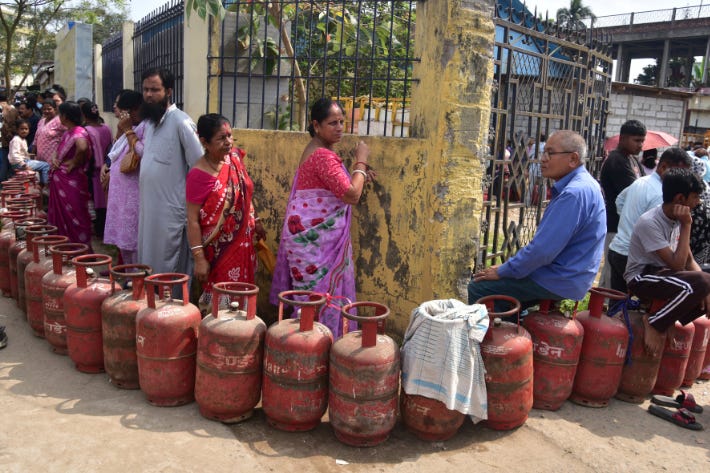
The blue LPG cylinder in the corner of Sunita Devi’s kitchen in Noida Sector 63 has been empty since the third week of March. She knows the date because she marked it in the small notebook she keeps for household expenditures, the same notebook that records her husband Ramesh’s fortnightly wage from the plastics factory three kilometers away: Rs 10,200 per pay period. The refill costs Rs 913 now, up from Rs 853 in early March, and the commercial cylinder her neighbor Kavita uses for her small tea stall costs Rs 1,883. Sunita is not cooking on LPG this week. She bought a small bag of wood charcoal from the vendor near the main road, the kind sold for barbecues, and she heats the dal on that. The smoke fills the single room that serves as kitchen and bedroom both. Her two daughters sleep through it; they are used to it.
She is not exceptional. She is representative.
The war that the United States and Israel launched against Iran on February 28, 2026, has consumed, in its first fifty-three days, a great quantity of commentary about strategic depth, nuclear thresholds, and the geopolitical futures of the Gulf states. It has consumed rather less commentary about Sunita Devi’s cylinder. This is a piece about the cylinder.
The Pipe That Runs Through Hormuz
India imports between 80 and 85 percent of the LPG it consumes. Qatar, the UAE, Saudi Arabia, and Kuwait are the dominant suppliers. Every shipment from every one of those four countries passes through the Strait of Hormuz, the 33-kilometer-wide passage at whose narrowest point the usable shipping lanes are each three kilometers wide, the same lanes that Iran’s Revolutionary Guard effectively closed in the hours following the American strikes on Fordow, Natanz, and Isfahan. The IRGC’s warning over VHF radio was not legally a blockade declaration but it achieved the same result: maritime intelligence tracking showed an 80 percent drop in traffic through the corridor within days. Most commercial operators, major oil companies, and their insurers withdrew.
India’s LPG market runs on a pricing mechanism tied directly to Saudi Aramco’s monthly Contract Price, which itself tracks global benchmark movements. When the Argus Far East Index propane swap hit $611 per tonne in late February, up from $566.50 just days before the war began, the transmission was automatic and arithmetically certain. On March 7, India’s state-run oil marketing companies: Indian Oil, Bharat Petroleum, and Hindustan Petroleum, raised the price of a domestic 14.2-kilogram cylinder by Rs 60 across the country. It was the second domestic hike in under a year. The commercial cylinder absorbed a separate Rs 114.50 increase that same day, following an earlier Rs 28 increase on March 1, bringing the total commercial hike for 2026 alone to Rs 302.50.
The government has maintained a Rs 300 subsidy per cylinder for up to twelve refills annually under the Ujjwala Yojana scheme, which covers over 100 million poor households. The subsidy arithmetic has a flaw. Ujjwala beneficiaries receive Rs 300 off a cylinder now priced at Rs 913. They pay Rs 613. Before the first Ujjwala rollout in 2016, many of these same households cooked on wood and dung. The program made headlines for bringing clean cooking fuel to rural India. What is less discussed is that the subsidy ceiling was set years ago and has never been indexed to the price it was meant to offset. As the price climbs, the distance between the subsidy and the cost widens at every increment. Analysts at Wood Mackenzie warned in early March that if Brent crude crosses $120 per barrel, India’s domestic LPG price could cross Rs 1,000 per cylinder before the financial year ends. As of mid-March, Brent stood at $100, up 13 percent since the war began.
For the Ujjwala beneficiary, the question is not ideological. It is arithmetic. Rs 613 for a cylinder, on a household income that may be Rs 8,000 to Rs 12,000 a month, means a single cooking fuel refill absorbs somewhere between five and eight percent of the month’s income. When the cylinder empties faster than the budget allows, the household returns to biomass. The smoke returns. The respiratory disease that the Ujjwala program was specifically designed to reduce comes back. Migration experts and labor economists have a name for this sequence. They call it welfare rollback without policy change.
The Kerala Equation
There is a second pipeline, less visible than the LPG supply chain, that connects the Strait of Hormuz to India’s poor. It runs through remittances.
Nine million Indians live and work across the six Gulf Cooperation Council countries. They are not evenly distributed across class. A portion are professionals: engineers, accountants, physicians. The majority are not. They work in construction, hospitality, domestic service, and logistics. They fill the tanks, pour the concrete, staff the hotel kitchens, and drive the delivery vehicles of the Gulf’s energy infrastructure. Their monthly earnings, transferred home through mobile banking platforms and hawala networks, amounted to $135.46 billion in the fiscal year ending March 2025, a record high, according to Reserve Bank of India data. Between 38 and 40 percent of India’s total inward remittances originated in the GCC countries.
Kerala sits at the center of this system. According to the Kerala Migration Survey of 2023, the state received $23.4 billion in remittances that year, an increase of more than 150 percent since 2018. One in four families in Kerala has a direct connection to Gulf migration. The money pays school fees, hospital bills, house construction installments, and the daily grocery costs that a Kerala agricultural wage could not cover. It is not supplementary income in any meaningful sense; it is the income.
A potential 20 percent drop in remittances from the Gulf, which migration researchers studying the war’s economic trajectory now consider a realistic near-term scenario, would translate to a loss of approximately $5.39 billion to Kerala alone. Migration experts studying the conflict have described it as the most severe crisis faced by Indian migrant workers in fifty years, a framing that places it above the 1990 Gulf War, above the 2009 financial crisis, above the COVID-19 period that sent 900,000 Keralites home in a matter of months.
Over 220,000 Indian nationals had been repatriated from the GCC region and Iran by March 2026. Several Indian blue-collar workers reported to Al Jazeera that they feared job losses if the war escalated further, a fear grounded not in speculation but in the observable contraction of Gulf economic activity as the Hormuz disruption raised operating costs across every energy-adjacent sector. Iranian drone and missile attacks reaching Dubai and Bahrain in early March killed several Asian workers, Indians among them. The Indian government’s capacity for evacuation at scale, given a diaspora that forms the largest expatriate community in most Gulf nations and numbers in the millions, is a logistical problem with no clean solution.
For the worker who comes home without his savings, who left his village in Bihar or Kerala four years ago and sent back what he could every month, return is not a relief. His family spent those remittances as they arrived. There is no reserve. The house that was half-built is half-built. The loan from the cooperative bank is still running. He arrives back in a village economy that did not create a job for him when he left and has not created one while he was gone.
The Factory Floor in Noida
By the third week of February 2026, the Migrant Workers Solidarity Network had already counted 28 major industrial strikes across India in the preceding three months. The number was not a coincidence. It was a register of pressure that had been building through wage stagnation, rising costs, and the new Labour Codes implemented by the Modi government in November 2025, which expanded employer rights to hire and dismiss contract workers. The cost shock of the Iran war hit that system with the effect of a lit match in a room already full of gas.
On April 10, workers in the National Capital Region walked off their jobs. The immediate trigger in Haryana was the state government’s announcement of a 35 percent minimum wage hike, a number that workers across the border in Uttar Pradesh recognized as an implicit indictment of their own wages. The movement spread to Noida industrial clusters within days. By April 13 to 14, police deployed in force, firing tear gas and arresting over 350 workers in Noida alone. Workers threw stones and overturned police vehicles. Uttar Pradesh Chief Minister Yogi Adityanath labeled the protests a Naxal conspiracy, then announced a 21 percent minimum wage hike.
The NCR is home to approximately 15,000 manufacturing units, domestic and transnational, employing around 4.5 million workers. Most hold contract or temporary positions. Their monthly earnings range from Rs 10,000 to Rs 15,000, with the majority at the lower end of that band. Workers across the region are demanding Rs 23,000 per month as a basic living wage. Between 2021 and 2026, the all-India inflation rate for industrial workers, measured by the Consumer Price Index for Industrial Workers, rose by 24.8 percent. Average wage hikes in states like Haryana over the same period averaged 15 percent. The gap between those two numbers is where the protests live. Workers told researchers that they were paying as much as Rs 4,000 for LPG cylinders on the black market because formal supplies were rationed or delayed. That is more than four times the official price, on wages that leave nothing for a margin.
The government’s response was to invoke state police authority and, separately, to reiterate that fuel stocks remained adequate. The first response cleared the roads. The second addressed a different question than the one being asked.
The workers in the NCR factories are predominantly migrants from Bihar, Uttar Pradesh, West Bengal, and Jharkhand. They came to the NCR industrial belt for the same reason their cousins went to Dubai: the village could not hold them. The urban factory could. Now the factory is absorbing a cost shock it cannot pass entirely to its clients, because its clients are themselves absorbing a cost shock, and the first savings the factory finds is in the wage.
The Field That Feeds Them
The consequences of the Hormuz closure have not yet fully reached India’s fields, but the trajectory is clear and the timing is punishing. India’s Kharif planting season, the monsoon crop cycle sown in June and July and harvested in October, produces the rice, maize, cotton, and pulses that feed hundreds of millions. That crop depends on fertilizer. That fertilizer depends, in material quantities, on supply chains that run through the Gulf.
India sources approximately 40 percent of its urea imports from Oman and the GCC countries, and West Asian countries collectively supply over 45 percent of its total fertilizer imports, according to the UNDP’s April 2026 assessment. Additionally, 85 percent of domestic urea production depends on imported regasified LNG, making the supply chain doubly exposed. When the Hormuz closure disrupted those flows in late February, global urea benchmark prices surged approximately 26 percent within two weeks of the war’s start, from around $465 per tonne to $585 per tonne by mid-March, according to Bloomberg data cited by Rabobank. Prices have continued rising since.
The government moved quickly to front-load imports, diversify supply routes through Russia and Morocco around the Cape of Good Hope, and expand domestic production through emergency gas procurement. By mid-March, buffer stocks were materially higher than the year before. The Fertiliser Association of India declared that immediate availability for Kharif 2026 was adequate, while simultaneously issuing a warning that shortages in imported fertilizers were expected if the war continued. The two statements are not contradictory. The first refers to existing stockpiles. The second refers to June.
India’s fertilizer subsidy bill stood at approximately Rs 1.68 lakh crore, or roughly $20 billion, in the FY 2025-26 budget. That bill will rise as every additional tonne now costs more to procure, more to transport via longer alternative routes, and more to subsidize for a government that has capped retail fertilizer prices to prevent farm-gate costs from rising. The difference between the world price and the controlled domestic price is paid by the national treasury. Each rupee spent on that gap is a rupee not available for rural employment programs, health infrastructure, or the school meals that are the only guaranteed nutrition for tens of millions of children.
If the conflict extends into May and June, which is not an implausible scenario given that the war has passed its fiftieth day with no credible ceasefire signal, the calculus shifts. The buffer stocks become insufficient for the full Kharif requirement. Specific states and crops face physical shortages. Farmers who cannot access urea at any price use less of it. Yield falls. Food prices rise. The household that was already at the margin of nutrition falls below it.
The UNDP released estimates in April 2026 projecting that the Iran war’s economic fallout threatens to push 2.5 million people in India into poverty. West Asian markets account for 14 percent of India’s exports and 20.9 percent of its imports. The report noted that for India, any prolonged disruption would coincide precisely with Kharif preparations. The word “coincide” is a diplomatic euphemism for what, in practice, constitutes a compounding of shocks in a system with structurally insufficient buffers.
The Architecture of Exposure
India’s vulnerability to a war it did not choose and was not consulted on was not built in 2026. It was built across fifty years of energy policy, labor export strategy, and the structural logic of Gulf integration.
The decision to make LPG the primary cooking fuel for India’s poor was correct on its public health merits: solid biomass combustion causes indoor air pollution that kills hundreds of thousands annually in South Asia. But the political economy of that decision was never resolved. The subsidy structure that would insulate the poor from international price volatility was always under-resourced relative to the price risk it was meant to absorb. Every previous price spike, the Ukraine war’s inflationary wave in 2022, the COVID-era supply disruptions, revealed the same gap. Each time, the government patched it temporarily and moved on. The underlying architecture, 80 to 85 percent import dependence for a fuel with no strategic reserve equivalent to oil, was left intact.
The Gulf labor export model has a similar history. India has for decades encouraged the export of its labor surplus to the GCC countries, understanding that remittances would return and reduce pressure on domestic employment generation. The arrangement was rational from a macroeconomic standpoint and rational for individual families. What it created, aggregated across millions of households and across states like Kerala, Andhra Pradesh, Telangana, and Tamil Nadu, was a structural dependence on the continued stability of Gulf economies. When that stability is interrupted, the consequences cannot be absorbed in the Gulf. They travel home.
These two dependencies, in cooking fuel and in labor income, intersect at the level of the household. Sunita Devi’s neighbor whose husband works in Qatar sends home Rs 30,000 a month when the transfers come through. She pays for her LPG with that money and keeps the rest for food, school fees, and the installment on the plot of land she is buying at the edge of the colony. If the transfers slow because her husband’s construction project has paused because Gulf project financing has tightened because the war has raised operating costs across the region, then she too joins Sunita at the charcoal vendor. The two crises are not separate events requiring separate analysis. They are the same event, registered at different points in the same supply chain.
The decisions that produced the Hormuz closure were made in Washington and Tehran and Tel Aviv. The people bearing the most concentrated cost of those decisions are in Noida factory dormitories, in Kerala households waiting for a transfer that does not come, in Bihar villages where the man who left for Riyadh has returned empty-handed to a family that spent what he sent. They did not vote in any of the elections that produced the decision-makers. They do not appear in any of the strategy documents. They are the variable that strategic frameworks label “second-order economic effects.”
Sixty-three percent of Indian companies froze hiring or downsized in the first quarter of 2026 as the war reshaped supply chains and credit conditions. The workers those companies did not hire are not a statistic in any ceasefire negotiation.
What the Cylinder Costs
There is a detail in the government’s March gas rationing order that is worth holding. The Natural Gas Supply Regulation Order, issued on March 9, 2026, under the Essential Commodities Act, established a priority hierarchy for gas allocation. Households received 100 percent. Fertilizer plants received 70 percent of their six-month average. General industrial consumers received 80 percent. Refineries were directed to reduce consumption to 65 percent. The household was protected first; the framework was correct in its priorities.
But the household protection is measured in supply availability, not in price. The cylinder is available. The question is whether the household can afford to fill it. Those are not the same question, and the policy framework addresses only the first.
Sunita Devi has not filed a complaint. She does not know which ministry to contact. She knows the price of a cylinder, the price of charcoal, the difference between them, and the distance from one to the other measured in her husband’s wages. The distance is not closing.
The question nobody in the policy record has answered is how many more increments the price can absorb before the Ujjwala program’s public health gains are fully reversed, and who will count those deaths when they come.


