The Day Democracy Died on Portland Avenue
How the killing of Renee Nicole Good by a federal agent turned a Minneapolis neighborhood into a crime scene for America’s slide from liberal democracy into everyday fascism
The killing of Renee Nicole Good by a federal immigration agent in a Minneapolis neighborhood is not a tragic footnote in an otherwise healthy democracy. It is a clear, bloody line that shows how a government that once pretended to answer to its people now treats them as an internal enemy to be controlled, lied to and, when they get in the way, killed. What unfolded at the corner of East 34th Street and Portland Avenue was not a misunderstanding or an unfortunate escalation. It was the open exercise of unaccountable power by an agency that behaves like a domestic occupation force inside the borders of the United States.
On the morning of January 7, 2026, thirty seven year old Renee Nicole Good sat in a Honda Pilot on a quiet residential block about a mile from where George Floyd was murdered. Federal immigration agents had flooded the area as part of a massive enforcement push in the Twin Cities, bragging that this was one of the largest operations they had ever run there. Streets that usually held kids walking to school and neighbors shoveling snow were suddenly filled with heavily armed, out of town agents hunting for people they had decided did not belong.
Witnesses watched as officers surrounded Renee’s SUV, shouting at her to get out, yanking on the driver’s door. In videos taken from porches and sidewalks, the Honda is seen reversing slightly and then moving forward in the chaos. An ICE officer steps into the path of the vehicle, pulls his gun and fires through the glass at close range. The SUV jerks into parked cars and comes to a stop, as people on the block start screaming and ducking behind fences. In the driver’s seat, a mother of three is slumped and bleeding, killed in seconds by a government that will later insist it was never really about her at all.
Renee was not the target of an immigration arrest. City leaders say she was out caring for neighbors, trying to watch what was happening, acting more like a legal observer than a suspect in any crime. Her family remembers her as incredibly compassionate, a caregiver by instinct and habit. In any system that deserves to be called democratic, she is exactly the kind of person the state exists to protect. Instead, federal agents met her with barked orders, drawn weapons and live rounds. Then they went to work on her memory.
Within hours, Homeland Security’s top leadership were on television, not to grieve or accept any possibility of fault, but to redefine a dead mother as a monster. They described the shooting as an act of domestic terrorism. They claimed she weaponized her vehicle and tried to run over an officer, turning her car into a symbol and her final minutes into a script. ICE spokespeople repeated the same phrases. They would not name the shooter. They assured the public he had followed his training. An investigation was promised, but it would be led by the same structures that sign off on raids and train officers to fire when they feel afraid.
In a healthy democracy, the first obligation of the state after it kills one of its own citizens is to submit to real scrutiny. Evidence is released. Independent investigators are given power. Trials are held in open court. In Minneapolis, something very different happened. Local officials, who saw the same footage as the rest of the country, publicly called the federal story garbage and propaganda. The mayor dismissed the self defense narrative as nonsense. The police chief rejected the talk of terrorism and said there was no basis to claim that Renee had intended to injure anyone.
The Minneapolis City Council did something rare for an elected body. It named the reality federal officials tried to soften. An ICE agent shot and killed Renee Nicole Good, they said, a member of our community. They demanded that ICE leave the city and insisted that anyone who kills someone in Minneapolis should be arrested, investigated and prosecuted to the fullest extent of the law. Yet, even as they said those words, they had no power to arrest the shooter, no power to pull him off the street, no power to stop the next operation. The center of gravity had shifted upward into an untouchable security state.
This is how authoritarianism functions in a country that still holds elections. It does not always announce itself with uniforms and marching songs. It spreads through the creation of zones of power sealed off from meaningful public control. Federal security agencies become a parallel government with their own rules and their own loyalties, answerable to the public only through carefully worded statements and closed door reviews. Ordinary people are reclassified in an instant as threats, terrorists or rioters the moment they step outside the role assigned to them. Once that label is applied, the bullet that follows is framed as a tragic necessity.
What makes Renee’s killing so stark is not just the violence of the moment, but the scale and posture of the operation wrapped around it. This was not a quiet service of warrants. The federal government poured hundreds, even thousands, of agents into the Twin Cities. The official justification was a toxic stew of alleged fraud, trafficking and vague claims about criminal networks. Entire communities were treated as suspect. Businesses were described as if they were fronts. The air was thick with the language of war, not of ordinary law enforcement.
That is the logic of occupation. Armored officers descend on neighborhoods they do not live in, wearing gear that sets them apart from everyone around them. Their superiors answer to political appointees in Washington, not to local councils or school boards. Residents who step outside to see what is happening are treated as obstacles. Those who film are described as interfering. People who stand in the street are accused of blocking officers. Basic acts of civic resistance and human curiosity are redefined as reasons to push, cuff or shoot.
When a state that calls itself democratic saturates a city with military style units and trains them to view the streets as a hostile environment, it has already crossed a line. The neighborhood is no longer a shared space governed by mutual obligation. It becomes a field on which the security apparatus runs drills and collects scalps, testing how much fear and blood loss the public will tolerate. Elections continue in the background, but the most consequential decisions about life and death are made in windowless rooms by people who never have to face a jury.
On paper, the United States still describes itself as a democracy. It holds votes. It seats legislatures. It maintains courts draped in the language of rights and accountability. Yet the regime that sent heavily armed immigration agents into Minneapolis, killed a citizen mother in her car and then smeared her as a terrorist while stonewalling local demands for justice is democratic in form and authoritarian in substance. Fascism here is not a distant threat. It is a set of habits and institutions that treat certain lives as expendable and certain guns as beyond question.
A truly democratic state accepts that the power to kill is a last resort. It recognizes that any use of lethal force must be justified not just in the officer’s mind, but in the eyes of the people as a whole. An authoritarian state treats lethal force as a management tool. It uses it to send messages, to draw invisible boundaries, to put fear in the hearts of those who might stand in its way. When the first instinct after killing a woman like Renee is to cast her as a domestic terrorist and to reassure the public that the shooter did exactly what he was trained to do, the message is clear. The training itself has become a license to treat the public as an enemy population.
That is what the death of democratic substance looks like. It is not just a matter of rewritten constitutions or canceled elections. It is the gradual and deliberate erasure of limits on state violence. It is the moment when local elected officials can call a federal narrative a lie and still be powerless to touch the person who pulled the trigger. It is the sight of mothers burying their daughters while being told that the true victim is the man who chose to stand in front of a moving vehicle and open fire into it.
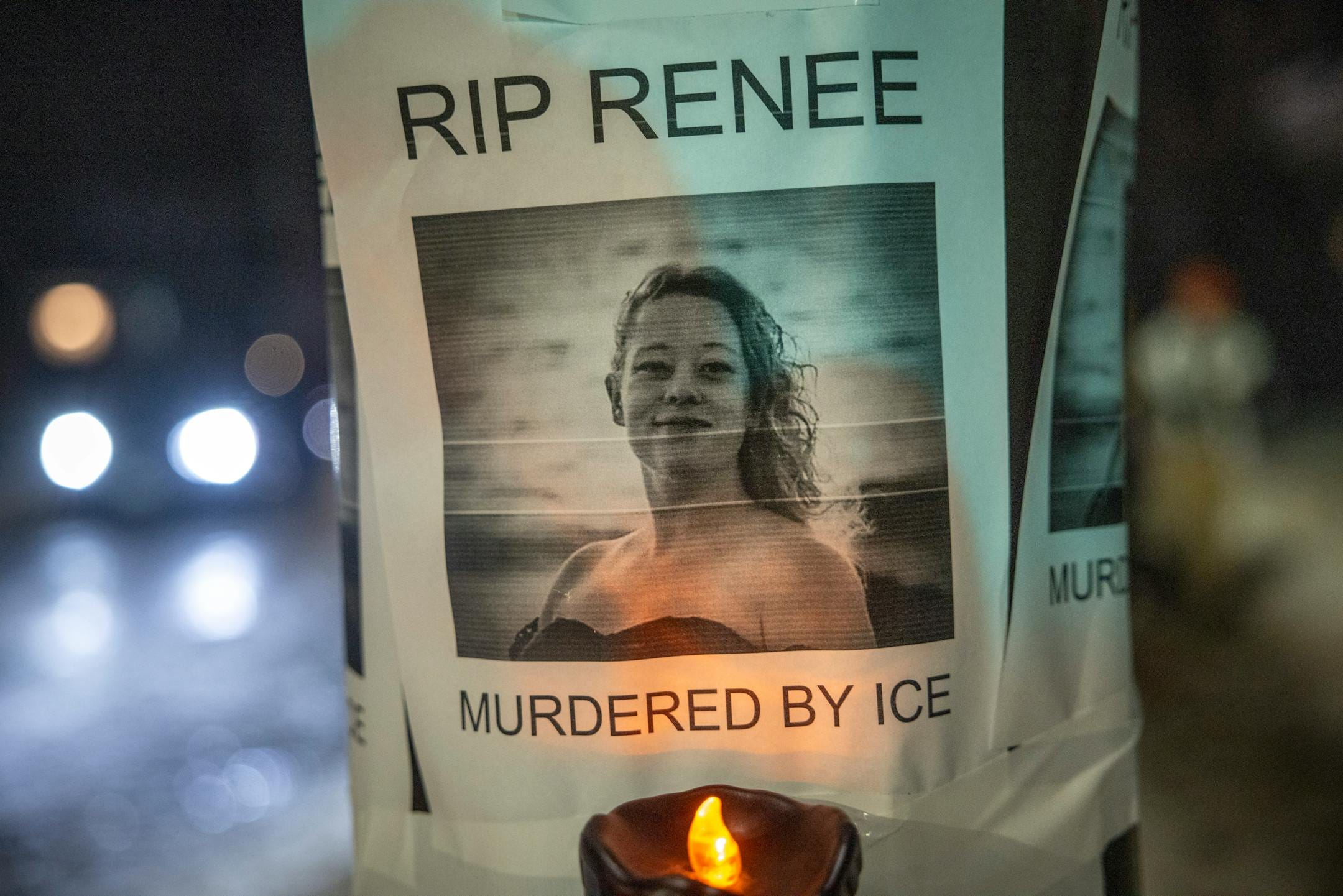
Yet if the institutions are hardening into something cruel and unaccountable, the people who poured into the streets of Minneapolis after Renee’s death show that democracy, in a deeper sense, is not dead. Thousands gathered at vigils and marches. In the winter dark, they held candles where she was shot. They covered the sidewalk with flowers and posters. They called ICE what it is in their eyes, an occupying force, and demanded that it be driven out of their city. They risked being labeled rioters and extremists simply by standing together and refusing to let her name be washed away.
Neighborhood residents, immigrant organizers, church groups, parents who saw their own children in Renee’s story, all stood shoulder to shoulder. They chanted, they cried, they held each other up. Local leaders raised their voices too, demanding that immigration agents leave, urging people not to believe federal propaganda, calling for the removal or restraint of those at the top who gave the orders. A deep fracture runs through the system. On one side stands a federal apparatus that claims total authority over life and death in the name of security. On the other side stand communities that insist that no badge, no agency and no president outranks the basic value of a human life.
That fracture is the last opening where real democratic possibility lives. It survives in the refusal of neighbors to stay quiet. It lives in the insistence that Renee’s name be spoken in full and with love, not hidden under labels and acronyms. It is there whenever people insist that officers who kill must face the same law as anyone else who pulls a trigger. If there is a path out of this slide into full blown fascism, it will not come as a gift from those who control the agencies that killed her. It will be forced into existence by people willing to treat every Renee Nicole Good as a line that cannot be crossed without consequence, and to act on that belief even when the state points its guns back at them.


