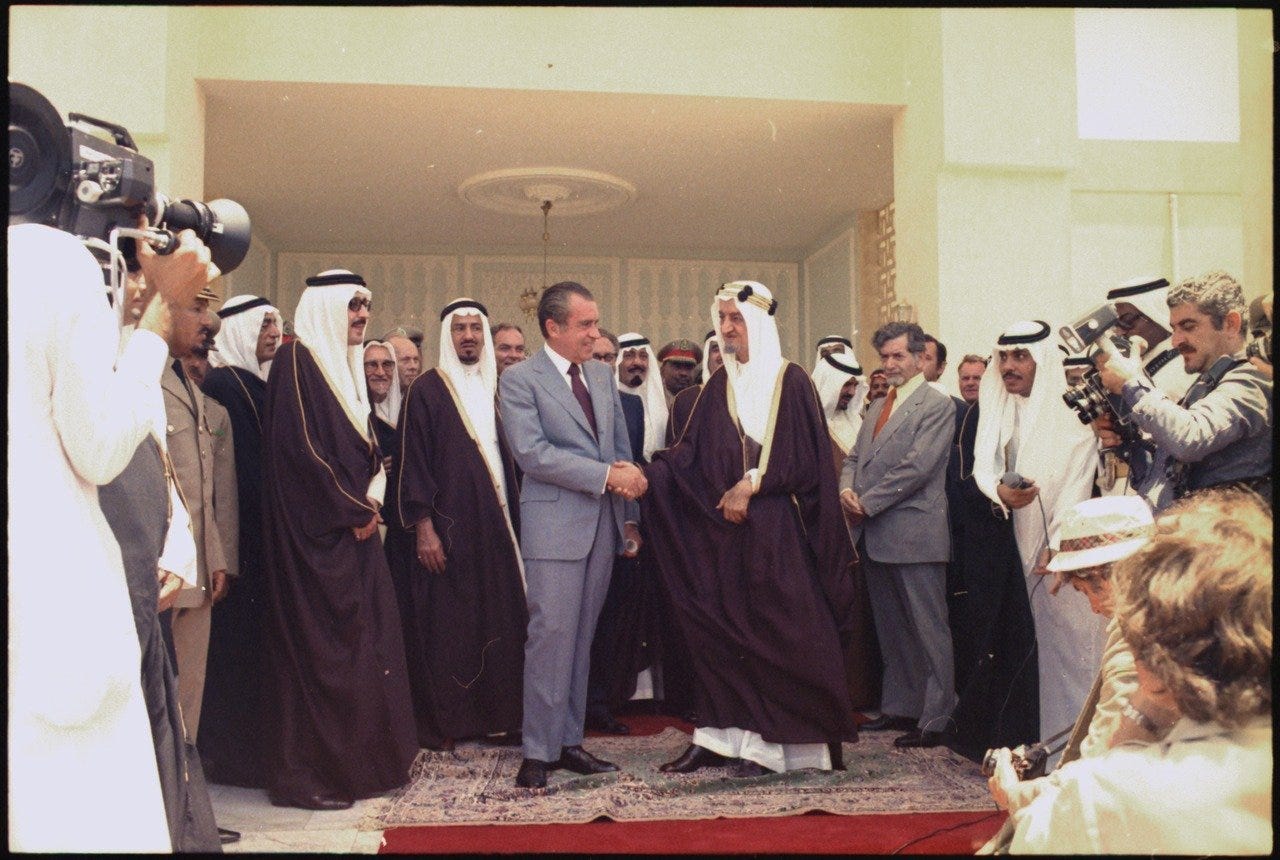
In August 1971, Richard Nixon went on television and ended the world. Not with a war, though wars were already in progress. With a sentence: the United States would no longer convert dollars to gold. The Bretton Woods order, which had governed international finance since 1944, collapsed in a televised press conference. The dollar, which every central bank was accumulating and every major currency was pegged to, was suddenly backed by nothing except the continued willingness of the world to treat it as if it were backed by something.
Washington had three years to figure out what that something would be. The answer was oil.
The arrangement Henry Kissinger negotiated with Saudi Arabia between 1973 and 1974 was not a trade deal. It was a protection racket with paperwork. The United States would provide military hardware and a security guarantee. In return, Saudi Arabia would price its oil exclusively in dollars and recycle the surplus into US Treasury bonds. By 1975, every OPEC member had agreed to the same terms. The dollar was no longer backed by gold. It was backed by the fact that you needed dollars to keep the lights on. Every oil-importing country on earth, which was most of them, now had to accumulate dollars before it could run its economy. The United States had found something better than gold: a commodity the entire world needed, arranged so that its purchase required acquiring American currency first.
The system that emerged from this arrangement is sometimes called the petrodollar, but that name understates what it actually is. It is a vertically integrated architecture in which energy markets, financial markets, and military power reinforce one another. The global oil market runs at roughly two to three trillion dollars a year. A significant share of those revenues has historically been recycled into US Treasury bonds, sustaining demand for dollar assets, suppressing American borrowing costs, and locking the dollar into its position as the currency in which major contracts and debts are written worldwide. This is what gives the United States what the French economist Valéry Giscard d’Estaing once called its “exorbitant privilege”: the ability to run permanent deficits, denominate its debt in its own currency, and export inflation to everyone else.
What is less often stated plainly is that this system was never maintained by market confidence alone. It was maintained through bases, fleets, coups, and the selective destruction of governments that tried to route around it.
In October 2000, Saddam Hussein announced that Iraq would no longer accept dollars for its oil exports under the UN Oil-for-Food programme, switching instead to euros. Baghdad converted roughly ten billion dollars of its reserve holdings into euros. The move was partly symbolic and partly practical, a way of tilting trade toward European and Arab partners. The financial logic was questionable, as the UN itself warned Iraq would lose money on the conversion. But the political logic was unmistakable: Saddam was signaling that the petrodollar was optional, that a major producer could exit the arrangement and survive.
He did not survive. Whether the euro switch was a direct cause of the 2003 invasion or one factor among several is genuinely contested by historians. The official justifications accumulated and fell apart in sequence: al-Qaeda links, weapons of mass destruction, regional threat, humanitarian emergency. What is not contested is that after US forces took Baghdad, Iraqi oil sales were quietly converted back to the dollar. The lesson was absorbed.
Eight years later, Muammar Gaddafi was pursuing something more ambitious: a gold-backed pan-African currency, the gold dinar, which would replace the dollar and the French CFA franc in African oil and commodity transactions. Libya had accumulated approximately 143 tons of gold to back the project. A leaked email from Sidney Blumenthal to Hillary Clinton, later released through FOIA, cited a sensitive source describing the gold reserves and the currency plan explicitly. By 2011, countries including Nigeria, Angola, and Tunisia were reportedly moving toward adoption. NATO intervened in March of that year, under a UN resolution authorizing civilian protection. Gaddafi was killed in October. The gold dinar project ended with him.
These cases do not constitute a law. Leaders have been removed for many reasons, and the petrodollar threat is always one argument among several in any retrospective account. But the pattern is consistent enough to have shaped the calculations of every government that has since contemplated pricing its energy exports in something other than dollars. The cost of demonstrating that the architecture is optional has historically been regime change. That background is not incidental to understanding why Iran’s current position is structurally different from anything that came before it.
The more immediate turning point was February 2022. When Washington excluded major Russian banks from the SWIFT messaging network and froze approximately 300 billion dollars of the Russian central bank’s foreign exchange reserves, it crossed a threshold that financial analysts had long debated in the abstract: the use of the dollar system itself as a weapon of war against a major economy. Russia lost access to the assets overnight. The ruble dropped more than 30 percent in the weeks that followed.
But the more consequential effect was not on Russia. It was on every other government watching. The message was clear: dollar-denominated reserves are not property. They are a revocable privilege, conditional on political alignment with Washington. Governments that had been gradually diversifying away from dollars accelerated. Central banks that had been cautiously accumulating gold became less cautious. By 2025, according to research published in the Journal of Risk and Financial Management, central banks globally held more gold than US Treasury securities for the first time since 1996, adding more than 1,000 metric tons annually over the three preceding years. The dollar’s share of global foreign exchange reserves fell from roughly 71 percent in 1999 to approximately 57 percent by late 2025, its lowest level since 1994.
None of this constitutes an imminent dollar collapse. The BIS 2025 Triennial Central Bank Survey found the dollar involved in 89.2 percent of all foreign exchange transactions, up from the prior survey. No competing currency combines the convertibility, liquidity, and institutional depth to substitute for it. The yuan is not freely convertible, which limits its function as a reserve asset and which China has deliberately chosen to preserve, understanding that full convertibility would expose its economy to the destabilizing capital flows that have broken other countries. De-dollarization is real and ongoing, but it is slow, uneven, and nowhere near complete.
What February 2022 changed was not the speed of de-dollarization. It changed its political character. Before the Russian sanctions, opting out of dollar primacy was expensive and structurally difficult. After them, it became a matter of national security planning for any government that could imagine itself on the wrong side of a future Washington policy disagreement. Saudi Arabia, which joined BRICS in January 2024, declined to formally renew the petrodollar arrangement in June of that year, allowing the fifty-year framework to lapse without replacement. The contractual foundation that had made Gulf dollar recycling explicit and obligatory was quietly removed.
What is happening in the Strait of Hormuz since February 28, 2026 is a stress test of everything described above, conducted in real time and at scale.
Since the United States and Israel launched air strikes against Iran that day, killing Supreme Leader Ali Khamenei in the initial assault, the twenty-one-mile passage through which roughly a fifth of the world’s oil normally flows has been effectively closed to Western-linked shipping. Iran has attacked more than twenty merchant vessels, reportedly laid sea mines, and established a toll system that inverts the logic of the petrodollar arrangement itself. Ships from countries it regards as friendly, primarily those settling in Chinese yuan, receive passage and naval escort. Everyone else waits, pays, or finds another route.
Iran continued shipping its own crude through the strait throughout the blockade, almost exclusively to China, sending at least 11.7 million barrels in the first two weeks of the conflict alone. A senior Iranian official told CNN that Tehran was considering allowing additional oil tankers through provided the cargo was traded in Chinese yuan. Iran’s parliament began working to formalize the fee structure, with a lawmaker close to the Revolutionary Guard stating publicly that since Iran was providing security for the waterway, ships and tankers should pay accordingly. Bloomberg reported that some operators were paying fees in Chinese currency or cryptocurrency before receiving escorts. One vessel reportedly paid two million dollars for passage through Iran’s designated channel north of Larak Island.
This is not a diplomatic signal. It is a functioning alternative architecture, operational under live fire conditions. The currency in which you settle your energy purchase now determines whether your cargo moves. That is the petrodollar system’s core logic, turned against it.
The bond market felt this immediately. Ten-year Treasury yields climbed significantly from the war’s start, as oil prices surged more than 55 percent, headline CPI jumped to 3.6 percent, and the Federal Reserve’s capacity to cut rates was effectively frozen. Treasury auctions showed weakening demand. A 70-billion-dollar five-year auction and a 69-billion-dollar two-year auction both recorded disappointing results, with the latter showing the weakest demand since March 2025. The mechanism the Tricontinental Institute’s Vijay Prashad describes as the “Oil-Dollar-Wall Street complex” is not an abstract formulation. It is the reason that disruption to a twenty-one-mile strait registers within hours in the borrowing costs of the American government.
For countries like Pakistan, the crisis landed not as a geopolitical story but as an arithmetic one. Pakistan imports 80 to 85 percent of its petroleum requirements, mostly from Gulf producers who ship through the strait. It receives approximately $3.3 billion per month in remittances, with the UAE and Saudi Arabia alone contributing over 1.3 billion dollars of that total, sent home by the roughly 4.9 million Pakistanis working in the Gulf. Analysts estimated the country faced potential monthly losses of up to three billion dollars across energy, remittances, fertilizer, and export disruption. Pakistan formally requested Saudi Arabia reroute crude exports through the Red Sea port of Yanbu, a workaround of limited capacity that cannot substitute for normal transit at scale. The IMF warned of current account deterioration and rising external financing costs.
Pakistan’s exposure is not exceptional. It is the sharpest version of a common condition. Countries across the Global South that import oil, carry dollar-denominated debt, and depend on Gulf remittances are not participants in the petrodollar system. They are its subjects. When the system functions, they pay the cost of dollar demand through compressed fiscal space and chronic current account pressure. When it fractures, they absorb the shock first and most severely, without having designed the system or held any stake in its governance.
The ceasefire announced in early April, under which Iran would allow passage for non-hostile shipping via coordination with its armed forces, stabilized oil prices temporarily. Iran declared the strait completely open to commercial traffic as long as the Israel-Lebanon ceasefire holds. Treasury yields fell as markets processed the de-escalation. But the architecture Iran demonstrated remains. It showed that the passage can be closed, that closing it creates leverage, and that the leverage can be denominated in a currency other than the dollar. Those facts are now part of the permanent strategic landscape.
The petrodollar was never destined to last forever. Every reserve currency system before it ended, not through sudden collapse but through the gradual accumulation of moments when enforcement became too costly and alternatives became sufficiently credible. Sterling’s decline after 1945. The guilder’s before it. The Spanish real’s before that. The architects of those systems consistently failed to see the end coming because they were too invested in the assumption that what had worked would continue to work. That assumption is the thing history keeps breaking.
What is different about the current moment is not that the dollar is about to be displaced. It is not. What is different is that the military capacity to discipline governments that try to exit the system, the capacity demonstrated against Saddam and Gaddafi, has run into a limit. Iran has not been destroyed. It has been bombed, sanctioned, and isolated for decades, and it has retained enough military capability and geographic leverage to close the most critical oil corridor on earth and charge admission in a rival currency. The lesson other governments draw from that will shape energy finance for a generation.
The terms of the petrodollar system, which were imposed rather than negotiated, are now subject to contest. That is not the same as saying they will be overturned quickly. But a system that could once enforce compliance through the threat of regime change is now operating in a world where that threat has visibly failed. The next fifty years of the dollar will look different from the last fifty, not because of a single dramatic rupture, but because of what happened in a twenty-one-mile strait in the spring of 2026.


