The Echoes of History
America's Renewed Quest for Regime Change - Surrender or Die - and IRAN' Response?
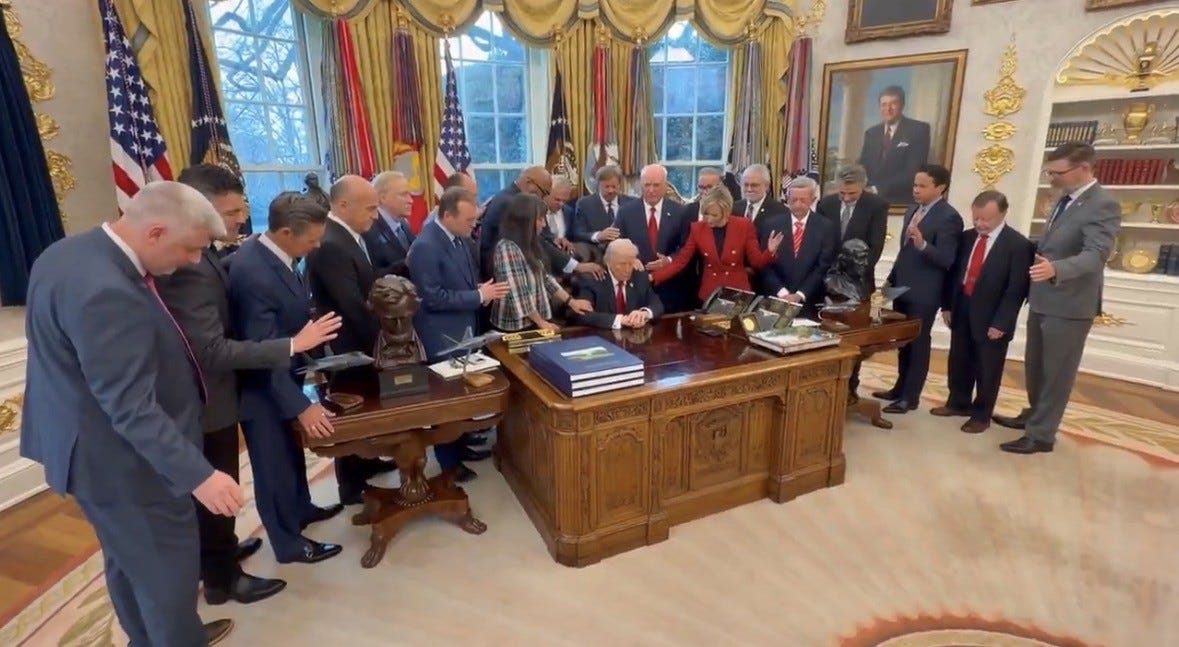
In the seventh day of the U.S.-Israeli military campaign against Iran, dubbed "Epic Fury" by Washington and "Lion’s Roar" by Tel Aviv, the conflict shows no signs of abating. Launched on February 28, 2026, the operation has targeted Iran's nuclear sites, missile infrastructure, and leadership, resulting in the martyrdom of Supreme Leader Ali Khamenei and over 700 civilian casualties. President Donald Trump has openly called for Iran's "unconditional surrender" and emphasized the need for new leadership, even suggesting U.S. involvement in selecting a "GREAT & ACCEPTABLE Leader(s)." This push for regime change echoes a long history of U.S. intervention in Iran, from the 1953 coup to the 1979 Islamic Revolution, raising questions about whether history is repeating itself in a more volatile form. As oil prices surge [above $92] and global recession looms, the world watches a conflict framed by some as a "religious war," highlighted by ironic White House imagery of Trump hailed as a saint by clerics — mirroring criticisms long leveled at Iran's theocracy; while Trump, his cabinet members and American corporate leaders accused of mingling with Jeffery Epstein.
Historical Foundations: From Nationalization to the Shah's Throne
The roots of today's tensions trace back to the early 1950s, when Iran's democratically elected Prime Minister Mohammad Mossadegh nationalized the Anglo-Iranian Oil Company (later BP) in 1951, challenging British economic dominance over Iran's oil fields in regions like Abadan. Britain imposed an embargo, crippling Iran's economy, and appealed to the U.S. for help amid Cold War fears of communist influence. In 1953, the CIA, under Operation Ajax led by Kermit Roosevelt Jr., orchestrated a coup with British MI6 support, overthrowing Mossadegh after initial failures. Mossadegh was tried, imprisoned for three years, and spent the rest of his life under house arrest, while Shah Mohammad Reza Pahlavi was reinstated as an absolute monarch.
Under the Shah, Iran became a staunch U.S. ally, with streets in Tehran named after American presidents and U.S. troops enjoying R&R in luxurious hotels during the Vietnam War — often indulging in behaviors that alienated locals. The CIA helped establish SAVAK, Iran's notorious secret police, which suppressed dissent through torture and executions, targeting groups like the Soviet-backed Mujahedin-e Khalq (MEK), which conducted occasional assassinations in the streets of Tehran. SAVAK's brutality, employing 30,000 agents and killing thousands, fueled resentment against both the Shah and his Western backers. The U.S. poured military and economic aid into Iran, securing oil concessions and positioning the Shah as a Cold War bulwark, but this "American puppet" regime sowed seeds of anti-Western sentiment.
By the late 1970s, economic inequality, inflation, and the Shah's secular "White Revolution" — inspired by U.S. paranoia over Islam — alienated the masses. Protests erupted in 1978, leading to the 1979 Islamic Revolution. President Jimmy Carter initially considered military intervention but advised the Shah to flee and hand power to a civilian-military coalition [based on today’s Trump Venezuela model] — a plan that collapsed. Ayatollah Ruhollah Khomeini returned from exile in Paris, establishing the Islamic Republic. Ongoing conspiracies by CIA triggered the Revolutionaries, to storm the U.S. embassy in Tehran, taking over 50 hostages for 444 days. This crisis solidified anti-Americanism and prevented regime change for nearly five decades, prompting Iran to build the Islamic Revolutionary Guard Corps (IRGC) for defense against future interventions.
The Post-Revolutionary Era and Recent Concessions
In the years following the revolution, U.S.-Iran relations deteriorated amid mutual accusations of interference. The U.S. continued efforts to undermine the regime, while Iran developed robust asymmetric capabilities through the IRGC to deter invasions. Fast-forward to recent years: In a gesture toward the West, Iran elected Masoud Pezeshkian, a moderate heart surgeon and reformist from the Azerbaijani minority, as president in 2024 (with implications carrying into 2025 policies). Pezeshkian, critical of the morality police and promising to end Iran's isolation, represented a concession to the U.S. and EU, echoing the reformist era under Mohammad Khatami. However, ultimate power rests with the Supreme Leader and guardians of the revolution.
Despite this moderation, tensions escalated. Trump, drawing parallels to his Venezuela policy — where he labeled it a "narco failed state" before pushing for regime change — has not formally branded Iran similarly until the 2026 war. Now, amid strikes degrading Iran's missiles, Trump demands constitutional changes to install a non-clerical Supreme Leader, using military decapitation and "carpet bombing" threats as leverage. Analysts warn this could backfire, as airpower alone rarely achieves regime change without ground troops, which Trump has ruled out; even if the US 82nd Airborne Division is mobilized to the theater, it’ll need a space to gather in Saudi Arabia similar to the operation that played out against Sadam Hussein in Iraq. Today’s Attack on American troops at Prince Sultan AB makes it highly unlikely that US ground troops would be able to stand-up a bridgehead anywhere near Iran’s borders.
Iran's response to Trump's demands for unconditional surrender mirrors the revolutionary fervor of 1979, when perceived threats of regime reversal prompted bold, asymmetric actions to stun the world and deter intervention. Back then, revolutionaries seized the U.S. embassy in Tehran, holding over 50 hostages for 444 days to neutralize CIA operations and rally domestic support against foreign meddling. Today, facing Trump's ultimatum and the loss of Khamenei, Iran's interim leadership and the IRGC have escalated beyond diplomatic targets, launching drone strikes that have damaged at least three Amazon Web Services data centers in the UAE and Bahrain, disrupting global cloud services, while Iranian state media claims similar hits on Microsoft facilities, and continued assaults on U.S. military bases across the region. This shift targets economic infrastructure [including oil and natural gas facilities, plus closure of the Strait of Hormuz] critical to world economy and U.S. tech giants, aiming to impose global costs, erode international support for the campaign, and reinforce regime resilience through defiance, much like the hostage crisis prolonged the revolution's survival.
Potential Settlements: Scenarios Amid Escalation
Drawing from expert assessments, the conflict's resolution remains uncertain, hinging on U.S. objectives — containment or full overthrow — and Iran's resilience. A negotiated de-escalation appears most plausible, if Trump backs out: A short war ending in ceasefire via Oman, with Iran conceding nuclear caps for sanctions relief.
Alternatively, a prolonged stalemate could emerge, with intermittent strikes and Iranian asymmetric retaliation via proxies like Hezbollah, disrupting the Strait of Hormuz and sustaining oil shocks. Regime collapse is impossible, historical precedents suggest bombings rally nationalism [which are clearly visible on the streets of Iran] rather than spark uprisings.
Trump's shifting rationales - from nuclear threats to regime change -underscore the gamble, potentially embroiling the U.S. in another quagmire like Iraq. The White House's saintly portrayal of Trump adds irony, as it critiques Iran's religiosity while waging what critics call a holy war.
Conclusion: Risks of Repetition and the Path Forward
As we enter day 7, the 2026 war risks global recession from oil disruptions and refugee crises if escalation continues. Trump's demand to nominate Iran's Supreme Leader in a sovereign nation revives 1953's interventionist ghosts, potentially alienating allies and empowering nationalists; without clear strategy, history will judge this as another failed bid for Middle East reshaping. The world must urge diplomacy to avert a broader catastrophe, learning from the past that imposed change often breeds enduring resistance.


