The Enclosed Sea
How Iran and Russia Built an Empire Washington Couldn’t Bomb. Until Now
On February 18, 2026, ten days before the bombs, Russian Energy Minister Sergey Tsivilyov stood before reporters in Tehran and announced that construction on the Rasht-Astara railway would begin April 1. All remaining issues had been resolved, he said. The land acquisition was nearly complete. The approximately $1.9 billion in financing was secured. The contractor was in place. “We said today that on April 1, during a transport forum in Russia, there will be a final agreement on the start of this project,” Tsivilyov told journalists on the sidelines of the intergovernmental trade commission between Moscow and Tehran.
The contractor selected to build the railway was Khatam al-Anbiya Construction Headquarters. It is the IRGC’s engineering and construction conglomerate.
Nine days later, on February 19, Iranian and Russian naval units conducted joint exercises in the port of Bandar Abbas, simulating the rescue of a hijacked vessel.
On February 28, US B-2 stealth bombers, Tomahawk cruise missiles, and Israeli F-35s turned Bandar Abbas into fire.
The Body of Water No American Ship Can Enter
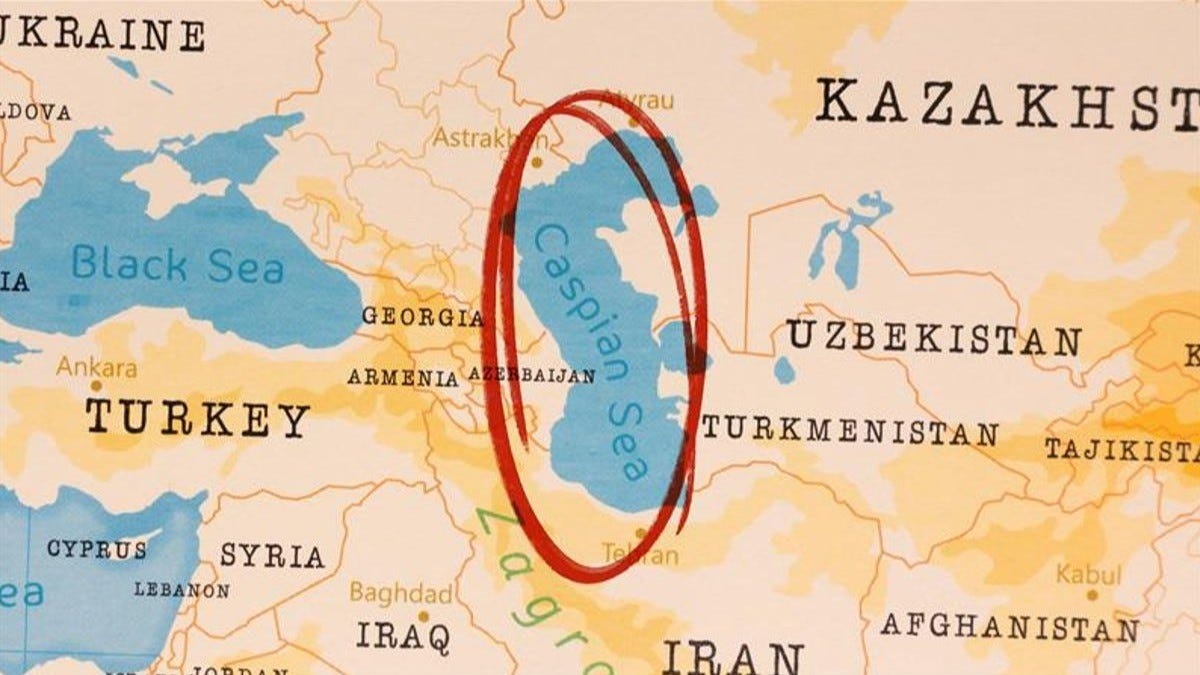
The Caspian Sea does not connect to any ocean. That is not a geographic footnote. That is the entire story.
Every maritime chokepoint Washington has used to discipline the world for the past century sits within reach of a carrier strike group. The Strait of Hormuz. The Suez Canal. The Bab el-Mandeb. The Strait of Malacca. All of them are reachable, monitorable, closeable. The Caspian is none of those things. It is a landlocked body of water 1,200 kilometres long, 370 kilometres wide at its broadest point, bordered by Russia to the north, Iran to the south, Azerbaijan to the west, and Kazakhstan and Turkmenistan to the east. No US Navy vessel has ever operated there. None ever will. To reach it militarily, Washington would need to invade or cross four sovereign states.
The Caspian is, in the precise strategic meaning of the term, the one body of water on earth that the American architecture of maritime control cannot touch.
Russia and Iran spent the better part of two decades understanding exactly what that meant. Through that enclosed sea, they built the most consequential alternative trade architecture of the 21st century. It stretches 7,200 kilometres from St. Petersburg to Mumbai and is called the International North-South Transport Corridor. The people who built it understood that the Caspian was not merely a transit route. It was a moat.
Washington watched every metre of it being constructed. On February 28, 2026, it moved to destroy the end it could reach.
The Architecture
The International North-South Transport Corridor is a multimodal freight network agreed upon in 2000 by Russia, Iran, and India in St. Petersburg. The original intergovernmental agreement was signed September 12 of that year. It has since expanded to twelve member states. Its purpose was always explicit: link the Indian Ocean to Northern Europe through the Persian Gulf, the Caspian Sea, and Russia, bypassing the Suez Canal and every chokepoint Western naval power controls.
The corridor operates across three routes, each designed as a redundancy against the others. The western route moves cargo by rail from Russia through Azerbaijan, south through Baku, across the Caspian by ferry or container ship into Iran’s northern ports, and then by Iranian rail and road to the Persian Gulf. The central route crosses the Caspian directly, ship to ship, between Russian ports and Iranian ports without touching Azerbaijani territory. The eastern route runs overland from Russia through Kazakhstan and Turkmenistan before entering Iran from the northeast. All three branches converge on Iranian territory and feed south to Bandar Abbas.
The numbers tell the shape of what was being built. The corridor reduces the distance between Mumbai and St. Petersburg from 16,000 kilometres via the Suez route to 7,200 kilometres. It reduces transit time between South Asia and Northern Europe from sixty days to thirty. It cuts freight costs by 30 to 40 percent compared to traditional Suez routing, and by up to 55 percent on specific Russia-India legs. From a pure logistics standpoint, it is not a marginal improvement. It is a restructuring.
For Russia, the corridor offers access to warm-water routes and Indian and Southeast Asian markets without passing through Turkey’s Bosphorus, the Mediterranean, or any waterway subject to European inspection or American surveillance. For Iran, it provides transit revenues, foreign investment in its northern ports, and a role as a regional logistics hub that no sanctions regime can strip without also sanctioning Kazakhstan, India, and Russia simultaneously. For both governments, it functions as a shield against the financial pressure that Washington has used as its primary instrument of coercion for three decades.
The Ports
The corridor’s operational backbone is a chain of ports on both ends of the Caspian, none of which sits within range of any weapon Washington can deploy without triggering a wider war.
On the Russian side: Astrakhan, the largest Volga hub, undergoing a capacity expansion to 25 million tonnes annually, timed for 2026 completion; Makhachkala, the only ice-free Russian Caspian port, a key centre for cargo transshipment and the site of the joint Iranian-Russian maritime consortium negotiations in late 2025; and Olya, a deep-water facility south of Astrakhan. On the Iranian side: Bandar-e Anzali, rebuilt within the Anzali Free Zone with modern quays capable of handling heavy container traffic despite the Caspian’s receding waters; Amirabad, which carries the bulk of dry cargo transit; and Nowshahr.
Between 2021 and 2025, the number of Iranian-registered vessels operating on the Caspian doubled from 47 to 94. The combined annual capacity of Iran’s three Caspian ports reached 32 million tonnes, with a 30 percent expansion planned by 2030. Russia’s fertilizer exports via the INSTC alone reached 2.5 million tonnes in the first half of 2025, a 20 percent increase through corridor routes year-on-year.
In January 2026, the first regular container trains successfully linked the Moscow region to the Iranian port of Bandar Abbas. The milestone arrived without ceremony. The corridor had stopped being a project and become a functioning system.
The Rasht-Astara Railway: The Missing Link That Was About to Close
For 25 years, the corridor had one gap. A 162-kilometre section of railway in northern Iran, running from the city of Rasht to the Azerbaijani border town of Astara, was the only piece of the western branch that did not exist. Without it, cargo reaching Rasht from Bandar Abbas had to be offloaded from trains, transferred to trucks, driven across the border into Azerbaijan, and reloaded onto a different rail gauge. That handover added cost, added time, and added vulnerability. It was the corridor’s structural weakness, and both Moscow and Tehran spent years trying to close it.
Closing it required 162 kilometres of track, eight new stations, 56 overhead crossings, 73 bridges, and 30 overpasses, in terrain that tested every engineering estimate. The total project cost: approximately $1.9 billion, euro-denominated. Russia agreed to provide a government loan of approximately $1.53 billion at a 3 percent interest rate, repayable over ten years. The remaining costs would be jointly financed. By late 2025, land acquisition for 80 of the 162 kilometres had been completed. By December 12, 2025, Iranian President Pezeshkian told Putin directly that more than 100 kilometres of the route had been purchased for construction. The remaining territory was scheduled for transfer to Russian contractors by March 20, 2026. That date is still ahead. The war arrived first.
On February 10, 2026, Iran and Russia signed two new documents on the project, including the transfer of 125 kilometres of the route to Russia’s Caspian Service Company as the designated construction representative. On February 18, ten days before Operation Epic Fury began, Russian Energy Minister Tsivilyov confirmed that construction would formally launch April 1, 2026. All contentious issues had been resolved. The contractor was the IRGC’s Khatam al-Anbiya.
Once operational, the Rasht-Astara link would close the western branch entirely, creating a continuous, high-capacity rail line capable of handling 15 million tonnes of cargo annually. The journey for goods from India to Finland would shrink from 45 days to 21. The corridor would become, in the words of the project’s own assessments, the fastest overland freight route between the Indian subcontinent and Northern Europe.
April 1 is 24 days away. As of this writing, Bandar Abbas is burning, Khatam al-Anbiya’s leadership is either dead, underground, or managing an active war, and no construction forum is scheduled anywhere. The corridor’s final missing link will not close on the timeline Russia and Iran spent two years building toward.
What Crossed the Water
Before the bombs, the Caspian route operated as the most consequential unsupervised freight corridor on earth.
The Iranian-flagged cargo ship Rona operated between the Russian ports of Astrakhan, Makhachkala, and Azov and the Iranian ports of Amirabad and Anzali, calling at Russian ports 20 times between October 2024 and December 2025. On January 14, 2026, the vessel sent a distress call from Turkmen Caspian waters and was rescued by Turkmenistan’s coast guard. Its crew: citizens of Iran and India. Its last port before distress: Astrakhan.
In 2023, CNN reported that the Astrakhan-Amirabad and Astrakhan-Anzali routes constituted the primary maritime pathway for weapons deliveries from Iran to Russia, specifically the Shahed drones deployed against Ukrainian cities. The Caspian was not merely carrying fertilizer and machine parts in one direction. It carried drones and components north, and electronics and machine tools south. Two sanctioned states under parallel wars resupplied each other through the one body of water their adversary could not monitor or interdict.
In December 2025, as the operational planning for Epic Fury was proceeding in Tampa, Iran signed a $591 million arms deal with Russia to acquire 500 Verba MANPADS launch units and 2,500 9M336 missiles, with delivery scheduled from 2027 to 2029. The contract was signed in Moscow. The weapons were requested by Iran in direct response to the June 2025 Operation Midnight Hammer campaign, in which US and Israeli strikes degraded Iran’s integrated air-defense network. The planned delivery route, given the bilateral treaty and consortium infrastructure already in place: south across the Caspian. Neither party made any secret of the corridor’s function as a military resupply lifeline. Russian officials called it a “strategic corridor” ensuring resilience under sanctions. They were not speaking exclusively about fertilizer.
The Treaty, the Consortium, and the Timing
The institutional scaffolding underneath the corridor hardened in 2025 in ways Washington could not have missed and did not miss.
In January 2025, Presidents Putin and Pezeshkian signed a comprehensive bilateral cooperation treaty committing both states to expand collaboration across road, rail, air, and sea transport, and encoding their shared resolve to reduce reliance on routes vulnerable to political pressure from third countries. The treaty was the formal expression of what both governments had already been doing for three years. It also provided the legal framework for what came next.
In early November 2025, Iran and Russia signed the agreement establishing their first joint maritime consortium, bringing together state and private port and shipping companies from both countries to coordinate tariffs, share facilities, and develop multimodal container transport across the Caspian. Officials at the Makhachkala talks discussed harmonizing port tariffs, improving container handling, developing training programs for maritime professionals, and establishing a joint legal structure for shipping operations. The target: raise annual Caspian cargo volumes beyond five million tonnes.
That same month, Tehran signed a free-trade agreement with the Eurasian Economic Union, deepening Iran’s integration into the post-Western trade architecture Moscow had been building since 2022. The Eurasian Economic Union covers Russia, Belarus, Kazakhstan, Kyrgyzstan, and Armenia. Iran’s accession to the free trade regime made the INSTC not simply a transit corridor but a commercial gateway into a bloc of 184 million people transacting outside the dollar system.
In May 2025, a senior railway officials meeting in Tehran brought together representatives from Iran, China, Kazakhstan, Uzbekistan, Turkmenistan, and Turkey to construct a transcontinental rail network linking China’s Xinjiang province to European markets via the INSTC. That same month, Iran and Turkmenistan signed a cooperation roadmap for 2025-2027. On May 25, 2025, the first direct freight train from Xi’an, China arrived at Iran’s Aprin dry port. In June 2025, Pakistan inaugurated its first freight train from Lahore toward Russia via the INSTC, covering approximately 8,000 kilometres through Karachi and Zahidan to Astrakhan in 20 to 25 days.
The corridor was not a Russia-Iran bilateral arrangement. By the time Operation Epic Fury launched, it was a 12-member multilateral trade infrastructure involving India, China, Pakistan, Kazakhstan, Azerbaijan, Armenia, Turkmenistan, Uzbekistan, Kyrgyzstan, Tajikistan, Oman, and Belarus. Seventeen states, if you count the bilateral agreements attached. Its disruption was not a surgical strike on two hostile governments. It was a structural blow to a quarter of the world’s freight geography.
Washington understood all of this. The corridor had been described in US government assessments as a “sanctions evasion corridor.” That characterisation is accurate and incomplete. It was also a dollar-bypass corridor. An influence corridor. A proof of concept that the financial coercion America had used against both states for decades was becoming operationally irrelevant.
The Strategic Logic
The INSTC threatened something far more dangerous to American power than Iranian nuclear centrifuges or Russian hypersonic missiles. It threatened the sanctions architecture itself, and with it the dollar’s function as the instrument of American foreign policy.
Washington was explicit about this. US officials warned publicly that increased Iranian control over the INSTC corridor could weaken sanctions enforcement and shift regional leverage. This was the diplomatic version. The operational version was more direct: a functional Iran-as-Eurasian-hub renders the financial pressure Washington has deployed against Tehran since 1996 unable to produce the compliance it was designed to extract.
The Eurasian Development Bank projected that the INSTC at full capacity would handle 30 million tonnes of goods annually by 2030, generating $1.5 billion in transit revenue for Iran each year. That revenue stream, sustained over a decade, constitutes an independent financial base for the Iranian state outside any dollar-denominated clearing system. Russia and China were simultaneously moving to settle bilateral trade in Iranian rials and, for specific transactions, in cryptocurrency. Washington, Brussels, and SWIFT are absent from those payment channels.
An Iran earning $1.5 billion annually from corridor transit fees, resupplied by Russia through the Caspian, deepening free-trade integration with the Eurasian Economic Union, and connected by direct rail to China’s export economy, is not an Iran that comes to Geneva to negotiate away its sovereignty. It is an Iran that calculates it can outlast the pressure. That calculation, once it became visible in infrastructure and treaty form, required a military answer.
The Strike on the Southern End
Operation Epic Fury began at 01:15 Eastern time on February 28, 2026. In the first 24 hours, B-2 stealth bombers, carrier-based F/A-18s, and US Navy Tomahawk missiles struck more than 1,000 targets. According to the US Central Command fact sheet, the initial target list included IRGC aerospace forces and joint headquarters, Iranian ships and submarines, anti-ship and ballistic missile sites, command and control infrastructure, and air defense systems. Bandar Abbas was hit in the opening hours.
Satellite imagery from Planet Labs and Vantor, released March 2, showed fires burning across Iran’s primary naval headquarters. The IRINS Makran, a converted Japanese-built Aframax crude tanker that Iran had transformed into a forward base ship capable of deploying five helicopters and special operations fast-attack boats, was on fire at its berth. The drone carrier IRIS Shahid Bagheri, a converted containership that had entered service with the IRGC Navy only in February 2025, was struck and destroyed within hours of the operation’s start. The IRIS Kurdistan and multiple Jamaran-class frigates were targeted. In the Gulf of Oman, a Jamaran-class corvette was sunk at the Chabahar pier. CENTCOM confirmed: “Two days ago, the Iranian regime had 11 ships in the Gulf of Oman. Today they have zero.” Across the first seven days, the US attacked 43 Iranian ships and 27 military bases and missile positions. B-2 bombers alone struck nearly 200 targets inside Iran in a 72-hour window, including deeply buried ballistic missile launchers.
Bandar Abbas is not only Iran’s primary naval base. It is the INSTC’s southern terminal. It is where the container trains from Moscow, inaugurated for regular service just six weeks before the strikes, unload into vessels bound for Mumbai. Destroying it achieves two objectives simultaneously: it eliminates Iran’s capacity to close the Strait of Hormuz by force, and it severs the corridor’s connection to the Indian Ocean. The military target and the economic target are the same building.
Commercial tanker traffic through the Strait of Hormuz dropped by 85 percent after February 28. The entire region was designated a war-risk zone, with P&I clubs withdrawing coverage and major container lines including Maersk, CMA CGM, and Hapag-Lloyd suspending all Hormuz transits. Approximately 27 vessels carrying an estimated 12 million barrels were adrift in the Arabian Sea, holding without confirmed discharge destinations. The INSTC’s southern artery was not disrupted. It was stopped.
The Caspian End Breathes
The northern half of the corridor remains intact.
Russia’s ports at Astrakhan, Makhachkala, and Olya are operating. Iran’s Caspian ports at Anzali and Amirabad and Nowshahr are not in the current strike corridor. The Caspian itself is unreachable. One Iranian frigate, the Deylaman, was in the Caspian at the time the war began; it remains there. This is not because Washington chose restraint. It is because the Caspian offers no access point for the kind of force being applied to the Persian Gulf. The enclosed sea remains enclosed.
What Operation Epic Fury has done is sever the corridor at both ends of Iranian territory without touching the middle. The northern Caspian-to-rail link in Gilan province, the exact section the Rasht-Astara railway was ten days away from formalising construction on, is structurally suspended. Not bombed. Suspended. The contractor, Khatam al-Anbiya, is an IRGC entity. The IRGC leadership that approved the contract is either dead, underground, or absorbed in the active defence of the Iranian state. The April 1 construction start will not occur. The Rasht-Astara link will not close on the timeline that was ten days away from becoming real.
The southern terminal at Bandar Abbas is on fire.
The corridor breathes through its middle and has no functioning ends.
What Russia Loses
For Moscow, Iran was the indispensable gateway. The Soufan Center assessed directly: the future of the INSTC “is heavily disrupted” by the conflict. Following the degradation of Russian influence in the South Caucasus and the Levant after the fall of Assad, Iran was one of Moscow’s last operational anchors in Eurasian connectivity. The loss of that anchor does not merely disrupt a trade route. It collapses the strategic rationale Moscow had built for absorbing Western sanctions pressure since 2022.
Russia-India bilateral trade reached a record $68.7 billion in fiscal year 2024-25. The INSTC carried a significant and growing share of non-oil volumes, including the 2.5 million tonne surge in Russian fertilizer exports to India in the first half of 2025 alone. That growth trajectory is now frozen. India Ports Global Limited held a ten-year contract to equip and operate Iran’s Shahid Beheshti terminal at Chabahar, the INSTC’s eastern anchor and India’s most significant infrastructure investment in the region. That contract is now operating inside an active war zone. India’s $1.5 billion railway link between Chabahar and Zahedan, already complicated by IRGC contractor involvement, faces indefinite suspension.
The Rasht-Astara railway represented approximately $1.9 billion in committed Russian capital, roughly $1.53 billion of it in government loans at favourable rates, deployed as a strategic investment rather than a commercial one. That investment was ten days from beginning physical construction when the war started. It is now stranded.
Russia’s response has not been military engagement. It has been technological support: providing Iran with high-resolution satellite imagery of US force movements and jam-resistant targeting data, according to CBS News and The Washington Post. The $591 million Verba MANPADS deal, contracted in December 2025, represents Moscow’s hedge against an Iran too degraded to function as a corridor partner. An Iran that survives with Russian weapons needs Russian weapons. The arms deal and the transit deal are the same calculation.
What Central Asia and Pakistan Lose
The INSTC’s membership includes states that did not choose this war and have no ability to stop it.
Pakistan formally entered the INSTC in June 2025, inaugurating its first freight train from Lahore to Russia via Karachi and Zahidan, covering 8,000 kilometres in 20 to 25 days. The route passed through Zahidan in Iran’s Sistan-Baluchestan province, one of the provinces analysts have identified as a potential relocation zone for IRGC command infrastructure under sustained strike pressure. Pakistan’s corridor access, inaugurated less than nine months before the war, is effectively severed.
For the landlocked states of Central Asia: Kazakhstan, Uzbekistan, Turkmenistan, Tajikistan, Kyrgyzstan. The disruption cuts their primary access to southern markets. Iranian ports on the Persian Gulf are essential to Central Asia’s trade geography for reaching Europe and South Asia. Their alternative is northward, through Russia’s Volga-Don canal, which adds cost, distance, and its own geopolitical exposure. As insurers reassess war risk across the corridor, smaller carriers and landlocked economies absorb the cost first, before the big players do.
On March 3, the foreign ministers of all six Caspian states convened by telephone to coordinate responses to the war’s impact on the Caspian Sea and Greater Central Asia region. Six foreign ministers on a call, managing the fallout from a decision made in Washington and Tel Aviv without consulting any of them.
Israel’s Parallel Calculation
The INSTC’s disruption serves a second strategic interest that Washington’s briefings do not cover.
Israel was building the Haifa Port-UAE-India corridor as its entry into the India trade route, positioned as an alternative to the INSTC within the broader India-Middle East-Europe Economic Corridor (IMEC), backed by the US and Saudi Arabia and running through the UAE, Saudi Arabia, Jordan, and Israel. IMEC’s commercial logic depends on one premise: that there is no cheaper, faster alternative connecting India to Europe and Russia. The INSTC, once fully operational with the Rasht-Astara link closed, would have rendered IMEC commercially superfluous. The same freight would move faster and cheaper through Iran than through Israel. India understood this. China understood this. Even India’s concern about the INSTC was that it ran too close to competing with China’s Belt and Road, not that it lacked commercial merit.
Destroying Bandar Abbas and suspending Rasht-Astara construction simultaneously degrades the INSTC and improves IMEC’s viability. The military objective and the commercial objective converge on the same target. That convergence is not coincidental. It is the geometric logic of the operation.
The Precedent: Every Sanction Made the Corridor More Necessary
There is a structural irony that Washington’s Iran policy has been producing for 30 years and that the current war has now resolved with firepower rather than acknowledged.
The INSTC was initiated in 2000 and ratified in 2002. It stalled for two decades primarily because of American sanctions on Iran that made it difficult for Indian and Russian companies to operate there. The 2015 JCPOA briefly unlocked investment momentum before the Trump administration withdrew in 2018, reimposing sanctions. Those sanctions did not kill the corridor. They accelerated it. Russia’s invasion of Ukraine in February 2022 brought Moscow the full weight of Western financial punishment, made Iran Russia’s closest peer in sanctions severity, and gave both states an urgent mutual interest in completing what had been theoretical for twenty years.
Every round of sanctions added urgency. Every isolation measure deepened the bilateral dependency. Every threat of military action increased the infrastructure investment, because both governments concluded, correctly, that the corridor needed to be operational before the military option arrived. In January 2026, regular container trains ran from Moscow to Bandar Abbas for the first time. The war came 28 days later.
The One Number Washington Could Not Absorb
Before the war, Iran’s Caspian ports combined for 32 million tonnes of annual capacity. Russia’s Caspian port at Astrakhan alone was being expanded to 25 million tonnes. The INSTC at full capacity, with the Rasht-Astara link operational, was projected to carry 15 million tonnes annually on the western branch by 2028, 20 million tonnes total by 2030, and 30 million tonnes by the Eurasian Development Bank’s 2030 projection. Transit revenue to Iran at that scale: $1.5 billion annually.
That number is the one Washington could not absorb. Not the centrifuges. Not the missile ranges. The $1.5 billion. An Iran earning $1.5 billion annually from a Eurasian trade corridor outside the dollar system, backed by approximately $1.53 billion in Russian infrastructure loans, integrated into the Eurasian Economic Union under a free-trade agreement, connected by direct rail to China, is not an Iran that presents itself at Geneva on American terms. It is an Iran that has already solved the problem that sanctions were designed to create.
The Caspian Sea cannot be bombed. The Iranian rail network that feeds into it can be suspended by destroying the contractor responsible for building it. The Persian Gulf terminal that connects the corridor to the Indian Ocean can be bombed.
Operation Epic Fury is being presented as a campaign against missiles and nuclear infrastructure. That is accurate. It is also a campaign against a trade corridor that was ten days from construction on its final missing link, run by the IRGC’s own engineering arm, financed by Moscow, connecting St. Petersburg to Mumbai through the one body of water the US Navy will never enter.
The headlines will say: Iran’s navy destroyed. The corridor will say: the southern terminal is rubble, the missing railway link has no contractor, and the Caspian breathes on without its two ends.


