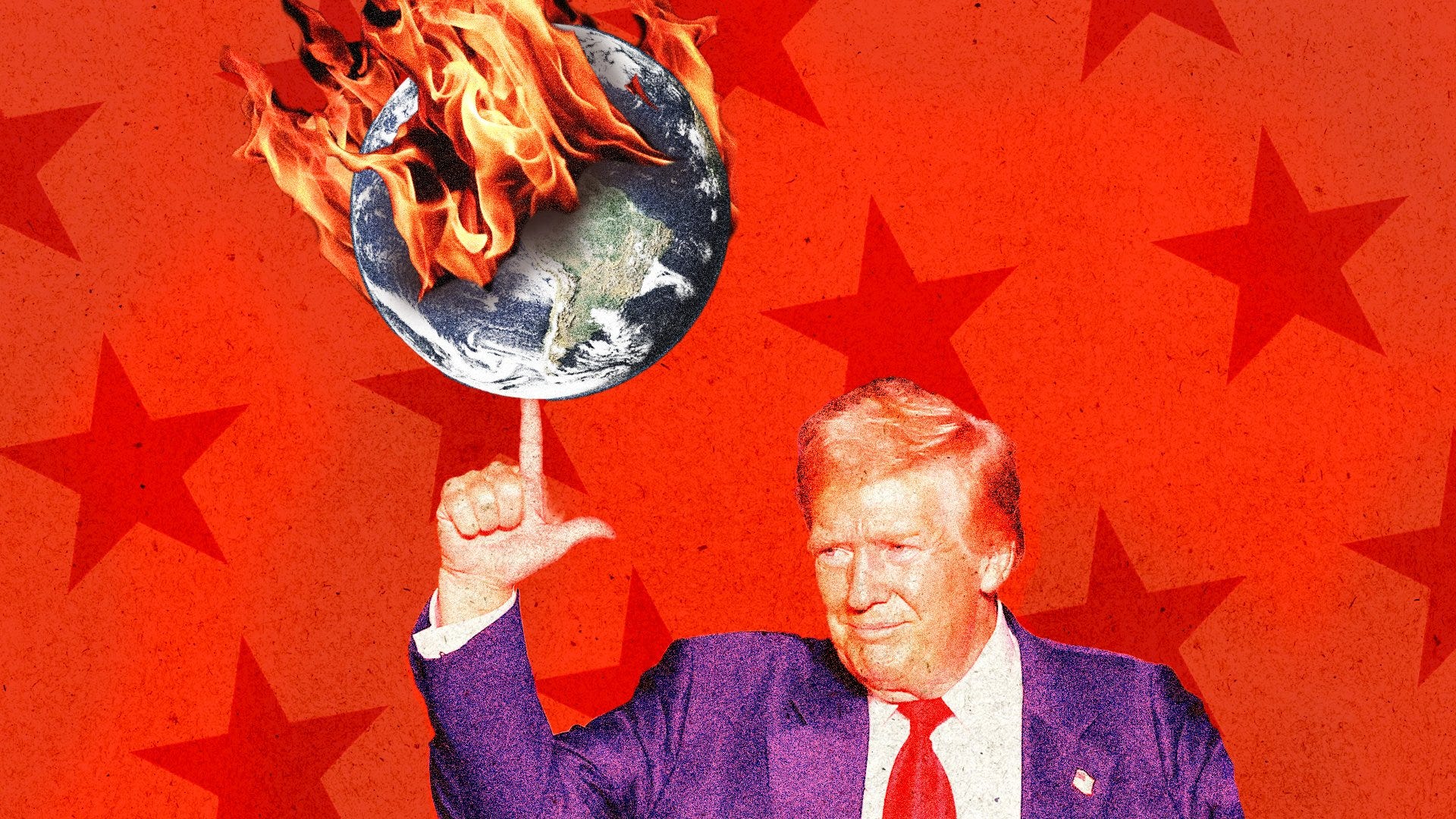
The Exit Strategy
Trump Is Breaking the World Order Because America Can No Longer Pay for It
A nation does not lose its place in the world order all at once. It loses it through a thousand institutional arrangements it accepted as necessary, rational, and modern until the day it announces it can no longer afford them. That announcement has now been made. Washington is not walking away from the liberal international order out of ideology. It is walking away because the arithmetic of empire has finally outrun the empire’s capacity to ignore it.
Trump is not breaking the system. He is administering its conclusion.
THE ARITHMETIC OF EMPIRE
The United States currently funds approximately 62 percent of NATO’s total defense budget, a figure running at an estimated $980 billion annually. Its European allies, across decades of post-Cold War complacency, underfunded the alliance by a cumulative $827 billion. Washington absorbed the shortfall and called it indispensable leadership.
That indispensability now has a credit rating. US public debt held by the public stands at 99 percent of GDP. The Congressional Budget Office projects that figure reaches 107 percent by 2027, surpassing the post-World War II record. In May 2025, Moody’s downgraded America’s credit rating. By that same month, the United States registered the highest sovereign default risk among all G7 economies as measured by credit default swap pricing. Heritage Foundation analysts, not critics of American power by any measure, stated the structural problem without decoration: interest payments on US national debt are on course to exceed annual defense spending. Washington cannot subsidize allies while bearing an outsized share of global security burdens.
From Hong Kong, from Tokyo, from Seoul, from Jakarta, the arithmetic reads the same way. The patron cannot pay. The arrangement is being repriced.
THE CONSUMER OF LAST RESORT PROBLEM
The post-war order was not built on military capacity alone. Its economic foundation rested on the United States functioning as the consumer of last resort. The arrangement was straightforward: Asian manufacturers produced, American consumers absorbed, and the surplus recycled back into US Treasury bonds that financed the next round of American military and institutional primacy. The circuit ran for two generations.
It ran until it could not. China no longer needs the American market the way it did twenty years ago. When Trump launched his tariff war in 2025, Beijing did not capitulate. It negotiated from a position of sufficient industrial scale and domestic market depth to absorb the blow. The Plaza Accords of 1985, which forced Japan into a yen revaluation that wiped out the export competitiveness Tokyo had spent three decades building, worked because Japan had no comparable insulation. China studied that history. The leverage that made American economic threats credible for a generation had been progressively spent against a rival that spent the same period methodically reducing its dependency.
American household consumption, meanwhile, roughly 70 percent of US GDP, is itself leveraged on debt. The domestic consumer powering the global engine is financially exhausted. The engine did not stall recently. It stalled years ago. The world continued operating on inertia and dollar momentum while the underlying machinery deteriorated beneath the official statistics.
WHAT IS HAPPENING TO THE DOLLAR
The dollar’s global role rests on three simultaneous foundations: trust in US fiscal management, trust in US institutional stability, and trust in the rules-based order Washington built and enforced. Trump’s second administration has, by the documented account of researchers published in Cambridge University’s International Organization journal, attacked all three at once.
Across Asia, central banks read this in the reserve data before the commentary caught up. Between 2017 and mid-2025, gold’s share of global reserves increased from 11 percent to 23 percent. The purchasing is concentrated in emerging economies. It is not speculative positioning. It is a documented institutional judgment that dollar-denominated assets are no longer a politically neutral store of value when held by a custodian willing to weaponize the system for domestic political ends.
Trump’s own Council of Economic Advisers Chairman Stephen Miran formalized what the administration had been signaling through policy: the Mar-a-Lago Accord, a deliberate weakening of the dollar to reduce the US current-account deficit and rebuild American manufacturing. The proposal named explicitly what the financial order had obscured for decades. Dollar dominance, the exorbitant privilege that let Washington borrow cheaply and project power globally, came at a structural cost: it overvalued the American currency, hollowed out manufacturing, and transferred wealth from the industrial working class to the asset-owning class. The base that elected Trump twice absorbed that cost. The exit strategy is, in one reading, a demand that Asia absorb it instead.
The administration is not trying to preserve dollar hegemony. It is extracting one final round of advantage from it before the system resets.
TRUMP’S CALCULATION
The Trump administration’s 2025 National Security Strategy does not attempt to restore unipolarity. It manages a tripolar transition: the US, China, and Russia each dominant in their respective spheres, with Washington maintaining primacy as first among unequals. The objective is to reduce American global burdens while maximizing returns. Arms sales to NATO allies are projected to exceed $400 billion between 2026 and 2030. Tariffs function as revenue instruments. Bilateral deals now price access to American security rather than extending it as a public good.
The logic is internally consistent. If America can no longer afford to run the liberal international order as a commons, it will run the exit as a monetization event. Allies that want security guarantees will pay for them. Markets that want dollar liquidity will negotiate terms. Countries that built their development models inside the post-war architecture will absorb the cost of its dismantling.
From inside the arrangement, this looks like abandonment. From Washington’s domestic political calculus, it is overdue collection. Decades of European free-riding on American defense spending, manufacturing offshoring that gutted American industrial capacity, and a rules-based order that generated enormous returns for global financial capital while delivering flat wages at home: these are the grievances that returned Trump to power. The world order, as his base experienced it, was a subsidy they paid and others collected.
The exit strategy is a domestic political argument conducted through the instruments of foreign policy.
THE CONTROLLED DEMOLITION
Empires do not usually get to choose how they end. Britain did not choose Suez. The arrangement that ended was chosen for it. The United States arrives at this moment with something most declining hegemons never possessed: enough residual institutional leverage to attempt a managed descent rather than a crash.
Whether Trump is executing that descent deliberately or arriving at it through instinct is a question the historical record will settle. What the structural evidence establishes now is that the policies he is pursuing, the tariffs, the NATO burden-shifting, the deliberate dollar weakening, the transaction-based security model, are consistent with a country that has made one calculation: the order cannot be sustained, so break it in a way that leaves you holding the strongest position in whatever comes next.
The alternative, continuing to fund 62 percent of an alliance whose members spent thirty years below the two percent floor, continuing to run trade deficits that transferred industrial capacity to competitors, continuing to borrow at a trajectory the CBO describes as definitionally unsustainable, was not stability. It was a slower version of the same collapse, with Washington arriving at the end holding fewer cards.
THE UNRESOLVED VARIABLE
The problem with a controlled demolition is that the rubble does not arrange itself. What Trump’s exit strategy cannot control is the interregnum: the period between the old order’s operational collapse and the emergence of whatever replaces it.
Researchers at Cambridge describe the current moment as a financial interregnum, with rising powers seeking autonomy without assuming hegemonic responsibility. No state is willing or able to provide a safe asset at global scale. The renminbi is gaining traction in bilateral trade settlement but commands insufficient systemic trust to anchor global finance. The euro may deepen as Germany’s new defense-linked debt issuance creates the sovereign bond market depth the eurozone has long lacked. Neither is a system. Both are adaptations to the absence of one.
In that absence, the countries that will absorb the turbulence first are not the ones that designed it. Across South and Southeast Asia, economies running dollar-denominated external debt without dollar-generating export bases face currency exposure that American hegemony, for all its extractive qualities, had helped suppress. The BRI borrowers, who entered China’s infrastructure architecture with collateral structures tied to port access and resource rights on default, face a double exposure: the dollar system is fragmenting and the alternative architecture they entered is itself extractive, different terms, same basic logic.
Trump can break the order on his terms. He cannot control what fills the space.
The variable nobody in the room is discussing is the speed. A managed dollar depreciation over a decade is survivable. A disorderly Treasury market event is not. In April 2025, Trump reversed his tariff position after a run on US Treasuries by large institutional investors. The bond market checked the White House faster than the White House could check the bond market. Asia holds enough of that market to move it.
Whether the governments holding those reserves can coordinate fast enough to shape the landing, rather than simply absorb it, is the question that has never been tested at the required scale.


