THE FALL OF EL MENCHO
HOW MEXICO’S MOST POWERFUL CARTEL BOSS DIED, AND WHY THE CHAOS HAS ONLY JUST BEGUN
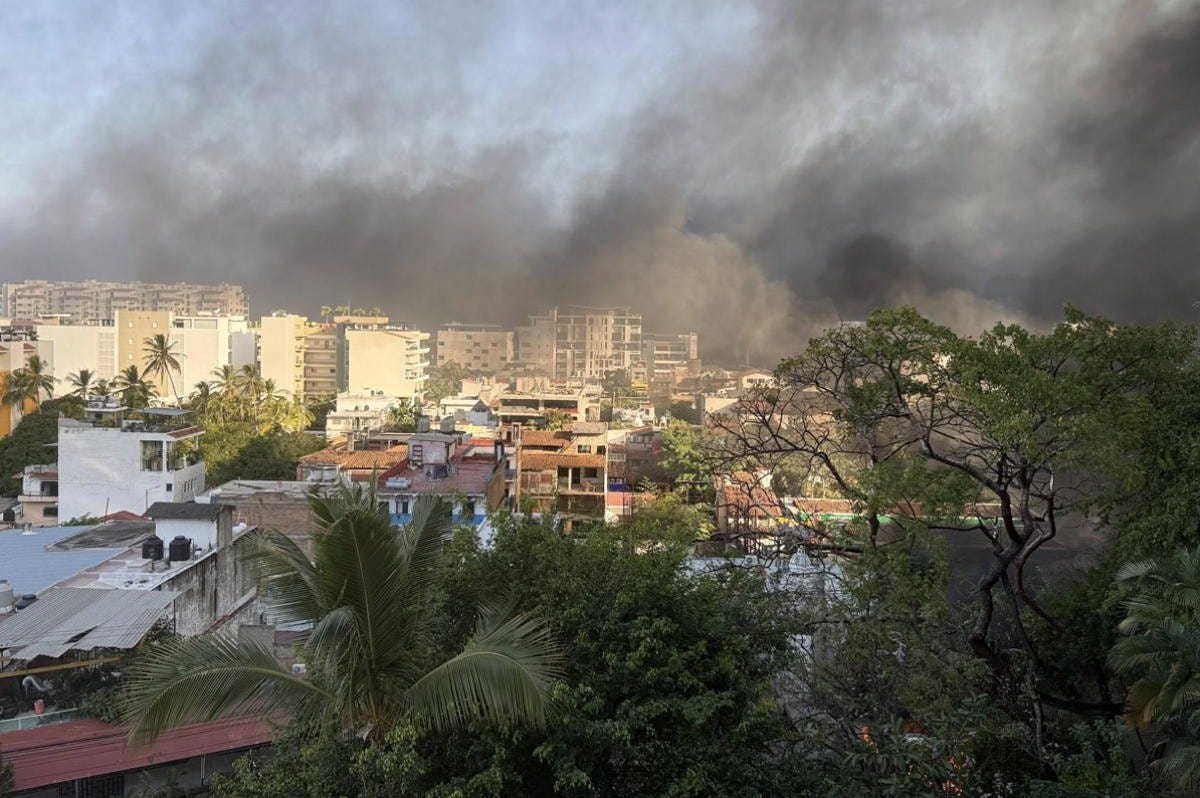
The smoke rose over Puerto Vallarta before most tourists had finished their breakfast. By 9 a.m. Sunday, columns of black poured from burning vehicles across Jalisco, and families who had flown in for the beach found themselves trapped inside resort hotels with no working information and no flights home. Air Canada had already pulled its operations entirely. The Costco on the edge of the city was engulfed. Every exit road was blocked.
This is not a story about one man’s death. It is a story about what his death tells you about the country he helped build, and the empire of dependency that made him possible.
Nemesio Rubén Oseguera Cervantes, known to Mexican law enforcement, the DEA, and to approximately 185,000 cartel employees as El Mencho, was shot and mortally wounded Sunday morning by Mexican Army forces in Tapalpa, a town tucked into the hills roughly 90 kilometers south of Guadalajara. He was airlifted toward Mexico City. He did not survive the flight. The Ministry of Defense confirmed the operation with unusual speed. The White House confirmed the intelligence cooperation with even greater speed. Karoline Leavitt, Trump’s press secretary, issued a statement before the smoke had cleared over Puerto Vallarta.
The DEA had Oseguera Cervantes listed as its number one priority in Mexico since the late 2010s. Washington placed a $15 million bounty on his location. He moved freely through Jalisco for over a decade, building an organization that operates on six continents, maintains armed presence in at least 21 of Mexico’s 32 states, and controls the largest fentanyl pipeline into the United States. The official story is that Trump administration pressure and intelligence sharing finally produced results. That story is incomplete.
What the official story omits is the architecture of tolerance that allowed Oseguera to function at all. Sheinbaum herself, in the months before this operation, repeatedly criticized the kingpin strategy her predecessors used, calling it counterproductive because decapitation produces succession wars. On Sunday, after the confirmation of his death, she applauded the operation and called for calm. The policy reversal was not ideological. It was transactional. Trump had been threatening tariffs, troop deployments, and formal designation of Mexican cartels as foreign terrorist organizations. That last step was completed in February 2025. Sheinbaum needed a visible result to preserve the bilateral relationship. El Mencho was the result.
The operation itself was not clean. Four CJNG operatives were killed at the scene in Tapalpa. Three more, including Oseguera, were wounded and died in transit. Three Mexican soldiers were also wounded. The Ministry of Defense seized armored vehicles and rocket launchers. Within hours, the cartel’s response transformed that military operation into a national crisis: over 250 narco-blockades ignited across 20 Mexican states simultaneously. This was not organic. It was a coordinated institutional response, designed and pre-authorized by a command structure that knew the operation was coming.
Twenty-five National Guard officers were killed in attacks across Jalisco in the hours that followed. Thirty-four cartel members died in clashes with security forces. Prisons were assaulted. Guards were killed. Escapes were reported. Schools across multiple states were closed Monday. The U.S. Embassy issued shelter-in-place orders for American citizens and staff in Guadalajara, Puerto Vallarta, Tijuana, Chiapas, and Michoacan. Guadalajara itself, a city of five million people, went empty. People locked their doors and waited.
This is what Mexico’s cartel economy looks like when it is disrupted. Not a war between the state and criminal organizations on opposite sides of a clear line. A system fracturing along the fault lines of its own interdependencies. The state and the cartel were never simply adversaries. They operated within the same institutional geography, sharing informants, tolerating each other’s logistics, and occasionally cooperating on targets. El Mencho’s death collapsed that arrangement.
Oseguera was born in Aguililla, Michoacán, in July 1966. Michoacán is not peripheral. It is where the CJNG developed its roots, where it first built territory, and where the state’s institutional failure is most legible in everyday life. He was a police officer before he became a cartel enforcer. That biographical detail is not a curiosity. It is the key to how the CJNG achieved the institutional penetration it did. Oseguera understood policing from the inside. He understood how operations were planned, how intelligence moved, and where the gaps were. He moved from the Milenio Cartel to the Sinaloa Cartel to co-founding the CJNG around 2007-2009 with Érick Valencia Salazar, who was among 29 wanted cartel leaders surrendered to U.S. custody in February 2025 as part of the Sheinbaum-Trump security cooperation framework.
He built the CJNG differently than El Chapo built Sinaloa. El Chapo operated through corruption, bribery, and negotiated territorial control. Oseguera operated through violent displacement. The CJNG did not buy territory. It seized it, holding it through armed force and visible brutality. In 2015, CJNG operatives responded to a security operation by simultaneously blocking roads across multiple municipalities and shooting down a military helicopter, killing three soldiers. That attack was a message to the Mexican state: we can match you. Five years later, the cartel carried out a grenade and high-powered rifle assault on then Mexico City police chief Omar Garcia Harfuch in the heart of the capital. Garcia Harfuch survived. He is now federal security secretary. The man who was nearly assassinated by CJNG now directs the security apparatus that killed El Mencho.
That is the kind of institutional memory that structures Mexican security policy. It runs on debts and enmities.
The global supply chain that made the CJNG the FBI’s most powerful trafficking organization in Mexico runs through chemistry labs in Wuhan and Guangzhou before it reaches clandestine fentanyl kitchens in Jalisco and Sinaloa. China is the primary source of precursor chemicals for fentanyl production. This is documented in the State Department’s 2025 International Narcotics Control Strategy Report, in DEA threat assessments, and in federal indictments unsealed in 2024 charging eight Chinese chemical companies and their principals with supplying Mexican cartels. Congressional reporting documented that CCP-controlled entities are complicit in this trade, with one Chinese government prison operating a chemical company that served as a hub for websites selling fentanyl products directly to Americans.
China banned finished fentanyl in 2019 but continued exporting the precursor chemicals that cartels use to synthesize the drug in Mexico. When regulators scheduled specific precursors, Chinese manufacturers began producing slightly modified variants that fell outside existing controls. This is not a supply chain problem with a technical solution. It is a political decision, maintained over years, that allowed chemical companies operating in China to service criminal organizations in Mexico, who then supplied the American drug market. The 2025 INCSR confirmed that companies in the PRC remain the largest source of precursor chemicals and equipment used to manufacture illicit fentanyl, and that Mexican customs officials have consistently failed to detect the illicit diversion of these chemicals.
The Trump administration addressed this through tariffs rather than targeted enforcement, then used Busan summit optics to declare the problem managed. In November 2025, China issued new export permit requirements for 13 precursor chemicals bound for North America. Whether those controls hold, and whether designer precursors beyond those 13 continue to move freely, remains unanswered by either Washington or Beijing.
CJNG imported these chemicals through ports of entry that Mexican customs had neither the capacity nor the institutional will to monitor. The cartel’s logistics were not underground. They were embedded in the normal freight flows of a major Latin American economy. This is how modern criminal organization works at scale. It does not hide from the supply chain. It becomes part of it.
Oseguera also became part of Mexico’s agricultural economy in ways that demanded a reckoning that never came. The CJNG penetrated the avocado industry, the lemon and lime industry, and the lumber trade across Michoacán and surrounding states. Mexico is the world’s largest avocado exporter, with the United States absorbing the majority of production. When Americans buy Mexican avocados, some portion of that supply chain has moved through cartel-controlled territory, under cartel-imposed taxes, with cartel logistics. Mexican investigative journalists and international researchers documented this for years. It did not stop the supply chain. The market absorbed the violence.
This is precisely what the Patriot One News post circulating on Facebook this weekend cannot explain and will not try to. The post claims Sheinbaum works for the cartel, sourcing a Fox News appearance by Mexican Senator Lilly Tellez, a right-wing opposition figure with her own political calculations. The claim that the MORENA government is cartel-financed and that Sheinbaum is personally subordinate to organized crime is politically useful to the Mexican right and to the Trump administration’s framing of Mexico as a narco-state requiring external management. It is also a simplification that obscures the actual mechanism. The relationship between the Mexican state and organized crime is structural tolerance, managed at institutional levels, with enough plausible deniability to survive electoral cycles. Sheinbaum ordering the operation that killed El Mencho does not contradict this. It confirms that the tolerance was conditional, and that the conditions changed when U.S. pressure became existential.
Senator Tellez said on Fox News that the president threatened her with criminal prosecution for speaking out. That threat, if real, warrants investigation. It is not, by itself, evidence of cartel control of the presidency. It may be evidence of ordinary political retaliation in a country with weakened judicial independence. These are different things, and collapsing them serves a specific political project that has nothing to do with the structural analysis Mexico’s crisis demands.
The question that matters most now is succession. Oseguera’s brother is in a U.S. prison. His son, El Menchito, is in prison. His daughter is in prison. There is no obvious heir, and no mechanism to identify one, because Oseguera ran the CJNG the way a dictator runs a state: consolidated command, no institutional succession planning, loyalty enforced by personal proximity and fear. Former DEA official Mike Vigil put it plainly: “El Mencho controlled everything. He was like a country’s dictator.” That concentration of control is what made the organization lethal. It is also what makes its future volatile.
The historical parallel is not El Chapo’s arrest. When El Chapo was captured in 2016, Sinaloa had a distributed leadership structure that absorbed the loss. The CJNG does not have that. What applies more accurately is the Milenio Cartel’s collapse: violent fragmentation, regional bosses asserting territorial claims, years of warfare before a new equilibrium formed. That process started Sunday. The 250 blockades were not just retaliation. They were territory-marking. CJNG regional commanders were showing each other, and rival organizations, who controlled what roads, what cities, what logistics corridors. The succession war started before El Mencho’s body was cold.
The Sinaloa Cartel, the CJNG’s primary rival, is simultaneously locked in its own internal power struggle between El Chapo’s sons and the faction loyal to Ismael “El Mayo” Zambada, now in U.S. custody. Both major Mexican trafficking organizations are in succession crises at the same time. The territorial map of Mexican organized crime is being redrawn by violence.
One variable has not been sufficiently integrated into the weekend’s coverage: the 2026 FIFA World Cup. Guadalajara is a host city. The timing of the Tapalpa operation was not random. The Mexican government needed to show Washington and FIFA that Jalisco could be secured before tournament play begins. Whether killing El Mencho achieves that or triggers the opposite will be answered in the next several weeks by the men who ran his logistics and now run them for themselves.
What will not change is the supply chain. Precursor chemicals will continue moving from Chinese manufacturing zones to Mexican ports. Fentanyl will continue being synthesized in Jalisco and Sinaloa. Distribution networks reaching into 40 countries, through contacts in Australia, Southeast Asia, the Americas, and Europe, will continue operating under new management. The avocados will continue moving through the same toll roads. The lumber will continue coming out of Michoacán.
El Mencho is dead. The architecture that made him is not. It runs through chemical companies in Wuhan, through agricultural supply chains in North America, through the institutional memory of a Mexican security apparatus that once tried to kill its own security secretary in broad daylight in the capital, and through a U.S.-Mexico relationship where counter-narcotics cooperation is priced in tariff concessions and diplomatic optics rather than structural reform.
The cartels took a hard hit Sunday. What comes next will determine whether a hit is the same thing as a change.


