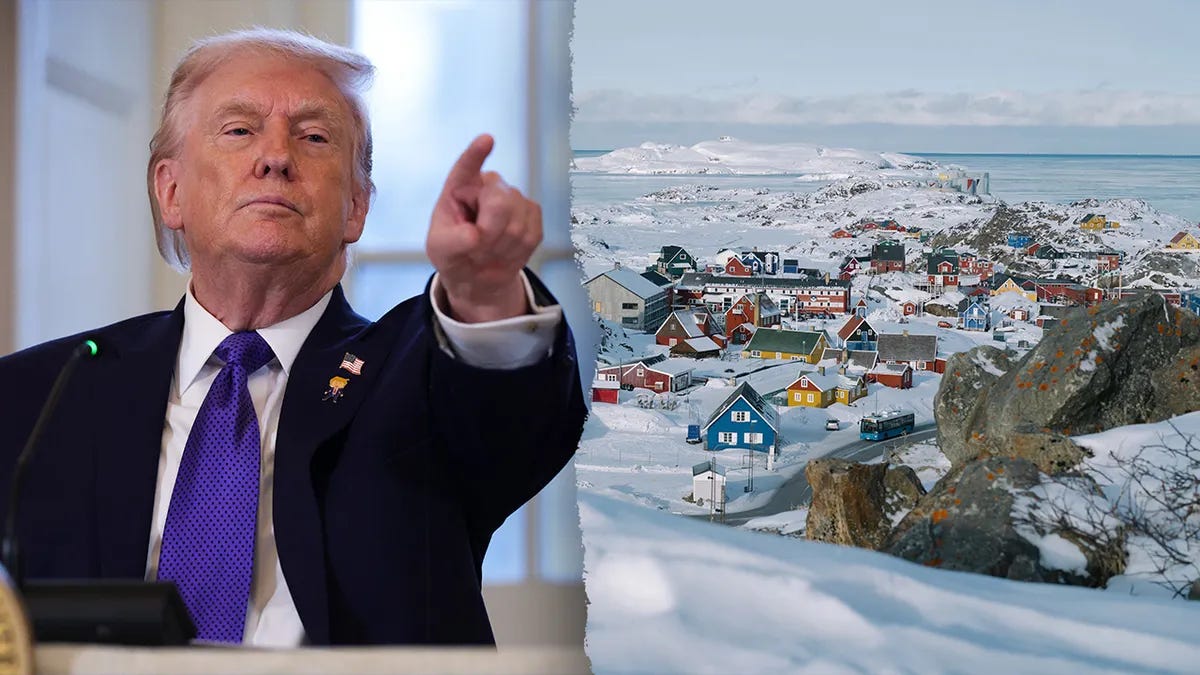
The Frozen Gambit
Inside Trump’s Relentless Pursuit of Greenland
On a frigid January afternoon in Nuuk, Greenland’s tiny capital, thousands of people poured into the streets. Their breath formed clouds in air so cold it stung the lungs. They carried homemade signs reading “Stop Trump” and “Greenland Is Not For Sale,” their voices rising in protest beneath the pale Arctic sky. It was January 17, 2026, and President Donald J. Trump had just fired his latest salvo in a campaign that has consumed his second term: a 10 percent tariff on eight NATO allies, with promises to raise it to 25 percent unless Denmark hands over the world’s largest island.
For most Americans watching the news that evening, Trump’s Greenland obsession seemed like another bizarre detour. But for those paying close attention, the tariff announcement was no surprise. It was the culmination of a methodical, seven-year campaign that began with a laughed-off proposal in 2019 and has now become an international crisis threatening to shatter the Western alliance.
Trump has mentioned Greenland in at least 47 public remarks since 2019. He sent his son to meet with mining executives in Nuuk. He installed a loyal billionaire as ambassador to Denmark with one job: figure out how to get Greenland. And through it all, he has ignored the ridicule, the diplomatic rebuffs, and the polls showing three-quarters of Americans oppose the idea.
This is the story of why Trump won’t let Greenland go, told through the voices of the people trying to make sense of his obsession: the Pentagon strategists who see genuine security concerns, the Inuit protesters who fear losing their homeland, the Silicon Valley billionaires betting on Arctic real estate, the European diplomats scrambling to contain the fallout, and the president himself, who views 836,000 square miles of ice as the ultimate trophy in a lifetime of deals.
To understand Trump’s Greenland strategy, you have to understand how he sees the world. Donald Trump is not a traditional politician shaped by years in government. He is a New York real estate developer who learned business in the brutal 1980s Manhattan property market, where success meant spotting undervalued assets and using aggressive tactics to acquire them on favorable terms.
His proudest early deal was the Commodore Hotel, a decrepit wreck in Hell’s Kitchen that everyone else had written off. Trump saw potential. He secured a 40-year tax abatement from the city, convinced skeptical bankers to finance renovations, and transformed it into the gleaming Grand Hyatt. That deal made his reputation. It taught him that with enough leverage and nerve, anything could be bought.
When Trump looks at Greenland, he sees the Commodore Hotel multiplied by a million. An island three times the size of Texas, mostly covered in ice, home to just 56,000 people. Currently under Danish control, subsidized by Copenhagen to the tune of $600 million annually. No roads connecting towns. Residents traveling by helicopter and dogsled. By conventional measures, one of the least developable places on Earth.
But Trump doesn’t see obstacles. He sees the deal of the century.
“I understand real estate,” he told reporters in December. “I know when something is worth more than people think.” At 79, facing questions about his mental sharpness and legacy, Trump wants a monument. Mount Rushmore said no. The Panama Canal is already built. But Greenland? Greenland could be his. The Trump Territory. A land grab that would echo through history alongside Thomas Jefferson’s Louisiana Purchase and secure his place in textbooks forever.
While Trump’s personal psychology drives much of the Greenland push, there are genuine strategic concerns that give his campaign legitimacy among national security professionals who might otherwise dismiss it as a vanity project.
The story begins with geography. Greenland sits at the center of the GIUK Gap, a term that sounds like bureaucratic jargon but represents one of the most strategically important pieces of ocean on Earth. The acronym stands for Greenland, Iceland, United Kingdom, and it describes the maritime chokepoint that any Russian submarine must navigate to reach the Atlantic Ocean.
During the Cold War, American and British forces fortified this corridor with underwater listening devices and patrol aircraft, effectively trapping the Soviet Northern Fleet in the Arctic. After the Soviet Union collapsed in 1991, that infrastructure fell into disrepair. The threats seemed to disappear.
They didn’t. Russia’s military has rebuilt under Vladimir Putin. Moscow now operates more than 40 submarines from its northern base at Murmansk, including cutting-edge nuclear-powered vessels that can launch ballistic missiles at American cities while hiding beneath Arctic ice. And Russia isn’t the only player in the Arctic game.
China, which has no Arctic coastline, has declared itself a “near-Arctic power.” Beijing sends research ships to map the ocean floor. It funds port construction in Iceland and Norway. Chinese President Xi Jinping talks openly about a “Polar Silk Road” where cargo ships will use newly ice-free waters to cut shipping times between Asia and Europe by 40 percent.
Climate change has turned the Arctic from frozen wasteland into contested territory. In 2025 alone, Greenland’s ice sheet lost 105 billion metric tons of mass. Glaciers that have existed for millennia are retreating, exposing new shipping lanes and making previously inaccessible resources suddenly reachable. By 2040, scientists project, the Arctic Ocean will be navigable for commercial shipping six months per year. That changes everything.
The United States already has a major military installation on Greenland’s northwest coast: Pituffik Space Base, formerly known as Thule Air Base. Under a 1951 agreement with Denmark, American forces operate early-warning radars there that track incoming missiles and satellites. Just last week, the Pentagon announced major upgrades: longer runways for heavy bombers, improved radar arrays, expanded fuel storage.
Defense analysts at Washington think tanks describe Pituffik as irreplaceable for American homeland defense. Trump has seized on Denmark’s low military spending to argue that full American ownership is the only way to guarantee Arctic security. “Denmark won’t spend. We will,” he posted on social media in December.
Even critics who despise Trump’s methods admit he has a point. Senator Chris Van Hollen, a Maryland Democrat who has called the Greenland campaign “showmanship, not security,” nevertheless concedes that Arctic competition is real and demands American strategic attention.
If the GIUK Gap provides the military rationale for Trump’s Greenland obsession, what lies beneath the island’s ice sheet provides the economic engine. Greenland harbors some of the world’s richest deposits of rare earth elements, a group of metals with strange names that most Americans have never heard of but that make modern life possible.
Neodymium. Dysprosium. Yttrium. These elements strengthen the magnets in electric car motors. They enable the heat-resistant alloys in fighter jet engines. They form the superconducting materials in quantum computers and the phosphors that light up smartphone screens. Without them, twenty-first century civilization grinds to a halt. No iPhones. No Teslas. No stealth fighters. No MRI machines.
And China controls 90 percent of the global supply.
Beijing has occasionally weaponized this monopoly. In 2010, during a territorial dispute with Japan, China briefly restricted rare earth exports. Prices soared. Manufacturers panicked. Defense contractors realized their entire supply chain depended on a rival power’s goodwill. Trump has railed against this vulnerability since his first term, but American rare earth production remains minimal, hamstrung by environmental regulations and high costs.
Greenland could change that calculation. The Kvanefjeld deposit in southern Greenland contains an estimated 11 million tons of rare earth oxides, enough to supply U.S. demand for a decade or more. Other sites scatter across the island’s southern edge, many of them previously buried beneath glaciers that are now melting due to climate change. The grim irony is hard to miss: the technologies that contributed to global warming now become accessible because of that same warming.
Trump’s economic advisors have prepared detailed proposals. Leaked White House documents outline a $700 billion purchase price, more than 100 times what the United States paid for Alaska in 1867. Additional infrastructure investments would push total costs into the trillions: ports capable of handling container ships, roads across hundreds of miles of frozen tundra, power plants, worker housing, subsidies for Greenland’s existing population.
Financial analysts are skeptical. Greenland’s environment creates nightmarish logistics. Permafrost turns to unstable mud when you disturb it. Winters reach 40 below zero, shutting down work for months. No roads connect potential mine sites to ports. Labor costs run astronomically high because Greenland has no mining workforce, requiring companies to import specialists who demand premium wages for Arctic hardship.
One investment research firm estimated it would take at least 20 years to turn a profit, if ever. But Trump isn’t focused on spreadsheets. He sees breaking China’s monopoly as a national security imperative worth any price.
Trump isn’t pursuing Greenland alone. Behind the scenes, a network of Silicon Valley billionaires and libertarian ideologues has nurtured his ambitions, seeing in the Arctic a blank slate for experiments that would never be permitted in regulated societies.
Ken Howery stands at the center of this network. As U.S. ambassador to Denmark, Howery occupies a crucial diplomatic post. But his real importance comes from his biography. Howery co-founded PayPal in the late 1990s alongside Peter Thiel and Elon Musk, amassing an $800 million fortune. He belongs to what insiders call the “PayPal Mafia,” a group of entrepreneurs united by libertarian politics and deep suspicion of government regulation.
Howery and his allies have floated a radical vision: transforming parts of Greenland into “freedom cities,” deregulated zones operating outside normal laws. These enclaves would offer minimal taxes, no labor protections, no environmental rules, and legal systems based on private contracts rather than public courts. Tech companies could escape Silicon Valley’s rising costs and increasing oversight. Wealthy individuals could enjoy offshore tax havens.
Joe Lonsdale, another PayPal alumnus who co-founded the surveillance technology firm Palantir, has described Arctic frontiers as “psychologically healthy” escapes from “overregulated societies.” Balaji Srinivasan, a cryptocurrency entrepreneur in Peter Thiel’s orbit, has publicly suggested using Greenland to test technologies for Mars colonization, arguing that its extreme environment would validate systems for eventual space settlement.
These techno-utopian dreams mesh perfectly with Trump’s real estate instincts, but they terrify Greenlanders. Freedom cities would almost certainly exclude local Inuit communities, who lack the capital and technical skills to participate in high-tech industries. Deregulation would permit exactly the environmental destruction that Greenlanders have spent decades resisting through democratic processes.
The model resembles 19th century colonial extraction zones, where European powers carved out tax-free enclaves from African and Asian territories, enriching distant investors while devastating local populations and ecosystems.
Ronald Lauder planted some of the earliest Greenland seeds in Trump’s mind. The Estée Lauder cosmetics heir has known Trump since their University of Pennsylvania days in the 1960s. At a 2018 dinner at Mar-a-Lago, Lauder reportedly pitched Greenland as Trump’s chance to eclipse his grandfather’s real estate empire and join Jefferson and Seward in the pantheon of presidents who expanded American territory.
Donald Trump Jr. has made multiple trips to Nuuk, glad-handing mining executives and local officials, though his visits have produced more photo opportunities than actual business deals. Investment funds connected to Trump Media and Technology Group, the president’s social media company, have poured money into Arctic resource startups, blurring the line between public policy and private profit.
The January 17 tariff announcement marked a turning point. Until then, Trump’s Greenland talk could be dismissed as bluster. The tariffs made it real.
Ten percent duties on imports from eight NATO countries, set to rise to 25 percent by summer. German cars. French wine. Norwegian seafood. Swedish pharmaceuticals. British financial services. Economists estimate these measures could cost the U.S. economy $600,000 jobs and reduce GDP by nearly one percent. But Trump sees pain as leverage.
Europe scrambled to respond. The European Union began preparing retaliatory tariffs targeting $100 billion in American goods, carefully selecting products from politically crucial swing states. Kentucky bourbon. Wisconsin motorcycles. Iowa corn. Nebraska beef. The strategy: make Trump’s Greenland obsession hurt in places that matter to Republican senators facing reelection.
UK Prime Minister Keir Starmer called Trump directly, calling the tariffs “misguided and counterproductive.” Denmark’s foreign minister walked out of White House meetings, declaring “fundamental disagreement on basic principles.” NATO’s secretary-general warned that the alliance faces its worst crisis since 1949.
Trump coupled economic warfare with military theater. In December, he ordered an aircraft carrier strike group to conduct exercises near Greenland, a show of force that Danish officials interpreted as barely veiled intimidation. He has repeatedly used the phrase “the easy way or the hard way” when discussing Greenland, refusing to rule out military options when reporters press him.
Legal scholars note that such threats potentially violate the United Nations Charter’s prohibition on acquiring territory through force or coercion. A German constitutional law journal published detailed analysis arguing that any annexation without Greenlandic consent would breach international human rights law and Indigenous peoples’ right to self-determination.
Secretary of State Marco Rubio has reportedly urged compromise: expanded lease agreements, joint mining ventures, development aid packages. Trump has rejected everything short of outright ownership. “They will come to me,” he told advisors in December, according to multiple leaks. “They always do.”
Lost in the strategic calculations and economic projections are the people who actually live on Greenland. They have their own plans for their homeland, and those plans don’t include Donald Trump.
Múte Egede, Greenland’s premier, leads the left-wing Inuit Ataqatigiit party that dominates the island’s parliament. He has called Trump’s campaign “an assault on our fundamental right to self-determination as an Indigenous people.” In December, his government held a non-binding referendum on U.S. annexation. Ninety-four percent voted to stay with Denmark.
The protests in Nuuk drew thousands, an extraordinary turnout in a city of only 19,000. For Greenlanders, this isn’t abstract geopolitics. It’s about survival of their culture, their language, their way of life.
They remember history. In the 1950s, the U.S. military forcibly relocated an entire Inuit village to expand Thule Air Base. Families were promised temporary displacement. They never went home. They received minimal compensation and lost traditional hunting grounds that had sustained their ancestors for generations. That trauma lives on in collective memory.
Current fears center on environmental destruction. Rare earth mining generates massive quantities of toxic waste. The acids used to separate valuable elements from rock contaminate water supplies. Uranium, which often occurs alongside rare earths in Greenland’s geology, produces radioactive tailings that remain dangerous for thousands of years.
Greenlanders depend on subsistence hunting and fishing. Contamination of coastal waters would poison the seals, fish, and whales that form dietary staples. Public health researchers have documented elevated cancer rates and birth defects in mining communities worldwide. Greenland’s small, genetically homogeneous population could face catastrophic health impacts from even modest pollution.
Greenland has spent decades gradually gaining autonomy from Denmark, taking control of most domestic affairs while Denmark handles defense and foreign policy. Many Greenlanders dream of full independence, but they recognize their tiny population and limited economy make complete sovereignty challenging. Trump’s intervention has paradoxically strengthened Danish-Greenlandic bonds. Polls show increased support for maintaining current arrangements rather than risking American domination.
Premier Egede has stated unequivocally that Greenland is not for sale at any price. Denmark’s government backs him. But Trump doesn’t take no for an answer.
Few serious observers expect Trump to order an invasion. The political fallout would be catastrophic. NATO would shatter. Allies would abandon the United States. American military officers might refuse orders to attack a peaceful ally. Congress would face overwhelming pressure to impeach.
But there are other paths to Trump’s goal, subtler forms of coercion that stop short of tanks and troops.
He could push for another referendum, this time with sweeteners attached. American citizenship. Casino licenses. Tax-free status. Massive infrastructure investment. Held under the economic pressure of ongoing tariffs, such a vote might produce different results than December’s landslide rejection.
He could pursue incremental expansion of American presence. Convert Pituffik’s lease into a 99-year agreement resembling Hong Kong’s former status under Britain. Establish special economic zones for mining that gradually extend American jurisdiction. Exploit potential Greenlandic independence from Denmark to position the United States as the preferred security partner for a vulnerable new nation.
The Supreme Court offers another avenue. Trump’s lawyers could invoke emergency powers acts, framing Greenland acquisition as a national security crisis requiring extraordinary presidential authority. The Court’s conservative majority might prove sympathetic, especially if lawyers emphasize Arctic military threats. Legal challenges would take years, during which de facto American control over resources and bases could become permanent.
Special envoys continue working diplomatic channels. Vice President JD Vance has hinted at breakthrough deals in the works. But Trump’s public statements consistently reject anything less than full sovereignty. “Ownership is very important,” he told The New York Times. “Leases don’t give you what ownership does. Psychologically, it’s needed for success.”
That word, psychologically, reveals everything. This isn’t really about security or minerals. It’s about Trump’s need to own, to dominate, to leave an indelible mark that outlasts his scandals and courtroom battles.
Beyond geopolitics lie darker consequences. Greenland’s ice sheet contains enough frozen water to raise global sea levels by 23 feet. Complete melting would drown Miami, Mumbai, Shanghai, Amsterdam. The ice already loses 105 billion metric tons every year due to climate change.
Industrial mining and military expansion would accelerate this disaster. Pollutants darken ice surfaces, increasing how much solar heat they absorb instead of reflecting back into space. Scientists warn that disruption of Greenland-based climate research stations could cripple humanity’s ability to monitor Arctic changes that affect weather patterns worldwide.
The health threats to Indigenous communities are profound and immediate. Mining waste contains heavy metals and radioactive materials. These toxins enter food chains, concentrating as they move from tiny organisms to fish to seals to the humans who eat them. Inuit communities already suffer diabetes and heart disease at rates two to five times higher than Europeans. Environmental contamination would compound these health disparities catastrophically.
Trump’s Greenland strategy also tests whether international law means anything anymore. The UN Charter prohibits seizing territory through force or economic coercion. Human rights treaties guarantee peoples’ right to determine their own future. Trump’s willingness to override these principles through tariff warfare and military threats signals American abandonment of the rules-based system that has preserved relative peace for 80 years.
If the United States successfully coerces Denmark into surrendering Greenland, what precedent does that set? Could China point to Trump’s example when it moves on Taiwan? Could Russia cite American actions when absorbing more of Ukraine?
On a cold morning in Nuuk, as another protest forms in the main square, children wave Greenlandic flags and elderly Inuit women sing traditional songs of resistance. They are facing down the most powerful nation on Earth, led by a president who has never accepted defeat in business or politics.
Donald Trump sees Greenland as his final masterpiece, the capstone deal that will secure his legacy. At 79, aware that time grows short, he has deployed every tool at his disposal: military justifications grounded in real Arctic competition, economic arguments exploiting genuine Chinese monopolies, billionaire networks providing ideological cover, diplomatic pressure through tariffs and threats, potential legal pathways through emergency powers and a friendly Supreme Court.
Whether he succeeds through purchase, lease expansion, coerced referendum, or gradual encroachment remains uncertain. That he will continue trying is not in doubt. Trump doesn’t quit. He escalates. He doubles down. He finds new leverage points and exploits them ruthlessly.
Polls show three-quarters of Americans oppose acquiring Greenland. Even larger majorities reject using force. Republicans increasingly voice skepticism. None of it matters to Trump. The performance is the point. Tariff wars, diplomatic crises, and international condemnation generate the headlines he craves and reinforce his brand as the dealmaker who defies conventional wisdom.
Greenland’s ice melts four times faster than the global average, opening routes and exposing ores that were frozen solid when Trump was born. Climate change has made his Arctic ambitions physically possible even as it threatens the ecosystems that sustain life there.
The frozen gambit proceeds. History will judge whether it represented strategic vision or imperial overreach, calculated risk or reckless gamble. For now, the world watches as a New York developer turned president pursues his most audacious deal: 836,000 square miles of ice, rock, and destiny, inhabited by people who never asked to become pawns in someone else’s legacy project.
In Nuuk, the protesters bundle against the cold and raise their voices. They know what’s at stake. They’ve seen what happens when powerful nations decide small peoples’ homelands are resources to be exploited. They’ve learned their history. And they’re determined not to let it repeat, no matter how many tariffs Trump imposes or how many threats he makes.
The Arctic sun hangs low on the horizon, casting long shadows across the ice. The question isn’t whether Trump will stop pursuing Greenland. The question is whether anyone can stop him.


