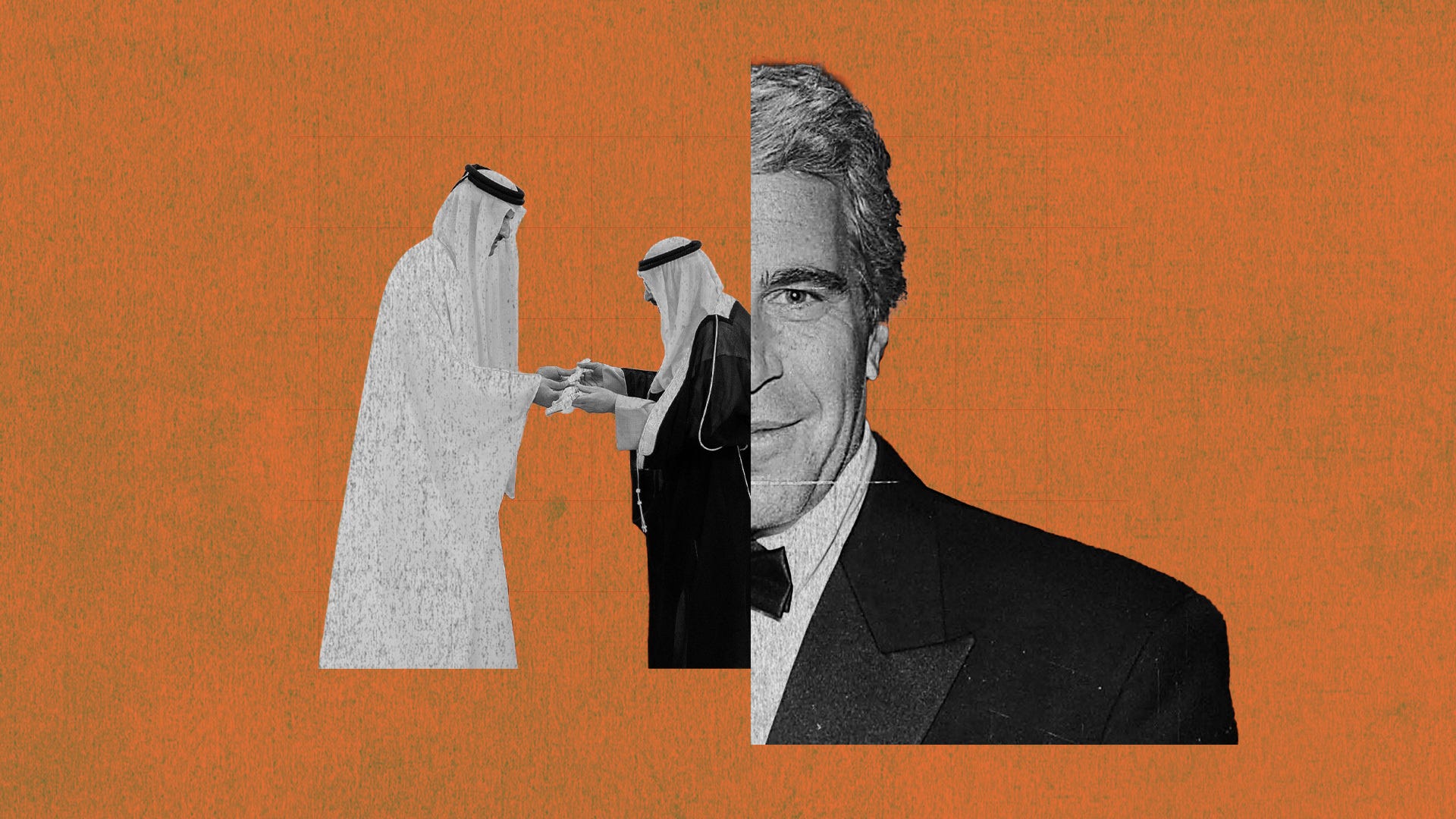
The Gaza Endgame
How a Dead Spy’s Networks, Regime Change, and Gulf Proxies Are Engineering Palestine’s Erasure
Something is unfolding in Gaza that requires us to see the entire chessboard. On February 1st, Israeli Channel 12 dropped a story that should have stopped the world: the United Arab Emirates is negotiating to take over full civilian administration of the Gaza Strip. Not coordinate humanitarian aid. Not assist with reconstruction. Full takeover.
The details: Abu Dhabi would manage Gaza’s markets, control all trade and logistics, deploy armed Emirati forces alongside US private contractors, and route every single incoming good through Israel using Israeli suppliers and contractors. Draft agreements have already been exchanged among Israel, the UAE, and the United States. Israeli officials are not hiding what this is. They describe it plainly: a complete Emirati civilian takeover, backed by multibillion-dollar investment.
The UAE denies everything, naturally. But denials mean nothing when the infrastructure for implementation already exists, when the networks have been built over fifteen years, when obstacles have been systematically removed, and when the same players who constructed this architecture are now moving to execute.
Understanding how we arrived here requires connecting threads. A dead intelligence operative who spent years brokering Israel-UAE ties. A Pakistani prime minister identified as “dangerous” and then toppled through documented regime change. Mercenary forces trained on occupied territory. Surveillance technology binding autocrats together. And billions in Gulf money ensuring American political cooperation.
Let’s look at the pattern.
Epstein’s Real Work: Building the Israel-UAE Shadow State
Jeffrey Epstein was not a financier who happened to know powerful people. The files released in January 2026 confirm what investigators suspected for years: he was an intelligence operative constructing the Israel-UAE alliance that is now positioning itself to absorb Gaza.
Back in 2013, seven years before the Abraham Accords made headlines, Epstein was arranging meetings between Ehud Barak, former Israeli Prime Minister and military intelligence chief, and Sultan Ahmed bin Sulayem, the CEO of DP World. If you don’t know DP World, you should. It is one of the largest port and logistics operators on Earth, and it is UAE-controlled. Epstein was not setting up business lunches. He was pitching Sulayem as essential to Israeli strategic interests, pushing logistics investments, intelligence sharing, economic integration. He used his direct connections to Dubai’s ruling family, positioning himself as the shadow diplomat making Israel-UAE cooperation possible before it was politically acceptable to say out loud.
The files show Epstein trained under Barak when Barak ran Israeli military intelligence. He brokered Russian-Israeli intelligence channels on Syria and Iran. He facilitated Israeli surveillance technology deals across Africa. He cultivated UAE elite access with surgical precision. Emirati businesswoman Aziza al-Ahmadi was shipping him sacred Kaaba cloth and checking on his island after hurricanes. Leaked messages reference meetings with Mohammed bin Zayed himself, the man who now runs the UAE and is arguably the most powerful figure in the Arab world.
FBI memos are explicit. They describe Epstein as Mossad-linked, operating as a fixer for Israeli influence operations targeting American officials including Trump and Kushner. This was not networking. This was constructing a covert alliance built on kompromat, economic leverage, and intelligence fusion that would eventually mature into the Abraham Accords.
Epstein died in 2019. But the networks he built did not die. They formalized, expanded, and now they want Gaza as their ultimate proof of concept.
The Imran Khan Problem: Why He Had to Go
Here is where the story gets darker and the pattern becomes impossible to ignore. In 2018, shortly after Imran Khan’s party won Pakistan’s national elections, Jeffrey Epstein sent an email that should have been international news. He described Khan as “a much greater threat to peace” than Turkish President Erdogan, than Iran’s Ayatollah Khamenei, than China’s Xi Jinping, than Vladimir Putin.
Stop and think about that for a moment. Epstein, operating inside networks connected to Israeli and American intelligence, considered Pakistan’s democratically elected prime minister more dangerous than the leaders of Turkey, Iran, China, and Russia. Why would a freshly elected Pakistani prime minister threaten the kind of “peace” Epstein’s networks were engineering?
Because Khan represented something none of those other leaders did: a nuclear-armed Muslim-majority democracy led by a populist who actually meant what he said about independence. Khan was not a compliant client. He advocated loudly for independent foreign policy, refusing to let Pakistan be anyone’s proxy. He supported Palestinian rights without qualification and rejected any Israeli normalization, stating clearly after the UAE and Bahrain signed the Abraham Accords: “Pakistan will never recognize Israel until Palestinians are given their right of a just settlement.”
But what made Khan truly dangerous to these networks was his refusal to choose sides in the way Washington demanded. In February 2022, as Russian tanks rolled into Ukraine, Imran Khan was in Moscow meeting Vladimir Putin. This was the first visit by a Pakistani prime minister to Russia in 23 years. American officials made clear they were watching this visit “very closely.” When Khan returned to Islamabad, he stressed in a televised address that Pakistan wanted a “free and independent” foreign policy and would not be a “slave of Western powers.”
Five weeks later, Khan was removed from power.
The Documented Coup: How Obstacles Get Eliminated
What happened to Imran Khan was not organic political opposition. It was engineered removal, and we have the documentation. In March 2022, just weeks after Khan’s Moscow trip, the US State Department held a meeting that sealed his fate. A classified Pakistani diplomatic cable, later leaked and published by The Intercept, documented exactly what Assistant Secretary of State Donald Lu told Pakistan’s ambassador.
Lu was explicit. He said “all will be forgiven in Washington” if Khan is removed from power. Then came the threat: “Otherwise, I think it will be tough going ahead.” This was not subtle diplomacy. This was a shakedown operating at the state level, documented in Pakistan’s own classified communications.
On April 10, 2022, with that American threat hanging over Pakistan’s military establishment, parliament ousted Khan in a no-confidence vote. Khan became the first Pakistani prime minister in the country’s history removed through this mechanism. The new government immediately filed corruption charges so transparently manufactured that even Khan’s critics struggled to take them seriously. The point was not conviction. The point was ensuring Pakistan’s most popular politician could never return to power.
Jeffrey Sachs, the Columbia economist and foreign policy analyst, wrote about this with unusual bluntness: “There are strong reasons to believe that US actions led to the removal from power of Pakistan’s Prime Minister Imran Khan in April 2022.” He described the charges against Khan as “trumped-up” and designed explicitly to block Pakistan’s most popular political figure from any comeback.
Why does any of this matter for Gaza? Because Khan’s removal was not about corruption or governance failures. It was about eliminating an obstacle to the regional architecture that now seeks to absorb Gaza. Khan stood in the way of Israeli normalization with Pakistan. He championed Palestinian sovereignty as non-negotiable. He pursued genuinely independent foreign policy that could not be controlled from Washington, Abu Dhabi, or Tel Aviv. Epstein had flagged him as “dangerous” back in 2018. By 2022, the networks Epstein helped construct had matured to the point where they needed Khan gone.
And once he was eliminated, Pakistan could be integrated into the system he had refused to join.
Post-Khan Pakistan: From Defiance to Complicity
Flash forward to January 2026. Prime Minister Shehbaz Sharif, who took power after Khan’s ouster, signed Trump’s “Board of Peace” charter at the World Economic Forum in Davos. Pakistan joined the UAE and 24 other nations in a multilateral framework to oversee Gaza’s future, with Donald Trump serving as lifetime chair.
Think about what this represents. Imran Khan had declared Pakistan would never recognize Israel without Palestinian justice. The government that replaced him after regime change has now embedded Pakistan in a framework explicitly designed to facilitate UAE-Israeli control of Gaza. Officials claim Pakistan will only provide humanitarian support, not military forces. But reports of 3,500 Pakistani troops deploying under a US-led International Security Force have been circulating for weeks.
Whether those troops deploy or not is almost beside the point. The signature itself is complicity. Pakistan is providing Muslim-majority legitimacy to what amounts to corporate colonialism dressed up as reconstruction. The Board of Peace is not about peace. Read the fine print. It is about “deradicalization,” economic integration, and administrative control, all sanitized language for dismantling any political infrastructure that could sustain organized Palestinian resistance.
Pakistan’s participation makes perfect sense once you understand the regime change context. The United States has applied enormous pressure on Pakistan’s military chief, General Asim Munir, to participate in Gaza operations. Pakistan is economically desperate, dependent on Gulf loans and IMF bailouts that come with conditions. By joining the Board of Peace, Pakistan secures American goodwill, Gulf financial support, and access to reconstruction contracts that will be worth billions.
But the cost is betrayal of everything Khan represented. He was removed precisely because he would have refused this arrangement. His independent foreign policy made him incompatible with the regional architecture being constructed by the networks Epstein helped build. Once Khan was eliminated, Pakistan became available for integration into the UAE-Israeli proxy system that is now moving on Gaza.
This was not accident or coincidence. This was planning, obstacle removal, and execution.
The Kushner Money: How the Trump Family Got Bought In
Jared Kushner left the Trump White House in January 2021 with exactly zero experience running a private equity firm. Six months later, he somehow secured $2 billion in investment for his newly created fund, with the money coming from sources that had every reason to reward him for services rendered. The fund’s own advisers had described it as “inadequate on all fronts,” yet the money flowed anyway.
This was not investment. This was payment. During his time in the White House, Kushner had been the primary architect of the Abraham Accords, the normalization deals between Israel and Gulf states that completely bypassed Palestinian sovereignty. He had defended Gulf autocrats, facilitated massive arms deals, and designed a Middle East policy that treated Palestinians as an obstacle to economic integration rather than a people with rights.
Kushner later described the Israeli-Palestinian conflict as “a real estate problem,” and called the two-state solution “a super bad idea.” Real estate problem. That phrase tells you everything about how this network views Gaza. Not as a political issue requiring justice, but as a development opportunity requiring management. Not as occupied territory that needs liberation, but as underutilized land that needs better administration.
The money Kushner received has reportedly gone into Israeli tech investments, marking documented instances of Gulf capital flowing directly into Israeli companies. That money cycles back into the surveillance and defense industries that form the technological backbone of the UAE-Israel alliance. It is a closed loop: American political access secures Gulf investment, which finances Israeli technology, which enables authoritarian control across the region, which generates more opportunities for American political access.
And now Kushner is back, advising Trump on Middle East policy while holding billions that came from the very Gulf states now positioning themselves to take over Gaza. The conflicts of interest are not bugs. They are the entire system.
The Abraham Accords: Erasing Palestine Was Always the Point
The Abraham Accords were sold as historic peace agreements between Israel and Arab states. That is marketing copy. What they actually represented was the formalization of intelligence and economic networks that Epstein had been building since at least 2013, creating a regional architecture that rendered Palestinians irrelevant to their own future.
Trump’s “Deal of the Century,” unveiled in 2020 alongside the Abraham Accords process, was not a peace plan. It was annexation with paperwork. The plan stipulated that 87 percent of the West Bank under Israeli control would be annexed to Israel outright. Palestinians would receive a “state” with no military, no control over airspace or borders, no control over electromagnetic spectrum, and no right to make treaties without Israeli approval.
Israel would retain total security control over the Jordan Valley and all international crossings. The Palestinian “state” would be required to disarm completely and suppress any resistance movements, meaning Palestinians would be expected to provide security services for Israeli occupation. Jerusalem’s status would remain under Israeli control, with holy sites managed by Jordan, not Palestine.
This was not statehood. This was Bantustan administration, a security subcontract wrapped in sovereignty language. The deal failed because it was too explicit, too obviously colonial to sell internationally. But the logic did not die. It migrated into new forms, quieter arrangements, technocratic language about reconstruction and stabilization.
That logic is now being operationalized in Gaza through the UAE as civilian administrator, Pakistan as Muslim legitimizer, and Trump’s Board of Peace as multilateral theater. This is the Deal of the Century implemented through the back door, rebranded as humanitarian intervention.
The UAE Proxy Model: Tested, Refined, Ready for Gaza
The UAE is not entering Gaza as a neutral humanitarian actor. It is Israel’s most capable regional proxy, with infrastructure purpose-built for exactly what Gaza requires: occupation managed through mercenaries and surveillance rather than visible military deployment.
Since 2011, the UAE has constructed one of the world’s most sophisticated foreign mercenary forces specifically because its tiny citizen population makes large-scale military deployment politically impossible. It hired Erik Prince, the Blackwater founder, to build an 800-man foreign battalion for over $500 million. Prince, facing legal problems in the United States, relocated to Abu Dhabi and recruited Colombian mercenaries because, as he reportedly stated, he did not trust Muslims to fight other Muslims.
These forces have been deployed across Yemen and Libya. Many were trained on Israeli-occupied territory in the Negev, deliberately chosen because the desert terrain resembles Yemen. The UAE has used over 15,000 Sudanese mercenaries, many of them children. It has established military bases, radar systems, and surveillance infrastructure on strategic Yemeni islands including Socotra, Perim, and Zuqar, working directly with Israel.
This is documented fact, not theory. Israel and the UAE have jointly constructed intelligence infrastructure throughout the Red Sea and Gulf of Aden, positioning themselves to control the maritime chokepoints that govern global trade. The UAE backed the Southern Transitional Council in Yemen specifically to gain control over key ports and the Bab al-Mandab Strait.
The surveillance dimension is equally proven. NSO Group, the Israeli company behind Pegasus spyware, has sold its technology to the UAE with explicit approval from Israel’s Ministry of Defense. Pegasus has been deployed against dissidents, journalists, and human rights activists across the region, including Emirati activist Ahmed Mansoor, who was imprisoned after UAE authorities compromised his phone. This shared surveillance capacity is the technological core of the Israel-UAE alliance: integrated intelligence, coordinated repression, unified control.
Now imagine this entire infrastructure applied to Gaza. Emirati forces providing security on the ground. Israeli contractors controlling every supply chain. American private military companies providing operational cover. Surveillance systems monitoring every communication, every movement, every transaction.
This is not reconstruction. This is the complete securitization of a captive population, Gaza transformed into a proof-of-concept for technocratic occupation that does not require visible Israeli military presence.
The Pattern Completed: Every Piece in Place
Once you see it, you cannot unsee it. The architecture is complete:
2013-2019: Epstein constructs shadow networks connecting Israeli intelligence to UAE economic and political power, brokering critical meetings between Barak and DP World leadership, cultivating access to MBZ, operating as documented Mossad-linked fixer.
2018: Epstein identifies Imran Khan as “much greater threat than Erdogan, Khamenei, Xi, or Putin,” flagging him as an obstacle due to his nuclear-armed populism and commitment to genuine independence.
2020: Abraham Accords formalize the Israel-UAE alliance that Epstein spent years building in shadow, with Kushner as public architect and Trump as executive authority. The Deal of the Century proposes Palestinian annexation disguised as statehood, but fails due to excessive transparency.
2021: Kushner secures $2 billion after leaving White House, monetizing his role in constructing regional realignment that serves UAE-Israeli interests.
2022 February: Khan visits Putin in Moscow as Ukraine invasion begins, doubling down on independent foreign policy and Palestinian solidarity that make him incompatible with the emerging order.
2022 March: US State Department explicitly threatens Pakistan with consequences unless Khan is removed, documented in leaked classified cable showing direct American intervention.
2022 April: Khan removed through no-confidence vote engineered via Pakistani military under American pressure, becoming first PM in Pakistani history ousted through this mechanism.
2026 January: Post-Khan Pakistan signs Board of Peace, joining UAE framework to oversee Gaza and abandoning Khan’s pro-Palestine commitments that had been non-negotiable.
2026 February: Israeli media reports UAE negotiating full civilian takeover of Gaza with Israeli backing, American coordination, and draft agreements already exchanged.
This is not a collection of unrelated events that happen to align. This is systematic obstacle removal followed by implementation. Khan had to be eliminated because he represented exactly the kind of independent Muslim leadership that could have mobilized opposition to UAE-Israeli control of Gaza. Once he was removed through documented regime change, Pakistan became available for integration into the framework he had refused to join.
The networks Epstein built to connect Israeli intelligence with UAE power have achieved their objective: transforming Gaza from a site of resistance into a logistics hub managed by Gulf proxies, legitimized by Muslim-majority states that have had their independent leaders removed, secured through surveillance and mercenary forces that leave no visible Israeli footprint. Trump’s Board of Peace provides the multilateral theater. Kushner’s billions ensure Trump family cooperation and access. Pakistan’s signature provides Islamic legitimacy after its obstacle was eliminated.
And the UAE takeover transforms military occupation into civilian administration, making permanent what was supposed to be temporary, erasing sovereignty while maintaining the language of reconstruction.
What Comes Next: The Model for Erasure Without Conquest
When the UAE assumes civilian control of Gaza, and all signs suggest this is when rather than if, it will not be described as occupation. International media will frame it as stabilization, as pragmatic reconstruction, as humanitarian necessity. There will be glossy coverage of market openings, investment announcements, infrast
ructure projects. Press releases will emphasize job creation and economic development.
What will remain unspoken is permanence. Once UAE contractors embed themselves in supply chains, once Emirati security forces establish operational control, once surveillance infrastructure begins monitoring the population, Gaza will never regain actual sovereignty. It will exist as a managed territory, economically dependent on Gulf capital, security outsourced to foreign mercenaries who answer to Abu Dhabi, politically neutered by the Board of Peace framework that defines resistance as terrorism.
Palestinians will face the same false choice embedded in the Deal of the Century: accept proxy administration or remain under siege. Any organized resistance will be classified as terrorism and suppressed by Emirati forces with Israeli intelligence support. Demands for genuine sovereignty will be dismissed as unrealistic, as radical, as obstacles to the pragmatic solution that has finally brought stability.
And the international community, exhausted by Gaza coverage and eager to move on, will largely accept this outcome as the best available option.
This is the future that Epstein’s networks made possible. This is the future that Kushner’s billions helped purchase. This is the future that the Abraham Accords were designed to enable. This is the future that required Imran Khan’s removal to clear the path. And this is the future that Pakistan, having had its obstacle eliminated, now provides legitimacy for through its signature on the Board of Peace.
But the implications extend far beyond Gaza. Once this model proves viable, once it demonstrates that occupation can be rebranded as administration, that sovereignty can be dissolved through economic dependency, that resistance can be managed through surveillance and mercenaries rather than visible military force, it will be applied everywhere.
The West Bank. Southern Lebanon. Anywhere that resistance movements exist and independent leadership threatens the regional architecture that has been constructed. Anywhere that populations can be isolated, besieged, and then offered the choice between continued suffering and accepting technocratic control by proxies.
This is not just about Palestine. This is about the infrastructure of 21st century domination, where intelligence operatives like Epstein build the networks, autocrats like MBZ provide the capital and muscle, opportunists like Kushner monetize the political access, mercenaries like Erik Prince provide the operational capacity, obstacles like Imran Khan get removed through regime change when they cannot be co-opted, and states like Pakistan provide legitimacy after their independent leadership has been systematically eliminated.
The pattern is complete. The infrastructure is operational. The obstacles have been removed. And Gaza is the proof of concept for how sovereignty gets erased not through military conquest that the world can see and condemn, but through administrative absorption, economic dependency, and multilateral frameworks that provide theater while permanent subjugation operates beneath the surface.
The fingerprints are everywhere once you know where to look. And they all point to the same engineered endgame that has been fifteen years in the making.


