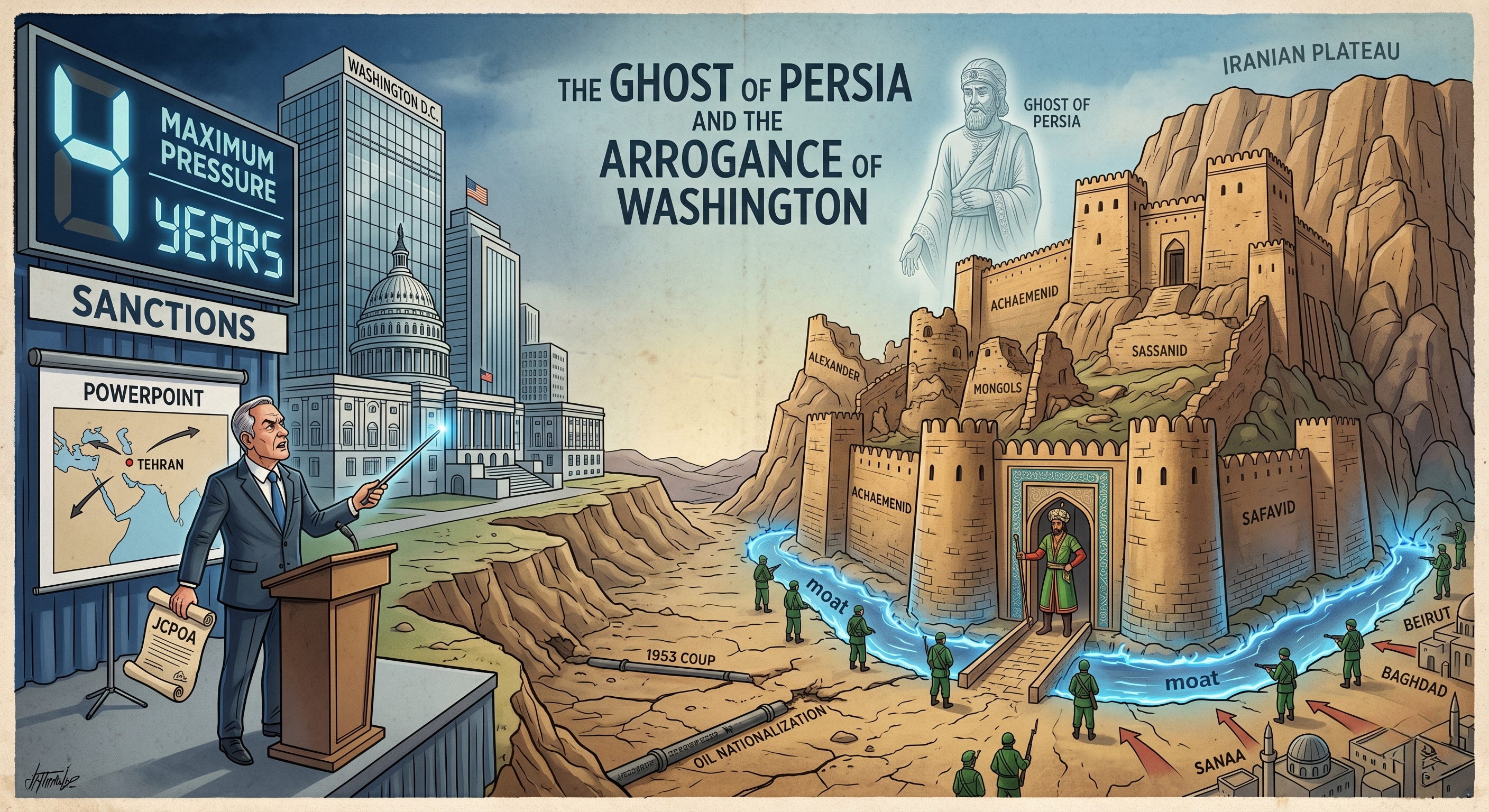
In a glass-walled conference room three blocks from the White House, a PowerPoint map of the Middle East glows on the screen. Tehran is marked with a red dot. Arrows point outward toward Beirut, Damascus, Baghdad, Sanaa. The presenter, a former official turned think tank scholar, talks about “export of revolution” and “terror proxies.” The discussion circles back, as it always does, to one question: What does the Islamic Republic want?
No one in the room asks what Persia wants.
A country made of memory
Iran sits in a geological fortress: a high plateau ringed by the Zagros and Alborz ranges, wedged between the Caspian Sea, the Persian Gulf, the Caucasus, Central Asia, and Mesopotamia. The plateau is not merely terrain. It is a kind of argument made in rock, one that every empire approaching it from any direction has eventually been forced to acknowledge. Alexander’s armies crossed it on the way to India. Arab caliphates pushed east through Khorasan. Mongol horsemen burned Nishapur to rubble and then, when survivors attempted to rebuild, sacked it a second time. Russian expeditions forced cessions from the Qajars in the 19th century. British agents ran networks from Basra to Mashhad during both world wars.
The count of invasions is not symbolic. Between the Arab conquest of the 7th century and the Constitutional Revolution of 1906, Iran was overrun, partitioned, or subjected to foreign-administered capitulations on roughly seventeen distinct occasions by modern historians’ reckoning. Each time, the plateau absorbed the blow, reconstituted some form of Persian administration, and carried the memory forward into the next confrontation. When the current generation of Iranian strategists in Tehran’s think tanks and war colleges speaks of civilizational survival, they are not deploying a rhetorical trope. They are describing a sequence that runs through every century of recorded Iranian history.
Western policy debates compress that history into a single date: 1979. What Washington treats as a 47-year-old revolutionary problem is, in Tehran’s own self-image, a 500-year effort to keep larger powers from overrunning a plateau that occupies the center of Eurasian geography. One side operates on a four-year electoral clock. The other builds on a different timescale entirely.
The Safavid moat
The modern Iranian state, as a geopolitical system, begins not with Khomeini but with Ismail I riding into Tabriz in 1501. He was fourteen years old, the scion of a Sufi order from Ardabil that had spent two generations building a military-religious following among Turkmen tribal confederations. The territory he had seized was hemmed in by larger Sunni powers on every side: the Ottomans under Bayezid II to the west, the Uzbek Shaybanid khanate under Muhammad Shaybani Khan to the northeast, hostile Turkmen confederations in the interior. In that precarious geography, Safavid Persia reached for an answer that was part theology, part defensive architecture, and part state-building logic that no subsequent Iranian government has fully abandoned.
Within months of seizing Tabriz, Ismail proclaimed Twelver Shiism the official state religion, enforced in mosques and bazaars from Azerbaijan to central Iran despite the population’s overwhelmingly Sunni background. The process was coercive and systematic. Sunni clerics who refused to curse the first three caliphs, Abu Bakr, Umar, and Uthman, were expelled or executed. Whole urban populations were subjected to forced conversion over the following decade. Because there were not enough trained Twelver scholars in Iran to staff the new religious bureaucracy, the Safavid court imported learned clerics from Arab Jabal Amel, the Shia-majority region of what is now southern Lebanon, effectively transferring an intellectual class across a thousand miles to administer a new state religion.
Contemporary Safavid chronicles and modern historians alike describe this as a political and strategic act as much as a spiritual one. Shiism gave the Safavids a distinctive legitimacy against their Sunni rivals and marked the Iranian realm as something fundamentally other in the Islamic world. An Ottoman army that conquered Tabriz would find itself governing a population whose religious identity had been deliberately constructed as incompatible with Sunni imperial administration. It was an ideological moat, a way of making the plateau indigestible.
The Ottoman Sultan Selim I understood the strategic stakes. He had already massacred tens of thousands of Anatolian Shia before his Iran campaign, viewing the Safavid religious project as an existential threat to Ottoman political coherence from within. At the Battle of Chaldiran in August 1514, his forces crushed Ismail’s cavalry with artillery and firearms the Safavids did not possess. It was not a close contest. Ismail fled the field, Tabriz was occupied, and Selim looted the city methodically. The young shah, who had believed himself divinely protected, reportedly never recovered from the psychological blow: contemporary accounts describe him withdrawing from public life and spending his final years in alcoholic retreat.
But Selim could not hold Tabriz. The logistics of sustaining an Ottoman army deep in Iranian territory across mountain passes were prohibitive, and Safavid administration reconstituted itself within a generation. What Chaldiran demonstrated, and what Iranian military planners have cited across centuries of strategic writing, was not that Persia could match Ottoman firepower. It was that the plateau could absorb a catastrophic battlefield defeat, lose its capital, watch its ruler collapse, and still persist as a state. The lesson was about endurance, not victory.
The consequences of the confessional choice lasted centuries beyond the dynasty’s fall in the early 18th century. By the mid-16th century, Iran had become the one large, consolidated Shia power in the Islamic world, a reality that set it permanently apart from almost every neighbor and hardened the fault lines that run from the Gulf to the Levant to this day. What Western security memos now call the “Shia crescent” is, in Iranian terms, simply the outer ring of that Safavid moat drawn five centuries earlier. When policy papers in Washington describe an “Axis of Resistance,” listing Hezbollah in Lebanon, militias in Iraq, the Houthis in Yemen, Palestinian factions in Gaza, and framing this web as an instrument for exporting Islamic revolution, Iranian strategists use a more prosaic phrase: defa-e moghaddam, forward defense. The doctrine, articulated in Iranian military journals and think tank papers, frames these groups as cushions to neutralize threats to Iranian national security as far from Iranian borders as possible. Fight the empire in someone else’s ruined suburbs so it never reaches Isfahan’s bridges or the oil facilities of Khuzestan. The moat is still there. The medium changed.
The coup that cut the spine
The United States did not begin its relationship with modern Iran in 1979. It began in earnest in August 1953, when the CIA and Britain’s MI6 helped to overthrow Mohammad Mossadegh, a nationalist prime minister who had nationalized the Anglo-Iranian Oil Company in April 1951 following a parliamentary vote of 79 to 12.
Mossadegh’s argument was simple and documented. The Anglo-Iranian Oil Company had paid more in British taxes in a single year than it paid to the Iranian government across the entire preceding decade of operations. The company’s royalty agreements, last renegotiated in 1933 under duress after the Shah threatened cancellation, gave Britain roughly 84 percent of profits. Iran received the remainder from a resource extracted from Iranian soil by Iranian labor. The nationalization law Mossadegh’s government passed stated that the oil belonged to the Iranian people, which was also the legal position of every other oil-producing state that had not yet been forced into comparable arrangements.
For Britain, dependent on cheap Iranian crude for both its military requirements and its postwar economic recovery, this was intolerable. London imposed an embargo, organized a global buyer’s boycott of Iranian oil, froze Iranian sterling assets, and began planning for covert destabilization. When Dwight Eisenhower entered the White House in January 1953, American officials agreed to join the operation, designated TPAJAX in CIA cables and Operation Boot by MI6.
The CIA’s operational lead was Kermit Roosevelt Jr., Theodore Roosevelt’s grandson and head of the CIA’s Near East operations. Roosevelt later wrote a memoir, Countercoup, describing his activities in Tehran in the summer of 1953. The CIA declassified its own internal history of the operation in 2013 following a Freedom of Information request by George Washington University’s National Security Archive. The document confirms that the CIA allocated approximately $1 million to the operation, distributed across payments to Iranian military officers, street organizers, and religious figures. One of the clerics approached was Ayatollah Abol-Qasem Kashani, who had been among Mossadegh’s most important popular supporters; his defection, financed in part through CIA funds, severed a critical religious-nationalist alliance. The Rashidian brothers, three Iranian businessmen already on the British payroll, organized street gangs and hired demonstrators to attack pro-Mossadegh rallies and generate the appearance of popular opposition.
The CIA document also details a black propaganda campaign in which fake newspaper articles were planted in the Iranian press attributing pro-communist statements to Mossadegh, designed to alarm both religious conservatives and moderate nationalists simultaneously. On 19 August 1953, paid mobs moved through Tehran while military units loyal to the Shah seized key positions. Street battles left around 300 dead. Mossadegh was arrested, tried before a military court on charges of treason, and confined to house arrest at his village of Ahmad Abad for the remaining eleven years of his life.
The oil consortium that replaced the nationalized company distributed the assets accordingly: American firms, including Standard Oil of New Jersey, Socony-Vacuum, Standard Oil of California, the Texas Company, and Gulf Oil, received a combined 40 percent stake. Anglo-Iranian Oil, renamed British Petroleum, retained 40 percent. The remaining 20 percent went to Royal Dutch Shell and the Compagnie Française des Pétroles. Iranian oil, which had been Iranian national property for two years, became a Western consortium asset again, and the Shah who returned to power on the strength of CIA money governed as an increasingly autocratic client for the following 26 years.
Iranian histories treat 1953 as the original sin of the modern era. The revolution of 1979 made extensive rhetorical use of that memory. But the deeper wound belonged to the state, not the clerics who subsequently inherited it, and it shaped Iranian strategic culture in ways that no change of government in Tehran has erased: the conviction that Washington will honor no agreement that conflicts with its energy and security interests, that legal compliance is not a shield, and that no multilateral framework protects a state that cannot protect itself.
Trench lines and gas clouds
The trauma that most directly shapes Iran’s current military doctrine came almost three decades later. In September 1980, Saddam Hussein’s Iraq invaded, calculating that post-revolutionary purges of the officer corps had left Iran incapable of sustained resistance. Iraqi armored divisions crossed the Shatt al-Arab into Khuzestan province, and what Baghdad expected to be a short punitive campaign became the longest interstate war of the 20th century, ending only in August 1988.
The battle for Khorramshahr in the autumn of 1980 established what the war would cost. Iraqi forces seized the city after weeks of intense urban combat in which the Iranians lost an estimated 7,000 killed, and the city was reduced to rubble so complete that it entered Iranian memory as “the City of Blood.” Iran retook Khorramshahr in May 1982 and captured 19,000 Iraqi prisoners in the process, one of the largest prisoner hauls in the modern Middle East. The front then stabilized into positional trench warfare, reminiscent of the Western Front in 1915 and 1916, along lines that barely moved for the next four years.
Iraq had structural advantages that Iran could not match through courage alone. Gulf Arab monarchies, led by Saudi Arabia and Kuwait, funneled an estimated $30 to $40 billion into Saddam’s war chest across the eight-year conflict, providing the financial base for sustained weapons procurement. The Soviet Union supplied T-72 tanks, artillery, and aircraft. France sold Mirage F1 fighters, Exocet missiles, and eventually agreed to lease Super Etendard aircraft specifically capable of attacking Iranian oil tankers. The United States restored full diplomatic relations with Baghdad in November 1984, began sharing satellite reconnaissance imagery of Iranian troop positions with Iraqi commanders through a CIA intermediary program, and blocked attempts at the Security Council to impose arms embargoes or formal censure on Iraq.
From 1983 onward, Iranian troops began arriving at field hospitals with burns and respiratory injuries consistent with blister and nerve agents. UN investigators confirmed over subsequent years that Iraqi forces had deployed mustard gas, tabun, and sarin at the battles of Panjwin in 1983, the Majnoon Islands in 1984, the Fao Peninsula in 1986, and dozens of smaller engagements across northern and central front lines. The scale was methodical, not incidental. Iranian estimates put the chemical weapons death toll at approximately 30,000; the physical effects on survivors, lung damage, blindness, and cancers, continued killing and disabling veterans for decades after the ceasefire.
Western complicity in supplying the program’s industrial base was not incidental either. German companies provided precursor chemicals for Iraq’s mustard gas production. A U.S. Commerce Department review, declassified and cited in Senate Foreign Relations Committee hearings during the 1990s, found that American firms had exported biological agents and chemical precursor materials to Iraq during the war years under standard export licenses, including anthrax cultures and materials applicable to nerve agent production. When Iran brought evidence of chemical weapons use to the Security Council in 1986 and pressed for formal condemnation and sanctions, the United States and its allies blocked measures with enforcement teeth, arguing for “balance.” By March 1988, when Iraq deployed chemical weapons against the Kurdish town of Halabja and killed approximately 5,000 people in a single afternoon, the international legal framework had been demonstrated in practice to have no guardian willing to enforce it.
Iranian veterans drew one lesson from those eight years and repeated it without variation: when the shells fall and the gas comes, no one comes. Not the Security Council. Not the Geneva Conventions. Not Washington, which knew what Iraq was doing because Washington had provided the intelligence that directed Iraqi operations. That lesson is not an Islamic Republic ideological construction. It is a state-level conclusion drawn from a documented evidentiary record, and it has governed Iranian military procurement and strategic planning from 1988 to the present.
The war also forced an immediate reckoning with air power. Iran’s air force, equipped before the revolution with American F-14s, F-4s, and F-5s, was now cut off from American spare parts, engines, and technical support. Pilots cannibalized multiple aircraft to keep single jets operational. By the mid-1980s, Iran’s effective air combat capacity had deteriorated so severely that it could no longer contest Iraqi air superiority over large portions of the front. The contrast with Iraq’s Soviet and French-supplied air arm was a structural disadvantage Tehran could not close through ingenuity. The internal conclusion about missiles was already being drawn while the war was still being fought.
From Scuds to Shaheds
Tehran began importing Scud variants from Libya and North Korea during the latter stages of the war. Within a decade, it had established the industrial base to build its own derivatives. The Shahab series, developed through the 1990s and 2000s, extended Iran’s strike range incrementally: from a few hundred kilometers with early variants to over 2,000 kilometers with the Shahab-3 and its successors, placing Israeli cities within range for the first time. The Fateh series of solid-fuel missiles, easier to move and faster to prepare for launch than liquid-fueled systems, gave Iranian ground forces a flexible tactical option that could be dispersed across terrain and concealed from aerial surveillance.
The IRGC’s Aerospace Force, established specifically to operate the ballistic missile program outside the conventional military command hierarchy, placed the weapons under ideological as well as operational control. Reports by SIPRI and American military analysts document that Iran invested systematically in large inventories of relatively simple, short- and medium-range missiles producible with domestic industry, dispersed across tunnel complexes and hardened underground bases, and launched from mobile platforms designed to complicate any preemptive strike calculation. The program was not designed to fight a conventional war. It was designed to make attacking Iran prohibitively costly, a deterrence logic drawn directly from the conclusion that international law offered no protection.
The drone program followed the same logic at lower unit cost. By the early 2000s, the IRGC was fielding reconnaissance UAVs. By the 2010s, armed drones and loitering munitions had entered service. The Shahed-136, a delta-wing loitering munition using a piston engine, is estimated to cost between $20,000 and $50,000 per unit and can be mass-produced with components available through global electronics supply chains. An investigation by C4ADS, published in 2025, traced the transfer of Shahed designs and production specifications to Russia, which now manufactures a localized version, the Geran-2, at a facility in Tatarstan under a contract for at least 6,000 units. The report details covert payment networks involving gold shipments routed through Gulf banking intermediaries to circumvent sanctions, and documents how two states, each expelled from the dollar-based financial system, converted mutual isolation into a shared production architecture.
A generation ago, Iranian planners were improvising defenses against Iraqi Scud salvos while their air force disintegrated from lack of spare parts. Today, those drones are integrated into Russian strike packages against Ukrainian power infrastructure. The line runs straight through the trenches and the gas clouds of the 1980s.
The illusions of 2015
For a brief period after 2015, the calendars of Western and Iranian diplomacy did align. The JCPOA was the product of twenty months of negotiations involving Iran and the P5+1, supplemented by intensive bilateral U.S.-Iranian back-channel engagement that represented the most direct diplomatic contact between the two governments since the revolution. Iran agreed to cap uranium enrichment at 3.67 percent, reduce its enriched uranium stockpile by 98 percent, redesign the Arak heavy-water reactor to prevent weapons-grade plutonium production, and accept a monitoring regime that included IAEA long-term presence, 24-hour surveillance at key nuclear facilities, and continuous monitoring of the uranium supply chain for 25 years.
The IAEA issued eleven consecutive reports confirming Iranian compliance between January 2016 and April 2018. European businesses moved immediately to reenter Iranian markets. The French energy major Total signed a $4.8 billion agreement to develop South Pars Phase 11, the world’s largest natural gas field. Airbus signed contracts to sell 100 aircraft to Iran Air. Siemens opened infrastructure negotiations. European banks began exploratory discussions on correspondent relationships with Iranian counterparts. Inside Iran, President Hassan Rouhani and Foreign Minister Mohammad Javad Zarif had spent their political capital on a single argument: that a theocratic state could negotiate in good faith with Washington and receive good faith in return, and that economic normalization through engagement was achievable.
On 8 May 2018, Trump announced U.S. withdrawal from the JCPOA and reimposition of all nuclear-related sanctions. The IAEA had certified Iranian compliance. Washington’s own European allies had certified Iranian compliance. None of it mattered. Within 90 days of the announcement, Total had abandoned the South Pars deal rather than lose access to the U.S. financial system. Airbus cancelled its aircraft contracts. European banks that had been preparing correspondent relationships withdrew without completing a single transaction. The Instrument in Support of Trade Exchanges, a special purpose vehicle Europe created specifically to facilitate limited Iran trade outside the U.S. financial system, processed one transaction in three years of operation, a single humanitarian goods transfer, before being wound down in 2023.
The political destruction inside Iran was more consequential than the economic damage. Rouhani and Zarif had persuaded the Supreme Leader to accept real and verifiable constraints on the nuclear program in exchange for sanctions relief, and had staked the entire reformist political project on the premise that Washington would honor a multilateral agreement that Iran had observed to the letter. When the administration tore up that agreement, the specific argument Rouhani had made was publicly and irrefutably destroyed, not by Iranian hardliners but by the U.S. Treasury. Hardline factions that had insisted for years that America would pocket concessions and move the goalposts held the certified record to prove it. Zarif’s position in Iranian politics never recovered. Rouhani left office in 2021 having failed to deliver the economic normalization he had promised. His successor, Ebrahim Raisi, had campaigned on the straightforward premise that negotiation with Washington was a category error.
The Americans accomplished in two years what Iranian hardliners had failed to do in two decades: they discredited the reformist argument from the outside, using the one tool hardliners could not have deployed themselves: verified Iranian compliance followed by American bad faith.
China’s patient bargain
Beijing watched the maximum pressure campaign with the attentiveness of a state that had been thinking seriously about energy security for twenty years. China’s dependence on imported oil had been rising steadily since domestic production plateaued in the mid-1990s; by 2019, China was importing approximately 70 percent of its oil, making the security of supply lines a strategic priority of the first order. The Gulf, through which a substantial portion of that oil moved, was dominated by U.S. naval forces operating from bases in Qatar, Bahrain, and the United Arab Emirates. In any serious confrontation with Washington over Taiwan or the South China Sea, American naval power could theoretically interdict Chinese oil imports through the Strait of Hormuz at will. That vulnerability had no easy answer inside the existing U.S.-led energy order.
The 25-year Comprehensive Strategic Partnership signed in Tehran in March 2021 addressed it directly. The framework, described in reporting by the New York Times and the Atlantic citing draft texts and Iranian officials, provides for up to $400 billion in Chinese investment in Iranian energy, infrastructure, transportation corridors, ports, and telecommunications over 25 years, in exchange for a steady supply of heavily discounted Iranian crude estimated at $5 to $10 per barrel below prevailing market prices. Chinese imports of Iranian oil, routed through intermediaries in Malaysia, Oman, and the UAE to obscure their origin and evade U.S. secondary sanctions, rose significantly after the deal’s formalization. Analysts at Kpler and S&P Global Commodity Insights estimated Chinese Iranian crude imports at between 1.5 and 1.8 million barrels per day in 2023 and 2024, a volume representing a substantial portion of Iran’s total export capacity.
Specific infrastructure projects under negotiation or development include expansion of the Chabahar port complex on the Gulf of Oman, development of rail and road corridors connecting Chabahar to Central Asian networks, and participation in Iranian petrochemical and refinery expansion. The geographic logic is straightforward. A Chinese-funded Chabahar connected to Central Asian rail networks reduces Chinese dependence on the Strait of Malacca chokepoint and provides a southern access route to Eurasian markets that does not pass through waters where the U.S. Navy operates freely. It is a piece of the broader Chinese infrastructure strategy aimed at reducing exposure to American naval interdiction, and it is being built with American sanctions serving as the primary recruitment tool.
Maximum pressure achieved what no Chinese diplomat could have arranged through negotiation: it handed Beijing a willing, politically committed energy partner at a structural discount, with no alternative patron and every incentive to deepen the relationship regardless of the terms.
The butcher from the north
If the China alignment was strategically predictable, the depth of the Russian-Iranian military partnership required a longer explanation, because the history argues against it at almost every point.
In the 19th century, a sequence of catastrophic wars ended with the Treaty of Golestan in 1813 and the Treaty of Turkmenchay in 1828, by which Qajar Iran ceded vast portions of the South Caucasus to the Tsar: Dagestan, eastern Georgia, the Karabakh and Ganja khanates, and in the final settlement, Erivan and Nakhichevan, territories containing hundreds of thousands of Azerbaijani Turks, Armenians, and Lezgins who had been subjects of the Iranian crown. The Turkmenchay treaty imposed an indemnity of 20 million silver rubles on Iran, a sum requiring the crown to borrow from Russian banks and creating a financial dependency that lasted decades. The popular Iranian phrase for Russia across generations of political culture was “the butcher from the north,” a designation that persisted through the Tsarist, Soviet, and post-Soviet periods.
Russian troops occupied Tabriz in 1911 and again in 1941. In the Azerbaijan crisis of 1945 to 1946, Soviet-backed separatists established a short-lived autonomous government in northwestern Iran, and Soviet forces refused to withdraw under the terms of the 1942 Tripartite Treaty until American diplomatic pressure and an Iranian oil concession offer that Tehran subsequently declined to honor combined to force a pullback. The experience was not distant historical memory. Iranian politicians who negotiated the JCPOA in 2015 had been born into a country that had watched Soviet forces occupy its northwest within living parental memory.
Ideologically, the gap between Tsarist Orthodox empire, atheist Soviet state, and theocratic Islamic Republic appeared too wide to bridge by any political logic. Yet by 2022, Iranian engineers were sharing drone assembly specifications with Russian counterparts in Tatarstan workshops, and by early 2023, the Central Bank of Iran and Russia’s central bank had signed agreements to connect their interbank messaging systems outside SWIFT. Reports in 2024 showed Iranian bank cards functioning in Russian ATMs via integration with Russia’s Mir payment system. Both governments publicly described their bilateral trade as fully de-dollarized.
The explanation is not ideological convergence and never was. It is that maximum pressure and financial exclusion created a structural incentive for two sanctioned states to route around identical chokepoints, and that each possessed what the other needed urgently. Russia needed affordable, mass-producible drone technology after February 2022. Iran needed diplomatic cover, energy revenue channels, and economic liquidity that a deepening Russian partnership could provide outside the dollar system. Orthodox Christian nationalism and Shia revolutionary theology were irrelevant. Two states, expelled from the same financial infrastructure, built a bilateral economy from shared necessity.
Investigations by C4ADS and subsequent reporting detail the specific architecture: initial deliveries of Iranian-made drones in 2022, followed by technology transfer and construction of a drone manufacturing facility on Russian soil, financed in part through covert payments routed via UAE banking intermediaries and physical gold shipments specifically designed to circumvent sanctions. U.S. Treasury sanctions actions in 2025 named front companies accused of supplying Western electronics components for Shahed drones used in Russian strikes, illustrating how Iranian designs, global components, and Russian production capacity had fused into a single system operating across three continents.
Forward defense, not global jihad
Western intelligence mapping of Iran’s regional network typically presents lines of control radiating from Tehran to Baghdad, Damascus, Beirut, and Sanaa: the picture of a puppet master directing proxy armies across the Arab world toward a coherent revolutionary objective. The reality is messier and, from Tehran’s perspective, considerably more functional than ideological.
Scholars of Iran’s proxy doctrine describe a layered strategy in which ballistic missiles, UAVs, cyber capabilities, and non-state armed groups form a forward defense toolkit designed to extend Iran’s strategic depth and deter direct attacks by raising the cost of confrontation. The Houthis in Yemen received Iranian training, weapons technology, and maritime intelligence enabling increasingly sophisticated attacks on Red Sea shipping. Studies of the Houthi-Iran relationship, including detailed work by the UN Panel of Experts on Yemen, consistently establish that the Houthis retain significant operational autonomy, using Iranian support to pursue local aims even while their operations align with Tehran’s broader posture. The relationship is patron and client managing competing interests, not headquarters and field command.
The same dynamic applies to Iraqi militias, Hezbollah, and Palestinian factions. None of these organizations are Iranian divisions in foreign uniforms. All retain local political bases, domestic agendas, and the demonstrated capacity to resist Iranian direction when their interests diverge. Hezbollah’s decision-making in Lebanon has never been fully subordinate to Tehran’s timetable, as the 2024 exchange with Israel illustrated. Iraqi militias have repeatedly acted on local political calculations that created complications for Iranian diplomacy rather than serving it. Tehran’s network is real and consequential, but it is a coalition managed under friction, not an army commanded from above.
From Washington, these networks look like a single revolutionary will extended across five Arab states. From Tehran, they are the latest iteration of the Safavid moat, adjusted for the age of precision guidance and satellite communication. The Qizilbash cavalry that held the plateau’s perimeter in the 16th century were also tribal allies with local agendas that Safavid shahs managed carefully and did not fully control.
A Eurasian axis made in Washington
None of this means Iranian power is limitless. The Twelve-Day War of June 2025 saw Israeli strikes degrade a significant portion of Iran’s missile launch infrastructure and kill several senior IRGC commanders. Western and Israeli analysts noted real constraints in Tehran’s ability to regenerate depleted missile stocks at pace, coordinate its proxy network under sustained pressure, and defend against concentrated air operations targeting hardened facilities. The war exposed genuine vulnerabilities in Iran’s air defense architecture.
But the structural outcome of three decades of Western policy runs in the opposite direction from its stated objectives. The United States tried to prevent the consolidation of a Eurasian political and economic bloc capable of challenging its primacy. It now faces a Russia that depends on Iranian drone technology to sustain a European land war, an Iran embedded in Chinese energy security calculations and Russian financial networks, and a set of trade and payment infrastructure built deliberately to bypass the old Western chokepoints in the dollar system, SWIFT, and the Gulf-centered oil pricing mechanism.
Sanctions have been real and painful for ordinary Iranians: living standards deteriorating, the rial collapsing in value, access to imported medicines and industrial equipment becoming a daily operational problem for hospitals and factories alike. On the strategic level, however, the maximum pressure campaign has consolidated exactly the alignment Washington feared. A Chinese-Iranian energy partnership that gives Beijing a discounted, politically committed Gulf supplier outside American leverage. A Russian-Iranian military partnership that provided Moscow the drone production capacity to fight a sustained war in Europe. A shared financial architecture designed to reduce U.S. Treasury leverage over time, built by two sanctioned states that had no incentive to leave the system and every incentive to build an alternative.
Every additional year of maximum pressure deepens the integration. The institutions are already built: the payment rails, the energy contracts, the production lines, the port development agreements. The political cost of reversing them is now higher for all three governments than the political cost of maintaining them.
The cost of chronological blindness
The core error has not been moral outrage at Iranian abuses or legitimate concern about nuclear proliferation. It has been a refusal, sustained across administrations of both parties, to separate the Islamic Republic’s clerical architecture from the older and colder logic of the state it sits on.
When the United States withdrew from the JCPOA while Iran was in verified compliance, it handed the hardline argument its best evidence in forty years and wrapped it in the flag of national defense. Every Pasdaran commander and Friday prayer imam who had spent years insisting that Washington could not be trusted now held the certified documentary record. When sanctions were applied with sufficient breadth to cut off medicine imports alongside weapons technology, they fed the narrative that Iran faced not a contest over specific policies but a siege aimed at submission. When European governments demonstrated that they could not protect their own signatures on multilateral agreements, Iran drew the rational conclusion that there was no independent West to engage. There was the U.S. Treasury and those who complied with it.
The JCPOA’s collapse did not just fail as a diplomatic instrument. It closed the one political pathway inside Iran that might have, over time, produced a governing coalition less invested in the proxy network, less dependent on Russia and China, and more responsive to the costs of permanent confrontation. Rouhani and Zarif were not naive men. They understood what they were asking the Supreme Leader to accept. They staked their political careers on a single bet: that Washington would honor a verified agreement. They lost. No Iranian politician of comparable stature will make that bet again in the calculable future.
For half a century, Washington has managed policy toward Tehran as a question of containing an ideological nuisance, subject to rotation with each administration’s preferred instrument: sanctions, covert operations, support for regional adversaries, international isolation, and now armed conflict. Iran has managed policy toward Washington as another chapter in a 500-year effort to prevent larger powers from overrunning a plateau that has absorbed every previous attempt. Cyrus built an empire on it. Alexander crossed it. The Mongols burned it twice. The British and Russians divided it between them. The Americans overthrew its elected government, armed its enemy, and tore up its most significant diplomatic agreement in the modern era while the IAEA certified compliance.
The plateau endured all of them. The West keeps asking what the revolution wants. The question Persia has been answering for five centuries is a different one entirely.


