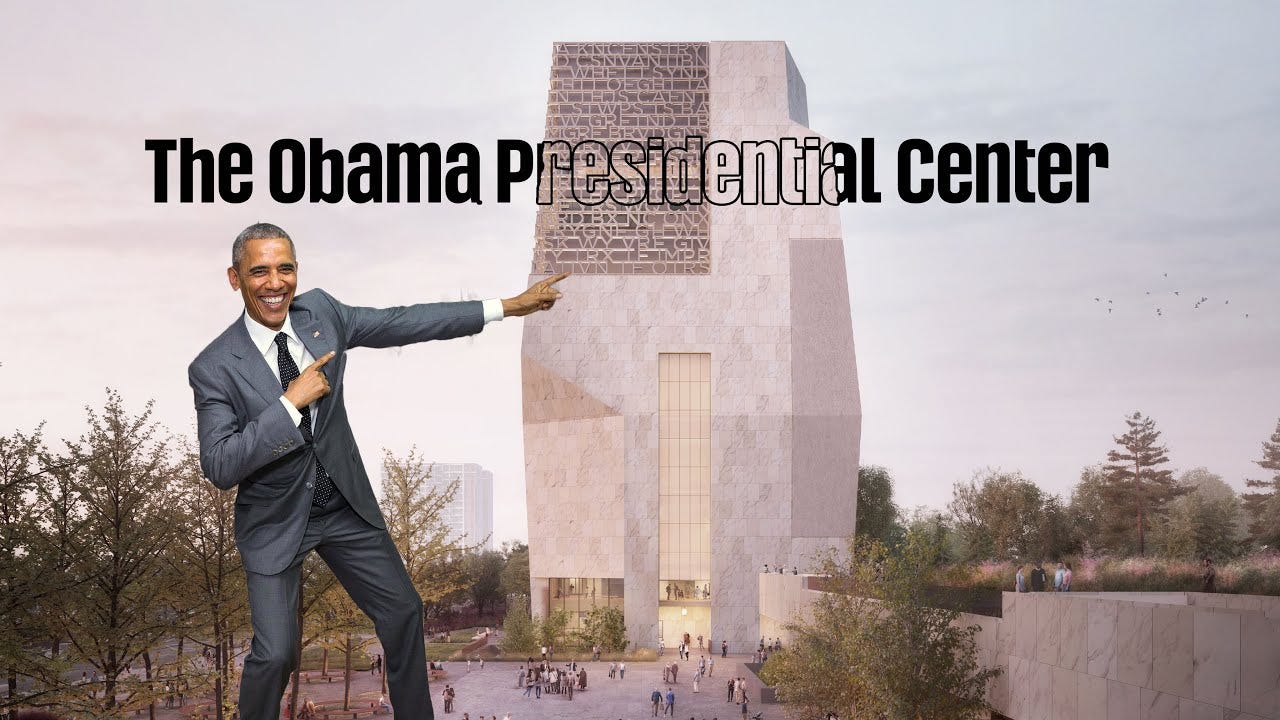
The Gift That Keeps Taking
Barack Obama’s Presidential Center, Its Oligarch Donors, and the Community It Is Displacing
Jackson Park sits at the southeastern edge of Chicago, a 550-acre expanse of lakefront green designed by Frederick Law Olmsted, the landscape architect whose work defines Central Park in New York and the Emerald Necklace in Boston. Olmsted built Jackson Park for the 1893 World’s Columbian Exposition. The park’s mature tree canopy, some of its oldest specimens more than a century in age, has for generations provided what residents of the surrounding South Side neighborhoods could not afford to manufacture elsewhere: cool air in Chicago summers that routinely exceed 90 degrees Fahrenheit, clean atmosphere in a city ranked 16th most polluted in the United States for ozone levels, and a quiet refuge from the compressed poverty of Woodlawn, South Shore, and Hyde Park. A 2018 inventory commissioned by Bartlett Tree Experts valued the 640 trees on the 19.3 acres of Jackson Park at $3.5 million, calculating that they removed 341.5 pounds of air pollution annually and stored 203.8 tons of carbon
.
In August 2021, construction crews began felling them.
By the time the Obama Presidential Center opens on Juneteenth 2026, an estimated 789 mature trees from the park’s interior and surrounding construction zones will have been removed. The National Park Service, in its Environmental Assessment of the project, concluded that construction would “diminish Jackson Park’s overall integrity by altering historic, internal spatial divisions that were designed as a single entity.” The agency nonetheless determined there would be “no significant impact to the human environment.” Construction proceeded. The Women’s Garden, which the Obama Foundation had told residents would be left intact, was uprooted. The track and field near 61st Street was torn up. The lagoon-facing drive along Cornell Road, a six-lane thoroughfare, was closed and converted to green space, a conversion that required the city to reroute traffic through nine intersections that will now operate over capacity.
Barack Obama once called this project a “gift” to Chicago.
Gifts, ordinarily, do not cost the recipient several hundred million dollars in infrastructure. The question of what this gift actually cost, and who paid for it, and whose interests its principal funders hold in parallel to their philanthropy, is the investigation this piece intends to conduct.
The Terms of the Deal: $10 for 19.3 Acres
The mechanism by which the Obama Foundation secured 19.3 acres of historic public parkland in Jackson Park for construction deserves specific examination, because the legal architecture of the deal is as revealing as the financial.
When filmmaker George Lucas sought to build his Museum of Narrative Art on the Chicago lakefront in the years before 2016, the city offered him a 99-year ground lease on the land. A federal judge ruled in 2016 that this arrangement violated the public trust doctrine: the principle in American common law that certain public resources, including parks and navigable waters, are held in trust by governments for the benefit of the public and cannot be alienated to private interests without clear public benefit. Judge John W. Darrah’s ruling sent Lucas looking for another city. He found Los Angeles.
Duly warned, the Obama Foundation and the City of Chicago rebranded the arrangement. Rather than a “99-year lease,” it became a “99-year use agreement.” Title to the land remained nominally with the city. The economic substance was identical: 19.3 acres of prime lakefront park, valued by legal challengers at approximately $200 million, transferred to a private foundation’s effective control for 99 years at a price of ten dollars.
The mayor who negotiated the deal was Rahm Emanuel. Emanuel had previously served as Barack Obama’s White House chief of staff. The arrangement his administration produced for his former boss passed legal review at the district court level, with courts declining to examine the financial merits on standing grounds, ruling that citizen plaintiffs, including the nonprofit Protect Our Parks, lacked sufficient standing to compel examination of whether the deal served the public interest.
Richard Epstein, law professor emeritus at the University of Chicago, has argued in published analysis that the use agreement is a “sham transaction” and that the terminological shift from “lease” to “use agreement” was engineered specifically to avoid the public trust review that sank the Lucas deal. “They put a million dollars into a $400 million endowment, so it’s endowed,” Epstein told Fox News in 2025. “That gets you in jail as a securities matter. An endowment means you have the money in hand. But they have nothing.”
What Epstein is referring to is the reserve fund. When the foundation signed its agreement with the city in 2018, it committed to building a $470 million endowment to protect taxpayers in the event the center ran into financial difficulty. As of late 2025, the endowment held $1 million, 0.21 percent of the pledged amount. The foundation has not added to the fund since the groundbreaking in September 2021.
Alongside the $850 million in private construction costs, the public infrastructure required to support the center, including road redesigns, traffic rerouting through Cornell Drive’s closure, utility relocations, and stormwater systems, has generated a public bill that no single government agency, after months of FOIA requests by Fox News Digital in late 2025, would quantify in consolidated form. Illinois alone has committed approximately $229 million in related infrastructure spending. Chicago’s 2024-2028 Capital Improvement Plan allocates more than $206 million to surrounding roadway and utility work. Whether these figures overlap, and whether federal transportation funds routed through the Illinois Department of Transportation are counted in one or both tallies, officials at the city and state levels consistently refused to clarify. Initial projections put combined public infrastructure costs at $350 million. The current numbers suggest the total has already exceeded that.
The Obama Foundation’s response to these questions is consistent: the center represents $850 million in private investment in an underserved community. This is accurate as a description of the construction budget. It does not describe who is paying for the roads.
The Records Question: A Library With No Books
The Obama Presidential Center is not a presidential library. This distinction is legally precise and practically significant, and it has generated sustained concern among historians, archivists, and transparency scholars since the Obama Foundation announced its intention in May 2017.
Every president since Franklin Roosevelt has built a physical archival facility, administered by the National Archives and Records Administration, housing paper records, artifacts, and research collections from their administrations. NARA’s mandate is explicitly nonpartisan: to preserve and provide access to presidential records as a public trust. The tensions between presidential legacy management and archival neutrality are chronic in the system. The Nixon library’s decades-long resistance to a full Watergate exhibit is the most documented case, but the framework at least imposes a structural check on the impulse of any administration to curate its own memory.
Obama’s Center abandons this framework entirely. The building in Jackson Park will house a museum, a basketball court, a public library branch, gardens, and programming space. It will not house the presidential records of the Obama administration. Those records, comprising 30 million pages of paper documents plus an estimated 300 million emails, 500 million digital files, tweets, Snapchat postings, and Salesforce documents, will be stored at NARA facilities in the Washington area. The Obama Foundation has committed to funding the digitization of the unclassified paper records, which will then be made available online.
The foundation’s framing is that this democratizes access: anyone with an internet connection can consult the archive rather than traveling to Chicago. Historians and archivists have found this argument insufficient on several grounds. Bob Clark, former director of the Franklin D. Roosevelt Presidential Library, told the New York Times: “Everybody is still calling it a presidential library, but it’s not. It’s a museum and a headquarters for a foundation that is funding the National Archives’ goal of digitizing all its documents.” Timothy Naftali, former director of the Nixon library, who oversaw the renovation of the Watergate exhibit to remove its pro-Nixon bias, described the decision as “astounding” for a president whom he called otherwise good.
The more structural concern is one of sequencing and control. The Obama Foundation, a private nonprofit with a stated mission to advance “the legacy of the Obama Presidency,” has influence over the order and pace at which records are digitized. The foundation selects and pays the private vendor handling the scanning. A private political organization is, in effect, managing its own former employer’s historical record, a situation without precedent in the American presidential library system. The Daily Beast, in a published investigation, concluded that the absence of any public facility to house and serve the Obama presidential records, combined with a private organization controlling the digitization of official records and NARA’s documented failure to build a working large-scale Electronic Records Archive, made the entire arrangement deeply problematic for public accountability.
The records became subject to Freedom of Information Act requests on January 20, 2022. Digitization began in 2021. As of the center’s 2026 opening, no comprehensive timeline for the completion of the digitization work has been published.
The Internal Economy: Who Gets Paid
Before examining the donors who funded the monument, it is worth understanding the internal financial architecture of the entity that manages it.
The Obama Foundation’s IRS Form 990 filings from 2018 through 2024, reviewed by multiple outlets, document a payroll that expanded from $18.5 million annually in 2018 to $43.7 million in 2024 as the foundation grew to 337 full-time employees. Total revenue in 2022 reached $311 million. In 2024 it stood at approximately $210 million. Net assets as of 2024 exceeded $1.1 billion.
Valerie Jarrett, the foundation’s CEO since 2021 and one of the most trusted figures in Obama’s personal and political life, was paid $755,862 in total compensation in 2024, according to the most recent 990 reviewed by CharityWatch. Her salary exceeded the reported CEO compensation of every other major presidential foundation: the George W. Bush Presidential Center paid its CEO approximately $661,000 in 2024; the Carter Center and Reagan Foundation leaders typically earn in the $500,000 range; the Clinton Foundation CEO compensation falls below $500,000. David Simas, who served as Obama’s White House political director and led the foundation from 2017 through 2020, received up to $626,000 annually in that role.
A review of the foundation’s 990 filings identified that at least six of its ten highest-paid executives in the 2018-2024 period previously held senior roles in the Obama administration or campaign. Tina Tchen, Michelle Obama’s former White House chief of staff, joined the foundation as an executive vice president in July 2022 and was paid $192,333 for that partial year; Robbin Cohen, foundation executive vice president, earned $651,929 in 2022. The concentration of former Obama officials at six-figure salaries within the foundation is so consistent as to function as a structural feature.
The foundation has simultaneously solicited unpaid volunteer labor. In March 2026, it advertised for between 75 and 100 unpaid “ambassador” volunteers to staff the center when it opens, alongside 300 full- and part-time salaried employees. The volunteer recruitment materials invoked Obama’s “vision of civic life” and his “earliest days as a community organizer on Chicago’s South Side.”
The endowment, promised at $470 million to protect Chicago taxpayers, holds $1 million.
The Bezos Ledger
Jeff Bezos gave $100 million to the Obama Foundation in November 2021, the largest individual contribution the foundation had received to that date. Bezos, who founded Amazon and stepped down as its CEO in the same year, remains the company’s largest individual shareholder. His gift arrived as “unrestricted,” meaning it could be deployed for any foundation purpose, including construction of the Center.
It arrived in the same year that Amazon Web Services, Amazon’s cloud computing division, jointly won a $1.2 billion contract with Google to provide cloud infrastructure to the Israeli government and its military. The contract, called Project Nimbus, was announced publicly in April 2021. The timing is a documented fact, not an insinuation. Whether it is relevant to an assessment of Bezos’s philanthropy is a question each reader will answer independently.
What is documented by leaked Israeli Finance Ministry contracts, published in a joint investigation by +972 Magazine, Local Call, and The Guardian in early 2026, is that Project Nimbus operates under terms Amazon has not accepted in any comparable contract elsewhere. Israel secured a contractual prohibition against Amazon restricting how its cloud products are used, even if Israel’s use violates Amazon’s own terms of service. Amazon is additionally obligated under the contract to secretly notify the Israeli government if any foreign court orders Amazon to produce Israel’s data, a provision that places Amazon’s legal obligations to foreign judicial orders subordinate to its contractual obligations to the Netanyahu government. The contract runs for an initial seven years with extension options.
A supplementary investigation by The Intercept in May 2024 established that the Nimbus digital marketplace, the app store-style catalog available to Israeli government users through the contract, provides access to tools from Israel Aerospace Industries and Rafael Advanced Defense Systems, both Israeli state-owned arms manufacturers. IAI and Rafael have supplied weapons used throughout Israel’s military campaigns in Gaza and Lebanon. Google lawyers, the New York Times reported in December 2024, had raised concerns as early as four months before the Nimbus contract was signed in 2021 that the arrangement could facilitate human rights violations in the West Bank. The lawyers’ documented concerns did not prevent the signing.
By spring 2024, Amazon had terminated the employment of approximately 50 workers, engineers, cloud specialists, and product managers, who organized or participated in protests against Project Nimbus, including sit-ins at company offices in New York and Sunnyvale. Amazon has not modified its contractual position.
The donation Bezos directed toward Barack Obama’s monument on Chicago’s South Side was announced by the Obama Foundation with a statement from Bezos that invoked John Lewis and “freedom fighters.” The Foundation named the central plaza of the campus the John Lewis Plaza at Bezos’s request.
The Griffin Position
Ken Griffin donated $1 million to the Obama Foundation in October 2017. The gift is confirmed in Foundation founding-donor records. At the time, Griffin’s net worth was a fraction of its current value; by January 2026, Forbes estimated it at $51.2 billion, placing him 34th among the world’s richest individuals. The Citadel founder and CEO has become one of the most consequential private funders of American political culture, giving $60 million to candidates and political action committees in the 2022 election cycle alone, placing him third among all political donors that cycle behind Richard Uihlein and George Soros.
Griffin identifies as a “Reagan Republican” in his own words and has consistently directed his largest political expenditures toward conservative and Republican causes. His engagement with Democrats has been selective and transactional. He donated $4,600 to Obama’s 2008 presidential campaign, one of several bipartisan gestures in his early donation history. The $1 million to the Obama Foundation in 2017 was consistent with that history.
Since October 7, 2023, Griffin’s public profile has been defined by something more specific. On October 9, 2023, two days after the Hamas attack on southern Israel, Griffin personally telephoned Penny Pritzker, senior fellow of the Harvard Corporation, urging Harvard to issue a public statement in strong support of Israel. The call was reported by the Harvard Crimson. Griffin then announced he was suspending donations to Harvard, where his cumulative giving had exceeded $500 million, citing the university’s response to campus antisemitism. He additionally stated that Citadel LLC and Citadel Securities would refuse to hire any students who had signed a pro-Palestine letter circulated by a student group in the immediate aftermath of October 7. In January 2024 he described Harvard’s handling of the subsequent protests as “heartbreaking.”
In May 2024, Griffin told the Financial Times that American universities had produced a “cultural revolution” through campus anti-Israel protests. “Harvard should put front and center that it stands for meritocracy in America,” he said, adding that institutions should “embrace Western values that have built one of the greatest nations in the world.” The Times of Israel covered these remarks at length. His position, that American universities should suppress pro-Palestine speech as a condition of his continued philanthropic support, is not a private preference expressed in correspondence. It is a public posture maintained consistently from October 2023 through the Center’s opening.
His $1 million to the Obama Foundation predates October 7 by six years. The relevance is not that the donation was conditioned on a political position. The relevance is what the donor register of a monument to American progressive values contains when examined without the curatorial lens the Foundation would prefer.
The Benioff Infrastructure
Marc Benioff, co-founder and chairman of Salesforce and owner of Time magazine since 2018, appears on the Obama Foundation’s donor list in its highest published giving tier. Salesforce has constructed one of Israel’s most substantial corporate technology presences of any American firm, maintaining an R&D center in Israel employing hundreds of workers. The company’s own senior Israeli executive, Meir Amiel, who holds the title of Executive Vice President and Chief Technology Officer of C360 Applications and helped establish the Israeli center, told Calcalist technology publication in 2024: “Salesforce is committed to Israel.”
Benioff attended the Israeli Presidential Conference in Jerusalem in 2013, at which Benjamin Netanyahu delivered a keynote address. He has donated to United Hatzalah, an Israeli emergency medical organization, following October 7, and opened trading at the Tel Aviv Stock Exchange in the period following October 7, stating at that event, per Jerusalem Post reporting, that “there is no better time to invest in Israel.” The Jerusalem Post’s “50 Influential Jews 2025” list included Benioff in its annual ranking of influential figures. Salesforce has continued acquiring Israeli technology startups throughout the Gaza campaign, maintaining its Tel Aviv operations as what the company describes as a “strategic hub.”
Time magazine, which Benioff owns, covers the Gaza conflict. The editorial relationship between Benioff’s personal positions and Time’s coverage of Israel is not documented in the public record. The ownership structure is.
The Record Obama Built Before He Built the Monument
None of the donor connections above exist in isolation from the record of the administration the monument commemorates. They sit inside that record. Understanding one requires understanding the other.
Barack Obama signed the third US-Israel Memorandum of Understanding on military assistance in September 2016. The White House’s own fact sheet, published on September 14, 2016, described it as “the largest single pledge of bilateral military assistance in US history”: $38 billion over ten years, structured as $33 billion in Foreign Military Financing grants and $5 billion in missile defense funding, disbursed at $3.8 billion annually from fiscal year 2019 through fiscal year 2028. By comparison, the previous MOU, signed under George W. Bush in 2007, provided $30 billion over ten years. Obama increased the commitment by 27 percent. The White House fact sheet additionally noted that between 2009 and 2016, the Obama administration had provided Israel with $23.5 billion in Foreign Military Financing assistance, representing approximately 51.4 percent of the United States’ entire global Foreign Military Financing budget for fiscal year 2016.
The weapons the MOU authorized were specific: F-35 Joint Strike Fighters, the first two of which were delivered to Israel in December 2016; C-130 heavy-lift cargo aircraft; Hellfire missiles; Joint Direct Attack Munition precision-guided bombs; Merkava tanks and Namer Armored Personnel Carriers. These are not abstract defense items. These are the weapons systems that appear, by designation, in international human rights documentation of strikes on civilian infrastructure in Gaza in the years after October 7, 2023. The MOU runs through fiscal year 2028. Every arms transfer authorized under it since the beginning of Israel’s Gaza campaign was made possible by a deal Barack Obama signed in the final months of his presidency.
Beyond the arms deal, the Obama administration provided, over eight years, the Iron Dome missile defense system, paying a majority of its production costs from 2011 onward. Diana Buttu, former PLO spokeswoman and a trained lawyer who participated in peace negotiations, told PBS Frontline in 2015: “He ended up becoming one of the most pro-Israel presidents that we’ve seen in a very long time. He’s condoned attacks on the Gaza Strip. He’s allowed the blockade to continue over the Gaza Strip. And he’s given more money to Israel than any other US president.” Brookings Institution analyst Nathan Brown wrote in 2016 that Obama was “on his way to becoming the first US president in more than four decades to break no new political ground in terms of resolving the Israeli-Palestinian conflict,” and assessed that his legacy could prove to be “the death of the two-state solution itself.”
These are not fringe assessments. They come from within the liberal foreign policy establishment that surrounded and supported Obama through both terms.
Post-presidency, Obama’s public conduct on Gaza has been consistent with this record rather than discontinuous from it. In October 2023, he issued a lengthy statement defending Israel’s “right to defend itself” while calling for rhetorical restraint, a formulation immediately described by analysts across the political spectrum as equivocating about an asymmetric conflict between an occupying military power and the civilian population under its control. In October 2024, on the anniversary of the Hamas attack, he published a social media post memorializing Israeli victims while making no mention of the more than 41,000 Palestinians killed in Gaza by that date. The New Arab and Middle East Eye both documented the criticism that followed. In September 2025, speaking at the United Nations General Assembly, Obama said there was “no military rationale” for Israel’s offensive in Gaza. It was his strongest public statement, and it arrived after two years of mass casualty events documented by UN agencies, the International Court of Justice, and multiple national governments.
What the South Side Received
Since 2015, when the Obama Foundation announced Jackson Park as the site of its center, median rents in the surrounding pilot area have increased by 43 percent. Home values have increased by 130 percent. South Shore, the neighborhood immediately adjacent to the Center’s campus, has one of the highest eviction filing rates in Chicago. Three-quarters of its residents are renters. A third of the population earns less than $25,000 per year. A 2017 study by the Nathalie P. Voorhees Center at the University of Illinois Chicago found that 42 percent of renters within a two-mile radius of the Center site earned less than $20,000 annually, and 91 percent paid more than 30 percent of their monthly income on rent, the federal threshold that defines housing cost burden.
In 2018, Barack Obama met with South Side residents at a community forum. An attendee asked directly about displacement, about whether the coming of this monument to one South Side family’s success would price out the South Side families that remained. Obama dismissed the concern. “We’ve got such a long way to go in terms of economic development before you’re even going to start seeing the prospect of significant gentrification,” he said. “Malia’s kids might have to worry about that.”
Malia’s kids are not currently at risk of eviction from Woodlawn.
The community benefits agreement that residents demanded, which would have guaranteed affordable housing, local hiring commitments, and protections against displacement tied specifically to the Center’s development, was resisted by the Obama Foundation for years. A partial ordinance was eventually secured for Woodlawn by Alderwoman Jeanette Taylor in 2020; South Shore received nothing of comparable force. In September 2025, the Chicago City Council’s Housing and Real Estate Committee unanimously passed a Jackson Park Housing Pilot ordinance reserving 30 city-owned vacant lots for affordable homeownership and offering property tax relief, funded partly by a $3 million philanthropic pool the city had not yet raised. The ordinance does not include rent control. It does not limit luxury development. A 26-story hotel is planned near the Center site.
Dixon Romeo, executive director of Not Me We, a South Side advocacy organization, told In These Times in 2024: “The city has a deep, long record of building itself up on the backs of poor Black and Latino folks, destroying their communities, either through ineptitude, lack of investment or intentional displacement.”
Infiniti Gant, a community organizer with the same organization who grew up with a view of Jackson Park, told the same outlet that when she saw photographs of the park after the century-old trees were removed to clear the construction site, she understood what was being exchanged. Her family had been displaced three times from housing in the area.
The Coherence
The Obama Presidential Center will open on Juneteenth. The date is chosen; the symbolism is deliberate. The monument stands 234 feet in a park designed by Olmsted, on land the city transferred to a private foundation for ten dollars, underwritten by donors whose collective position toward the region’s most consequential military conflict is a matter of documented commercial and political record.
The center’s largest confirmed individual donor holds a $1.2 billion cloud infrastructure contract with the Israeli military that his own company’s lawyers flagged as a potential vehicle for human rights violations before it was signed. The center’s most politically active confirmed donor publicly lobbied an American university to suppress pro-Palestine speech and blacklisted students who expressed dissent. The center’s Salesforce chairman and Time magazine owner maintains Israel as a “strategic hub” for one of the world’s largest enterprise software companies and has described the period of the Gaza campaign as “the best time to invest in Israel.”
The center commemorates a president who signed the largest military aid package to Israel in American history, who presided over an unbroken Gaza blockade for eight years, and who, in the two years and eight months between October 7, 2023 and the Center’s opening, declined to call what was happening in Gaza by the name that multiple United Nations bodies, the International Court of Justice, Amnesty International, and Human Rights Watch applied to it.
This is not contradiction. It is the coherence of a political class, its philanthropy, its foreign policy, its community rhetoric, its record, examined without the curating hand of a private foundation that controls its own archive.
The trees are gone. The endowment is $1 million. The plaza is named for John Lewis.
Who paid for it is a matter of public record, if you look.
Primary sources for verification and editorial due diligence:
Obama Foundation donor disclosures: obama.org/about/contributors; quarterly 990 filings via ProPublica Nonprofit Explorer (EIN: 464950751)
White House Fact Sheet, “Memorandum of Understanding Reached with Israel,” September 14, 2016: obamawhitehouse.archives.gov
+972 Magazine / Local Call / The Guardian, joint investigation on Project Nimbus contract terms, February 2026: 972mag.com
The Intercept, “Project Nimbus Contract Ties Google, Amazon to Israel Arms Firms,” May 2024
Harvard Crimson reporting on Griffin’s October 2023 interventions: thecrimson.com
Chicago Sun-Times, Lynn Sweet’s financial reporting on the Obama Foundation, 2019-2023
Congressional Research Service, “U.S. Foreign Aid to Israel,” updated through 2025
Protect Our Parks v. City of Chicago litigation documents, including Richard Epstein’s published analysis, Illinois Policy Institute, June 2023
Fox News Digital FOIA investigation into infrastructure costs, October 2025-February 2026
WBEZ Chicago, “Obama Presidential Center Rising Rents Displacement,” September 2025
In These Times, “In the Shadow of the Obama Center, Chicago Residents Fight Displacement,” October 2024
National Archives and Records Administration, “Updated Information About Obama Presidential Library,” updated 2025: archives.gov
The Daily Beast, “Barack Obama’s Presidential Library Is Making a Mockery of Transparency”
Bartlett Tree Experts 2018 inventory of Jackson Park site trees, cited in Preservation Chicago and Chicago Sun-Times
Brookings Institution, Nathan Brown, “Obama’s Record on Israeli-Palestinian Peace: The President’s Disquieting Silence,” 2016
PBS Frontline, “Netanyahu at War,” Diana Buttu interview, 2015
Jerusalem Post, “50 Influential Jews 2025”; “50 Influential Jews 2014” (Benioff entry)
CharityWatch, “What Donors Should Know About Leadership Compensation at The Obama Foundation,” March 2026
Chicago Tribune; IJR; Fox News (Jarrett/990 compensation reporting), March 2026
FrameTheGlobeNews Editorial flag: The $200 million public land valuation figure is drawn from plaintiffs’ arguments in Protect Our Parks litigation and published legal analysis by Epstein. The city and foundation contest this valuation. This piece represents it as a contested claim, not a stipulated fact. All other figures are sourced to named government filings, IRS 990 records, or named investigative outlets. The piece should be reviewed by FTGN legal before publication.


