THE GOLDEN AGE THAT ISN’T
A RECKONING WITH TRUMP’S 2026 STATE OF THE UNION
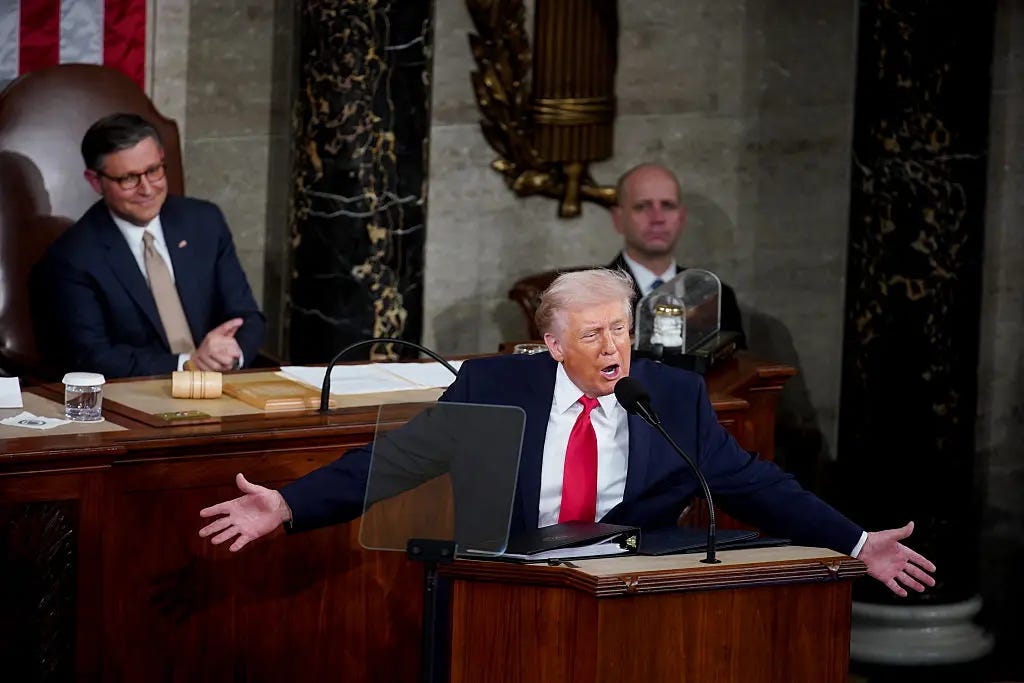
The longest State of the Union address in at least sixty years ended just before midnight on February 24, and what it produced was not a speech but a performance review. A two-hour advertisement for a presidency that has spent twelve months governing through spectacle while the structural machinery of American democracy quietly corrodes beneath the applause.
Donald Trump told the joint session of Congress that the United States was “bigger, better, richer and stronger than ever before.” He said “the golden age of America is now upon us.” He said he had ended eight wars. He said Iran’s nuclear program had been obliterated. He said tariffs are paid by foreign countries. He said gas prices were below two dollars and thirty cents a gallon. He said the Warrior Dividend was funded by tariff revenues. The record on each of these claims is unambiguous, and on nearly every count, the record contradicts him.
This is not an observation about political style. It is a forensic one. The gap between what was said from the podium of the House of Representatives and what the available documentation shows is not ordinary political distortion. It is systematic, and its purpose is not persuasion but displacement: the replacement of evidentiary public discourse with a manufactured one.
The Theater and Its Architecture
Trump arrived in the chamber trailing the production logic of a man who spent years on network television. The evening was structured as a series of emotional set pieces designed to crowd out analysis. A hundred-year-old Korean War Navy pilot received the Medal of Honor from First Lady Melania Trump. A Venezuelan opposition lawmaker recently freed from prison was reunited on camera with his niece. The gold medal-winning US Men’s Olympic hockey team sat in the gallery, having been flown in on a military aircraft directly from their final game in time to serve as patriotic props. A wounded helicopter pilot from the Maduro raid received the Congressional Medal of Honor on the floor of Congress.
Each moment was calibrated to produce a standing ovation that photographs would transmit to the world as unified national validation. The moments were real. The soldiers were real. The prisoners were real. The hockey players were real. But their presence served the function that spectacle has always served when deployed by concentrated power: to make emotional identification with authority feel like political judgment.
The speech ran longer than Bill Clinton’s record-setting 1999 address. Its length was not a function of its substance. It was a function of its method. Govern through assertion. Validate through repetition. Fill all available airtime so that no space remains for the question that follows every large claim.
The Venezuela Doctrine
In early January, US forces descended on Caracas in the night and abducted Venezuelan President Nicolas Maduro from his compound. Trump celebrated this at the State of the Union as “a colossal victory for the security of the United States.” He awarded Chief Warrant Officer Eric Slover the Medal of Honor for his role as pilot of the lead Chinook helicopter in the raid. He said Venezuela had already delivered 80 million barrels of oil to the United States. He reunited a freed political prisoner with family on national television.
What he did not say: Congress was not notified in advance. Not the Gang of Eight, not the Intelligence Committees, not the Democratic caucus, not even all Republicans. Federal law requires prior notification of particularly sensitive covert actions to at least eight bipartisan senior members of Congress. The administration has systematically eroded those notification requirements. For the Iran bombing campaign in June 2025, they informed Republicans but not Democrats. For Venezuela, the record shows they informed no one.
The sovereignty dimensions of the Caracas raid have been largely set aside in domestic American coverage because the political left lacks the institutional positioning to force the question, and because Maduro was genuinely unpopular. But the legal and precedential framework being established is not limited to unpopular leaders. A president who can authorize the military abduction of a foreign head of state without congressional authorization has claimed a power no statute grants him. That this power was first used against Maduro does not exhaust what it can be used for.
Trump’s justification centered on Maduro’s alleged role in drug trafficking and his deployment of the Venezuelan prison gang Tren de Aragua against American communities. The April 2025 report from the federal National Intelligence Council, a document produced by the president’s own intelligence apparatus, found that the Maduro government “probably does not have a policy of cooperating with TDA and is not directing TDA movement to and operations in the United States.” The Justice Department indictment against Maduro does not reference the Tren de Aragua claim Trump has repeated publicly for two years. PolitiFact rated the core claim “Pants on Fire.”
Trump also said that Venezuela plays a central role in drug trafficking to the United States. Experts on Venezuelan narcotics networks, consulted by multiple news organizations, described that claim as a significant distortion of actual trafficking geography.
What Venezuela has, and what this administration has clearly organized its policy around, is oil. The world’s largest proven reserves. Trump said Venezuela has already provided 80 million barrels to the United States. He said the operation would “make a lot of money” through American investment in Venezuelan oil infrastructure. He said it would not cost the United States anything. The framework he described is not justice. It is extraction with a Medal of Honor attached.
Iran: The Logic That Does Not Survive Contact with Itself
In June 2025, the United States conducted Operation Midnight Hammer, a series of airstrikes against Iranian nuclear facilities. Trump has said publicly, repeatedly, and emphatically, that the operation “obliterated” Iran’s nuclear weapons program. He said it again last night. He used the word obliterated.
Hours before the State of the Union, Secretary of State Marco Rubio and CIA Director John Ratcliffe briefed the Gang of Eight on Iran. Trump told a group of news anchors at a pre-speech lunch that the world was “wondering what he will do.” He said last week that Iran had ten to fifteen days to reach a deal or “bad things will happen.” He has deployed the largest US military presence in the Middle East in decades. He is threatening new strikes.
The contradiction is complete and no one has been required to explain it. If Iran’s nuclear program was obliterated eight months ago, what precisely is the target of the threatened new campaign? If it was not obliterated, why has the president said it was, and why has no official corrected the record? The administration’s own answer, implicit in the briefings to Congress, is that Iran has reconstituted or accelerated its program since the June strikes. Iran has not allowed international inspectors into its facilities, making independent verification impossible. But if reconstitution happened that quickly, the obliteration framing was false when it was first deployed. The logic does not survive contact with itself.
What it produces, reliably, is a domestic political posture. The June bombing polled well. The trophy was a clean narrative of American military power decisively applied. To acknowledge that the program survived or reconstituted is to complicate that narrative. The solution is to hold both claims simultaneously and allow the contradiction to sit unexamined in the gap between news cycles.
Iran’s Foreign Minister Abbas Araghchi posted hours before the speech that Iran “will under no circumstances develop a nuclear weapon.” Iranian officials have denied pursuing nuclear weapons continuously for decades. Whether Iran is telling the truth is a matter of legitimate debate among international analysts and arms control experts. What is not a matter of debate is that the US administration has claimed both to have destroyed a program and to be preparing to destroy it again, without publicly reconciling those two positions.
Tariffs: The Supreme Court and the Alternative Statutes
Four days before the State of the Union, the Supreme Court struck down large portions of Trump’s reciprocal tariff regime. Trump called it “an unfortunate ruling.” He described the justices by name as he entered the chamber and shook their hands. He has called them an “embarrassment to their families.”
By Tuesday, he had moved to impose a new global tariff regime of ten percent under what he described as “fully approved and tested alternative legal statutes,” declaring that “congressional action will not be necessary.” His administration is preparing to push to fifteen percent. The statutory basis for this new framework has not been publicly detailed or subjected to judicial review. The pattern is clear: when one legal mechanism is blocked, a replacement is asserted without democratic deliberation.
Trump told Congress that tariffs are “paid by foreign countries.” Every major economic institution that has examined the question has documented this claim as false, including the Congressional Budget Office, the Federal Reserve, and Treasury Department analyses. American importers pay tariffs at the border and pass the costs to consumers and businesses. The government has been collecting approximately $30 billion per month in tariff revenues. That is not money paid by foreign governments. It is money extracted from American purchasing.
He said further that tariffs will, over time, “substantially replace the modern-day system of income tax.” Federal income tax revenue in fiscal year 2025 was approximately $2.5 trillion. Current tariff revenues at peak collection do not approach one fifth of that figure. The arithmetic is not close.
The “Warrior Dividend,” a payment of $1,776 to each active duty service member, was presented as having been funded through tariff revenues. Pentagon records published in December show it was funded through a supplemental housing appropriation that Congress included in the One Big Beautiful Bill. Acting Defense Department Comptroller Jules Hurst III said explicitly at the time that the funding came from legislation, not tariff collections.
Immigration: The Audit of Enforcement
Trump claimed the United States now has “the strongest and most secure border in American history.” Border patrol encounter data from US Customs and Border Protection records 237,538 border crossings in 2025. That is down sharply from prior years, and a Pew Research Center analysis confirmed encounters are at their lowest levels in more than fifty years. The claim of the “strongest border in history” is not supported by the statistics. What the statistics do support is a significant reduction in illegal crossings.
What the statistics do not capture is the domestic enforcement architecture that has accompanied the border operation. Two American citizens, Renee Good and Alex Pretti, died in Minnesota as a direct result of federal immigration enforcement actions in that state. Representative Ilhan Omar interrupted Trump’s speech shouting “you have killed Americans.” The confrontation was not spontaneous disruption. It was testimony.
The mass deportation campaign has, by documented accounts from multiple legal organizations and news investigations, resulted in the arrest and detention of US citizens and legal residents alongside undocumented immigrants. Abigail Spanberger, delivering the Democratic rebuttal, described communities living under fear of deportation sweeps regardless of legal status. The administration has disputed individual cases while defending the system that produced them.
What Was Absent
The most structurally significant element of the speech was not what Trump said. It was what he did not say.
China was absent. Not mentioned as a strategic competitor, not discussed as a factor in the trade war, not referenced in the context of AI or technology competition. A speech running over two hours on the state of American power had no section on the world’s second-largest economy, with which the United States is engaged in the most consequential trade and technology competition of the postwar order.
The silence has a documented explanation. The Supreme Court’s tariff ruling materially weakened the US position ahead of anticipated negotiations in Beijing. Analysts widely agree that China now holds a stronger negotiating hand in any trade talks following the ruling. Trump is preparing to make the trip. A president who campaigned on confronting China cannot acknowledge that he arrives in Beijing with reduced leverage. The solution is to not discuss China at all, and trust that the audience will not notice the omission in a speech long enough to fatigue attention.
Ukraine received a passing acknowledgment. Trump noted that 25,000 Ukrainian and Russian soldiers die on the battlefield every month, a figure he used not as an argument for urgency but as contextual texture in a speech primarily oriented toward claiming credit. No US Cabinet-level official attended the third anniversary of Russia’s full-scale invasion in Kyiv this week, as European leaders traveled there in solidarity. The contrast speaks for itself.
The Racial Subtext and the Sign
Representative Al Green of Texas was escorted from the House chamber at the beginning of the address after he unfurled a sign reading “Black People Aren’t Apes.” The sign was a direct response to a video Trump had reposted to his Truth Social account in the days before the speech, depicting former President Barack Obama and former First Lady Michelle Obama as primates in a jungle. No Republican member of Congress has publicly condemned the video. Trump won the 2024 election on a platform that included a formal return to the White House. The video was posted from that White House’s official social media accounts.
Green’s ejection was the moment the evening’s subtext became visible in physical space. The speech was about the golden age of America. But the golden age has a definition problem. When a sitting president posts primate imagery of his Black predecessor and the chamber votes to eject the congressman who objects, the question of whose golden age this is stops being rhetorical.
The 60 Percent and the Mirror
A Washington Post poll published three days before the speech found that six in ten Americans disapprove of Trump. CBS News polling found that most Americans believe Trump “makes the situation with prices and inflation sound better than it really is.” Beef prices hit a record high in January at $6.75 per pound. The national average gas price as of Tuesday was $2.95 per gallon, not the $2.30 Trump claimed. Non-partisan Congressional Budget Office analysis of the One Big Beautiful Bill Act found that for families making under $55,000 per year, losses in Medicaid and food stamp benefits will outweigh any tax savings, leaving them materially worse off.
The golden age of America is now upon us.
These are not poll numbers and fact checks in the abstract. They are descriptions of how people are living inside the economy Trump is describing. The distance between the speech and the lived experience it purports to capture is the central political fact of this administration as it enters its second year.
Trump told Congress that the revolution of 1776 “has not ended” and “still continues.” He is not wrong that something has not ended. But the continuity he is tracking and the continuity his critics are tracking are not the same revolution. One is a story of triumphant national power. The other is a reckoning with who that power has always served, and who has always been expected to bear the costs of its maintenance: in labor, in soil, in silence, in the slow administrative attrition of rights that never makes the record-long speech.
The address lasted longer than any in six decades. It named power, but not its consequences. It celebrated the military, but not the law that is supposed to authorize military action. It counted the oil extracted from a country whose president was abducted at night, called it a partnership, and moved to the next slide.
These are the terms of the golden age. They were stated openly. That is the most important thing to understand about last night. The administration is not hiding what it is doing. It is saying what it is doing at length and volume, and counting on the applause to fill the space where accountability would otherwise stand.