The Grid Is the Loan
How Russia Built a Nuclear Dependency Architecture Across the Global South While the West Sanctioned Everything Else
In 2021, Rosatom, the Russian state nuclear corporation, reported $8.979 billion in foreign revenue. By 2024, that figure had reached $17.983 billion. The doubling happened across three years of war in Ukraine, Western sanctions packages, the freezing of Russian sovereign assets, and the ejection of Russian banks from SWIFT. Every instrument the Western financial order had assembled to isolate Russia from global commerce was operational. Rosatom grew anyway.
The number requires a structural explanation, not a rhetorical one. The foreign order book for Rosatom’s nuclear construction projects reached $200 to $206 billion by the close of 2025. The company was building 31 large-capacity reactor units across 10 countries simultaneously. It held approximately 44 percent of global uranium enrichment capacity, 20 percent of conversion services, and controlled fuel supply chains threading through 73 reactors in 13 countries outside Russia. As of the first half of 2025, despite a congressional import ban signed into law the previous year, American utilities were purchasing 304.8 tonnes of Russian uranium, one and a half times the volume of the prior year, accounting for nearly a third of the national market. The European Union spent €700 million on Russian uranium products in 2024, inside a year when total Russian energy imports to the bloc stood at €22 billion.
The explanation is the model itself. Russia has been building a nuclear infrastructure export architecture designed not around the transaction of a reactor sale but around the dependency chain that follows. That chain begins with construction financing, continues through the fuel cycle, extends across operational support and technical training, and does not terminate until the last spent fuel rod is removed from a reactor that, if built to the current Rosatom standard, carries a design lifetime of 60 years and a potential operational extension to 80 or 100. From the moment a government signs an intergovernmental agreement with Moscow, it is enrolling in a relationship whose natural termination date falls somewhere in the second half of the twenty-second century.
The Mechanism: What Build-Own-Operate Actually Does
Rosatom’s export strategy is vertically integrated in a way no Western competitor currently matches. The corporation offers a prospective client government a single package: site assessment, design, financing, construction, fuel supply for the reactor’s full operational life, operational management and training for the first decade, and, in some contracts, handling of spent nuclear fuel and eventual decommissioning. The client government provides the land, grid access, and an agreed electricity tariff. In some configurations, the reactor itself remains Rosatom’s property, leased to the host state on a long-term operational agreement. This is the Build-Own-Operate model, deployed most explicitly in Turkey and extending with variations across the full Global South portfolio.
The financing structure is where the dependency is manufactured. Rosatom does not ask governments to secure commercial debt from international capital markets. It brings the money. The loans originate from Rosatom subsidiaries, Russian state-owned banks, and the National Wealth Fund, routed through intergovernmental agreements at interest rates and repayment terms that no private nuclear vendor can replicate. Hungary received a 10 billion euro loan for its Paks II expansion, contracted directly to Rosatom without a competitive tender. Egypt was extended a $25 billion loan covering 85 percent of the construction cost of its El-Dabaa plant, at 3 percent annual interest, repayable over 22 years beginning at commissioning. Turkey was offered approximately $20 billion for Akkuyu. Finland, before it cancelled the Hanhikivi project following the 2022 invasion, had received a 5 billion euro commitment against a project valued at 6.5 billion.
These are not arms-length commercial instruments. They are intergovernmental agreements, signed between finance ministries, carrying the sovereign weight of state-to-state obligation. When the Egyptian Ministry of Finance signed the $25 billion loan agreement with its Russian counterpart, the relationship between Egypt and Russia acquired a financial architecture that operates independently of the political atmosphere between the two governments at any given moment. Egypt may shift its position on Gaza, on Gulf alignment, on US pressure. The debt structure does not shift.
The fuel mechanism closes the circle. Rosatom’s reactor export program is built around the VVER, the vodo-vodyanoi energeticheskiy reaktor, a pressurized water reactor design whose fuel assemblies are manufactured to specifications not interchangeable with Western equivalents. VVER fuel is a proprietary format. A government that has commissioned a VVER-1200 reactor is, by the physical realities of reactor operation, a Rosatom fuel customer until the plant closes. Transitioning to an alternative supplier requires years of regulatory qualification, safety testing, and in some cases expensive design modifications to existing reactor cores; Westinghouse has been pursuing this for the European VVER fleet, and the qualification process is measured in years, not months. The Bulletin of the Atomic Scientists, analyzing the El-Dabaa contract, calculated that from the entry into force of the preliminary construction contracts in 2017 to the expected end of service life of the fourth reactor unit, the Egypt-Russia nuclear relationship extends to 2110. That is 93 years of structural entanglement contracted in a signature ceremony attended by Abdel Fattah el-Sisi and Vladimir Putin.
The Portfolio: Country by Country
Turkey: Akkuyu.
The Akkuyu Nuclear Power Plant in Mersin Province is the first reactor project globally structured under the full Build-Own-Operate model. Four VVER-1200 Generation III+ units, each rated at 1,200 megawatts, for a total installed capacity of 4,800 megawatts, sufficient to generate roughly 10 percent of Turkey’s electricity when all units are operational. The financing, approximately $20 billion, comes entirely from Rosatom, which retains a long-term ownership stake in the operating company. Construction began in 2018. Rosatom CEO Alexei Likhachev stated in December 2025 that the first unit would undergo its physical and energized launch in 2026. The project absorbed significant disruption from Western sanctions on Rosatom subsidiaries: payment systems seized, pre-manufactured equipment from Siemens blocked in Germany despite having been paid for, approximately $2 billion in frozen funds that Likhachev publicly acknowledged had not been returned. Rosatom rerouted through suppliers in what it calls “friendly countries” and found alternative financing mechanisms. The first unit is advancing.
The consequence for Turkey is not difficult to read. Ankara operates inside a NATO structure that in theory aligns it with the sanctions regime against Russia. In practice, Turkey has not sanctioned Rosatom, does not participate in the energy component of the Western sanctions regime, and has signed long-term electricity generation agreements with a Russian-owned facility on its own soil. When the second, third, and fourth units come online, the dependency deepens geometrically.
Egypt: El-Dabaa.
El-Dabaa is the most fully documented case study of what the Rosatom model produces for a Global South government. The plant sits on the Mediterranean coast 250 kilometers west of Alexandria in the Matrouh Governorate. The initial intergovernmental agreement was signed in November 2015. The preliminary construction contracts were signed in December 2017. Four VVER-1200 units, 4,800 megawatts total, a design life of 60 years. In February 2025, Rosatom announced that new materials and welding technologies applied during construction of the Unit 2 reactor pressure vessel could extend that operational life to 100 years.
Russia is financing $25 billion of the total $28.75 billion project cost: 85 percent. Egypt provides the remaining 15 percent. The loan carries 3 percent annual interest, with repayments beginning upon commissioning and running for 22 years. Rosatom will supply nuclear fuel for the plant’s full lifecycle and assist with operational management and maintenance for the first decade. As of September 2025, 25,000 workers were active at the construction site. The first unit is expected operational by 2028, the full plant by 2030. In October 2025, the reactor pressure vessel for Unit 1 was delivered following a 41-month manufacturing process in Russia. It was installed in November.
The first fuel delivery is scheduled for 2027. From that point, Egypt becomes a VVER fuel customer for every year those reactors operate. The El-Dabaa site is technically capable of accommodating eight reactors. The existing agreement covers four. The expansion framework is already written into the site design.
Hungary: Paks II.
Hungary’s existing nuclear plant at Paks accounted for nearly half of gross Hungarian electricity production and a third of domestic consumption as of 2024. The Paks II expansion adds two new VVER-1200 units, contracted directly to Rosatom in 2014 without a competitive tender. That decision was the subject of a formal ruling by the Court of Justice of the European Union in September 2025, which annulled the 2017 European Commission state aid authorization, finding that Brussels had failed to adequately justify the bypass of EU public procurement rules. The court judgment adds legal uncertainty to the financing framework within the EU internal market. It has not halted construction. First concrete was poured in early 2026.
The political mechanics around Paks II illuminate the leverage the model creates at a structural level. Hungary, under Viktor Orban, has consistently blocked EU sanctions packages targeting the Russian nuclear sector. When Budapest agreed to approve the 14th EU sanctions package in June 2024, covering Russian LNG supplies, it extracted in return a horizontal exemption for Paks II from all current and future EU sanctions measures. The project was written permanently outside the sanctions architecture. Separately, the United States under Donald Trump lifted all remaining sanctions constraints on Paks II following a bilateral meeting with Orban; the first concrete at the site in February 2026 proceeded after US Treasury OFAC restrictions blocking financing through Gazprombank were removed.
One EU member state, leveraging its nuclear dependency, effectively held the bloc’s Russia sanctions architecture hostage on the energy file. Hungary is not acting irrationally from its own position. It has a Russian-financed reactor expansion in progress, a 10 billion euro sovereign loan outstanding, and a fuel supply contract running for the operational life of two new units. The Rosatom model created that leverage through nothing more sophisticated than a construction contract and a government-to-government loan.
Bangladesh: Rooppur.
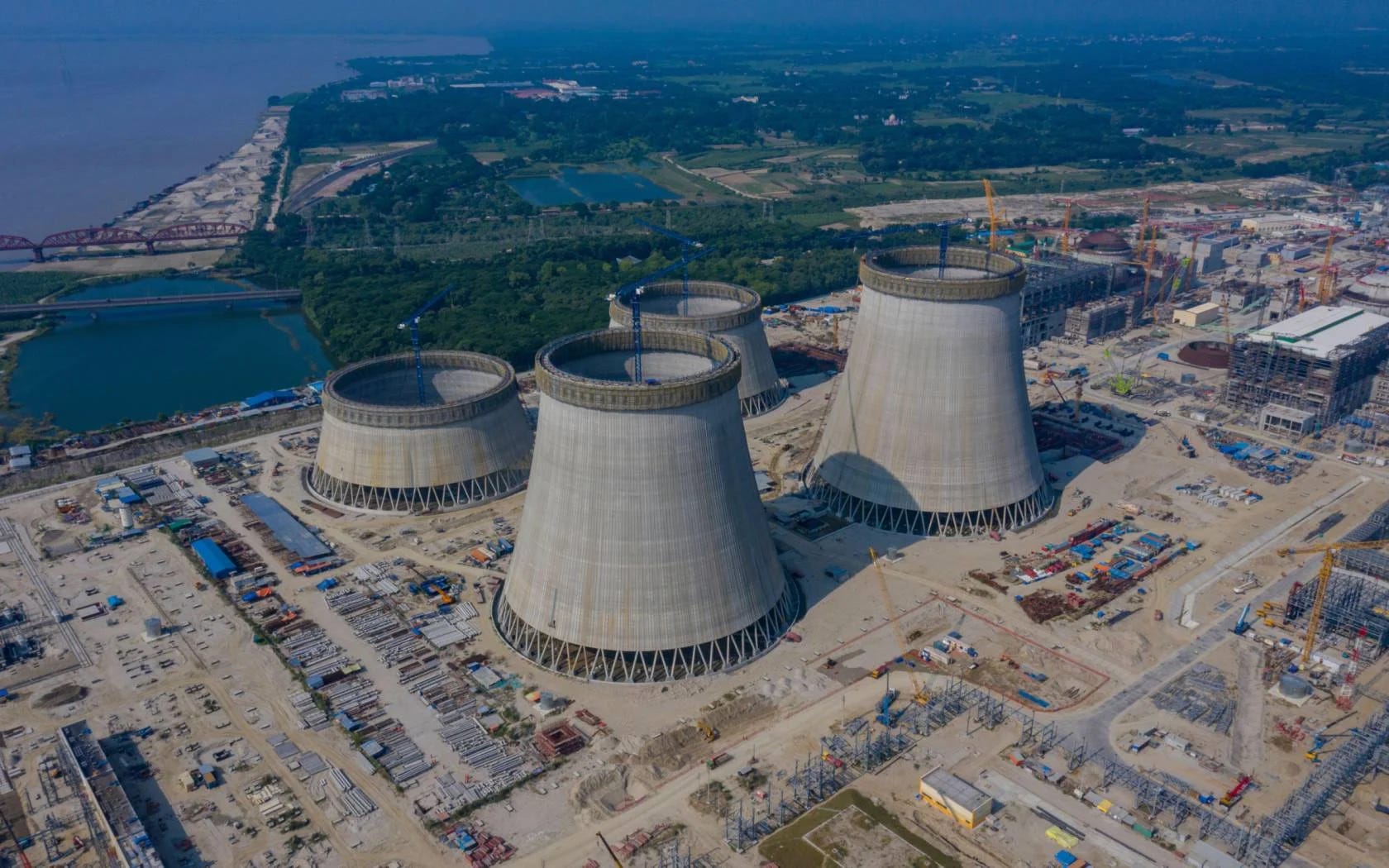
The Rooppur Nuclear Power Plant sits on the eastern bank of the Padma River in Pabna District, approximately 160 kilometers from Dhaka. The intergovernmental agreement was signed in November 2011. First concrete was poured in November 2017. Two VVER-1200 units, 2.4 gigawatts total, with Russian financing covering the bulk of the project cost. The first uranium shipment from Russia arrived in October 2023. Rooppur is Bangladesh’s first nuclear power plant, built by Russia at a moment when Bangladesh’s per capita income made construction financing through commercial markets structurally impossible. The country received a reactor, a fuel supply chain, and a decade of operational support. It also received a loan whose repayment is denominated against a sovereign relationship it cannot unilaterally restructure.
Kazakhstan: Balkhash.
In June 2025, Kazakhstan selected Rosatom to lead an international consortium for the construction of the Balkhash Nuclear Power Plant, a 2.4-gigawatt facility on the shore of Lake Balkhash in the Almaty region. This will be Kazakhstan’s first major nuclear power plant in nearly three decades. The choice came despite Western pressure and despite Kazakhstan’s own considerable uranium reserves; the country is one of the world’s largest uranium producers by volume. The Kazakhstan Atomic Energy Agency stated that UK sanctions against Rosatom subsidiaries issued in February 2026 would not affect the project, as there were no contractual ties to specifically sanctioned entities. Engineering surveys at the Balkhash site were underway as of early 2026.
The Kazakhstan decision is worth pausing on. Here is a country with substantial sovereign uranium resources, capable in theory of anchoring a diversified nuclear energy program, choosing to commission a Rosatom reactor on a Rosatom financing model. Ideology does not explain the decision. Financing does. No alternative supplier brings the money at those terms. The United States nuclear sector, operating through private companies without state-backed export credit at Rosatom’s scale, cannot offer a $20 billion government-to-government loan at 3 percent to a middle-income country. Westinghouse cannot. The European nuclear industry, disaggregated and without a unified export finance mechanism, cannot. The question of who brings the money produces a single answer.
The Enrichment Chokehold
The reactor construction business is the most visible part of the Rosatom architecture, but the enrichment business is what makes the construction impossible to sanction cleanly.
Rosatom commands approximately 44 to 46 percent of global uranium enrichment capacity, operating through four separation plants at Novouralsk, Zelenogorsk, Angarsk, and Seversk, with a combined output exceeding 27 million separative work units per year. Using the Herfindahl-Hirschman Index, the standard measure of market concentration, the uranium enrichment market registers above 5,000, indicating a sector dominated by essentially two actors: Russian providers and EU companies. One in four operating commercial reactors worldwide is connected to Russia through construction, technology, or fuel supply.
The sanctions the US and UK have imposed on Rosatom subsidiaries have not touched this capacity. Rosatom itself, as a corporate entity, remained outside the most severe sanction designations precisely because doing so would have destabilized reactor fuel supply chains in allied countries. As Likhachev told the Russian Federation Council in May 2025, roughly 150 Rosatom enterprises were on the toughest sanctions lists, but those sanctions were not stopping development. The company’s revenues from what Likhachev calls “unfriendly countries,” his term for the Western sanctioning bloc, still contributed approximately $4 billion of the $18 billion in foreign revenue for 2024, or about 20 percent.
Congress passed a ban on Russian uranium imports in 2024, with a phase-in structured to take full effect by 2028. In the first half of 2025, US utilities purchased 304.8 tonnes of Russian enriched uranium, one and a half times the volume of the prior year, representing close to a third of total US enrichment imports. The ban is in force and the purchasing continues simultaneously. US domestic enrichment capacity cannot cover the gap. Building a new enrichment plant costs over $1 billion and requires a multi-year Nuclear Regulatory Commission review process. Global Laser Enrichment’s plant at Paducah is not expected to be operational before 2030. The political instrument collides with physical reality, and the Russian uranium continues to move.
The enrichment leverage is particularly acute for the European VVER fleet. Nineteen of the 99 operational nuclear reactors in the EU are Soviet-era VVER design, representing 11 gigawatts of installed capacity. Their fuel assemblies are manufactured to Russian specifications. Framatome has been developing an alternative VVER fuel supply through a joint venture originally established with Russia’s TVEL subsidiary, a cooperation that has evolved post-2022 into a Framatome-led production line. The production line operates under a TVEL license. Rosatom retains board representation and voting rights in the joint venture. European energy utilities paying for fuel that Framatome manufactures under a Russian license, in a facility where Rosatom executives sit on the governance structure, have not exited Russian nuclear dependency. They have moved it one step upstream.
The Political Instrument and Its Mechanics
The loan binds the finance ministry to a sovereign repayment schedule. The fuel supply contract reaches the energy ministry and locks it to a single supplier for six decades. By the time construction is complete, Russian engineers and project managers have spent a decade inside the plant’s institutional culture, training a national nuclear workforce whose certification runs through Rosatom’s own structures. Nuclear cooperation agreements, the legal framework sitting behind each of these arrangements, typically include clauses covering regulatory infrastructure development and public acceptance programming; in March 2026, the Heinrich Boll Stiftung documented how these civic engagement clauses, in politically constrained environments, can narrow public debate around the project itself. Before the first reactor goes critical, the dependency architecture has been threaded through four separate institutions of the host-country state.
Workers protesting conditions at the Akkuyu construction site in Turkey have faced police intervention. Environmental activists opposing the project have been arrested. In Bangladesh, civil society groups have raised concerns about emergency preparedness infrastructure at Rooppur. In Kazakhstan, public hearings on the Balkhash plant reportedly restricted participation by critics. The suppression of opposition is a structural output of the model, not a coincidence: governments whose political survival is tied to a decades-long Russian infrastructure investment have every incentive to ensure that investment proceeds without organized disruption.
The Hungary case provides the clearest illustration of what that accommodation produces at the state level. Orban used the Paks II dependency to extract a permanent sanctions exemption from the EU’s sanctions architecture: not a case-by-case waiver, but a horizontal exclusion insulating the project from all future EU sanctions measures. He then used the same diplomatic position to extract a full US sanctions waiver from the Trump administration in 2025. One country’s nuclear dependency contract became a bilateral diplomatic instrument that reshaped the Western sanctions regime affecting an entire theater of the Russia-Ukraine war. The Rosatom model did not require Orban to take any covert action, forge any document, or break any law. It required only that he do what any government does: protect a $10 billion infrastructure investment already contractually committed.
The Order Book and What Comes Next
Rosatom’s order book of $200 to $206 billion as of the close of 2025 represents a pipeline of future dependency relationships at various stages of political negotiation and formal agreement, not a static inventory of work already contracted. Beyond the 31 large-capacity units under active construction, Rosatom has signed framework agreements with Vietnam for the Ninh Thuan 1 NPP, is leading construction of six small modular reactor units in Uzbekistan, constituting the first export SMR program in the world, and has been actively pursuing partnerships across sub-Saharan Africa, where it has positioned itself explicitly as a development finance partner rather than a technology vendor.
Ryan Collyer, CEO of Rosatom Central and Southern Africa, described the offer in explicit terms in June 2025: intergovernmental agreements, build-own-operate schemes, and public-private partnerships, combined with small modular reactors and floating nuclear power plant designs suitable for regions with limited grid infrastructure. Rosatom is not selling reactors to Africa. It is offering to build the grid. When Collyer speaks of Russia bringing “80 years of nuclear expertise, a full-cycle offering from uranium to decommissioning,” he is describing a vendor relationship that begins before the foundation is poured and does not end until the decommissioning contract expires, somewhere in the century after the government that signed the original agreement has itself been succeeded by multiple administrations.
The $30 billion Egyptian project, the $20 billion Turkish project, the 10 billion euro Hungarian project are not the ceiling. A comparable-scale project on the African continent, with similar financing structures, would represent a sovereign debt claim against a low-income government that no IMF adjustment program addresses and that no Paris Club restructuring mechanism cleanly accommodates, because the debt is not a commercial bond but an intergovernmental bilateral loan tied to a physical asset Russia owns and operates.
The sanctions the US and UK have imposed on Rosatom subsidiaries have made the construction process more difficult; Likhachev acknowledged frozen funds, payment disruptions, and the Siemens equipment that Germany refused to deliver despite completed payment. They have not altered the fundamental structure of the model. Rosatom’s foreign revenue doubled across the period of maximum sanctions pressure. Its order book grew. The only country that defiantly cancelled a Rosatom project was Finland, which walked away from the Hanhikivi plant after the 2022 invasion. Rosatom went to court. As of early 2026, the litigation was ongoing.
What the Revenue Number Actually Records
There is a question this record leaves open: at what point does the physical scale of Russian nuclear infrastructure embedded in other countries’ energy systems become large enough that the sanctions architecture cannot target it without targeting the electricity supply of US allies, EU member states, and Global South governments whose cooperation is sought on other issues? Hungary’s case suggests that threshold has already been passed inside the European Union. The Paks II exemption was not granted because Orban was persuasive. It was granted because the alternative, a sanctions designation that stopped a reactor construction program financed by a 10 billion euro intergovernmental loan, would have created a sovereign debt crisis in an EU member state over a nuclear facility producing a third of that country’s electricity. The dependency had accumulated past the point where the sanction could be cleanly applied.
Whether Egypt, Bangladesh, or Kazakhstan reach the same threshold is not speculative. It is a construction timeline. The El-Dabaa reactors will produce more than 10 percent of Egypt’s electricity. When they are operational, the leverage that allowed Russia to sign the contract in 2015, Moscow’s unique ability to finance a $25 billion infrastructure project at 3 percent interest, will have been converted into a different kind of leverage: Cairo’s dependency on the operating integrity of four VVER reactors and their continuous fuel supply. The contract that built the dependency was the policy.
Rosatom’s foreign revenue doubled while Ukraine burned.


