The Gulf’s Structured Trade
How Saudi Arabia, Qatar, and the UAE Built Financial Positions That Pay From the Iran War They Helped Enable
The official framing of Gulf Cooperation Council exposure to the Iran war runs as follows: Bahrain, Kuwait, Qatar, Saudi Arabia, and the UAE are allies caught in a dangerous neighborhood. The Strait of Hormuz carries roughly 20 percent of global oil trade. Iran is mining it. GCC export revenues are at risk. The Gulf states are with Washington because they need Washington, and what they need Washington to do is end the war fast, keep the channel open, and restore the conditions of normal commerce on which their fiscal models depend.
Between 2017 and 2024, the governments whose oil revenues are now described as threatened systematically built financial positions in US energy infrastructure that is geographically, logistically, and economically insulated from Strait of Hormuz disruption. Positions that do not merely survive a closed Strait. Positions that appreciate from one. They built these positions during the years when the diplomatic architecture that would produce the Iran war was being assembled piece by piece in public view, while their sovereign wealth managers sat inside the US national security frameworks that were tracking each piece. The war opened on February 28, 2026. The positions were complete years earlier. Brent crude is above $130. The Strait is mined in three sections. The positions are performing.
What follows is a documented accounting of what was built, when, by whom, and what it means that the same governments holding these positions are simultaneously the military platform without which Operation Epic Fury cannot sustain its strike tempo, the intelligence partners whose cooperation shapes targeting, and the diplomatic back-channel through which any exit from this war will eventually move.
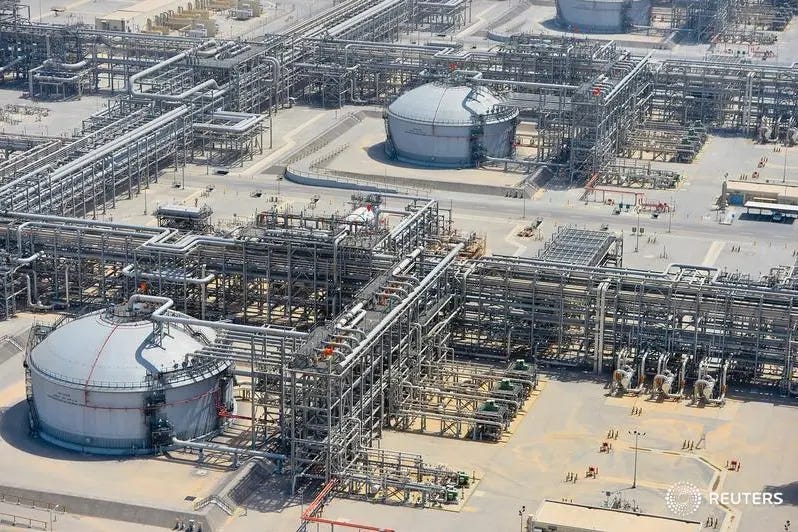
Saudi Aramco has owned 100 percent of Motiva Enterprises since 2017, when it completed the acquisition that ended its joint venture with Shell and took full control of the Port Arthur refinery in Texas. Port Arthur is the largest single refinery in the United States. It processes approximately 630,000 barrels per day. Its crude feedstock comes from the Permian Basin. It does not require a single tanker to transit the Strait of Hormuz. When Gulf crude supply contracts under Strait disruption and global supply tightens, US domestic refining margins improve. Motiva’s Port Arthur operations sit directly in the path of that improvement. The acquisition was completed nine years before the war began. It was completed the year Donald Trump’s administration began signaling its withdrawal from the Joint Comprehensive Plan of Action.
The JCPOA withdrawal was formally executed in 2018. The maximum pressure campaign against Iran’s oil exports began the same year. Aramco’s Port Arthur position was already in place.
QatarEnergy holds a 70 percent stake in Golden Pass LNG, located at Sabine Pass, Texas. ExxonMobil holds the remaining 30 percent. Golden Pass is a liquefaction and export terminal: it receives natural gas from US domestic fields, liquefies it, and exports it as LNG to the Atlantic Basin. Qatar’s primary LNG exports originate from the North Field and move through the Strait of Hormuz. Golden Pass does not. When the Strait is mined and North Field LNG cargoes are delayed, rerouted, or held at anchor while insurance markets price the risk, the Atlantic Basin develops a structural supply gap. Golden Pass fills it. The premium QatarEnergy earns on that gap flows to Doha.
Golden Pass LNG’s export capacity was under construction through the early 2020s. The timeline of its development maps directly against the timeline of JCPOA deterioration. By the time JCPOA revival talks definitively collapsed in August 2022, Golden Pass was approaching operational readiness. ADNOC, Abu Dhabi’s national oil company, began acquiring Permian Basin upstream equity that same year, through a series of transactions that continued through 2024.
The JCPOA collapse was not a surprise to Gulf sovereign wealth managers. It was the publicly documented outcome of a process they had been briefed on, engaged with, and in certain cases actively shaped through their back-channels to both Washington and Tehran. Nobody in Doha or Abu Dhabi was building LNG export capacity in Texas as a hedge against an event they did not see coming.
In 2020, Saudi Aramco completed the acquisition of a 70 percent stake in the Saudi Basic Industries Corporation — SABIC — for approximately 69 billion dollars. The figure deserves to be read slowly. Sixty-nine billion dollars, paid in 2020, for a company whose Texas petrochemical operations run on US domestic natural gas as feedstock. When energy price shocks cascade outward from a Strait of Hormuz disruption into global feedstock markets, Aramco’s Texas-based petrochemical capacity sits upstream of that cascade. It processes US gas into chemicals and plastics whose global supply has just tightened. The SABIC acquisition closed in the same year that the Abraham Accords normalized diplomatic relations between Gulf states and Israel, expanding the intelligence-sharing architecture that connected Washington, Tel Aviv, Riyadh, and Abu Dhabi into a formally institutionalized framework.
Three positions. Three different states. Three different asset classes. One shared characteristic: geography outside the Strait, financial exposure inverse to Strait disruption. This is not diversification in the portfolio management sense. Portfolio diversification moves capital across uncorrelated risk profiles. These investments were correlated to the specific risk of a US-Iran military conflict that disrupts Gulf energy transit. They were not hedges against a generic geopolitical shock. They were positioned against a particular event whose approach was documented in the public record and whose direction was legible to anyone sitting inside US strategic planning frameworks, which Gulf sovereign wealth managers do routinely.
The Public Investment Fund of Saudi Arabia is governed by a board whose chair is Crown Prince Mohammed bin Salman. Its governor, Yasir Al-Rumayyan, sits inside the Crown Prince’s inner circle on economic transformation. The Abu Dhabi Investment Authority’s board structure interlocks with the UAE’s national security apparatus through the same individuals who govern both. The Qatar Investment Authority operates as an instrument of Qatari foreign policy, coordinated with the foreign ministry, not as a separate commercial entity with a firewall from state decision-making. These are not independent asset managers making capital allocation decisions on the basis of publicly available financial analysis. They are instruments of state strategy whose investment decisions reflect the information environments their principals inhabit.
The information environment their principals inhabited between 2017 and 2024 included formal US national security briefings conducted through the US-GCC security architecture, bilateral defense framework consultations, and the intelligence-sharing channels established and expanded under the Abraham Accords. It included the US CENTCOM’s Gulf theater planning, which Gulf host nation representatives are briefed on at the level necessary to coordinate basing, overflight, and logistics. It included back-channel access to Iranian government positions through the same mediators who would later broker the 2023 China-Iran normalization and who have historically conducted every major Iran-West negotiation since 2013.
The wall between what the Gulf sovereign fund managers knew about the trajectory toward war and what their investment decisions reflect does not exist. The wall is not a legal fiction or a regulatory category in these states. It was never constructed. When the Crown Prince decides to build a position in Texas LNG, the decision integrates everything the Crown Prince’s national security apparatus knows about the conditions under which that position will pay.
Bahrain hosts the US Navy’s Fifth Fleet. The fleet is the naval backbone of Operation Epic Fury’s maritime component, managing the escort corridor through the Strait and the carrier strike group rotations that sustain US air operations over Iran. Qatar hosts Al Udeid Air Base, the largest US airbase in the Middle East and the primary logistics hub from which the sustained strike tempo of the war is maintained. The UAE’s ports processed US military logistics in the weeks before February 28. Saudi Arabia has provided overflight rights and intelligence sharing that two US Congressional briefings conducted since the war began have documented at the classified level.
These are not passive contributions. A war at this operational scale and geographic distance cannot be sustained without the logistical and intelligence architecture that GCC basing provides. Remove Al Udeid and the strike tempo drops by a factor that would fundamentally change the war’s trajectory. Remove the Fifth Fleet’s Bahrain infrastructure and the maritime component of the operation requires a complete restructuring. The GCC states are not observers to the conflict whose export revenues are incidentally at risk. They are the operational platform on which the conflict runs.
They are also, simultaneously, the owners of financial positions that pay from the war’s primary economic effect. The convergence of roles — platform, intelligence partner, financial beneficiary — is the piece of the analysis that Western financial and security reporting has consistently failed to hold in the same frame.
Iran has been conducting a systematic campaign to exit dollar-denominated oil trade since at least 2019. Sales to China have been conducted in yuan. Arrangements with India have included rupee settlement and barter-adjacent structures. The broader Iranian effort to route oil exports through shadow tanker fleets operating outside Western financial infrastructure represents a sustained attempt to decouple Iranian hydrocarbons from the dollar system.
Gulf sovereign wealth funds are priced in dollars. Gulf currency pegs are to the dollar. Gulf sovereign debt is denominated in dollars. The structural health of the petrodollar system — in which oil is priced and traded in US currency, maintaining global dollar demand and by extension the dollar’s reserve currency status — is directly tied to the fiscal health of every GCC state. A world in which a major oil exporter successfully conducts sustained non-dollar oil trade is a world in which the premium attached to dollar-denomination erodes across the board. The Iran war, which has targeted Iran’s oil export infrastructure directly and disrupted its shadow fleet operations through the Windward-tracked Strait blockade, is a war that reasserts dollar-denominated oil trade supremacy. It is a war that benefits GCC states in ways that the Texas equity positions do not capture. The Texas positions are the visible financial architecture. The petrodollar reinforcement is the systemic benefit beneath it.
This is not a new observation about Gulf state alignment with US monetary strategy. The petrodollar architecture has been the foundation of US-Saudi strategic relations since the 1974 agreement between Henry Kissinger and King Faisal. What has changed is that the war is now the enforcement mechanism, and the enforcement is happening while Gulf sovereign funds hold structured positions that pay from the enforcement’s primary economic effect.
China brokered the March 2023 normalization between Saudi Arabia and Iran, conducted through talks in Beijing. The agreement was the most significant diplomatic development in Gulf regional architecture in years, and it required Riyadh’s active consent and participation to close. Qatar conducted the back-channel communications that produced every major Iran-West confidence-building measure between 2013 and 2022. The Doha channel to Tehran is the most active, longest-maintained, and most trusted indirect line of communication between the Iranian government and the Western-aligned world.
When Operation Epic Fury reaches the point at which Washington decides it needs an off-ramp, the off-ramp will run through Riyadh and Doha. This is not a prediction. It is the structural reality of how this conflict’s diplomatic geography works. There is no direct US-Iran channel capable of producing a ceasefire agreement. The intermediaries who can produce one are the same governments whose Texas energy positions appreciate for every day the war continues.
Gulf states can accelerate the ceasefire. They can use the leverage of their position as the only credible interlocutors with Tehran to move the negotiation faster. They have chosen not to, so far. The war is in its fifteenth day. Brent is above $130. Golden Pass is running at export capacity. Port Arthur’s margins are at levels not seen since 2022. ADNOC’s Permian equity is appreciating against a global crude supply shock that shows no sign of resolution.
The day Riyadh and Doha activate their ceasefire leverage aggressively is the day they decide to close the trade. Until that day, the war’s primary economic beneficiaries are the governments described by the Western press as its most exposed victims.
The Public Investment Fund’s quarterly performance data does not separate the war-premium on Texas energy positions from its consolidated returns. Aramco’s annual report embeds Motiva’s Port Arthur margins inside the downstream segment of a company that produced 9.7 million barrels per day in 2024. The Golden Pass LNG premium is not disclosed in terms that allow a public analyst to calculate what QatarEnergy earned from the North Field supply gap that the war produced. ADNOC’s Permian equity is held through structures that do not require public disclosure of position-level performance.
The architecture of the profit is real. The architecture of its visibility is managed. No GCC sovereign wealth fund will publish a line item reading “Iran war dividend.” The accounting is not designed to be read that way. It is designed to be read as diversified global portfolio performance, denominated in a fiscal year that happens to have begun with a war.
The question the evidence cannot yet answer is whether the investment decisions documented above were made with a formal understanding, between GCC leadership and US strategic planners, that the war was coming and the positions should be built before it arrived. The documents that would establish that formal understanding are classified, if they exist in written form at all. What the unclassified record establishes is the timeline, the positions, the platform provision, the intelligence access, the petrodollar alignment, and the exit leverage. The formal understanding is the one door the evidence leaves open.


