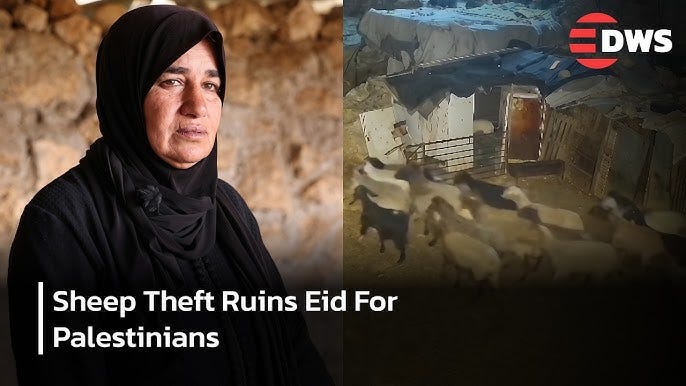
The IDF Stole Sameeha Rasheed's Livestock
Before dawn on May 21, masked men entered Sameeha Rasheed’s farm in Masafer Yatta, a spread of Palestinian hamlets pressed into the dry hills south of Yatta in the occupied West Bank. They took the family’s guard dogs first, removing the alarm before they removed the animals. Then they herded 45 sheep into the darkness. The animals were Rasheed’s preparation for the Eid al-Adha sacrifice. They were also her income. Her husband has cancer. Without the sheep, she has nothing to pay for his treatment.
CCTV footage verified by Reuters against archival and satellite imagery matching the buildings and terrain around the farm shows the masked men moving the animals out. Asked for comment, the Israeli military said it had deployed troops to the area and found no settlers. It handed the matter to the police. A spokesperson for the Yesha Council, which represents the municipal councils of Jewish settlements in the West Bank, did not respond. The police have done nothing. The men who walked into Rasheed’s farm before dawn are, by every available account, back in their outpost, uncontacted and unpunished.
Masafer Yatta’s vulnerability to this kind of raid was designed forty years before Rasheed lost her animals. In the early 1980s, Israeli authorities declared approximately 3,000 hectares of the South Hebron Hills a closed military zone, calling it Firing Zone 918. Within that boundary sat twelve Palestinian villages whose inhabitants had worked the land as herders and small farmers across generations. The Israeli authorities declared the area uninhabited and suited to military training exercises involving tanks, helicopters, and live fire. In July 1981, a ministerial committee on settlements convened a meeting at which Ariel Sharon, then serving as Agriculture Minister, asked IDF representatives to declare training zones across the South Hebron Hills. His stated reason was not operational. It was “the spread of Arab villagers from the hills toward the desert.” Sharon’s request became a formal committee decision, as recorded in a transcript later found in the Israeli State Archives by researchers at the Akevot Institute for Israeli-Palestinian Conflict Research. The Firing Zone 918 designation followed.
In 1999, the Israeli military moved to formalize what the designation had always implied. Troops expelled roughly 700 Palestinians from their homes on the grounds they were living illegally in a firing zone. The families petitioned the Israeli Supreme Court. An interim injunction in 2000 allowed them to return while the case was heard, and they came back to their houses and lived under that injunction for the next twenty-two years, prohibited from building new structures, including water networks and electrical infrastructure, while the military continued to conduct live training exercises on the land around them. In May 2022, the Supreme Court issued its final ruling. The court found that the communities had no legal claim to remain because they had not been permanent residents at the time of the firing zone’s original declaration in the 1980s. The semi-nomadic nature of pastoral life in the South Hebron Hills, which had always meant seasonal movement between grazing grounds, was used by the court to confirm that their presence had never been legally valid. The ruling cleared the path for the expulsion of roughly 1,300 Palestinians from eight of the twelve villages. Sharon’s 1981 minutes were not treated as dispositive. Two villages, Khirbet Sarura and Kharoubeh, have since ceased to exist. Their homes were demolished.
The UN Office for the Coordination of Humanitarian Affairs has noted that approximately 20 percent of the entire West Bank has been designated as firing zones, affecting more than 5,000 Palestinians across 38 communities. Nearly 30 percent of Area C, where Israel exercises full administrative and military control, falls under this classification.
The raid on Rasheed’s farm on May 21 was not the first of this kind in Masafer Yatta this year, and it was not the worst. On the night of January 27, hundreds of Israeli settlers descended on the villages of Halawa and Al-Fakhit. They moved through the hamlets for hours, burning homes and property, blocking ambulances attempting to reach the injured. Security camera footage later published by the monitoring group Masafering showed settlers walking livestock out of the hamlet of Khirbet al-Halawa while at least six uniformed Israeli soldiers followed behind them. The soldiers were not wearing tactical vests or helmets, as troops typically do when operating in the West Bank. They were present, and they were walking in the same direction as the animals. A military source told the Times of Israel the IDF was investigating claims that soldiers had stood by while sheep were stolen. That investigation has produced no documented outcome. On January 28, settlers returned. Homes, cars, and property were burned in Al-Fakhit. According to OHCHR, between January 23 and 25 alone, at least ten serious settler attacks were recorded across Jerusalem, the central and northern West Bank, the Jordan Valley, and the South Hebron Hills. Two Palestinians were arrested following the January raids on Masafer Yatta. Zero Israelis were.
The Palestinian Ministry of Agriculture has counted 4,000 head of livestock stolen by settlers across the West Bank since the start of 2026. Ismail Bani Hassan, a livestock trader at the Hebron market, told the Arab Weekly this month that settlers were carrying out near-daily attacks on shepherds in the Bedouin areas and Masafer Yatta, driving shortages and price increases. A sacrificial sheep that should have cost between 200 and 300 dinars was selling for 700. Palestinian employment across the West Bank has been falling since the Gaza war began in October 2023. The number of workers fell from 868,000 in 2023 to approximately 736,000 by the end of 2025, with sharp declines in construction, manufacturing, and transport. For the communities in Masafer Yatta, who have no factory work or formal employment sector to absorb the loss, livestock is the economy in its entirety.
The legal architecture that makes this possible operates through the permit system. In Area C, which covers approximately 60 percent of the West Bank and is home to all Israeli settlements and most Palestinian herding communities, Palestinian applications for building permits are rejected at a rate OCHA describes as almost total. Structures built without permits are subject to demolition orders. Since the May 2022 Supreme Court ruling, Israeli authorities have used the firing zone classification to issue demolition or stop-work orders against the majority of homes, animal shelters, water cisterns, and community infrastructure remaining in Masafer Yatta. Humanitarian organizations attempting to deliver water and basic supplies have had their vehicles confiscated and their workers denied access. The result is a population prohibited from building, prohibited from receiving outside assistance, and prohibited from remaining.
The scale of what has been documented across the West Bank in the past three years carries the weight of a policy, not a series of incidents. From January 2023, when OCHA began systematically tracking displacement linked to settler attacks, through February 2026, 883 Palestinian households comprising 4,765 people had been displaced across 97 communities, the majority Bedouin and herding families in Area C. Between October 2023 and the end of 2024, OCHA counted 1,860 separate settler violence incidents. Through 2025, attacks averaged five per day. In October 2025, during the olive harvest, OCHA recorded 264 settler attacks in a single month, the highest total since the organization began keeping records in 2006. Forty-two of those attacks injured 131 Palestinians, including fourteen women and a boy. In some cases, OHCHR documented, gender-based violence became the event that finally drove families out. January 2026 produced 694 Palestinians displaced from their homes in thirty-one days, the second-highest monthly figure since the October 2023 peak.
The OHCHR stated in January 2026 that settler violence had become “a key driver of forced displacement” across the West Bank, operating in “a coordinated, strategic and largely unchallenged manner, with Israeli authorities playing the central role in directing, participating in or enabling this conduct.” The distinction between state violence and settler violence had become, the office noted, almost impossible to draw.
The clearing sequence OHCHR documented is consistent across communities and years. An illegal outpost is established near or inside a herding community. Settlers restrict Palestinian access to water and grazing land. Attacks follow, destroying property, injuring residents, taking or killing livestock, and cutting water infrastructure, with Israeli forces present at a rate the OHCHR described as constituting participation or deliberate non-intervention. After enough attacks, the families calculate that remaining is no longer survivable. The outpost then expands into the space they leave behind. The settlement of Avigayil, retroactively legalized by the Israeli security cabinet in February 2023, and the outpost of Mitzpe Yair sit adjacent to communities in Masafer Yatta whose residents told Amnesty International in 2025 that settlers from those locations had been attacking them nearly every day since October 7, 2023. Amnesty verified 38 videos. The incident log from a single calendar month, May 2025, illustrates the operational tempo: settlers uprooted thirty olive and almond trees belonging to Ibrahim Ali Abu Aram in Khirbet al-Rakiz on May 4; released livestock onto Palestinian crops in al-Deerah on May 9; attacked and injured an elderly man on May 12; assaulted shepherds in Al-Tuwani on May 13; and on the same day attacked residents in Khirbet Khillet al-Daba’ with clubs and sharp instruments, leaving Suleiman Ali Dababseh with a deep head wound requiring treatment at Yatta Governmental Hospital. This was not an exceptional month. It was a documented one. Many attacks occur in areas inaccessible to humanitarian workers, where residents are too exhausted or too frightened to file reports.
Eid al-Adha falls on the tenth day of Dhu al-Hijja. The ritual at its center requires the sacrifice of a sheep or goat, with the meat distributed to the poor, to neighbors, and to the family. For Palestinian herding communities in the South Hebron Hills, it is also the primary commercial event of the year. Animals raised across many months command their highest prices in the days immediately before the holiday. The raid on Rasheed’s farm came five days before Eid, at the moment when her flock had its greatest monetary value and its deepest religious meaning simultaneously. Whoever organized it knew the farm’s security arrangements well enough to remove the guard dogs before removing the animals. This was planned.
Rasheed has no way to pay for her husband’s cancer treatment. She has said so plainly.
Yair Lapid, Israel’s opposition leader and former prime minister, has called settler violence “Jewish terror” and a national disgrace. He said it publicly and nothing changed, because the government in Jerusalem, which includes Finance Minister Bezalel Smotrich and National Security Minister Itamar Ben Gvir, does not regard it as a disgrace. Smotrich oversees civil administration in the West Bank. Ben Gvir has overseen the arming of settlement security squads. Both remain in government. Western governments have, at intervals, expressed concern. The United States designated several settlers for sanctions in 2024. The UK and EU followed. None of these designations altered the operational tempo. The sanctions target individuals inside a practice the Israeli state is, by the OHCHR’s own accounting, directing, participating in, or enabling.
The ledger of Masafer Yatta runs long. Dates, names, injuries, stolen animals, demolished structures, cut water lines, burned cars, uprooted trees, and families who packed what remained and drove toward Yatta city because they had calculated, correctly, that there was nothing left to protect. The mechanism is documented. The legal architecture is in place. The military escort has been filmed. The Supreme Court has cleared the evictions. What nobody has been able to establish, through all the documentation and all the OHCHR statements, is the threshold at which the international community treats what is happening in the South Hebron Hills as a matter requiring a response commensurate with what is being done.