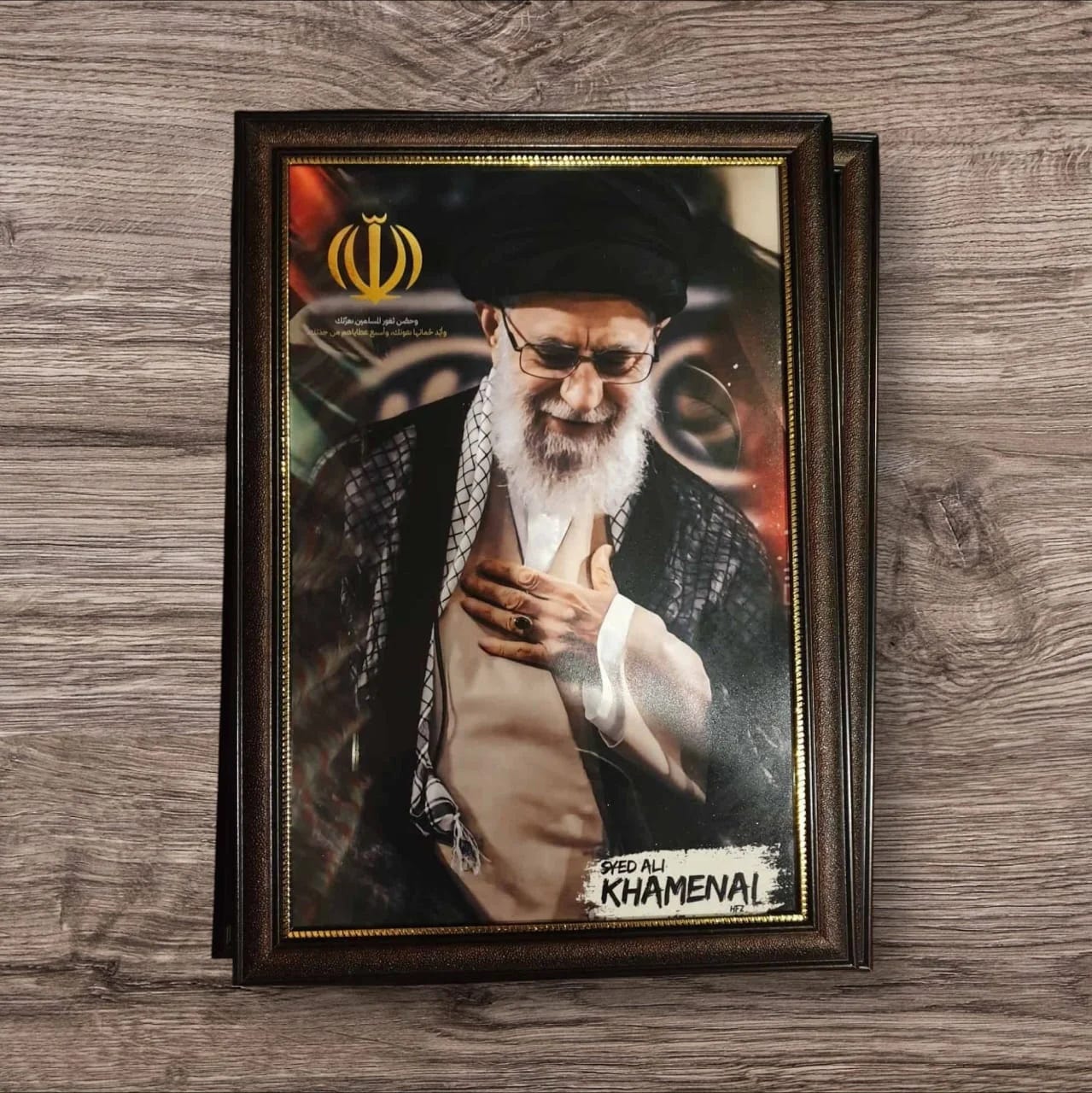
The Imam in His House
The Assassination of Ali Khamenei and the Law Washington Writes for Itself
On the morning of February 28, 2026, the United States and Israel killed Iran's Supreme Leader in his home, along with his daughter, his son-in-law, his granddaughter, and his daughter-in-law. The world called it a military operation. It was a family massacre.
Imagine, for a moment, that a Muslim country killed the Pope during lent.
Not in a battlefield. Not in a command centre embedded inside a military base. In his residence. During Lent. With his daughter beside him, and his grandchildren in the rooms nearby. Imagine the missiles arriving at the Vatican while the faithful still slept, and imagine that the men who fired them held a press conference afterward to call it justice.
There would be no debate about terminology. There would be no semantic gymnastics about whether this constituted assassination or targeted military action. Every newspaper from London to Los Angeles would call it what it was: the murder of a religious leader in his home. The Catholic world would grieve collectively. Western governments would convene emergency sessions. The UN Security Council would draft resolutions before the smoke cleared. Candlelight vigils would stretch across the piazzas of Rome.
None of that happened for Ali Khamenei.
What happened instead was that Donald Trump posted on Truth Social to say one of the most evil people in history was dead, and that the United States would continue bombing Iran. What happened was that Benjamin Netanyahu held a press conference. What happened was that the streets of Finchley in North London, home to a large Iranian diaspora, turned into a block party with champagne.
The Muslim world buried its grief, as it always does. The world moved on to the next briefing.
The CIA had been tracking Khamenei for months. This is not speculation or inference. It is, at this point, established fact, confirmed by Reuters citing US officials. His movements, his patterns, the depth of his bunker, the timing of his meetings, the names of the people he met. The American intelligence apparatus built a map of his life and waited for the right configuration.
What they found was a meeting. According to Reuters, Khamenei had gathered with Ali Shamkhani, the representative of the Supreme Leader in the Supreme Defense Council, and Ali Larijani, the Secretary of the Supreme National Security Council, at a secure location in Tehran shortly before the strikes began. The CIA knew. The targeting was adjusted. The missiles were pre-positioned.
The operation had two names in circulation. Fox News called it “Operation Epic Fury.” The Times of Israel referenced “Operation Roaring Lion.” Both are theatrical. Both obscure what it actually was: a coordinated assassination, planned across months, executed with full White House knowledge and authorization, timed to catch a head of state in a room with his advisors and his family.
His daughter was in that room, or near enough to it that she did not survive. His son-in-law did not survive. His granddaughter did not survive. His daughter-in-law did not survive.
Fars News Agency, affiliated with the Islamic Revolutionary Guard Corps, confirmed the deaths. CNN confirmed them. AFP confirmed them. The women and children of Khamenei’s household died in what Trump called a precision strike.
The language of precision, in the American military lexicon, has never meant what civilians assume it means.
Ali Khamenei was not a simple figure, and this piece does not intend to make him one.
He came to power in 1989 under the shadow of Ayatollah Ruhollah Khomeini, whom he had served as an obedient functionary rather than an ideological equal. He was, at the outset, an unlikely supreme leader. He lacked Khomeini’s charismatic religious authority. His theological credentials were contested from the beginning by senior clerics who viewed his rapid elevation as politically engineered. He overcompensated for his religious insufficiencies by entrenching the political ones. The Islamic Revolutionary Guard Corps became, under his watch, a parallel state within a state, controlling vast economic sectors alongside its military mandate.
He killed his own people in significant numbers. The Human Rights Activists News Agency documented more than 7,000 Iranians killed during weeks of mass protest that began in late December 2025 alone. He imprisoned poets. He silenced women who removed their hijabs. He presided over an apparatus of surveillance and detention that ground down ordinary Iranians with a bureaucratic thoroughness that never made the front pages of Western newspapers.
All of this is true, and none of it licenses what happened on February 28.
The question that journalists in the Western tradition consistently fail to ask is not whether a leader is bad. The question is what rules govern the planet, and who wrote them, and whether they apply equally. Because if they do not apply equally, they are not rules at all. They are permissions, issued selectively, by the powerful, to themselves.
Khamenei governed a country that the United States has sanctioned, covertly destabilized, and repeatedly threatened for four decades. He watched the United States withdraw from the 2015 nuclear agreement that his government had negotiated in good faith. He watched Israel assassinate his nuclear scientists. He watched his missile program degraded and his proxy networks systematically dismantled through what Israel called shadow warfare and everyone else calls state terrorism when a different country does it.
He played for time. He negotiated when he had to and stalled when he could. He miscalculated, as Barbara Slavin of the Stimson Center told Al Jazeera: he did not understand how much the world had changed around Iran. He assumed the deterrence architecture would hold. It did not.
On the morning of February 28, 2026, the United States and Israel confirmed that it would not hold, and they confirmed it with missiles.
The missiles did not kill an ideology. The Islamic Republic has a succession framework. An interim Leadership Council was announced at Khamenei’s funeral, comprising Alireza Arafi, President Masoud Pezeshkian, and Chief Justice Gholam-Hossein Mohseni-Ejei. Iran’s Supreme National Security Council functions. The IRGC’s chain of command, decimated at the top, survives in its middle and operational layers.
Iran has launched retaliatory waves of strikes. Its proxies in Iraq attacked the Erbil air base within hours of Khamenei’s death. Its ballistic missiles struck Tel Aviv and Gulf capitals. The region is at war in a manner that has not existed since the early 1980s.
Trump says the bombing will continue. He says it may last four weeks. He has said many things.
What the killing of Khamenei did, with absolute certainty, is instruct every government in the Global South that no head of state is safe once Washington decides its interests require his removal. The message is not new. What is new is the explicitness, the public celebration, the congressional Republicans cheering on social media, the Fox News tickers running the body count like a sports score.
The Economist called Khamenei’s killing an enormous success for the United States and Israel.
They rarely account for who absorbs the cost of that success.
The Law Washington Writes for Itself
In 2003, the United States invaded Iraq. It spent nine months looking for Saddam Hussein before pulling him from a hole in the ground. It hanged him. The Economist measured the efficiency of that operation too.
In 2011, the United States watched as Muammar Gaddafi was sodomized with a bayonet in a drainage ditch while Hillary Clinton laughed on camera. We came, we saw, he died.
In 2020, the United States assassinated IRGC Commander Qasem Soleimani at Baghdad airport, killing an Iranian general on Iraqi soil without informing the Iraqi government, generating a unanimous Iraqi parliamentary resolution demanding the expulsion of US forces, a resolution that Washington ignored.
Now Khamenei.
The pattern is not coincidence. It is policy. It is the doctrine that the United States reserves the right to kill the leaders of governments it has designated as adversaries, in their homes, in their cars, in their airports, at their meetings, with their families present, at any time of its choosing, and to call this liberation.
The doctrine has a corollary that is never stated but always enforced: no one may do this to the United States. No one may do this to Israel. The law is one-directional. It flows downward from the powerful to the permissible.
Imagine if a Muslim country killed the Pope.
In his house. During Lent. With his family.
You cannot imagine it, because you know it could never happen without the complete collapse of the international order, without the kind of military response that would make what is happening to Iran look like a skirmish. You know the rules would reassert themselves with enormous violence, because the Pope is covered by the rules.
Ali Khamenei was not covered by the rules.
Neither were his daughter, his son-in-law, his granddaughter, and his daughter-in-law.
The rules were never written for them.