The Installed State
How Washington and Tel Aviv Built Their War Platform Inside the UAE, and Why Dubai Is Burning
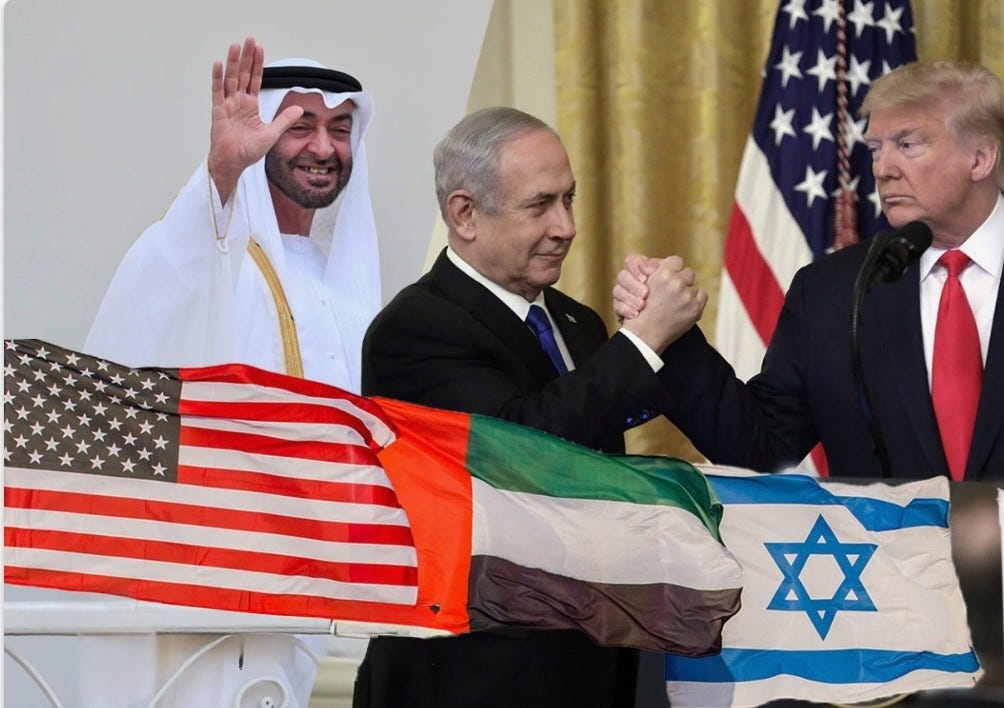
The smoke rising from Jebel Ali Port did not arrive without warning. It arrived as the answer to a question Mohamed bin Zayed answered in September 2020, when he signed his name to the Abraham Accords on the White House lawn: whose war is this, and whose soil will it be fought from?
The answer is documented in signed treaties, defense ministry procurement records, satellite imagery, leaked intelligence files, and five years of military integration that converted the UAE from a Gulf commercial hub into a forward operating platform for the American and Israeli campaign against Iran. Not rhetorically. Physically. In shared radar feeds, joint intelligence pipelines, Israeli missile batteries, American surveillance aircraft, Unit 8200 veterans running cybersecurity firms in Dubai Internet City, and a weapons bazaar that put Israeli defense companies on display 30 kilometers from Abu Dhabi’s civilian population while Gaza burned.
By March 3, 2026, day three of Operation Epic Fury and Operation Roaring Lion, Iran had fired hundreds of ballistic missiles and drones at the UAE across consecutive days. Explosions continued to be heard in Abu Dhabi and Dubai on Monday morning. Nasdaq Dubai suspended operations through Tuesday, March 3. The UAE closed its embassy in Tehran and recalled its ambassador. Dubai International Airport, the world’s busiest by international traffic, resumed only limited flights. Three people were confirmed killed in the UAE, all of them migrant workers, and at least 58 others were wounded. A fuel tank terminal in Musaffah caught fire. A warehouse in the Industrial City of Abu Dhabi was struck by drone debris. The world’s media covered the fires at the Burj Al Arab and the evacuation chaos at Terminal 3. Almost none of it asked the prior question.
How did a country that shares no land border with Iran, that maintained trade and diplomatic ties with Tehran for decades, find itself inside Iran’s retaliatory target envelope for a major military campaign?
The answer requires going backward. It requires naming every mechanism through which Washington and Tel Aviv installed themselves inside the UAE, converted its territory into an operational war platform, and left 11 million residents with no vote, no voice, and no public bomb shelters to absorb the consequences.
Phase One: The American Foundation
The US military presence in the UAE did not begin with the Abraham Accords. It begins in 1990, when the Iraqi invasion of Kuwait forced every Gulf ruler to make a foundational decision about what kind of relationship they wanted with American military power. Mohamed bin Zayed’s family chose full structural dependency and built an entire state security architecture around it.
Al Dhafra Air Base, located 30 kilometers south of Abu Dhabi, is the result. The US Air Force did not publicly acknowledge its presence there until August 2017, which tells you everything about how both governments preferred the arrangement to be understood by the region around them. What has been built at Al Dhafra since the 380th Air Expeditionary Wing was formally established in 2002 is not a liaison office. It is a full combat installation operating under Air Combat Command. The wing comprises ten squadrons. The 32nd Army Air and Missile Defense Command’s artillery brigade provides the US Army component. The base hosts F-22 Raptor stealth fighters, AWACS surveillance platforms, and U-2 reconnaissance aircraft running collection missions toward Iran’s borders. A Patriot missile battery system at the base intercepted Houthi ballistic missiles in January 2022.
The second American footprint in the UAE is Jebel Ali Port in Dubai. It carries no official classification as a military base, which has allowed both governments to maintain a useful fiction. What it functions as, in operational reality, is the largest port of call for the US Navy in the entire Middle East. American aircraft carriers dock there. Naval vessels arrive for resupply and maintenance. The facility services the ships that project American power through the Strait of Hormuz, the same waterway Iran has mined, contested, and shadowed with IRGC naval units for three decades.
This infrastructure predates the Abraham Accords by thirty years. What the Accords did was layer Israeli military and intelligence infrastructure directly on top of it.
Phase Two: The Israeli Installation
The mechanism requires plain statement, because the official language around the Abraham Accords was constructed specifically to obscure it.
In September 2020, the UAE and Israel signed normalization agreements. In January 2021, the Pentagon transferred Israel from the area of responsibility of US European Command into US Central Command, placing Israel inside the same military framework as the UAE, Bahrain, Saudi Arabia, Jordan, and every other American partner in the Gulf. The transfer was not ceremonial. It created the legal and operational architecture for integrated military planning, shared intelligence feeds, joint exercises, and unified air defense coordination against Iran. From that moment, when the UAE shared radar data with CENTCOM, it was sharing it with a command that now included Israel. The UAE became, in operational terms, part of an Israeli-American military axis on the day Israel entered CENTCOM.
The defense procurement that followed removed all remaining ambiguity about what normalization meant in practice.
Rafael Advanced Defense Systems, the Israeli state-owned manufacturer of Iron Dome, David’s Sling, and the Spike anti-tank system, moved into the UAE market. Elbit Systems, Israel’s largest private defense contractor, established a commercial presence. Israel Aerospace Industries engaged UAE counterparts on drone systems, surveillance platforms, and electronic warfare technology. In September 2022, Israel supplied the UAE with SPYDER air defense batteries in direct response to Houthi attacks: Israeli missile systems installed on UAE soil, integrated into an American command network, pointed at Iranian-supplied weapons. The geometry of alliance had been drawn explicitly.
In February 2025, as international condemnation of Israel’s operations in Gaza reached their highest point, Abu Dhabi hosted the International Defence Exhibition and Conference. Thirty-four Israeli arms companies attended, including Israel Aerospace Industries and Rafael, displaying joint products alongside their Emirati partners. Bilateral trade between Israel and the UAE had reached $3.24 billion in 2024, an 11 percent increase from the year before. By 2024, Abraham Accords signatories accounted for 12 percent of Israel’s record $14.8 billion in defense exports. In April 2025, UAE Mirage 2000-9 fighter jets joined the US and Israeli Air Forces in a multinational exercise in Greece.
Each of these transactions was a brick in a military platform. None of it was peace.
Phase Three: The Intelligence Architecture
The intelligence dimension of the US-Israeli installation in the UAE requires a separate accounting. It is the layer that most directly explains why Iran treats the UAE as a legitimate target in a war it is fighting with Israel and the United States.
The starting point is the Mossad’s documented relationship with the Emirati state security apparatus. Yossi Cohen, who served as Mossad chief from 2016 to 2021, has publicly described his involvement in restructuring that apparatus to institutionalize Israeli-Emirati intelligence cooperation. This is not an allegation or an inference. It is the former director of Israeli foreign intelligence describing, on record, his role in rebuilding a partner country’s security services around Israeli operational integration. In what framework does the Mossad’s chief restructuring the UAE’s State Security apparatus not constitute the installation of an Israeli intelligence platform on Gulf soil?
The technological foundation of this relationship was the NSO Group’s Pegasus spyware, acquired by the UAE under Israeli Ministry of Defense export licenses. The Citizen Lab at the University of Toronto documented its use against Emirati human rights activist Ahmed Mansoor as early as 2016. Mansoor received a ten-year prison sentence in 2017. After normalization, this intelligence relationship scaled significantly. An Israeli official quoted in Israel Hayom described the progression directly: “Pegasus and the defense industries caused intimate relations to tighten between the Israeli security system and the Emirati one. This also created a direct line between leaders.”
Project Raven extended the architecture further. Originally developed by the UAE with NSA technical assistance for domestic surveillance, Project Raven evolved into a regional collection platform subsequently integrated with Mossad intelligence pipelines, gathering data on Iranian leadership movements, missile infrastructure, and nuclear activities. The UAE is not, in this architecture, a passive recipient of intelligence. It is an active collection node feeding into Israeli and American targeting systems.
The joint intelligence platform named Crystal Ball formalizes part of this integration at the cyber level. Backed by Microsoft, Rafael Advanced Defense Systems, and Abu Dhabi’s CPX cybersecurity firm, Crystal Ball is a digital threat-sharing platform built specifically to counter Iranian and Russian cyber operations. At its launch in Tel Aviv, the UAE’s cyber chief Muhammad al-Kuwaiti said: “Thank God for the Abraham Accords,” crediting normalization directly for the platform’s creation. Rafael, the manufacturer of Israel’s missile defense systems, is now embedded inside the UAE’s national cyber defense infrastructure.
The satellite dimension adds a further layer. The UAE’s expanding satellite capabilities received direct Israeli support in 2024. Officially described as tools for development and environmental monitoring, assessments from leaked data indicate these assets are used to track Iranian military facilities and deliver high-resolution imaging to Israeli agencies. The UAE’s eyes in space are coordinated with Israeli targeting.
In May 2024, a security conference was held at Al Udeid Air Base in Qatar. Israeli military officials held bilateral discussions with representatives from every attending Arab country. Israeli delegations flew directly into the base, bypassing Qatar’s civilian entry points to avoid public exposure. A planning document for the event included a section explicitly headed “MUST NOT DO,” instructing participants not to take photographs or grant media access. By 2024, leaked US documents confirmed that CENTCOM had successfully linked partner states to its systems, allowing them to provide radar and sensor data directly to the US military and view the combined data feeds of all partners. The UAE’s radar was feeding the American command center that Israel sits inside.
Phase Four: The Regional Air Defense Shield, Built for One Purpose
The official language has always been about deterrence and stability. The operational architecture has always served one specific function: to hold Iran’s offensive capabilities at risk and to defend Israeli and American positions from Iranian retaliation.
The integrated air defense network CENTCOM constructed across the Gulf since 2021 must be understood as a single coordinated system. When Iran attacked Israel on April 13 and 14, 2024, the UAE’s radar data fed into the Combined Air Operations Center. Saudi Arabia provided raw sensor data with explicit understanding it would be used to coordinate Israeli air defense and shared directly with Israeli forces. Jordan opened its airspace to coalition aircraft. The system performed as designed.
When Israel launched Operation Rising Lion against Iran in June 2025, the same coalition structure activated. CENTCOM and the IDF jointly led planning and execution. Regional partners provided early warning infrastructure. The UAE’s radar feeds, its Israeli-supplied air defense batteries, its satellite imaging capabilities, and its American base infrastructure all contributed to an offensive and defensive operation against a country 150 miles off its coast.
Iran watched every training exercise, every procurement announcement, every CENTCOM press release, and every leaked planning document. It drew the logical operational conclusion: the UAE was no longer a separate actor maintaining careful distance from the Israeli-American confrontation with Iran. The UAE was the confrontation. Its territory was the platform. Its infrastructure was the enabling condition for strikes on Iranian soil.
What Iran Hit, and What It Means as of March 3
Iran launched its retaliatory campaign on February 28, 2026, the same day that US and Israeli forces, under Operations Epic Fury and Roaring Lion, killed Supreme Leader Ali Khamenei and struck targets across 24 of Iran’s 31 provinces. The IRGC announced it was targeting 27 US military bases across the region. The UAE was on that list because the UAE’s infrastructure was on that list.
Across three days, Iran fired 165 ballistic missiles, two cruise missiles, and more than 540 drones at the UAE. The UAE’s Ministry of Defense reported intercepting 132 of the 137 ballistic missiles counted in the first wave and 195 of 209 drones. Thirty-five drones struck their targets. On day three, Monday March 2 into March 3, explosions continued to be heard in Abu Dhabi. Drone debris struck a warehouse in the Industrial City of Abu Dhabi. A fuel tank terminal in Musaffah caught fire. In Ras Al Khaimah, an intercepted drone caused damage in Al Hamra Village.
The Fairmont Hotel on Palm Jumeirah caught fire. The Burj Al Arab’s facade burned. Dubai International Airport, Terminal 3 struck directly, evacuated thousands of passengers. Jebel Ali Port, the largest container port in the Middle East, was hit and DP World suspended operations. The port and its adjacent free trade zone account for 36 percent of Dubai’s GDP. Nasdaq Dubai suspended trading through Tuesday, March 3. The UAE government shuttered its embassy in Tehran and recalled its ambassador.
The three confirmed dead in the UAE across the first 48 hours: a Pakistani national, killed by debris from an intercepted missile near Zayed International Airport in Abu Dhabi. An Asian national, killed by falling shrapnel in a residential district of Abu Dhabi. A third, identity described only as an Asian worker, killed by debris from an intercepted missile that fell on a foreign vessel. At least 58 others were wounded. These were not policymakers. They were the human cost of decisions made by men they had never elected and could never remove.
Iran’s targeting was not random. It was the operational execution of a threat doctrine that Iranian officials, IRGC commanders, and the Supreme Leader’s office had been stating for four years. The UAE had been warned directly and repeatedly: the Israeli and American military presence on Emirati soil would make Emirati soil a target. The UAE government absorbed each warning, briefed Washington, and deepened its integration. The IDEX arms fair in February 2025 proceeded with 34 Israeli companies. The Crystal Ball platform continued operating. The Hermes 900 drone technology transfer to EDGE Group continued. Al Dhafra continued hosting the 380th AEW, and from Al Dhafra, the US surveillance flights toward Iran continued.
The UAE government’s statement after missiles began striking its airports described the attacks as “an aggressive and provocative approach” and “a flagrant breach of sovereignty.” The sovereignty argument would carry more weight had the UAE’s sovereignty not been negotiated away in phases: to American basing arrangements from the 1990s onward, to Israeli intelligence restructuring through the 2010s, to full military-industrial integration under the Abraham Accords. What was violated on March 1, 2026, was not sovereignty. It was the comfort of a government that believed it could host a war platform while remaining exempt from the war.
The Population That Did Not Choose This
There is one number that matters more than the missile counts, the interception rates, and the GDP figures.
Eighty-eight percent. That is the expatriate share of the UAE’s estimated 11 million residents. Pakistani construction workers. Indian nurses. Bangladeshi laborers. Filipino domestic workers. Western finance professionals. Egyptian engineers. All of them living in a state whose ruler makes military and intelligence decisions in closed rooms, without parliamentary oversight, without a free press to examine the agreements, without any mechanism by which the people living on the territory can contest what is done to it.
Dubai has no public bomb shelters. The city that sold itself to the world as a luxury safe haven, a tax-free oasis, an island of engineered serenity in a troubled region: its residents spent the night of February 28 in underground parking garages. Parents told children that the explosions overhead were Ramadan fireworks or the cannon fired at iftar. At the Burj Khalifa, smoke trails from intercepted missiles crossed the sky. At the Palm Jumeirah, a five-star hotel was on fire.
The three people confirmed killed were not architects of the Abraham Accords. They were the workers. The ones who built everything, own nothing, and had no vote in any of the decisions that placed them inside an Iranian target envelope. This is not incidental context. It is the political structure of Gulf autocracy rendered in its clearest form: the rulers decide, the workers absorb.
Marko Kolanovic, formerly chief strategist at JPMorgan, summarized the stakes on X: “What is happening in UAE could be catastrophic, unless they pressure Trump to defeat Iran quickly or to fold right away. With 88% of expats, tourism, finance, air and shipping exposure, this can also send shockwaves globally.”
He was right about the exposure. He did not ask how the UAE arrived at that exposure, or whether the workers sheltering in parking garages had been consulted about the risk.
The Liability of the Installed State
Washington wanted the infrastructure. The CENTCOM integration of Israel required Arab partner states willing to host radar networks, basing arrangements, and defense procurement relationships that would give the integrated air defense coalition operational depth. The UAE’s geography, commanding the entrance to the Strait of Hormuz and sitting 150 miles from Iranian territory, hosting the US Navy’s busiest Gulf port, made it uniquely valuable.
Tel Aviv wanted the intelligence platform. The Mossad’s restructuring of Emirati state security, the Pegasus sales, the Crystal Ball integration, the satellite imaging cooperation, the Unit 8200 veterans operating in Dubai’s technology sector: all of it was the Israeli intelligence establishment installing a collection and coordination network on Iran’s maritime border, with operational access to Iranian territory unmatched outside Israel itself.
The UAE’s government wanted the protection arrangement: American military cover against Iranian pressure, Israeli surveillance technology for domestic control, defense industry relationships providing weapons and international legitimacy. The transaction had logic on all sides.
What none of the parties fully reckoned with, or calculated they could absorb, was what happens when Iran decides the installed state is a legitimate military target and acts on that conclusion with full force rather than a calibrated demonstration. Not the Houthi warning shots of January 2022. Not the restrained single strike on Al Udeid during the 12-day war in June 2025. A sustained, multi-day campaign of hundreds of ballistic missiles and drones against airports, ports, hotels, and residential neighborhoods, running now into its third consecutive day.
The UAE government’s instinct, facing what has arrived, will be to demand American military action resolve the Iranian threat rapidly, to shelter behind the same security architecture whose construction produced the exposure, and to issue statements of injured sovereignty while hoping the foundational question never reaches a serious domestic audience.
That question is this: was the installation worth it?
Was the Crystal Ball platform, the SPYDER batteries, the Hermes 900 technology transfer, the 34 Israeli companies at IDEX, the joint exercises with Israeli aircraft in Greece, the Mossad restructuring of state security, the Pegasus deployment against Emirati dissidents, the shared radar feeds into a CENTCOM that Israel now commands from within worth the permanent conversion of UAE territory into an Iranian target, the exposure of 11 million residents to ballistic missiles across consecutive days, the suspension of Jebel Ali Port operations, the closure of Nasdaq Dubai, the incineration of the safe haven brand on which the UAE’s entire economic model depends?
Mohamed bin Zayed cannot answer this question publicly. He has no mechanism through which his population can ask it. There is no parliament. There is no free press. The Emirati rights activists who might have raised it years ago, Ahmed Mansoor among them, are in prison, surveilled by the same Israeli technology the Accords formalized.
The question has now been asked in the only language that bypassed every institutional filter the UAE erected to prevent accountability: hundreds of ballistic missiles and drones, across three days, from an Iranian state that the UAE helped arm the forces against.
Washington and Tel Aviv installed their war inside the UAE. The UAE’s government signed every agreement, opened every base, integrated every intelligence pipeline, and hosted every arms fair. And the workers from Pakistan, Bangladesh, Nepal, India, and the Philippines, the ones who built the towers and staffed the hospitals and drove the logistics that made Dubai the hub of global capital, they are spending the night in underground parking garages, telling their children that missiles are Ramadan fireworks.
This is what the installed state looks like from the inside.