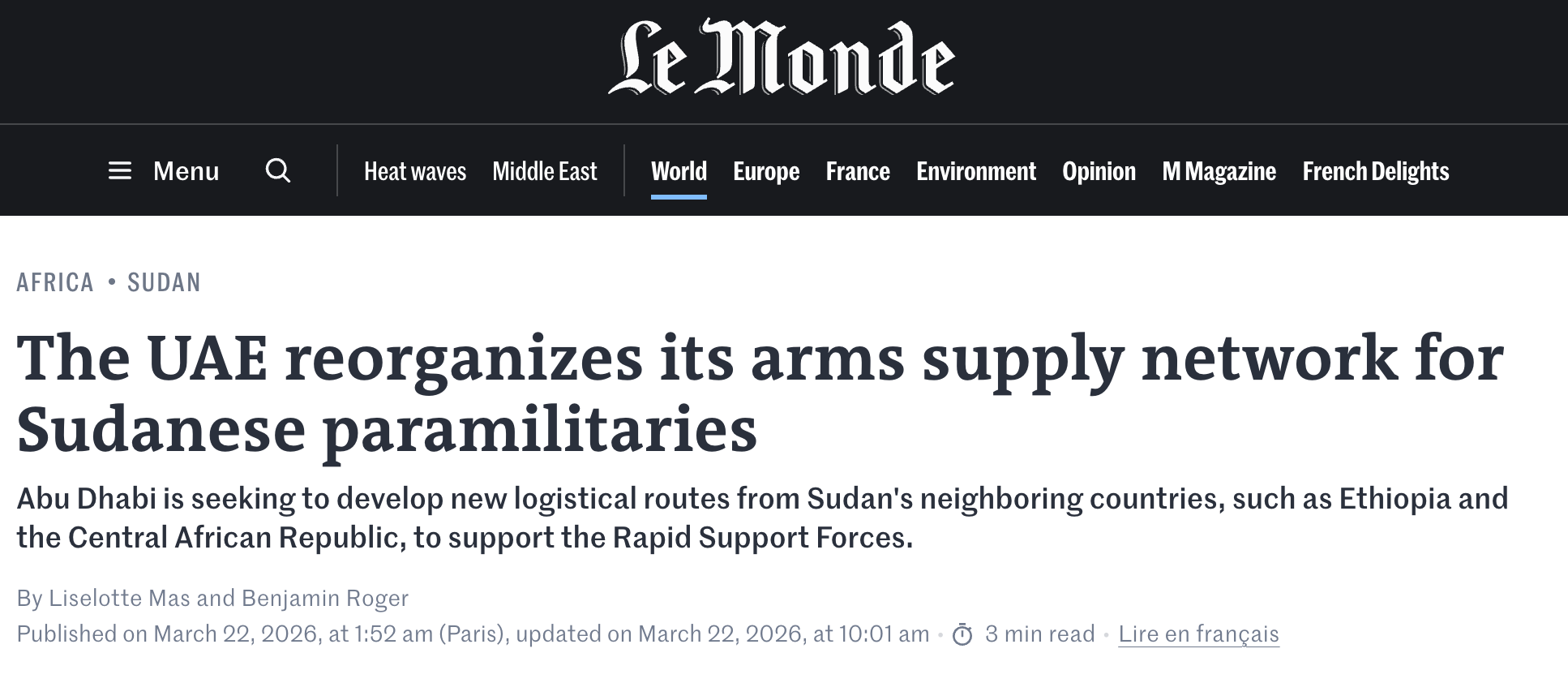
The Invisible Sponsor
How Abu Dhabi armed Sudan’s genocide, hired Latin American soldiers to fight it, and watched the world look away
One year into retirement, a Colombian army drone specialist saw a WhatsApp message arrive from a number he did not recognize. Any veterans interested in working?
It was ordinary in the way these approaches are often ordinary: vague enough to deny, specific enough to make clear that the sender knew exactly who was being contacted. The man had spent years in the Colombian military learning how to operate unmanned aerial vehicles. That kind of skill travels easily. It does not need a shared language, a shared flag, or even a clear explanation of the war waiting at the other end. He did not immediately say no.
What followed, for him and for hundreds of men like him, was a journey that placed retired Colombian soldiers inside Sudan’s war. They had been trained first by the Colombian state and later, according to investigators, through a pipeline tied to the United Arab Emirates. By late October 2025, some were operating drones and artillery systems near el-Fasher in North Darfur, beside a paramilitary force the United Nations has described as committing acts with the hallmarks of genocide.
The question is not only how they got there. It is how so many governments managed to know so much about the pipeline and do so little with that knowledge.
From Bogota
The route began, again and again, in Colombia.
Colombia has spent decades producing highly trained military veterans with experience in counterinsurgency, drone operations, and long-range artillery. Their skills are valuable abroad. Their civilian options at home are often narrow. That gap created a market, and into that market stepped recruiters who understood both the men and their price.
One Colombian army colonel, Alvaro Quijano, already sanctioned by the U.S. Treasury for earlier mercenary activity, was identified as a key figure in the Latin American recruiting pipeline. The offer was not complicated. The pay was better than anything most veterans could find in Colombia. The employer remained blurry by design.
The Conflict Insights Group, a European security analysis organization, later tracked the digital footprints of more than fifty Colombian fighters’ mobile devices between April 2025 and January 2026. What emerged from the data was not a spy novel. It was logistics. Flights, transit hubs, training sites, operational deployments. The kind of infrastructure that looks mundane until you follow it all the way to a killing field.
One device belonged to an operator who was in Bogota before February 2025. By early February, the phone appeared at the Puntland Maritime Police Force compound in Bosaso, Somalia. That facility had been built years earlier with funding from UAE-based financiers and, by 2025, was serving as a staging point for foreign fighters moving toward Darfur.
From Bosaso, the device moved to the military wing of N’Djamena Airport in Chad, then into South Darfur. There, it connected to localized Wi-Fi networks named in Spanish: “DRONES” and “LOBOS DEL DISIERTO,” Desert Wolves. The position was roughly fifty kilometers north of Nyala, close to a clandestine runway.
A second device told another version of the same story. In June 2025, its operator flew from Bogota to Zayed International Airport in the United Arab Emirates. For nearly two weeks, the phone stayed at a military training facility in Ghayathi, in Abu Dhabi emirate. From there, it moved to the military wing of Kufra Airport in southeastern Libya, an RSF logistics hub with major weapons storage infrastructure, before arriving at Nyala Airport in Sudan.
Investigators identified 143 Il-76 cargo flights landing at Kufra between April and December 2025, nearly sixteen a month on average. The routes matched patterns long associated with UAE arms corridors.
The unit these men joined was called the Desert Wolves. It was made up of four companies of retired Colombian military personnel and employed by a UAE-registered defense contractor called Global Security Services Group, a company with documented ties to senior Emirati officials and the UAE royal family. The Colombians served as drone pilots, artillery operators, infantrymen, drivers, and instructors. According to one Human Rights Watch interview, some trained RSF recruits who were children.
Ghayathi to El Fasher
The most important device in the Conflict Insights Group dataset was Device 3. Its operator followed the now familiar route: Colombia to Bosaso to Nyala. He arrived in July 2025. On October 24, four days before el-Fasher fell to the RSF, the phone moved to the city’s northeastern perimeter. Inside the besieged area, it connected to a localized network named “ATACADOR,” Spanish for “attacker.”
El-Fasher had been under siege for more than a year before it fell. It was the last major city in Darfur outside RSF control, and its population had swollen with people displaced from Nyala, Geneina, and the burned-out smaller settlements that had already passed through the war’s machinery.
The UN Security Council had discussed el-Fasher. Governments had issued statements. None of it changed the RSF’s decision to close the perimeter.
The six-day assault that followed was documented by multiple organizations. The International Criminal Court and the World Health Organization recorded targeted civilian executions. The Saudi Maternity Hospital was attacked, and more than 460 patients were killed inside it. Yale University’s Humanitarian Research Lab estimated that as many as 60,000 people may have died in the assault and its immediate aftermath. The figure cannot be confirmed with precision because access to the city was cut before an independent investigation could enter.
The UN, using a more conservative method, confirmed at least 6,000 deaths in three days. Geolocated combat footage, later verified by U.S. Treasury analysts and human rights researchers, showed Colombian mercenaries operating Serbian mortar systems inside the city during the offensive.
Human Rights Watch investigators interviewed Colombian fighters who had participated. One described training child soldiers in camps around Nyala. Several confirmed the structure of the pipeline: recruitment in Colombia, transit through the UAE, weapons issue, insertion into Sudan. When Sudanese forces recovered munitions from their positions, the ordnance was Serbian and Bulgarian manufactured and traceable to purchase contracts held by the UAE armed forces. The weapons had passed through Abu Dhabi before reaching Darfur.
Justin Lynch, the director of the Conflict Insights Group, described the findings plainly. He said the research proved UAE involvement and made public what governments had long known: there was a direct link between Abu Dhabi and the RSF.
That phrase matters, governments had long known. It was not a flourish. Sudan’s permanent representative to the UN Security Council filed a formal complaint in September 2025 saying Khartoum had extensive evidence of a systematic UAE campaign to recruit, finance, and deploy mercenaries alongside the RSF. The complaint entered the Security Council record. The UAE’s seat at the diplomatic table remained undisturbed.
The $500 Million Problem
On February 3, 2026, Lana Zaki Nusseibeh, the UAE’s Minister of State for International Cooperation, arrived in Washington for the U.S. donors’ conference on Sudan. Abu Dhabi pledged $500 million to the UN’s humanitarian fund for a war that had displaced more than 14 million people inside Sudan and pushed more than 4.4 million across borders.
The pledge was praised. It was reported cleanly by many outlets. What often went unmentioned was the investigation that had already placed UAE military facilities in the logistical chain connecting Bogota to the mass graves of el-Fasher.
Refugees International later addressed the dissonance directly, describing the $500 million as money needed largely because of Abu Dhabi’s history of enabling RSF atrocities. The formulation sounds severe because the relationship is severe. A state actor can help fuel a war at one end and write a relief check at the other. The world, if it finds the check useful enough, may pretend the two gestures belong to separate stories.
The UN’s Sudan humanitarian response plan for 2026 remains deeply underfunded. A pledge is not the same thing as aid delivered to people under siege. Even if every dollar arrives, it will still be measured against the destruction that made it necessary.
The UAE’s public posture is continuous engagement toward peace. Abu Dhabi welcomes peace plans. It welcomes ceasefire statements. It rejects claims of weapons transfers, financing, fighter deployment, or logistical support to the RSF. When Sudan filed a genocide case against the UAE at the International Court of Justice in March 2025, Abu Dhabi called it a cynical publicity stunt and moved for dismissal.
In August 2025, the Sudanese Armed Forces shot down what they identified as an Emirati military aircraft over RSF-controlled Nyala Airport. At least forty suspected Colombian mercenaries were reportedly killed aboard. The UAE said nothing publicly.
The Architecture of Silence
The European Union’s response to the evidence of Emirati involvement in Sudan is now its own subject. In June 2026, Human Rights Watch publicly challenged Brussels, noting that EU statements on Sudan’s “external actors” had been carefully written to avoid naming the UAE.
This is not a mystery of language. It is a map of interest.
The UAE is one of the European Union’s largest non-European trade partners. Bilateral commercial exchange exceeded 180 billion euros in 2024. Abu Dhabi holds investments, sovereign wealth relationships, and corporate logistics ties across Europe. The refusal to name it is not an accident. It is a commercial preference expressed as diplomatic grammar.
Britain, France, Germany, and Norway have been more direct at the UN Human Rights Council. They have at least warned of what an RSF assault on el-Obeid could mean. But none has imposed sanctions on Emirati officials or entities tied to the documented pipeline. The distance between warning and sanction is the distance through which weapons keep moving.
UN High Commissioner for Human Rights Volker Turk said in June 2026 that drones in Sudan reflected a global shift in warfare and warned that autonomous weapons could not become a license for atrocity crimes. He made the statement from Geneva. The drones were over el-Obeid.
Donald Trump
The United States’ failure to name Abu Dhabi is not simply inertia or diplomatic caution. On January 16, 2025, four days before Donald Trump’s second inauguration, Sheikh Tahnoon bin Zayed Al Nahyan, the UAE’s national security adviser and the man who oversees the country’s $1.5 trillion sovereign wealth apparatus, wired $187 million to Trump family entities as part of a $500 million investment purchasing a 49 percent stake in World Liberty Financial, the Trump family’s cryptocurrency venture. An additional $31 million was routed to entities connected to Steve Witkoff, who Trump would appoint as his Middle East envoy, the same envoy responsible for managing U.S. diplomatic engagement with the UAE. In May 2025, MGX, a separate Abu Dhabi state-backed firm also controlled by Sheikh Tahnoon, used World Liberty Financial’s proprietary stablecoin, USD1, to execute a $2 billion investment in the crypto exchange Binance, an arrangement that channeled fees and liquidity directly through the Trump family’s currency. The Trump family’s total cryptocurrency holdings have increased in net worth by more than $1 billion since the inauguration. Two weeks after the first of these crypto arrangements was announced, the Trump administration rescinded Biden-era export controls, clearing the way for the UAE to purchase 500,000 advanced AI chips annually, with 100,000 units specifically earmarked for G42, a company chaired by Sheikh Tahnoon that had previously been restricted for its documented ties to the Chinese military industry. That arms and technology pipeline to Abu Dhabi was finalized, according to the Center for American Progress, despite an active congressional hold protesting the UAE’s documented support for the RSF in Sudan. The hold did not hold. Ethics lawyers have described the crypto-for-chips exchange as a potential violation of the Constitution’s foreign emoluments clause, and law professor Kathleen Clark has called it, in plain terms, a potential bribe. The White House has said the president has no involvement in business decisions that would implicate his constitutional responsibilities. Sheikh Tahnoon’s two senior aides sit on the board of World Liberty Financial. When the State Department issued its June 21 statement on el-Obeid warning of “mass atrocities,” it named no consequences for the UAE. It did not mention the UAE at all.
El-Obeid, June 2026
The RSF has been trying to re-impose a full siege on el-Obeid since February 2025, when the Sudanese Armed Forces broke a two-year blockade. Since early June 2026, the campaign has intensified.
A resident named Hamed, speaking anonymously to Avaaz, described drones overhead and explosions almost every day. One strike hit a crowded residential neighborhood full of civilians and displaced families. When people went to dig graves and bury the dead, the area was reportedly struck again.
On June 11, drone strikes hit three targets across el-Obeid in a single day: a funeral procession at a cemetery, the Al-Muwazafin residential neighborhood, and the airport district. Twenty-three civilians were killed and dozens wounded. Ahmed Yaqoub Othman, a Red Crescent volunteer, was among the dead. He had been giving first aid to people injured in an earlier strike when the second one hit.
In the days that followed, the RSF targeted fuel stations and fuel trucks on the highway leading into the city. About eight stations were destroyed, along with tankers on the road from White Nile State. The effect spread quickly. Fuel prices rose. Water pumping stations came under pressure. Hospitals began rationing generator use.
Hamed described the economics of the siege from inside: fuel prices rising, food prices following, transport becoming harder, people walking long distances because the city itself had begun to shrink around them.
On June 16, the UN confirmed that more than 1,000 civilians had been killed by drone strikes in Sudan in the first five months of 2026 alone. That number covered only documented incidents from January through May. The June strikes on el-Obeid were not included. The actual toll will not be known until someone can reach the places where the bodies are.
By June 21, Sudan Tribune was reporting, citing military sources, that the RSF was deploying unprecedented reinforcements around el-Obeid. Fighters were arriving from Darfur and West Kordofan and positioning west, north, and south of the city, apparently in preparation for a multi-axis ground assault.
The U.S. State Department issued a formal statement the same day. It said it was deeply concerned by the massing of RSF forces and warned that mass atrocities could be imminent. It called on the RSF to stop endangering civilians. It named no consequences. It named no state actor responsible for helping give the RSF its operational capacity.
What the Record Shows
The chain connecting Abu Dhabi to Darfur is no longer only a matter of inference. It is a matter of documented logistics. Investigators traced specific mobile devices from Colombian fighters through UAE-linked facilities to positions inside el-Fasher on specific dates. Human Rights Watch interviewed fighters and checked their accounts against geolocation data and social media records. Recovered munitions were linked to UAE military purchases. Reporting reconstructed the recruiting pipeline from the WhatsApp message to the cargo flights out of Kufra. Sudan placed the accusation formally on the Security Council’s record.
The Conflict Insights Group’s conclusion was careful: individuals and state sponsors within the UAE-Colombian network share some responsibility for crimes committed during the fall of el-Fasher. That is not the language of outrage. It is the language investigators use when they know the evidentiary standard.
The UAE’s denial sits beside the record. Abu Dhabi says it investigates alleged links to the RSF. It says it supports peace. It pledges humanitarian funds. It welcomes ceasefire statements. None of those positions, in practice, prevents the continuation of a weapons and logistics pipeline unless other powers decide to impose a cost.
So far, they have not.
The ICJ will move at its own pace. The UN Security Council will not easily sanction a Gulf state whose financial relationships with permanent members are too important to disturb. The EU will keep writing statements about external actors. And Sudanese civilians will keep learning what those phrases are worth when the drones arrive.
The rainy season is closing in across Sudan. When the rains come, roads become impassable, ground operations slow, and the opportunity to break a siege narrows for months. The RSF’s positioning around el-Obeid is timed to that reality. The window before the rains is the window it intends to use.
Inside that window, in a city that already endured two years of blockade and is now watching its fuel supply burn from the air, hundreds of thousands of people are waiting for something the international community has shown, for three years, that it is not prepared to provide.
Hamed’s last words to the reporter were these: many people believe the RSF knows exactly what it is targeting, and that civilians are the primary victims.
The documents from Abu Dhabi to Bogota to Ghayathi to Kufra to Nyala to el-Fasher suggest he is right about more than the RSF.


