The Iran War and the Report
U.S. intelligence assessed that no military campaign would topple Iran's government. The administration read it. Then it started the campaign.
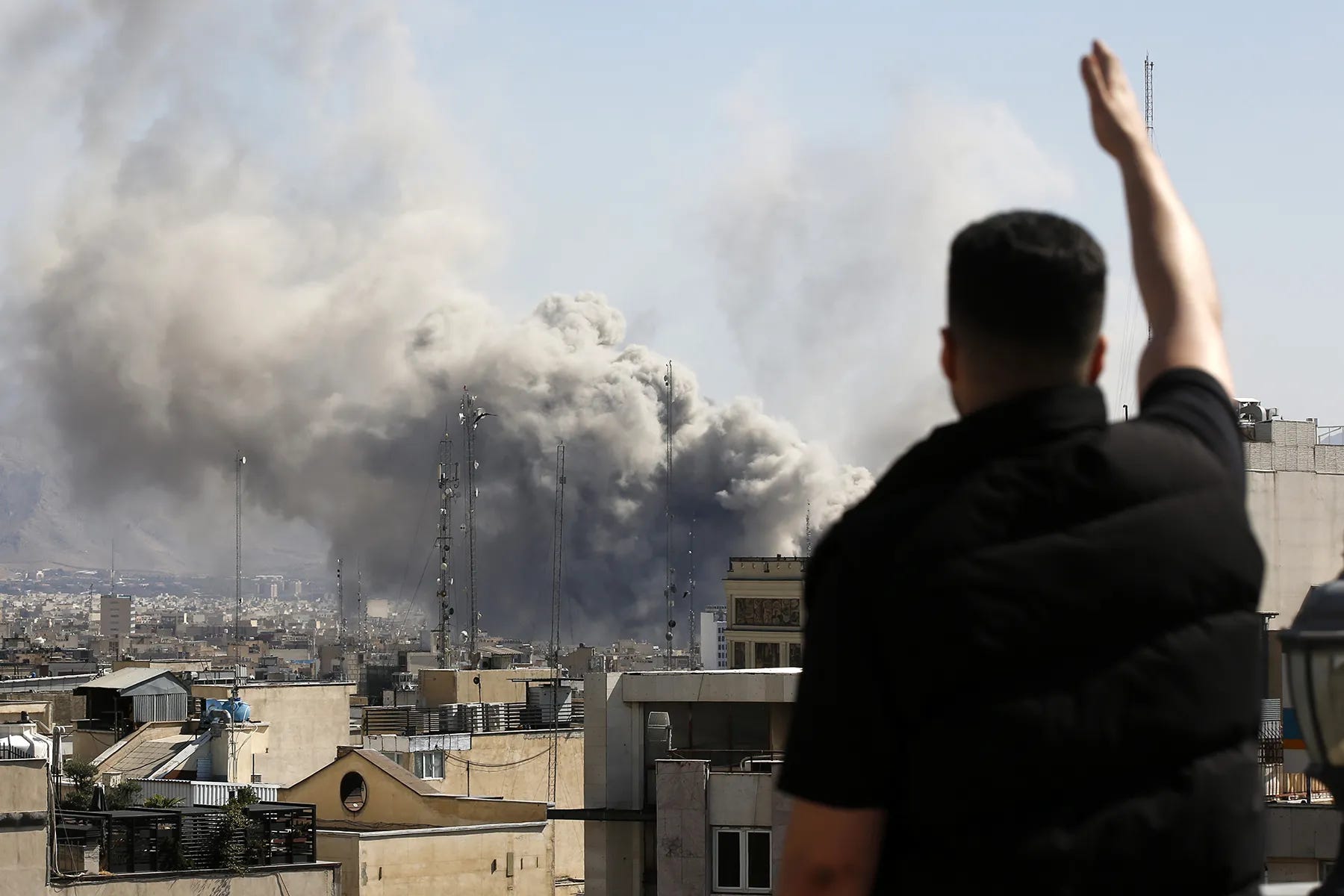
The bombs were still falling over Tehran when Washington’s own intelligence community put the conclusion in writing: a large-scale U.S. military assault on Iran would likely not topple the Islamic Republic.
The National Intelligence Council, the body that coordinates assessments across the entire U.S. intelligence apparatus, produced a classified report concluding that even an extended military campaign would be insufficient to dislodge Iran’s entrenched clerical and military establishment. The Washington Post reported the assessment on Saturday morning, seven days into Operation Epic Fury, while the Trump administration was simultaneously telling the public that the war had “only just begun.”
The report did not arrive after the bombing started as a corrective. Assessments of this kind are produced in advance of operations, circulated to senior officials, and reviewed at the level of cabinet and command. The people who ordered the war on February 28 had access to the conclusion that the war’s central premise could not be achieved. They ordered it anyway.
That is the document at the center of this story. Not the bombs, not the casualty figures, not the daily CENTCOM press briefings on percentage reductions in Iranian missile capacity. The document is the record of what Washington knew before the first strike, and what it chose to suppress in the space between the classified briefing room and the public podium.
In the weeks before Operation Epic Fury, the Trump administration built a public case for military action on three overlapping claims: Iran was rebuilding its nuclear program following the June 2025 strikes on Fordow, Natanz, and Isfahan; Iran was developing ballistic missiles capable of reaching the continental United States imminently; and the Iranian regime, weakened by mass protests and economic collapse, was ripe for change.
Each claim was directly contradicted by the intelligence agencies the administration nominally controls.
The Defense Intelligence Agency concluded in a May 2025 assessment that Iran could not develop a militarily viable intercontinental ballistic missile before 2035, and only then if Tehran made a determined and sustained push toward that capability. That is not an imminent threat. That is a decade-long conditional projection. Trump stood at a Medal of Honor ceremony at the White House on March 2 and told the assembled audience that the United States had been “very nearly under threat” from Iranian missiles. The intelligence record says otherwise.
On the nuclear question, the International Atomic Energy Agency reported in early 2026 that it had found no evidence of an organized Iranian nuclear weapons program. Satellite imagery showed repair activity at two of the previously bombed nuclear sites, but independent analysts assessed that the work reflected damage surveys rather than reconstruction of enrichment capacity. The IAEA could not confirm Iran had taken meaningful steps toward rebuilding a weapons program. Trump, in his State of the Union address on February 28, told Congress that Iran had restarted its nuclear program and was developing missiles capable of striking American cities. Neither statement was supported by the published intelligence record.
Democratic Senator Tim Kaine, a member of the Armed Services and Foreign Relations Committees for thirteen years, said publicly that nothing in the intelligence he had reviewed suggested an imminent threat from Iran that would justify sending American forces to war. He was not a dissenting voice from outside the system. He was one of the officials the system was obligated to brief.
In the days before the strikes, Trump and senior administration officials spoke openly about regime change. The language was direct: Iranians should rise up, take over their government, and Washington would support the transition. Secretary of State Marco Rubio briefed the Gang of Eight — the eight congressional leaders who receive the most sensitive classified intelligence — on February 24, with Iran’s missile program as the stated focus. Regime change was the subtext that administration officials were not yet ready to formalize.
Then the bombs dropped. And three days later, something shifted.
At his March 2 public remarks, Trump laid out four objectives for the campaign: destroying Iran’s missile capabilities, annihilating its navy, ensuring Iran could never obtain a nuclear weapon, and ending Iran’s support for armed groups across the region. He notably did not mention regime change. ABC News reported the omission explicitly, noting that Trump had spoken extensively about leadership change over the weekend but did not address it in his formal statement of objectives.
The National Intelligence Council report explains the silence. If the classified assessment concludes that Iran’s opposition cannot take power following either a short or extended U.S. military campaign, and that Iran’s governing system is built to survive external pressure, then announcing regime change as a war objective is announcing a failure in advance. The administration had the report. It adjusted the podium language accordingly.
The formal objectives Trump stated on March 2 are achievable without the regime falling. Missile facilities can be degraded. Naval assets can be sunk. The stated goals were retroactively calibrated to the classified conclusion the public was never shown.
The National Intelligence Council’s assessment does not rest on optimism about the Islamic Republic. It rests on documented structural analysis of how the Iranian state was built, how it has absorbed external shocks across four decades, and what the opposition actually consists of.
The Islamic Revolutionary Guard Corps is not a military force that sits adjacent to the Iranian government. It is woven through Iranian economic, political, and security life in a way that makes it impossible to extract through air power. The IRGC controls significant portions of the national economy, manages internal security operations, runs its own intelligence networks, and has cultivated an institutional culture specifically designed to survive the death of individual leaders. The Atlantic Council assessed before the war began that a U.S. regime change operation would likely inflict damage on the government without resolving any of the underlying problems, and that advocates of regime change were mistaking a weakened regime for one on the brink of collapse.
The distinction matters. Weakened and collapsing are not the same condition. Iran’s nuclear sites were bombed in June 2025. Its proxy network in Lebanon, Gaza, and Yemen absorbed sustained Israeli and American military pressure across 2024 and 2025. Khamenei was killed as part of Operation Epic Fury’s opening phase. By any conventional military logic, these are significant blows. And yet the CENTCOM commander reported on March 5 that Iranian ballistic missile attacks had decreased by 90 percent since the war began, and drone attacks by 83 percent. He said this as evidence of campaign success. What the numbers also show is that Iran is still firing. A state that has absorbed the killing of its supreme leader, the degradation of its air defenses, and sustained strikes on its capital is still launching missiles in the seventh day of war.
The distributed command architecture is the reason. Decision-making authority in the Iranian security apparatus is not centralized in a way that decapitation strikes can neutralize. The IRGC has trained for exactly this scenario, dispersing operational authority downward through chains of command that do not depend on a single node remaining intact. Iran’s Foreign Ministry stated in the early hours of the conflict that the military had lost control over several units operating according to standing general instructions. The administration read that as institutional collapse. It was the opposite: it was the design functioning as intended.
The classified report’s finding on Iran’s opposition is the second structural pillar of the assessment, and the more politically damaging one.
Washington has spent years cultivating the idea that a viable Iranian opposition exists, organized and ready to fill the vacuum that military pressure would create. The exile community is real. Its presence in Washington policy circles, in think tanks, in congressional testimony is documented. What the National Intelligence Council concluded is that this community is fragmented across ideology, geography, and competing foreign patronages, and has no unified organizational capacity to assume power in a post-conflict Iran.
This is not a new finding. The lesson was available from Iraq, where the exile opposition assembled in London and Washington before the 2003 invasion had no functional relationship with the Iraqi population it claimed to represent. It was available from Libya, where NATO’s 2011 campaign removed Gaddafi and produced not a transition but a decade of militia warfare and slave markets. It was available from every previous American exercise in the region where the gap between the opposition as Washington imagined it and the opposition as it actually existed produced not liberation but collapse.
The Middle East Institute’s analysts noted before Operation Epic Fury that without an intelligence-driven plan for political transition, airstrikes alone were unlikely to generate sustained internal momentum against the IRGC leadership, particularly in the absence of an organized opposition ready to act. The National Intelligence Council reached the same conclusion. The administration had both assessments. The war proceeded.
Set aside what the war was announced to accomplish. Look at what it is, in documented fact, accomplishing.
Iran’s conventional military capacity is being degraded. U.S. forces achieved air dominance over Iranian airspace by March 5, enabling strikes deep inside the country without meaningful air defense resistance. CENTCOM requested additional military intelligence officers from the Department of Defense to support operations through at least mid-June 2026 and potentially through September. This is not a short campaign. The planning horizon extends at least seven months from the launch date.
The Strait of Hormuz has been functionally disrupted since the conflict began. Energy markets are under structural stress. The disruption does not require the Iranian government to fall. It requires the war to continue. Every barrel of oil priced above pre-conflict levels represents a transfer of wealth along specific vectors: away from consuming nations and toward producers less exposed to Hormuz risk. The beneficiaries of a prolonged Hormuz disruption are not difficult to identify.
Israel’s strategic position in the region is being restructured. The Iranian proxy network that constituted the principal military pressure on Israel across the previous two years has been substantially degraded. Hezbollah’s command structure was damaged in the 2024 campaign. The Houthi threat was suppressed. Hamas is without meaningful external resupply. Operation Epic Fury removes the core of what remained. Israel’s Middle East Institute analysts described the current campaign explicitly as taking the war to its source: the regime in Tehran. Whether or not the regime falls, the network it built is being dismantled.
The U.S. Senate and House voted this week along largely party lines to reject restrictions on the president’s authority under the War Powers Act. The war has congressional acquiescence, if not formal authorization. It has the diplomatic cover of Israel’s operational participation. It has oil markets absorbing the shock without yet triggering the political crisis that would force recalibration. By every measure that actually governs how long American military campaigns continue, the conditions for continuation are intact.
None of this requires the Iranian government to collapse. None of it was contingent on the opposition being capable of governing. The war’s announced objective and the war’s actual operating logic were never the same thing.
There is a specific category of institutional dishonesty that is more dangerous than lying because it is harder to prosecute. It operates through selective disclosure: classify the assessment that forecloses the stated objective, announce the stated objective publicly, and allow the gap to be managed by news cycles, congressional deference, and the institutional inertia of a war already in motion.
The National Intelligence Council produced an honest document. It concluded that the war could not achieve what the administration said it was for. That document was circulated to the people who ordered the war. The war started. The document was not declassified. The public was told the opposite of what the classified record showed.
Senator Kaine said directly that nothing in thirteen years of intelligence briefings suggested an imminent Iranian threat justifying military force. The administration’s own DIA assessed Iran’s missile capability as a decade-contingent projection. The IAEA found no evidence of a reconstituted nuclear weapons program. Trump announced at the State of the Union that the threat was immediate and the program was active. Eight days later, his own intelligence community’s formal assessment says the war built on those claims cannot achieve its stated purpose.
Iran does not need to win this war. It needs to hold. The distributed command structure holds. The IRGC holds. The population, whatever its genuine grievances, is not mobilizing on Washington’s timeline to install Washington’s preferred outcome. Every week the Strait of Hormuz remains disrupted is a week of compounding pressure: on energy prices, on the economies of every country that depends on Gulf shipping, on the domestic American political arithmetic that will eventually reach a threshold.
The intelligence community put the conclusion in writing before the bombs dropped. The administration read it and started the war.