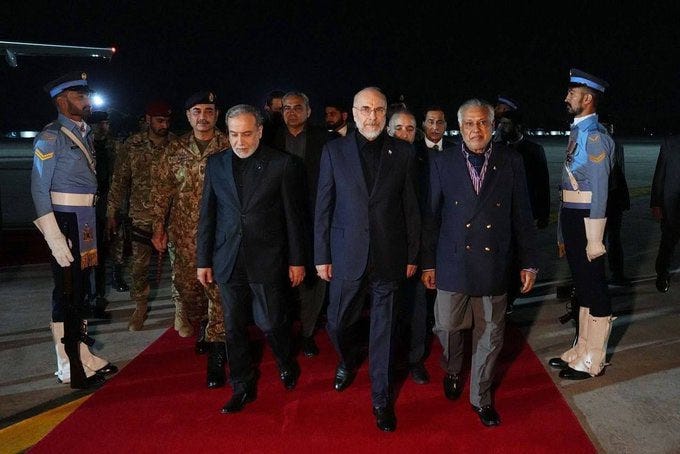
The ceasefire that brought forty days of American and Israeli bombing to a halt was announced not from Washington or Tehran but from a Pakistani prime minister’s social media account. Shehbaz Sharif posted the news to X on a Tuesday evening, inviting the delegations of both countries to Islamabad to negotiate a conclusive agreement to settle all disputes. It was an appropriately understated way to announce one of the more remarkable diplomatic reversals of recent memory.
The talks set for Saturday carry the weight of a war that has already killed over fifteen hundred people, closed the world’s most consequential maritime chokepoint, and ended the life of Iran’s supreme leader. A two-week truce, brokered by Pakistan, halted what had become six weeks of US-Israeli strikes that pushed the region toward broader conflagration, disrupting global shipping and sending shockwaves across Gulf economies. The ceasefire is not a peace agreement. It is, at best, a pause in which the harder arguments are deferred.
What makes this particular pause consequential is the question of who owns its terms.
Iran’s National Security Council confirmed Tehran’s agreement to the truce with the explicit condition that negotiations proceed on the basis of its own 10-point proposal: Iranian dominance over the Strait of Hormuz, the full withdrawal of US combat forces from the Middle East, comprehensive war reparations, and the lifting of every sanction imposed by Washington, the United Nations Security Council, and the IAEA. These are not opening positions designed for compromise. They are the demands of a country that believes it has already won the argument of force.
Washington’s journey to this table was no less tortured. On March 25, Pakistani officials delivered a fifteen-point American proposal to Tehran, demanding an end to Iran’s nuclear program, limits on its ballistic missiles, the reopening of Hormuz, and restrictions on Iranian support for allied armed groups across the region. Iran rejected it without ceremony. An anonymous Iranian official told Press TV that Tehran would end the war when it decided to do so, and when its own conditions were met. Trump, who had written on March 6 that there would be no deal with Iran except unconditional surrender, then described Iran’s 10-point counter-proposal as a workable basis on which to negotiate.
The distance between those two positions is the central drama awaiting both delegations in Islamabad. Bloomberg noted this week that when the two sides finally sit down on Saturday, they will face the same litany of disagreements they failed to resolve in the February negotiations that preceded the war, compounded now by new and thornier ones. If Trump had expected his bombs to make Iran regret not taking a deal back then, the plan appears to have backfired. Tehran has suffered thousands of casualties and its conditions for peace are more maximalist than before.
The ceasefire itself arrived under circumstances that do not inspire confidence in its durability. Iranian Parliament Speaker Mohammad Bagher Ghalibaf, who is leading Tehran’s delegation to Islamabad, said three clauses of Iran’s proposal had already been violated since the truce was announced: continued Israeli strikes in Lebanon, a drone entering Iranian airspace, and Washington’s refusal to acknowledge Iran’s right to uranium enrichment. Iran’s Supreme National Security Council called the ceasefire a victory while warning that its hands remained on the trigger. In the same breath, Netanyahu’s office declared the arrangement did not cover Lebanon. The first days of the truce were the deadliest in Lebanon since September 2024, with at least 357 people killed and over twelve hundred wounded in Israeli strikes.
Tehran’s preconditions for even beginning talks reflect the fragility of the moment. Ghalibaf said on Friday that two conditions must be met before negotiations can proceed: a ceasefire in Lebanon, and the release of Iran’s blocked assets. Neither has materialized. The Iranian delegation has landed at Nur Khan Airbase outside Islamabad, received by Pakistani Foreign Minister Ishaq Dar. Whether they actually sit across from their American counterparts on Saturday remains, as of this writing, unresolved.
The Lebanon question is where the entire framework is most likely to fracture. Iran has made the inclusion of Lebanon and Gaza a structural requirement, not a diplomatic nicety, and for reasons that run deeper than solidarity. Having been perceived across the region as abandoning Gaza during its worst year, Tehran cannot again be seen to secure its own interests while leaving its allies exposed to Israeli bombardment. Underneath the rhetoric sits a harder calculation: any ceasefire that leaves Israel free to escalate in Lebanon leaves open the exact pathway through which a new Iranian-Israeli exchange could ignite. Israel has shown no inclination toward restraint and has resisted being bound by any arrangement it had no hand in shaping. As one analyst told Al Jazeera, the greatest threat to any ceasefire in the region remains Israel, which has long preferred arrangements ambiguous enough to allow a return to fighting when the military calculus shifts in its favor.
JD Vance left Washington on Friday morning to lead the US delegation, accompanied by envoys Steve Witkoff and Jared Kushner. Before boarding, Vance offered the kind of studied optimism that accompanies talks whose outcome no one can honestly predict. On enrichment, the White House has declared Iran’s right to enrich uranium a red line the president will not abandon. Tehran has said the same about its own right to enrich. This is not a gap that creative drafting can bridge.
Trump, for his part, spent Friday oscillating between conciliation and threat. He told the New York Post that US warships were being reloaded with the best weapons ever made and that if talks fail, Washington would use them very effectively. He also said the world would know the outcome in about twenty-four hours. Pakistan’s own goal for the talks is, by official admission, modest: not a comprehensive agreement but enough common ground to keep the conversation alive.
Pakistan’s role in arriving at this moment deserves its own accounting. Islamabad is hosting the highest-level meeting between Washington and Tehran since the 1979 revolution, a remarkable development for a country more commonly in international headlines for security instability and a fragile economy. The pathway ran through Rawalpindi as much as through any foreign ministry. Sharif and military chief Asim Munir had visited the White House in September 2025, cultivating a working relationship with Trump, Vance, and Rubio that proved essential when the moment required a trusted intermediary. Trump called Munir his favorite field marshal. It was a personal investment that paid off in institutional access at the worst possible hour.
Pakistan also had reasons of its own for wanting the war to end. It imports most of its oil and gas from the Middle East and had signed a mutual defense agreement with Saudi Arabia the previous year. Had the conflict expanded, Islamabad could have found itself with binding obligations it had no capacity to fulfill. Foreign Minister Ishaq Dar’s visit to Beijing, where he met Wang Yi, added further weight. The five-point Chinese-Pakistani initiative gave Iran additional cover to accept a pause without appearing to capitulate to American pressure. A country absent from the table for the 2015 nuclear deal and the Abraham Accords had positioned itself at the center of a far messier and more consequential negotiation.
Whatever emerges from the Serena Hotel this weekend, the strategic landscape has already shifted in ways no agreement or breakdown will reverse. The United States prosecuted a war against Iran and did not achieve its stated objectives. Iran retained its leverage, its deterrent posture, and its negotiating terms. The Strait of Hormuz, through which a fifth of the world’s oil supply moves, remains subject to Iranian discretion in a way now formally acknowledged rather than merely suspected. Traffic through the strait sits at roughly ten percent of its normal pace. An Iowa farmer told CBS News this week that the price of farm diesel had more than doubled since December. The burden of Iran’s chokehold falls most heavily on Asia and Europe, the largest consumers of Gulf energy, nations that had almost no role in producing the crisis now governing their economic exposure.
A formal agreement, if it comes, will require Washington to accept ambiguity on enrichment, to manage rather than eliminate Israeli military freedom in Lebanon, and to offer sanctions relief without the verification architecture that would make such relief politically defensible at home. Iran will need to accept that sovereign control of Hormuz operates within limits, and that the domestic narrative of total victory cannot survive indefinite contact with the cost of reconstruction. Neither side has demonstrated appetite for those concessions yet.
The more plausible near-term outcome is not a comprehensive settlement but a negotiated ambiguity. A set of understandings loose enough that both sides can claim vindication and specific enough to prevent an immediate return to hostilities. Such arrangements are not failures. In the long history of intractable conflicts, they are often the best available result. The measure of Islamabad will not be whether it produces a document worthy of a signing ceremony. It will be whether it produces enough shared interest in continued restraint to hold when the next provocation arrives.
And it will arrive.


