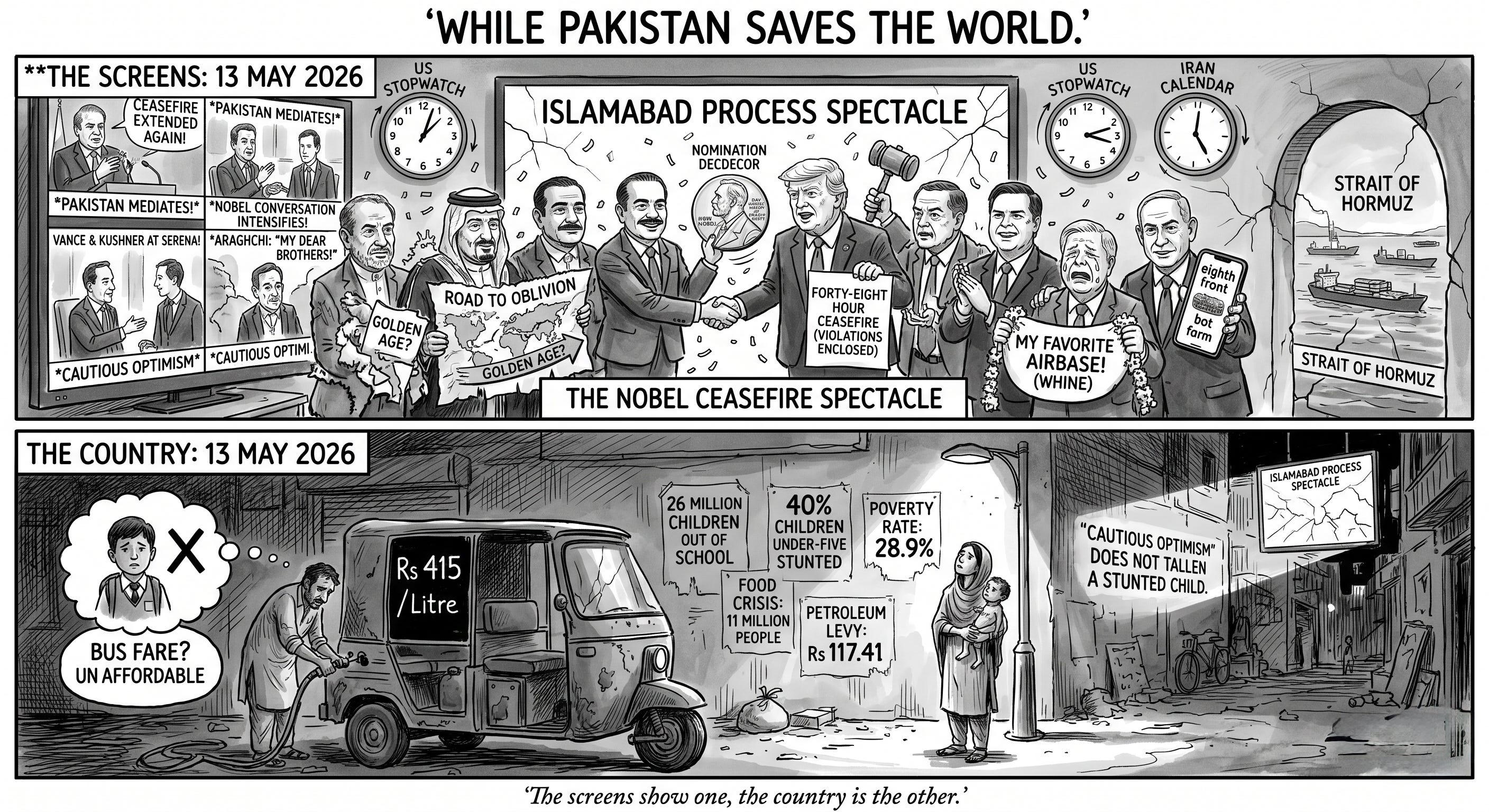
The rickshaw driver in Lahore fills his tank. Petrol is Rs415 per litre this week. Last month it was Rs393. Before the war it was Rs270. He does not know exactly what the Islamabad Process is. He knows the number at the pump.
The Karachi Chamber of Commerce and Industry knows what the Islamabad Process is. On 9 April 2026, the day after the ceasefire between the United States and Iran was announced via Pakistani mediation, the Chamber issued a statement. It called for Prime Minister Shehbaz Sharif and Field Marshal Asim Munir to be awarded the Nobel Peace Prize.
The rickshaw driver was not consulted.
Pakistan is the fifth most populous country on earth. Twenty-six million of its children are out of school, the second-largest such number anywhere on the planet. Forty percent of children under the age of five are stunted, their physical development permanently compromised by a lack of adequate nutrition in their earliest years. Nearly one in three Pakistanis lives below the national poverty line, a figure that was twenty-two percent before the chain of shocks that began in 2019 and has not come down since. The poverty rate as of 2024-25 was 28.9 percent, and that figure was measured before the Iran war added half a billion dollars per month to the country’s oil import bill.
Pakistan also just brokered a ceasefire between the United States and Iran.
Both of these things are true simultaneously, and the second one is on every screen, and the first one is the country.
The week of 11 April 2026 was, for Pakistani television, the greatest week in living memory. JD Vance, the Vice President of the United States, arrived at Nur Khan Air Base on a special plane, along with Jared Kushner and Steve Witkoff, to negotiate with the Iranian delegation at the Serena Hotel in the Red Zone. There were three hundred Americans and seventy Iranians. There were flags on the split-screen. There were breaking tickers. There were experts with three overlapping titles. There was Araghchi, the Iranian Foreign Minister, saying “my dear brothers” about the Pakistani prime minister and army chief who had made this possible.
There were twenty-one hours of talks.
There was no agreement.
Vance left. Trump announced a naval blockade of Iranian ports. Iran declared the ceasefire violated from the moment of its announcement. Pakistani officials said the process was moving in a positive direction.
Across the country that week, twenty-six million children did not go to school. Four in ten children under five remained stunted. The poverty line held at 28.9 percent, and the fuel price that was already too high went up again.
The screens did not cover the last part.
It is important to reproduce the Nobel conversation accurately, because its details carry a specific weight.
The Karachi Chamber of Commerce and Industry, an organisation whose area of expertise is trade, logistics, and the economics of Pakistan’s largest port city, issued its Nobel nomination call on 9 April. A retired lieutenant colonel writing in The Nation argued that the Nobel was warranted because Pakistan had “prevented a potentially devastating war.” A Pakistani senator told The Hill in Washington that Trump was impressed by the Pakistani brass, that Trump loves winners, and that Trump had asked, about Pakistan: “Who are these folks?” The senator described this as evidence of Pakistan’s restored international standing.
Pakistan had previously nominated Trump for the Nobel Peace Prize, for his claimed role in the India-Pakistan conflict of 2025. That nomination helped secure the White House lunch at which Trump asked who these folks were.
The Nobel committee awards the Peace Prize in October. It has made no indication that the Islamabad talks are under consideration.
One in three Pakistanis lives below the poverty line. Forty percent of children under five are stunted. Twenty-six million children are out of school. The Nobel conversation ran for two weeks on Pakistani television, displacing most other coverage.
There is no editorial comment required here. The facts are sufficient.
Pakistani broadcast media is not, in any simple sense, lying about the Islamabad Process. The talks happened. Vance arrived. The ceasefire held, imperfectly. Pakistan genuinely occupied a diplomatic position no other country could fill: simultaneously connected to Washington through the White House visit of September 2025, to Tehran through a shared border and a domestic Shia population of thirty-five to fifty million people, and to Riyadh through a mutual strategic defence pact signed in the same month. The country carried proposals, absorbed pressures, and kept a fragile process running for seventy-five days and counting. This is real work, performed under real constraint, by people who understood that a resumed war on their border would be worse than the current one.
The screens are covering real events.
What the screens are not is a mirror held up to the country they are broadcasting in. They are a mirror held up to the diplomatic moment, and the country behind the mirror is invisible in the reflection.
In the country behind the mirror: the poverty rate is 28.9 percent and climbing because the oil import bill went from $300 million to $800 million per month during a war Pakistan did not start and cannot end. In the country behind the mirror: the petroleum levy collected by the government at the pump is Rs117.41 per litre, a domestic fiscal instrument set under IMF programme conditions and unrelated to the Strait of Hormuz closure, applied to a population that already could not afford what petrol cost before the war began. In the country behind the mirror: twenty-six million children are out of school because their families need them to work, and the government’s education budget, per Save the Children, has hit a new low in percentage terms precisely when the country needs it most.
None of this went away during the weeks when Pakistan was on every wire service. None of it has been addressed, or even directly discussed, by any minister appearing on any channel to celebrate the Islamabad Process.
On 1 April: “We are blasting Iran into oblivion... back to the Stone Ages!!!”
On 7 April: “A whole civilization will die tonight, never to be brought back again.”
On 8 April: “A big day for World Peace! Iran wants it to happen, they’ve had enough! Likewise, so has everyone else!” Also on 8 April: the ceasefire could “usher in a Golden Age for the Middle East.”
On 10 May, after Iran submitted its latest counterproposal via Pakistan: “Iran has been playing games with the United States, and the rest of the World, for 47 years (DELAY, DELAY, DELAY!) ... They will be laughing no longer!” Two hours later: “I have just read the response from Iran’s so-called ‘Representatives’. I don’t like it — TOTALLY UNACCEPTABLE!”
Pakistan’s response to this, from the Foreign Ministry: a sign of continuing engagement.
The rickshaw driver in Lahore is paying Rs415 per litre to power the vehicle that earns him enough to keep his family slightly above the poverty line Pakistan has drawn at the level of subsistence. The Islamabad Process is being powered, in part, by the money he pays above that line.
On 11 May, CBS News reported that Iranian military aircraft had been parked at Pakistan Air Force Base Nur Khan, just outside Rawalpindi, after the ceasefire. Senator Lindsey Graham of South Carolina posted on X: “If this reporting is accurate, it would require a complete reevaluation of the role Pakistan is playing as mediator.”
Lindsey Graham arrived at PAF Base Nur Khan in December 2019 by special plane, for a meeting with then-Prime Minister Imran Khan.
The Iranian delegation that flew to Islamabad for the April talks arrived by aircraft. Those aircraft landed somewhere. The 300-member American delegation also arrived by aircraft. Their aircraft also landed somewhere. No senator called for a complete reevaluation of the American delegation’s mediator role because American government aircraft were parked at a Pakistani airbase.
Pakistani social media spent 11 and 12 May conducting a detailed rebuttal of the CBS report. The Foreign Ministry called it “misleading and sensationalized.” A senior official noted that Nur Khan is surrounded by dense urban population and that a large fleet of aircraft there could not be hidden from the public eye, which is a description of the base’s geography and not a denial of the aircraft’s presence.
Twenty-six million children are not in school. Forty percent of children under five are stunted. The Pakistani government has been running this media cycle for seventy-five days. The Nur Khan rebuttal generated more social media activity in forty-eight hours than the UNESCO report on Pakistan’s out-of-school children has generated in the six months since it was published.
Also on 11 May, Benjamin Netanyahu appeared on CBS “60 Minutes.” He picked up the journalist’s phone, held it in the air, and explained that a person could be painted as a monster on social media if the allegation was repeated often enough. He then accused Pakistan of running bot farms targeting young Americans, calling it the “eighth front” of the war. He described tracing a “red-blooded Texan” who had turned against Israel, the address leading “to some basement in P—,” at which point the sentence was apparently cut.
Israel’s Channel 12 reported in January 2026, based on research by the Scooper group, that roughly fifty percent of politically active accounts on Israeli social media were automated bots, amplifying Netanyahu’s content within seconds of posting, frequently from accounts based abroad.
The Iran war, according to OCHA data through 29 April 2026, had by that point killed 72,599 Palestinians in Gaza since October 2023, with 172,411 injured.
Netanyahu held up the phone. “It’s this,” he said. “You can penetrate this little instrument.”
The Pakistani government, which has been running the diplomatic corridor between Washington and Tehran for seventy-five days, found itself on the same week accused by an American senator of secretly harbouring Iranian aircraft and accused by a wartime Israeli prime minister of running a social media war against his country. The government’s Foreign Ministry issued bounded denials in both directions. Pakistani broadcast media ran both stories as affronts to national dignity, which they are, and did not ask why Pakistan’s diplomatic success has generated more hostile scrutiny from Washington than material relief.
Twenty-six million children are not in school.
Let the numbers sit without comment, because numbers do not require comment when they are arranged this way.
One in three Pakistanis below the poverty line: 28.9 percent as of 2024-25, the most recent national household survey, before the war added $500 million per month to the oil bill.
Petrol price, 13 May 2026: Rs415 per litre.
Domestic petroleum levy, 13 May 2026: Rs117.41 per litre.
Children out of school: 25 to 26 million, depending on the counting methodology. Second-highest number in the world.
Children under five who are stunted: 40 percent.
Children under five who are underweight: 28.9 percent.
Women who are moderately anemic: 49 percent.
Pakistan’s education budget as a percentage of GDP: declining toward its lowest recorded level.
Pakistanis in acute food insecurity, per the 2026 Global Report on Food Crises: approximately eleven million, at crisis or emergency levels.
Global coverage of Pakistan, April and May 2026: dominated by the Islamabad Process, the ceasefire framework, the Nobel nominations, the Nur Khan aircraft, and the question of whether Pakistan is a neutral mediator or a strategic opportunist.
Global coverage of Pakistan that mentioned stunting, out-of-school children, the petroleum levy, or the poverty rate during the same period: minimal.
The country receiving global attention and the country that exists inside that attention are not the same country. The first one negotiates between superpowers. The second one has 26 million children who cannot read.
Since March 2026, Pakistan has carried at minimum seven principal proposals between Washington and Tehran. It has hosted a 370-member combined delegation. It has brokered three ceasefire extensions. It has issued statements of cautious optimism after each round ended without agreement.
In return: no sanctions lifted. No frozen assets released. No Hormuz opened. No IMF programme relief. No fuel price reduction. No educational funding. No poverty line movement. The government of Pakistan that is hosting the world’s most important ceasefire negotiations is simultaneously collecting Rs117.41 per litre from the man at the pump whose wages have not kept pace with inflation since 2019, a figure documented in the household survey that showed nominal income rising from Rs47,545 in 2018-19 to Rs82,779 in 2024-25 while real income fell because prices rose faster.
The diplomacy is real. The destitution is also real. The screens are choosing between them.
On the morning of 13 May 2026, a Pakistani official is, somewhere, describing the current state of negotiations as cautiously optimistic. This is the phrase that has been used for seventy-five days. The ceasefire is technically in effect. The Strait remains closed. The US naval blockade has turned around 52 vessels. Trump’s last public statement on Iran’s proposal was “TOTALLY UNACCEPTABLE.” Iran’s last public statement on US demands was “unreasonable and one-sided.” Pakistan’s last public statement was cautious optimism.
On the same morning, in a city somewhere in Pakistan, a family is deciding whether to take a child out of school because the cost of the bus to school has gone up with petrol. This is not a hypothetical. The transport sector inflation was 30 percent year-on-year in April. The decision is being made in tens of thousands of households, in the country that is cautiously optimistic about the world’s most important peace process.
The Nobel committee has not replied.
The screens are magnificent.
The Rs415 will not go down when the peace prize is awarded.
The stunted child will not grow taller when the Strait reopens.
Pakistan is in the news. Pakistan is also in the country. These are different places.


