The Jeddah Departure
How Abu Dhabi's Planned Exit From OPEC & OPEC+ Can Redraw The Geometry Of The Region
The Gulf Cooperation Council meeting in Jeddah on Tuesday had been choreographed for weeks. Six heads of state, a single communique, an image of Arab unity in the face of an Iranian blockade entering its third month: Saudi Arabia, Kuwait, Qatar, Oman, and Bahrain arrived with pre-cleared talking points on the collective defense of the Arabian Peninsula. The United Arab Emirates arrived with a different script. Before the closing statement could be drafted, the Emirati delegation announced that effective May 1, after fifty-nine years of membership, the country would leave the Organization of the Petroleum Exporting Countries and its expanded alliance, OPEC+, the coordinated framework that has bound Riyadh, Moscow, and Abu Dhabi to a shared production discipline since 2016. Energy Minister Suhail al-Mazrouei described the move, in a measured statement read on Emirati state television, as “a sovereign national decision aligned with our evolving energy profile.” West Texas Intermediate crossed one hundred dollars a barrel within the hour, the first triple-digit print since April 10.
To characterize the exit as sudden would be to misread a decade of accumulating friction. The Wall Street Journal first reported in March 2023 that Abu Dhabi was conducting an “internal debate” about leaving the cartel, a story that the Emirati foreign ministry called “far from the truth” and that Reuters published officials denying within hours. Those denials read, in retrospect, less as refutations than as postponements. The quota disputes that surfaced publicly in 2021, the bilateral coolness between Sheikh Mohammed bin Zayed and Crown Prince Mohammed bin Salman, the two leaders visibly absent from each other’s state functions for the better part of two years, the divergent time horizons of Vision 2030 and ADNOC’s capacity-expansion program: each suggested a coming rupture. What the war supplied was activation energy. More than two thousand Iranian missiles and drones have struck Emirati territory since hostilities began on February 28. The Strait of Hormuz has been effectively closed since early March. The Islamabad negotiations collapsed in mid-April with Vice President JD Vance and Foreign Minister Abbas Araghchi unable to agree even on the sequence of a ceasefire. Against that backdrop, remaining inside an institution designed to restrain Emirati output became, for Abu Dhabi, a posture that no longer paid for itself.
The exit is therefore better understood as a disclosure than as a decision. Abu Dhabi has concluded that the multilateral structures of the twentieth century (OPEC, the Arab League, arguably the GCC itself) are no longer capable of securing its interests in the twenty-first, and it has stopped pretending otherwise. The reordering that follows will not be confined to energy markets.
The fiscal divergence between Riyadh and Abu Dhabi has been, for years, the most under-discussed fault line in the Gulf. Saudi Arabia requires oil prices in the vicinity of one hundred dollars a barrel to balance a national budget that now carries the weight of NEOM, the Red Sea developments, the Riyadh Metro, and the broader capital program of Vision 2030. The Kingdom’s strategy is therefore one of curated scarcity: restricted production, a defended price floor, a smaller share of a richer market, underwritten by a patient assumption that the energy transition will arrive slowly, that demand will plateau rather than collapse, and that high prices today finance the long arc of diversification.
The Emirati calculus is less patient, and less romantic. Abu Dhabi’s population of roughly one million citizens sits atop a sovereign-wealth apparatus that does not require crude prices to defend any particular consumption model, and ADNOC has spent the past decade investing toward a stated target of five million barrels per day by 2027. Actual capacity is already above four million. The most recent OPEC+ agreement held the UAE to roughly 3.2 million. Robin Mills of the Dubai consultancy QamarEnergy has described the gap between built capacity and permitted output as “the largest disconnect in the cartel,” and the Baker Institute estimated in 2023 that unconstrained Emirati production could approach a third of Saudi volumes, a structural shift the quota system was explicitly designed to prevent. Behind the numbers sits a philosophical disagreement about what oil is. For Riyadh, it is a revenue stream to be metered against a transition horizon. For Abu Dhabi, it is a stranded asset in waiting, to be monetized at maximum volume before the commodity is rendered obsolete by policy rather than geology.
The war has collapsed the patience required to manage that disagreement bilaterally. With Hormuz functionally shut, the UAE has been exporting roughly half of its normal volumes, a shortfall imposed by Iranian missiles rather than by the OPEC Secretariat, and the suggestion, floated quietly in late March by Saudi officials, that Abu Dhabi should absorb additional voluntary cuts to defend the price band became politically untenable. The structural argument for leaving OPEC has existed since at least 2021. The war supplied the moment at which leaving it could be narrated as national survival rather than commercial defection.
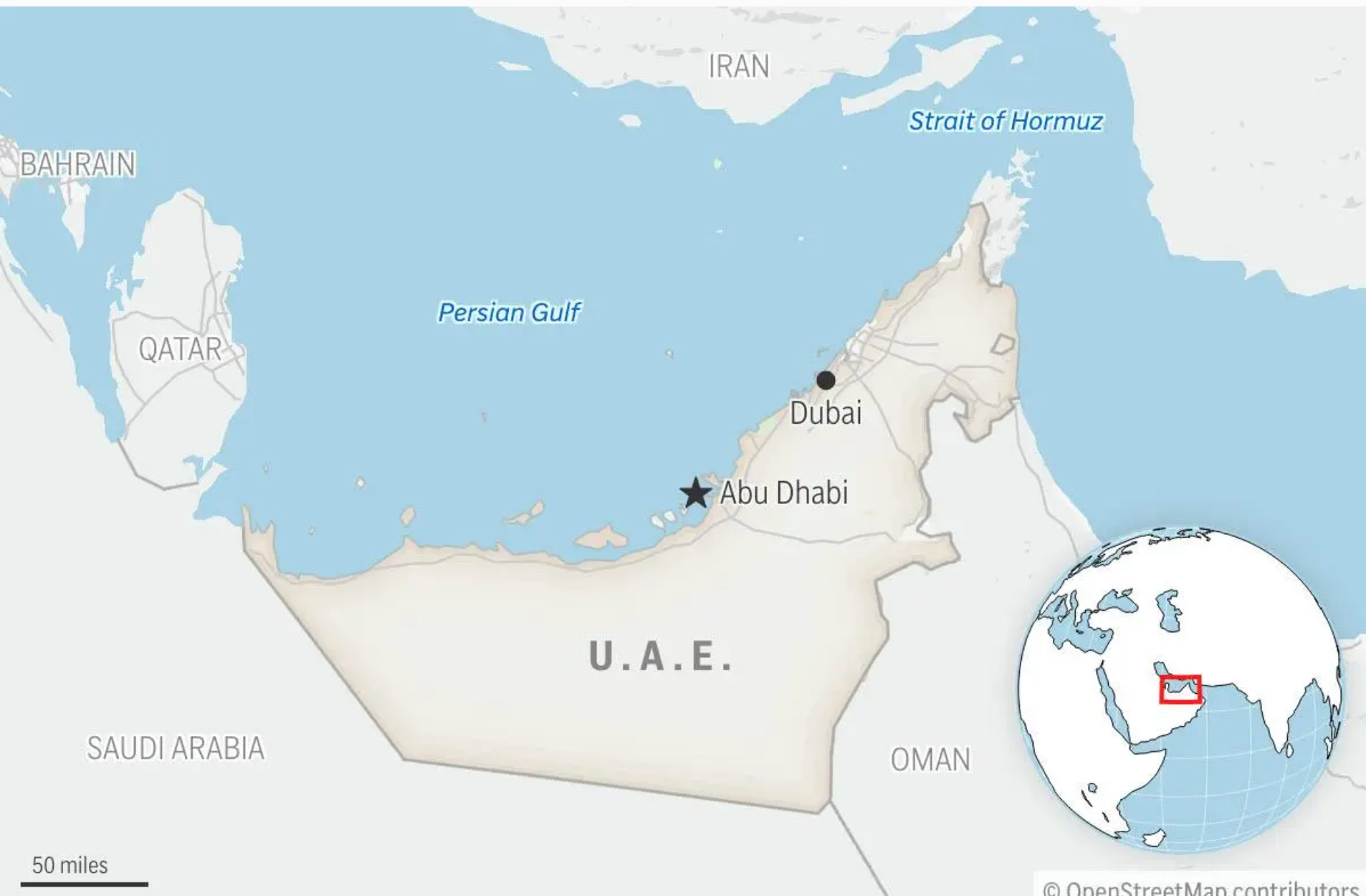
The physical case for the exit has been written in drone strikes and insurance premiums. Since February 28, Iranian forces have conducted a sustained missile and drone campaign against Emirati infrastructure, with open-source tracking by institutions including the Washington Institute and IISS converging on a figure of more than two thousand munitions fired. The Fujairah industrial zone, the terminus of the Abu Dhabi Crude Oil Pipeline, known as ADCOP, which transports crude from the Habshan fields to a port that loads outside the Strait of Hormuz, was struck on March 14, March 16, and March 17. Reuters confirmed that oil loading was at least partly halted after the third strike, and that operations at the Shah gas field, hit on March 16, were suspended. The reassuring architecture of “alternatives to Hormuz” that had calmed commodity desks for two decades was discredited in the span of a single week. The Saudi East-West pipeline was struck on April 9, cutting throughput by roughly 700,000 barrels per day. Al Jazeera’s energy desk, in a dispatch published March 27, concluded that the three major Gulf pipelines designed to bypass the Strait (ADCOP, the Saudi East-West, and Iraq’s northern export route through Turkey) could collectively carry at most half of the volumes normally moved through the chokepoint, and only if none of them were attacked. All three have now been attacked.
The Strait itself remains, in functional terms, closed. The U.S. Energy Information Administration estimates the chokepoint normally carries about a fifth of daily global oil flows, and the Reuters graphics desk has confirmed that figure went effectively to zero in late March. Wikipedia now maintains a standalone entry titled “2026 Strait of Hormuz crisis.” Bloomberg, in a graphics piece earlier this month, reported that U.S. government officials and Wall Street analysts are openly modeling a two-hundred-dollar scenario for Brent.
Against that ledger, the Emirati academic Abdulkhaleq Abdulla observed last week that after forty days of bombardment, there would be “a lot of rethinking” in Abu Dhabi about who had stood by the state and who had issued press releases. The OPEC exit is the first institutional answer to that audit. The statements from the Arab League and the GCC through March and early April had been a study in ornamental solidarity, condemning “aggression against Arab territory” without naming Iran as the aggressor, and Abu Dhabi appears to have concluded that a cartel designed to manage disagreement among producers is structurally incapable of managing a war among neighbors.
The rift between Abu Dhabi and Riyadh has been visible in the Yemen file for more than half a decade, and the war in the Gulf has reactivated every dormant fracture. By the end of 2025, the UAE-backed Southern Transitional Council, a separatist formation that Abu Dhabi has financed and armed since 2017, had seized most of southern Yemen, including the full southern coastline, the Omani border region, Dhale Governorate, and the Hadhramaut oilfields. A House of Commons Library briefing published in February 2026 documented the Saudi-recognized Yemeni government being reduced to a sliver of central territory. In January, a Saudi envoy publicly complained that STC leader Aidarous al-Zubaidi had blocked rival southern delegations from entering Aden. Riyadh’s response was a mixture of muted condemnation and an attempted forum in the Saudi capital. Abu Dhabi’s response was to keep arming the STC. The proxy theater and the financial theater have now converged at the same table.
The Russia dimension is the third vector. Moscow’s continued public and material support for Tehran through the current war, including the assurances offered to Foreign Minister Araghchi during the Islamabad talks, has rendered the “Plus” in OPEC+ politically untenable for Abu Dhabi. Russia depends on coordinated Saudi production restraint to underwrite its wartime budget, and without voluntary Emirati participation that discipline becomes materially harder to enforce. Euromaidan Press framed the news, not inaccurately, as “Moscow’s price floor cracks.” Western officials have gone further in private briefings, suggesting that the Emirati exit functions as an indirect sanction on Russian oil revenue, one that requires no SWIFT measure, no Treasury memo, and no congressional vote, but that may nonetheless compress the Kremlin’s fiscal space more effectively than the previous three years of formal restrictions combined.
The most under-reported strand of this story sits not in Vienna or Jeddah but in Washington. On April 22, Treasury Secretary Scott Bessent told CNBC that “many” oil-rich Gulf allies had requested currency swap lines from the United States to absorb the turbulence of the Iran war. On April 24, in a follow-up appearance, he confirmed that the UAE was among the requesting parties. Asked about the prospect of an Emirati swap line in a Squawk Box interview, President Trump volunteered: “If they had a problem, I would be there for them.” By April 25, according to reporting later stitched together by Fortune from a combination of Treasury sources and Gulf financial correspondents, the swap line was operational. By April 28, the UAE was out of OPEC.
The sequencing is not coincidental, and it is not ornamental. For roughly five decades, from the 1974 arrangement between Henry Kissinger and the House of Saud to the present, a structure whose documentary record was only substantially surfaced by a Bloomberg FOIA filing in 2016, the Gulf’s largest producers held the implicit half of a compact: oil priced in dollars, surpluses recycled into U.S. Treasuries, security guarantees underwritten by the Fifth Fleet. The petrodollar system did not require a formal treaty because it was the physical metabolism of the dollar’s global role. What Bessent appears to have done over the last fortnight is replace the implicit arrangement with an explicit one. A Federal Reserve swap line allows Abu Dhabi to defend the dirham’s peg without burning through reserves, in exchange for a strategic alignment that makes the OPEC quota, and the Russian relationship it carries, redundant. The petrodollar, on this reading, is not dying. It is being re-papered. And the new paper does not require Saudi Arabia to be its load-bearing beam.
The structural question that follows from Abu Dhabi’s exit is what replaces the institutions it is leaving. The answer, increasingly visible in Emirati public diplomacy and private briefings to Western correspondents, is a configuration that officials in the capital have begun referring to, in deliberately informal terms, as the “Hexagon of Alliances”: a six-vertex grouping anchored by the United States and Israel, extended through India and selected Mediterranean states, and counterbalanced by whichever Arab partners prove willing to operate inside the new framework rather than against it.
The institutional scaffolding already exists. I2U2, the India-Israel-UAE-United States quadrilateral established in 2021 and originally pitched as a green-energy and food-security forum, has over the last eighteen months quietly absorbed a defense-industrial dimension that was not present at its founding. IMEC, the India-Middle East-Europe Economic Corridor announced at the 2023 G20 in New Delhi, is the physical infrastructure: rail, fiber, and pipeline routes running from Mumbai through Jebel Ali, across Saudi territory to Haifa, and onward to Piraeus and Trieste. The corridor was conceived as a counter to the Belt and Road. It is now being repurposed, with remarkable speed, as a counter to Hormuz. An Atlantic Council report published in January framed IMEC’s value as “connectivity in an era of geopolitical uncertainty,” a phrase that reads, two months later, as an understatement of nearly embarrassing proportions. The Strait of Hormuz has become the defining chokepoint of the current era. IMEC is the only proposed corridor that bypasses it without traversing Iranian-influenced territory. The UAE’s decision to leave OPEC is, in that light, not merely a rejection of Saudi price management but an announcement that Emirati hydrocarbon revenues will be channeled into the equity of the corridor designed to outlive hydrocarbons altogether.
There is credible speculation, sourced to Emirati diplomatic interlocutors, that the next institutional casualty may be the Arab League itself, not a formal withdrawal (which would be costly) but a freeze on participation sufficient to render Cairo’s chairmanship ceremonial and to signal the end of the post-1945 Arab consensus. That consensus has bound Gulf states to a shared political grammar for eight decades. The Hexagon does not require the grammar. It requires throughput.
The immediate effect of the Emirati exit on global oil markets is paradoxically obscured by the closure of the Strait. With Hormuz functionally shut, OPEC’s market-management function is already in abeyance, and the UAE’s withdrawal arrives as a structural change to a system that is not currently operating. The volatility will come later. Jorge Leon, head of geopolitical analysis at Rystad Energy, has warned that OPEC will be “structurally weaker” without the Emirates: Saudi Arabia becomes the only remaining member with significant spare capacity, the cartel loses roughly twelve percent of its total output, and the instruments available for smoothing a supply pulse contract accordingly. Bloomberg’s two-hundred-dollar scenario assumes that the eventual reopening of the Strait is disorderly. The UAE’s exit makes orderly reopening measurably less likely.
For Riyadh, the consequences are sharper and more immediate than the market is pricing. Saudi Arabia now carries the burden of OPEC alone: the price defense, the diplomatic management, the residual coordination with Moscow, and the Kingdom’s break-even budget assumes a price band it can no longer set unilaterally. The fiscal shock will not arrive this quarter. It will arrive, and it will reshape the pace of Vision 2030’s execution.
For Moscow, the calculus compresses: the price floor cracks, the war budget narrows, and the leverage the Russian barrel exerts over European purchasing decisions thins.
For Tehran, the strategic outcome is close to tragicomic. A country that attempted to weaponize the Strait has, in doing so, accelerated the construction of the corridor designed precisely to bypass it.
For Washington and Jerusalem, the episode resembles a quiet victory, and one that has been unusually cheap. The public American criticism of OPEC dating to Trump’s first term has been answered not by tariff or sanction but by the cartel’s third-largest member walking off the field. The Bessent swap line secures the Emirati currency through the transition. The I2U2 and IMEC frameworks ensure that monetized Emirati volume flows through corridors Iranian missiles cannot close. The reordering is, if anything, almost too clean, of the sort that suggests the option had been available for a long time and was waiting only for a moment at which exercising it could be narrated as necessity.
The OPEC Secretariat in Vienna issued a brief statement on Tuesday afternoon thanking the UAE for its fifty-nine years of cooperation and “noting” the decision, in language that was correct, formal, and visibly exhausted. The Saudi response, at the time of this filing, has not yet come. In diplomacy, that kind of silence is not an absence but a data point.
The Strait remains closed. The ceasefire is set to expire. The Habshan-Fujairah pipeline has resumed loadings, at reduced volumes and under an air-defense canopy. The dirham peg is intact. The dollar remains the unit of account. And the third-largest producer in the most consequential cartel of the twentieth century has concluded, after sixty years, that the twenty-first century will require a different geometry: one in which Abu Dhabi’s security, revenue, and infrastructure are underwritten by Washington, routed through Haifa and Mumbai, and insured against the Persian Gulf rather than by it. The choice has been made. The adjustment now belongs to everyone else.


