The Jobs That Won’t Come
Pakistan didn’t send soldiers to the Iran war. It sent 1.7 million workers. They are still there.
Earlier this year, Pakistan’s Minister for Overseas Pakistanis, Chaudhary Salik Hussain, announced the country’s labor export target for the year: 800,000 workers, up from 740,000 in 2025. The Gulf was to absorb most of them. The UAE alone already employed 1.7 million Pakistanis across construction, logistics, hospitality, and security. The pipeline was full. Recruitment agencies in Karachi, Lahore, and Rawalpindi were processing applications. Workers were paying fees, arranging documents, waiting on visas.
On February 28, the United States and Israel launched strikes on Iran. By March 1, Iranian missiles and drones were landing across the Gulf. The pipeline has not been formally cancelled. The sectors it was feeding are shutting down anyway.
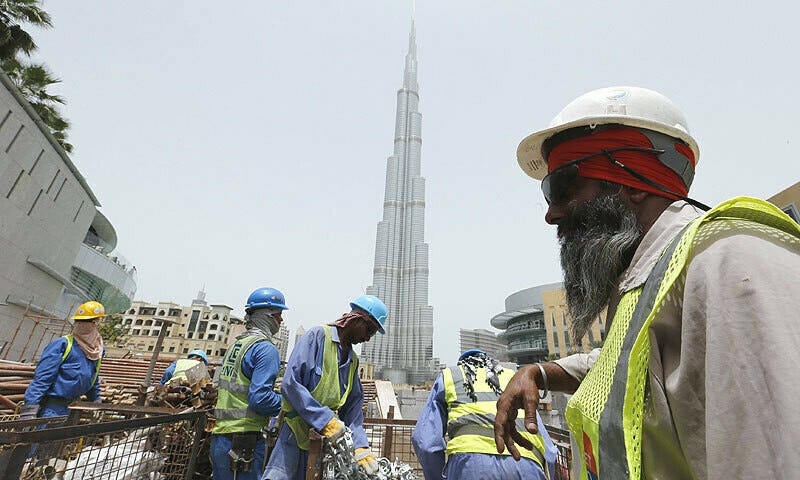
The construction sector was the first to feel it. Before the conflict, Dubai’s real estate market was running at a scale that required every available body. Between January and February 2026 alone, the Dubai Financial Market recorded AED 133.3 billion in real estate transactions across 34,452 deals. Off-plan sales, which depend entirely on foreign investor confidence, accounted for 65 percent of those transactions. The pipeline behind them: 300,000 to 400,000 new units targeted for delivery by 2028. The labor behind that pipeline is overwhelmingly South Asian and overwhelmingly Pakistani and Bangladeshi at the bottom of the skill tiers.
Waqas Ahmed, a Pakistani laborer in Dubai, told a journalist: “Large projects are still going on, but smaller contractors have less work now. Earlier we were called to sites every day, but now we’re not.” Imran Khan, a 34-year-old electrician from Mardan who has worked in Dubai for five years, put it more precisely: he used to get work almost every day of the week. Now he waits three or four days between jobs. “For people like us, when work stops it becomes very difficult because our income depends entirely on daily labor.”
The Emaar and Aldar stock charts tell the same story from a different angle. Both developers fell 5 percent when the Dubai Financial Market reopened after a two-day suspension. The DFM Real Estate Index dropped approximately 21 percent across the first two weeks of conflict, erasing all gains made in 2026. Bond markets for UAE developers effectively closed to new issuance. A senior real-estate banker told Reuters that a planned capital-raising round had been pulled because the risk had become “much higher.” Projects that require bond financing to break ground are not breaking ground.
Logistics followed construction down. Jebel Ali port, the largest in the Middle East and the transit point for most goods moving through the Gulf, caught fire on March 1 when debris from an intercepted Iranian attack fell on the facility. Arshad Mahmood, a Pakistani warehouse worker in Abu Dhabi, described the change: earlier in the week, several large shipments arrived. Now, loading “hardly happens.” The income workers like him receive is tied directly to cargo volume. No cargo, no shifts. No shifts, no transfer home.
Hospitality collapsed almost immediately. Hotels on Palm Jumeirah, including the Fairmont The Palm and the Burj Al Arab, sustained fire damage from drone strikes in the first days of the war. Hotel bookings dropped more than 60 percent. The Ramadan corporate iftars hosted by Mubadala, Emirates, and Masdar, the events on which Gulf deal-making runs, were cancelled in sequence. Those events employ catering staff, security personnel, drivers, and cleaners, almost all of them migrant workers. They were not rescheduled. Ayesha Farooq, a Pakistani woman in Dubai who taught private tuition to children, lost most of her students when schools moved online and parents stopped sending children out. “Many tuitions have stopped,” she said.
The financial district formalized its shutdown in writing. Goldman Sachs, Citi, and Standard Chartered ordered staff to work from home. PwC and Deloitte relocated their Dubai personnel on March 11. The Dubai International Financial Centre announced remote operations from March 2 to 4. The offices came back. The supply chain of workers feeding the services around those offices, the restaurants, the transport, the maintenance crews, did not follow the same news cycle.
Three Pakistanis are confirmed dead in the war zone. Muzaffar Ali, 27, from Jamshoro in Sindh, was killed when debris from an intercepted projectile struck his vehicle in Dubai. He was a laborer. He had three young children. His uncle, Abdul Malick, sat among mourning relatives in their village on March 12 and told AFP: “We have nothing to do with this war. It is unfortunate that the poor are being used as fuel for a conflict they have no part in.” Murib Zaman, 48, from Bannu, had driven in the UAE for 25 years. He left five children. A third Pakistani was killed in a drone attack while fishing in Iranian waters. All three were working when they died.
Equidem, the migrant worker rights organization, has documented across the UAE, Qatar, Saudi Arabia, and Jordan what its executive director Mustafa Qadri describes as “universal trauma, panic, worry, regardless of who the workers are.” Two forms of exclusion compound it. The first: official safety communications have not reached workers in any meaningful form. Air raid guidance, evacuation routes, shelter information, all of it was directed at residents in formal housing through formal channels. Workers in labor camps and informal accommodations received nothing. The second: as essential workers in construction, hospitality, healthcare, and security, they cannot stop. A Pakistani delivery rider in Abu Dhabi who has worked in the country for five years told Middle East Eye: “I came here to earn money, and working in any situation has become a necessity for me. If I do not work, I may go hungry.”
In Bahrain, five Pakistanis and one Bangladeshi worker were arrested for allegedly filming the aftermath of Iranian strikes and sharing footage online. They were accused of praising the attacks.
Pakistan received $3.3 billion in remittances in February 2026, up 5.2 percent year on year. The UAE was the single largest source: $696.2 million that month. The State Bank of Pakistan cited these figures on March 11 as evidence of stability. The Ministry of Foreign Affairs cited them too, noting that repatriation requests were “too few for a major outflow.”
Both statements are accurate. Both statements are about February. February ended before the Jebel Ali fire, before the airport closures, before the DFM suspension, before PwC relocated its staff, before hotel bookings fell 60 percent, before construction sites went dark, before the Ramadan iftars were cancelled. The State Bank’s remittance data runs on a one-month lag. The government is reading the receipts from a month that no longer exists.
Analysts are working with different figures. Insight Securities published a warning on March 14: remittances have climbed from 1.1 percent of Pakistan’s GDP in fiscal year 2000 to roughly 9.3 percent today, while the share of goods exports in GDP fell from 9.1 percent to 7.9 percent over the same period. Pakistan now earns more from its diaspora than from everything it ships. The Business Recorder noted on March 11 that more than half of Pakistan’s remittance inflows, 53.3 percent of the July to February total, came from Arab countries. Capital Economics warned in a published note that a prolonged conflict could hit Gulf economies with a knock-on effect on remittances to South Asia. The analysts at The News put the downside scenario at a 10 to 15 percent drop in remittance inflows. A 30 to 40 percent disruption would produce a monthly shortfall of $500 to $700 million.
The March figures are not yet published. They will be published in April. April is when the government will see what February looked like from the other side of the war.
The 800,000 target announced in January remains on the books. No formal suspension has been issued. But the sectors the pipeline was feeding, construction, logistics, hospitality, security, are exactly the sectors shutting down or operating at reduced capacity across the Gulf right now. Workers who had already paid recruitment fees in Karachi and Lahore and were waiting on UAE visas exist in a category the official record has not created. They are not yet employed, so they cannot be laid off. They have not yet departed, so they are not emergency repatriation cases. The Foreign Office’s formulation, too few returns for a major outflow, does not reach them. The Ministry of Overseas Pakistanis has not published a figure for how many workers are currently in the pipeline, waiting on contracts that may not materialize.
The ILO documented this exact category during COVID-19: workers stranded between a job offer and a departure date, carrying recruitment debt, ineligible for state support in either country. The mechanism is identical. The scale this time is larger.
Rising oil prices are also adding costs inside Pakistan for the families the remittances are meant to support. The government raised petroleum prices by Rs55 per litre in the first week of the war. The Strait of Hormuz disruption means oil arriving in Pakistan is now traveling longer routes with higher insurance premiums. Workers sending $300 or $500 a month are supporting households whose fuel, transport, and food costs have gone up since the war began.
Prime Minister Shehbaz Sharif mourned the three dead workers publicly and confirmed repatriation of the bodies. The Foreign Office issued guidance urging Pakistanis in the UAE to register with the embassy and follow official guidance. The Ministry of Foreign Affairs said it was coordinating with UAE authorities. The Ministry of Overseas Pakistanis has not published any assessment of employment impact, any figure for workers currently in the visa pipeline, or any contingency plan for the scenario in which Gulf construction slows for two to three months.
Pakistan condemned Iran’s retaliatory strikes on Gulf states. It has said nothing about the 1.7 million workers still inside those states, employed in sectors that are contracting around them.
The Business Recorder’s March 11 analysis named the structural risk precisely: this is not about near-term disruption. It is about “the growing concentration of Pakistan’s external lifeline in a region which is not secure and thriving as it was before.” Investment decisions will become more cautious. Expansion plans will slow. Future job creation will soften. The remittances will not collapse suddenly. They will decline through fewer new jobs, slower wage growth, delayed payments, and reduced working hours across sectors that employ millions of Pakistanis who have no alternative income source and no state safety net waiting for them at home.
Jim Krane, a fellow at Rice University’s Baker Institute, told CNBC: “Dubai’s economic model is based on expatriate residents providing the brains, brawn and investment capital.” The brains relocate on company instructions, with housing allowances and business-class tickets. The brawn waits to see if the contract survives.
There is one question the record cannot yet answer: at what point does the suspension of Gulf business activity convert to termination at scale, and how many months does that take? The components of the answer are already in the data. The month that will answer it has not yet been published.


