The Land of the Aryans
How Iran Borrowed a Racial Fantasy From Europe, Traded It to Nazi Germany, and Handed It to the Diaspora
THE INSCRIPTION AT BEHISTUN
Cut into a mountain face in the Kermanshah province of western Iran, carved 2,500 years ago at the order of Darius the Great, is one of the oldest self-descriptions in the Persian record. Darius identifies himself as “an Aryan, having Aryan lineage.” The inscription is in three languages: Old Persian, Elamite, and Babylonian. It is a list of conquered peoples, a declaration of divine right, and a statement of genealogy. It says nothing about Europe. It says nothing about Nordic bloodlines. It does not anticipate Max Müller. It predates Adolf Hitler by two and a half millennia and shares with him precisely nothing.
And yet this inscription, or rather the word “Aryan” inside it, became one of the most politically weaponized pieces of text in modern Iranian history. It was extracted from its context, laundered through 19th-century European racial science, re-imported into Iranian nationalist ideology, deployed by a modernizing monarch trying to shed the gravitational pull of the Islamic world, offered to Nazi diplomats as proof of racial kinship, accepted with strategic condescension, and now lives on in the identity politics of a diaspora community in California and London that watches Persian television and posts about Cyrus the Great.
The distance between Darius’s inscription and a secular Iranian American checking “white” on a census form is not large. The intellectual architecture connecting them was built in about eighty years, between roughly 1850 and 1935. It was built deliberately, by specific people, for specific reasons, and those reasons had very little to do with historical truth and very much to do with the politics of civilizational shame.
WHAT FOURTEEN CENTURIES ERASED
The Arab conquest of the Sassanid Persian Empire between 633 and 651 CE ended one of the ancient world’s most sophisticated imperial systems. The Sassanids had ruled for four centuries. They had a state religion in Zoroastrianism, a bureaucratic tradition, a cosmopolitan urban culture, and had fought the Byzantine Empire to exhaustion. They fell not because they were weak in the way nationalist mythology later claimed, but because the combination of a generational war with Byzantium, internal dynastic instability, and the extraordinary military momentum of the early Islamic armies under the Rashidun Caliphate produced a collapse no single factor alone would have caused. The decisive battle at Nahavand in 642 broke the last organized Sassanid resistance. The last Sassanid emperor, Yazdegerd III, spent a decade fleeing east before being assassinated near Merv in 651.
What came after was not erasure. This is the part that Iranian nationalist historiography spent two centuries aggressively misrepresenting. Persian language survived. Persian administrative traditions were absorbed into the Abbasid Caliphate and then dominated it. Persian bureaucrats, poets, physicians, philosophers, and mathematicians became the intellectual core of what European historians later called the Islamic Golden Age. Al-Biruni, Ibn Sina, Rumi, Ferdowsi, Al-Khwarizmi, the poets of the Samanid court who codified Classical Persian as a literary language: all were products of a civilization that was simultaneously Persian and Islamic. These were not opposing categories. The synthesis was the achievement.
The Samanid dynasty that ruled Khorasan and Transoxiana from 819 to 999 CE conducted its affairs in Persian, promoted Persian literature, and considered itself culturally sovereign within the Islamic world. Ferdowsi completed the Shahnameh, the Persian national epic drawn from pre-Islamic mythology, in 1010 CE. He was a Muslim writing in a Muslim polity. The tension between pre-Islamic heritage and Islamic identity was present and productive; it was not traumatic until the 19th century made it so.
THE QAJAR COLLAPSE AND THE ENCOUNTER WITH EUROPE
The Qajar dynasty ruled Iran from 1789 to 1925. They were Turkic in origin and ruled a diverse empire they struggled to modernize or defend. Two wars with the Russian Empire delivered the damage. The Treaty of Gulistan in 1813 cost Iran significant territory in the Caucasus, including what is now Georgia and parts of Azerbaijan. The Treaty of Turkmenchay in 1828, following a second disastrous war, formalized Iran’s loss of the entire South Caucasus and imposed an indemnity equivalent to two years of state revenue. Russian merchants gained capitulary rights inside Iran. It was the Ottoman capitulations applied to a Persian polity.
At roughly the same time, Iranian students and diplomats began encountering European industrial and scientific power directly, particularly through missions to France and Britain. The encounter produced a specific psychological configuration: admiration for European power combined with a desperate need to explain why Iran had fallen behind. The explanation settled on Islam and the Arabs.
This was not an accidental choice. It was a choice made structurally possible by European Orientalism, which arrived in Iran with diplomatic missions, trading relationships, and the prestige of the conqueror. European scholars studying Persian and Sanskrit had already constructed a framework. They called it the Indo-European language family, and in the hands of racial theorists, it became something else entirely.
THE EUROPEAN LABORATORY: FROM LINGUISTICS TO RACE
William Jones, a British jurist stationed in Calcutta, delivered a lecture to the Asiatic Society in 1786 in which he observed that Sanskrit, Greek, Latin, Gothic, Celtic, and Old Persian shared structural similarities too regular to be accidental. He proposed common ancestry. This was a linguistic observation. It was correct as linguistics. Within fifty years, nationalist and racial thinkers in Europe had converted it into a claim about blood.
Friedrich Max Müller, the German-British philologist who dominated nineteenth-century comparative linguistics, popularized the term “Aryan” to describe speakers of this reconstructed proto-language. He was, at various moments, ambivalent about whether “Aryan” referred to blood or to culture. He later explicitly said that an ethnologist who speaks of “Aryan race, Aryan blood, Aryan eyes and hair, is as great a sinner as a linguist who speaks of a dolichocephalic dictionary.” This retraction received approximately no attention. What spread was the earlier Müller: the one who had given Europe a category, a hierarchy, and a name for its superiority.
Arthur de Gobineau’s “Essay on the Inequality of the Human Races,” published in four volumes between 1853 and 1855, placed Aryans at the apex of a racial pyramid and argued that civilization decays through racial mixing. Gobineau is a figure of particular irony in this history. He served as French ambassador to Iran twice, in 1855-1858 and in 1861-1863. He spent years in the country whose people he was busy classifying. He admired ancient Persian civilization and believed modern Iranians retained traces of Aryan blood. His racial theories would later influence both Nazi ideology and Iranian nationalist thought, transmitted from opposite ends of the same European export.
Ernest Renan completed the framework by constructing the Aryan-Semitic binary. Aryans were philosophical, spiritual, capable of abstract thought and self-governance. Semites, by which he meant speakers of Semitic languages including Arabs and Jews, were materialistic, incapable of science or philosophy, suited to commerce and religion but not civilization. This was not an empirical claim. It was a prejudice dressed in philological language and given institutional prestige by the universities of Paris, Berlin, and Oxford. Iran’s nationalist intellectuals did not interrogate it. They consumed it.
Houston Stewart Chamberlain, the British-German philosopher whose 1899 “Foundations of the Nineteenth Century” Hitler reportedly kept by his bedside, synthesized these threads into a comprehensive racial ideology. He argued that Germanic peoples were the purest surviving Aryans and that the ancient civilizations of Persia, India, and Greece had been Aryan in origin but had declined through mixture with “lower races.” This tiering would become operationally important in the 1930s: ancient Iranians were Aryan, modern Iranians were degraded Aryans, and the distinction gave Nazi ideologists a way to use Iranian racial pride as a diplomatic instrument while privately holding Iranian people in contempt.
THE FOUNDERS OF DISLOCATIVE NATIONALISM
The man who first systematically applied these European racial categories to Iranian national identity was Mirza Fath-Ali Akhundzadeh, born in 1812 in the Russian-administered South Caucasus, educated in Arabic and Persian religious sciences, and employed for most of his adult life as an interpreter and translator for the Russian imperial administration in Tiflis. He never lived in Iran proper. He wrote in Azerbaijani Turkish and Persian. He was, in the biographical sense, a subject of the Russian Empire who had been raised in the zone of Iranian cultural influence and then spent his career watching that influence lose its prestige against the backdrop of Russian imperial expansion.
Akhundzadeh’s core intellectual project, developed across his plays, essays, and correspondence from the 1840s through the 1870s, was an indictment of Islam as the cause of Iranian backwardness. The argument ran as follows: Iran had been a great civilization. The Arab conquest had imposed an alien religion and culture. This alien imposition had stunted Iran’s intellectual and political development. The cure was to strip away the Islamic accretion and recover the Aryan Persian original. He proposed replacing the Arabic-derived Persian script with a Latin-based alphabet. He campaigned for purging Arabic vocabulary from Persian. He wrote drama in the realist European tradition, partly because drama as a literary form was associated in his mind with European modernity and stood in contrast to the Persian court poetry he associated with Islamic scholasticism.
Reza Zia-Ebrahimi, the Iranian-British historian whose 2016 book “The Emergence of Iranian Nationalism” provides the most rigorous intellectual history of this period, calls this configuration “dislocative nationalism.” The ideology does not simply promote Iranian pride. It dislocates Iranian identity from its actual geography and history, severing it from the surrounding Middle East, from the Islamic civilization that shaped its literature and science for centuries, from the Arabic-Persian synthesis that produced most of classical Iranian culture, and relocating it to an imagined European kinship with roots in pre-Islamic antiquity. Zia-Ebrahimi identifies three pillars: the belief that Iran is a land of Aryans; an obsessive attachment to pre-Islamic Iran; and a systematic hostility to Arabs as people, to Arabic as a language, and to Islam as a religion.
Mirza Agha Khan Kermani, who died in 1896 and was the direct intellectual heir to Akhundzadeh, intensified each pillar. His writing was virulently anti-Arab. He used Arabs as the universal scapegoat for Iranian failure, attributing not only political decline but moral and cultural degradation to the Arab-Islamic conquest. He adopted European racial vocabulary wholesale, writing of Aryan superiority in terms that would have been at home in a German nationalist pamphlet of the same period. He was born in Kerman, educated in Shiraz, and spent his final years in Istanbul, where he was executed by the Ottoman authorities in 1896. He was, like Akhundzadeh, a man of the periphery of Iranian civilization who was looking at Iran from outside and describing what he wished it to be.
Neither Akhundzadeh nor Kermani invented their ideas independently. They were reading European scholars, corresponding with European intellectuals, absorbing the prestige architecture of European thought. The specific ideological content, the claim of Aryan racial identity, the construction of the Arab as irreducible Other, the dismissal of Islam as a foreign imposition on an authentically non-Islamic civilization, came from Europe. Iranian intellectuals received it, amplified it, and handed it to the state.
THE STATE RECEIVES THE IDEOLOGY
Reza Khan was a Cossack Brigade officer who seized power in a 1921 coup, maneuvered through the subsequent political crisis, and had himself crowned Shah of a new Pahlavi dynasty in 1925. He was not an intellectual. He was a soldier with modernizing ambitions and a strategic grasp of what national identity could do for state consolidation. He wanted a centralized, secular, modernized Iran. The ideology that Akhundzadeh and Kermani had developed gave him exactly what he needed: a national narrative that delegitimized both the clerical establishment and the regional autonomy of ethnic minorities by placing both outside the authentic Iranian self.
The Pahlavi state project was systematic. A new dress code mandated European-style clothing and banned traditional dress, including the veil, which was forcibly removed from women by police during the 1930s. A new solar calendar replaced the Islamic Hijri calendar. The Persian language was purged of Arabic vocabulary through state-sponsored linguistic reform. Non-Persian languages, including Azeri Turkish, Kurdish, Armenian, and Luri, were suppressed in schools and public administration. The ancient royal titles, Shahanshah (King of Kings) and Aryamehr (Light of the Aryans), replaced Islamic-inflected honorifics.
Archaeologists were sent to Persepolis. The Achaemenid ruins became the central symbol of national identity, and their reconstruction and promotion received state funding while Islamic holy sites were deliberately downgraded in national prestige. The national airline was named Iran Air, not Persian Air. State tourist materials advertised Persepolis, not the shrines of Qom.
The name change was the most brazen symbolic act. In 1935, Reza Shah directed the Persian legation in Berlin to circulate a memorandum to all Iranian diplomatic missions abroad instructing them to require foreign governments to stop using “Persia” and substitute “Iran.” The justification, stated in the memorandum, was that “Persia” was geographically inaccurate, referring only to the Fars province, while “Iran” reflected the true nature of the country. The actual argument went further. The memorandum explicitly stated that because Iran formed the “racial origins of the Aryans,” it was natural that the country use a name reflecting this heritage, especially because “some countries pride themselves in being Aryan.” The idea for the name change had come directly from the Persian legation in Berlin. The German connection was not incidental.
THE BERLIN CONNECTION
Germany and Iran had built an economic relationship that predated the Nazis. German industrial firms, engineering companies, and merchants had been active in Iran from the late 19th century, partly as a counterweight to British and Russian influence. The Kaiser’s government had cultivated Persian goodwill as part of its broader anti-British strategy. The Weimar Republic maintained these ties. When the Nazis came to power in 1933, they inherited a working economic relationship and proceeded to intensify it.
By 1939, Germany had become Iran’s largest trading partner, accounting for roughly 45 percent of Iranian imports. German engineers were building Iranian infrastructure. German companies were supplying industrial equipment. The trade was underpinned by a bilateral clearing arrangement that allowed Iran to pay for German goods with exports, primarily cotton and agricultural products, rather than foreign exchange. Hjalmar Schacht, the Reichsbank president and financial architect of Nazi rearmament, visited Tehran in 1936 and signed further commercial agreements. The economic relationship was real, deep, and structural.
Reza Shah saw Germany as a third option in a world where Britain controlled the Persian Gulf and the Soviet Union controlled the northern border. This was not ideological alignment. It was a realist calculation by a ruler who understood that Iran’s sovereignty depended on playing outside powers against each other. Germany was useful precisely because it was not Britain and not Russia. The Aryan narrative was partly a facilitation of this diplomatic positioning: if Iranians were Aryans, they had a claim on German respect that transcended the usual colonial hierarchy.
The German side played the game. In 1936, as Germany prepared to host the Berlin Olympics and was managing its international image carefully, the Nazi foreign ministry assured the Iranian government that its citizens would not be subject to the Nuremberg Race Laws. Walter Gross, head of the German Office of Racial Policy, confirmed in a meeting with the Iranian ambassador that the Nuremberg Laws would not apply to marriages between non-Jewish Iranians and Germans. This was presented to the Iranian side as a racial recognition. It was not. The Nuremberg Laws did not apply to non-Jewish foreign nationals from any country. The “exemption” was legally meaningless. The Iranians were told they had received something they had never been in danger of losing.
The actual Nazi position on Iranians was tiered and dismissive. Alfred Rosenberg’s “Myth of the Twentieth Century,” the ideological bible of the Nazi racial movement, acknowledged that ancient Iranians had been “Aryans with northern blood” but argued they had degenerated through “mixing with lower races.” Rosenberg quoted the Behistun inscription and then contrasted it with the image of a “Persian muleteer” passing by the carving “soullessly,” representing the modern Iranian who had lost his racial inheritance. The ancient inscription proved Aryan origin. The muleteer proved Aryan degradation. Modern Iranians were, in this framework, the ruins of an Aryan people.
Hitler himself was blunter. “Nations which did not rid themselves of Jews, perished,” he said, pointing to Persia as an example of civilizational collapse. He told the German army command in 1939 that Arab and Middle Eastern peoples should be seen as “lacquered half-apes who want to feel the whip.” Albert Görter’s 1933 definition of Aryan for Civil Service Law purposes did include “Iranian (Persian, Afghan, Armenian, Georgian, Kurd)” as “eastern Aryans,” but this was a formal bureaucratic classification in a legal document almost immediately superseded by the 1935 Nuremberg Laws, which dropped “Aryan” as a legal category altogether and substituted “German or kindred blood.” The Görter classification was operational for approximately two years and was contested within the Nazi party throughout.
THE PROPAGANDA MACHINE
The German propaganda apparatus inside Iran was real, sustained, and strategically sophisticated. It operated on multiple channels simultaneously.
Erwin Ettel, Germany’s ambassador to Iran from 1939 to 1941, developed explicit guidelines for German propaganda directed at Iranians. The guidelines instructed propagandists to emphasize Aryan themes: the shared heritage of Iranian and German peoples, the kinship of two great civilizations, the mutual resistance to British imperialism. Ettel also specified that German propaganda should frame Britain and the Soviet Union as the enemies of Iranian sovereignty, positioning Germany as the natural ally of an independent Iran. He directed that antisemitic propaganda be embedded in these materials, framing Jewish influence as a foreign imposition on “the Aryan Iranian people.”
The radio operation was the most effective component. Beginning in 1939, the Nazis broadcast Persian-language programs from Berlin directed at Iranian audiences. The broadcasts were produced by Davud Munshizadeh, an Iranian political activist who had moved to Germany in 1937 and was employed by the Nazi state to produce Iranian-facing propaganda. The Persian service framed Germany as Iran’s liberator from British and Soviet colonialism. It used Aryan themes systematically. It built an audience that, by the early 1940s, was substantial enough to worry British officials.
Louis Dreyfus, the American ambassador to Iran, sent a warning to Washington in May 1942. German propaganda, he wrote, had made a “deep impression on the masses.” The daily radio broadcasts from Berlin had been “particularly effective.” A film audience in a poor section of Tehran had cheered for Hitler at the wrong moments during a British war film. At one point, the British pressured the Iranian police to remove all radios from public places. The measure was reversed when the British discovered that removing radios also meant no one could receive British broadcasts.
The Abwehr, German military intelligence, maintained a covert network inside Iran. Franz Mayr and Roman Gamotha arrived in November 1940 with orders to build a fifth-column network that would prepare Iranian public opinion for a German military advance. When Germany invaded the Soviet Union in June 1941, the strategic logic became concrete: if the Wehrmacht moved through the Caucasus and reached the Middle East, Iran was the corridor. The Abwehr’s Iran networks were the ground preparation for an invasion that never happened.
The Germans also funded Iranian-language publications. Abdulrahman Seif Azad, an Iranian journalist who had spent years in Germany, returned to Iran in 1941 to publish a journal called “Iran-Bastan” (Ancient Iran), funded by German sources, which promoted Aryan racial themes. The publication circulated among educated Iranians and made its arguments in the register of cultural pride rather than explicit Nazi ideology.
THE DEPOSITION AND WHAT IT LEFT BEHIND
On August 25, 1941, British and Soviet forces jointly invaded Iran. The operation was codenamed Countenance. The Soviets entered from the north. The British came from the south and west. The Iranian military offered some resistance and then collapsed. Reza Shah abdicated three weeks later and was exiled to South Africa, where he died in 1944.
The stated rationale was the removal of German influence from Iran and the securing of the supply corridor to the Soviet Union. The real rationale was everything Reza Shah had spent two decades doing: building Iranian independence, seeking a third-power counterweight, refusing to fully align with either Britain or the Soviet Union. The British had been working to curb him since the 1920s. The war gave them the pretext.
His twenty-one-year-old son, Mohammad Reza Pahlavi, was installed as Shah in his place. The British and Soviets occupied Iran for the duration of the war. The young Shah was compliant enough for their purposes. He would eventually develop his own version of his father’s nationalism, intensified rather than moderated.
Mohammad Reza Shah took the title Aryamehr, Light of the Aryans. He staged the 1971 Persepolis celebrations, a $300 million extravaganza at the ruins of the Achaemenid palace complex, to which he invited monarchs and heads of state from around the world. The guests were served food flown in from Maxim’s in Paris. Ordinary Iranians were kept far away. The celebration was meant to link the Pahlavi dynasty to a 2,500-year imperial tradition, skipping over the Islamic centuries as though they were a detour. Invited: the European royal houses. Not invited: the Islamic Republic that would abolish his dynasty eight years later.
The Aryan nationalism of the Pahlavi state had by this point become fully detached from the German connection that had partially inspired it. The Cold War had relocated Iran’s external patron from Germany to the United States. The Shah ruled as a pro-American modernizing monarch. But the ideological content of Pahlavi nationalism remained structurally identical to what Reza Shah had built: pre-Islamic pride, disdain for Arab-Islamic civilization, secular European alignment, and the Aryan narrative as the underlying grammar of national identity.
THE REVOLUTION AND THE DIASPORA
The 1979 Islamic Revolution was, among many other things, a reckoning with the eighty-year Pahlavi project of erasing Islamic civilization from the Iranian self-image. Ayatollah Khomeini’s movement drew its mass base from the urban poor and the bazaar merchant class that had been economically and culturally marginalized by Pahlavi modernization. It drew on the Shia clerical tradition that Reza Shah had spent three decades systematically degrading. It drew on the Arab-Persian Islamic synthesis that Iranian nationalist intellectuals had spent a century calling foreign contamination.
The people who fled were, with significant exceptions, those who had benefited most from the Pahlavi project: the urban professional class, the secular intelligentsia, the business elite, military officers, members of the court. They went primarily to Los Angeles, which became the largest Iranian community outside Iran, and to Paris, London, and Toronto. They carried with them the ideological formation of the regime that had just been overthrown.
Los Angeles is where this history becomes most visible in its contemporary form. The Iranian community there, concentrated in Westwood and Encino, built a media ecosystem of Persian-language satellite television, radio, and newspapers that reached not only the diaspora but, through satellite dishes, Iranians inside Iran. Much of this media was and remains Pahlavist in orientation: nostalgic for the monarchy, hostile to the Islamic Republic, organized around a politics of cultural restoration that maps almost exactly onto the dislocative nationalism of the 19th-century intellectuals.
The identity politics of this community are not subtle. Aryan heritage is invoked regularly in community discourse, in social media posts, in the messaging of monarchist political organizations. The pre-Islamic past is treated as the real Iran. The Islamic Republic is framed not as a political system but as an Arab imposition, a return of the 7th-century conquest that Akhundzadeh had identified as the original wound. “We are not Arabs” is a phrase that functions in this community not as a simple statement of ethnicity but as a civilizational positioning: we belong to Europe, not to the Middle East.
The US Census situation captures the legal dimension of this positioning. Iranians have historically been classified as white by the Census Bureau, a legacy of a 1977 OMB directive that defined “white” as “a person having origins in any of the original peoples of Europe, the Middle East, or North Africa.” Some Iranian Americans have fought to maintain this classification, partly for assimilation reasons and partly because the white classification aligns with the Aryan self-conception. Others have pushed back, recognizing that the classification has never matched the lived experience of Iranian Americans, particularly after 1979 and again after 2001, when “Iranian” and “Muslim” became tags for surveillance, discrimination, and suspicion regardless of how the Census classified them.
Reza Pahlavi, the son of Mohammad Reza Shah and the current figurehead of Iranian monarchism, has spent decades positioning himself as the democratic alternative to the Islamic Republic. His political language has evolved toward liberal democratic norms. He speaks of human rights, women’s freedom, and secular governance. The structural content of his political movement, however, remains rooted in the same civilizational framework his grandfather built: Iran as a secular, modernizing, European-aligned civilization temporarily misruled by Islamic reactionaries who represent the return of the foreign Arab-Islamic imposition.
WHAT THE NAZIS ACTUALLY THOUGHT
It is worth being precise about what the Nazi-Iranian racial encounter actually was, because mythology on both sides has distorted it.
Iranian nationalists and Pahlavist commentators have consistently overstated the Nazi recognition of Iranian Aryan status. What Walter Gross actually told the Iranian ambassador was that “the Iranians, lock, stock and barrel” could not be declared Aryans. The Nuremberg Laws exemption was a diplomatic courtesy with no racial content whatsoever. Nazi ideological texts located modern Iranians at the degraded end of the Aryan spectrum, contaminated by centuries of Semitic mixing in Rosenberg’s framing, descended from racial collapse in Hitler’s. The private contempt was never in doubt.
The relationship was, as historian Jennifer Jenkins at the University of Toronto argues, primarily economic. The ideological alignment served the trade, not the other way around. The Aryan narrative was a lubricant for the transfer of machine tools and cotton.
The ideological dimension was not negligible, though. Davud Munshizadeh returned to Iran after the war and in 1951 founded the Iranian National Socialist Party, modeled explicitly on the Nazi Party. The party attacked Iranian Jews and leftists. It did not arrive from nowhere. The years of Persian-language broadcasting from Berlin, the Aryan-themed publications, the fifth-column networks run by Mayr and Gamotha had seeded something. It grew.
The full arc of the construction is worth holding. Iranian nationalist intellectuals absorbed European racial theories to claim kinship with Europe. They deployed those theories to explain Iran’s backwardness as the product of Arab-Islamic contamination rather than structural political and economic causes. They institutionalized the ideology through a modernizing state. That state used the ideology to facilitate trade with Nazi Germany. Nazi Germany accepted the ideology instrumentally while privately maintaining that modern Iranians were racial inferiors. The Iranians believed they had been recognized. The Germans were moving product.
THE ARABOPHOBIA AT THE CENTER
The racial logic of dislocative nationalism requires an Other, and that Other has always been the Arab. This is the feature of Iranian nationalist ideology that receives the least critical attention in Western coverage, partly because Western audiences do not recognize it as racism when it is directed at Arabs, and partly because some of its claims have been absorbed into mainstream political science framing of the Iranian-Arab geopolitical rivalry.
Akhundzadeh and Kermani did not construct their ideology as a general claim about Iranian greatness. They constructed it as a specific claim about Arab inferiority. Their essays were not primarily about Persepolis. They were primarily about what the Arabs had done to Iran. The Arab became, in this framework, what European antisemitism needed the Jew to be: the explanation for civilizational failure, the contaminating presence, the alien body inside the national organism. Every dysfunction of Iranian political life could be attributed to the Arab-Islamic conquest and its continuing cultural consequences.
This anti-Arabism was institutionalized under the Pahlavi state and persists in diaspora political culture. It shows up in casual social discourse, in political commentary, in the reflexive framing of the Islamic Republic as “Arab-backed” or “Arab-oriented” regardless of the specific policy question. It shaped Iran’s approach to the Arab world and to the Palestinian cause, where the Pahlavi state’s alliance with Israel was partly an ideological statement about Iran’s alignment with the non-Arab, non-Islamic world, only partly the realist calculation it was presented as.
The irony is not subtle. The ideology that claims to rescue Iran from foreign contamination is itself entirely foreign. Its vocabulary came from European philologists. Its racial hierarchy came from Gobineau, Chamberlain, and Müller. Its anti-Arab framing was borrowed from the same European Orientalist tradition that also produced the Aryan-Semitic binary and which, in its German variant, ended in the Holocaust. Iranian nationalism did not produce this framework from within its own civilization. It imported it from the civilization it was trying to join.
THE QUESTION THE EVIDENCE RAISES
The Islamic Republic overturned the Pahlavi project but did not resolve its underlying questions. The clerical state’s response to dislocative nationalism was to insist on Islamic identity as the authentic Iranian self, suppressing the pre-Islamic heritage that the Pahlavis had promoted. This produced its own distortions. The result is a country whose official ideology suppresses one half of its history while a large segment of its diaspora suppresses the other half.
Iranian civilization is, in historical fact, the synthesis: Achaemenid administrative genius, Zoroastrian theological sophistication, Sassanid court culture, the Arabic-Persian literary symbiosis, the Islamic Golden Age contributions, the Safavid Shia theological architecture, the constitutional revolution, the 20th-century modernization. All of it. The Aryanism stripped this record out and replaced it with a fantasy of European kinship that Europe itself never accepted.
The question that remains open is whether Iranian national identity can be rebuilt on the actual history rather than the edited one. Not the pre-Islamic golden age, not the Islamic purism of Khomeini, but the full, complicated, multi-century synthesis that the country actually produced.
What the Behistun inscription actually shows is a king who spoke Old Persian ruling an empire of Elamites, Babylonians, Egyptians, and Scythians and listing them all as his subjects. Darius did not claim kinship with Nordic peoples. He claimed dominion over everyone.
The muleteer Rosenberg saw passing the inscription is still there, and he is not degraded.
Sources
IranWire — “Did Nazis Consider Iranians to be ‘Aryans’?” (2023)
Reza Zia-Ebrahimi — The Emergence of Iranian Nationalism: Race and the Politics of Dislocation, Columbia University Press (2016)
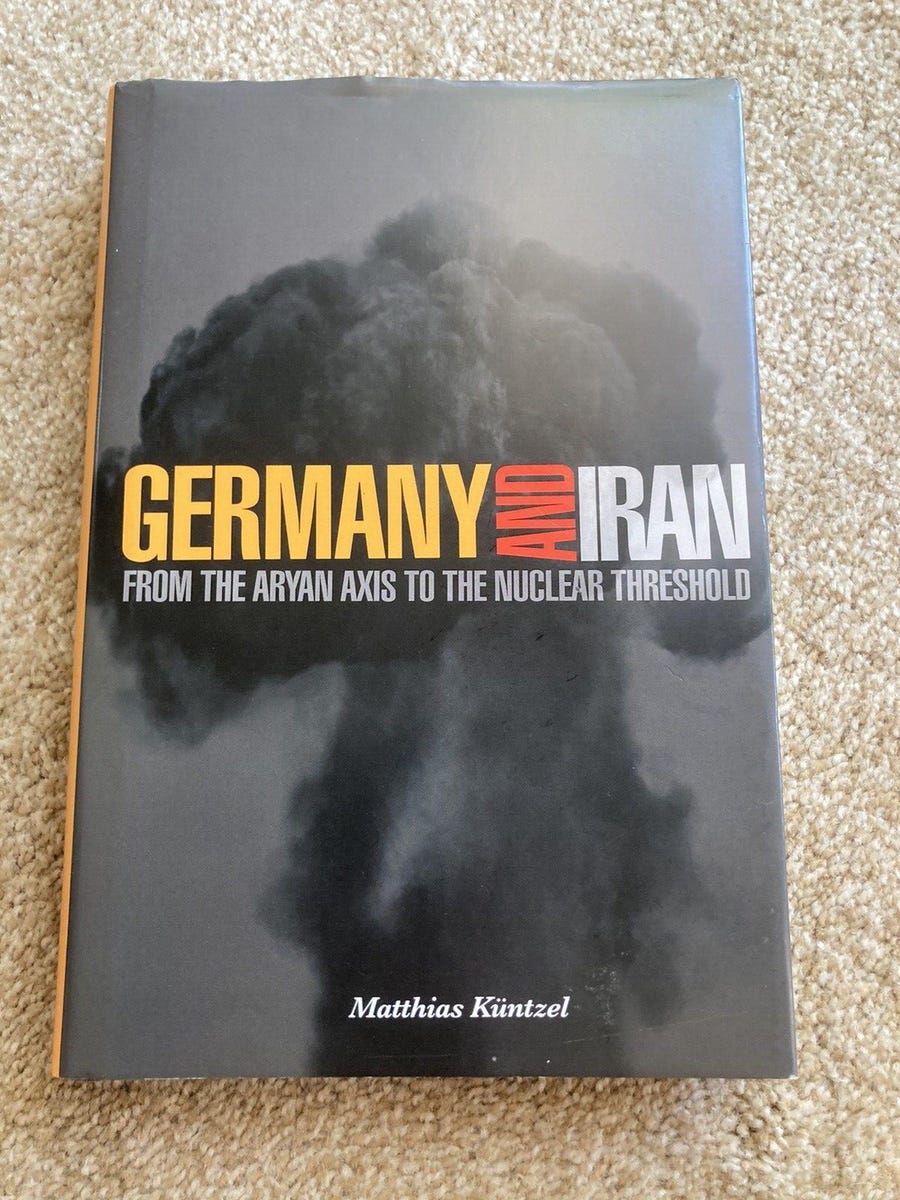
Matthias Küntzel — “Broadcasting as a Weapon: Persian-Language Nazi Propaganda and Its Consequences”
Nature / Humanities and Social Sciences Communications — “The Roots and Evolution of Iranian Nationalism and Its Historiography” (2023)
Cambridge University Press / Iranian Studies — “Self-Orientalization and Dislocation: The Uses and Abuses of the Aryan Discourse in Iran” (2011)
History Today — “Arab Conquests and Sasanian Iran”
Mizan Project — “The Arab Conquests and Sasanian Iran, Part 2”
The Daily Princetonian — “Zia-Ebrahimi Talks Dislocative Nationalism in Iran” (2017)
Israel Academia Monitor — “The 1948 War and the Iranian and Arab Nazi Propaganda” (2023)
Military History Now — “Nazi Agents in Iran: Hitler’s Middle East Spy Ring” (2020)
Jadaliyya — “Reactionary Politics in the Iranian Diaspora and the Crisis of Legitimacy” (2026)
Responsible Statecraft — “Not White Enough: 41 Years of Othering Iranian Americans” (2020)
JSTOR / Iranian Studies — “Iran in the Nazi New Order, 1933-1941”
Wiley / Nations and Nationalism — “Reclaiming Histories: Debunking Aryanism’s Myth in the Middle East” (2026)
HipHiLangSci — “Rethinking the History of the Aryan Paradigm” (2013)
Iran1400.org — “Molding the Language of Nationalism in Three Recent Periods in Iran”
Prallagon Consulting Group — “Iranian Myth of Whiteness” (2025)


