The Last Guardrail
Jerome Powell and the Unmaking of the Independent Fed
On the night of October 22, 1907, J.P. Morgan locked the leading bankers and trust company presidents of New York inside his private library on East 36th Street and refused to let them leave until they had agreed to a collective rescue of the American financial system. The panic had been running for two weeks. The stock exchange had shed nearly half the prior year’s value. Banks were failing across the country. And the single man who stopped it, who manufactured the liquidity, coordinated the commitments, and held the system together through an act of private will, was not a government official, not an elected representative, not a Treasury secretary. He was the richest private banker in the world, operating without legal authority, without democratic accountability, and without any mechanism that would prevent him from doing the same thing in reverse: manufacturing a panic instead of ending one.
That night inside the Morgan Library is where the Federal Reserve begins. Not in 1913 when Woodrow Wilson signed the Federal Reserve Act into law, but in 1907 when the American political class understood, with collective terror, what it meant to have no lender of last resort other than a private man who answered to no one. The legislation that followed, debated for six years and shaped by competing banking interests, regional anxieties, and the progressive politics of the era, was designed to answer one question: how do you create a body powerful enough to rescue the financial system without making it so powerful that it becomes the system’s master?
The answer was independence, and the architects built it into the institution’s bones rather than its bylaws. A central bank whose governors could not be fired by the president. Whose budget could not be defunded by Congress in a single session. Whose monetary decisions would be made on the basis of economic data and price stability rather than the electoral calendar of whoever held the White House. The governors of the Federal Reserve serve fourteen-year terms, staggered so that no single administration can reconstitute the board quickly. The chair serves four-year terms but remains on the board for the remainder of the governor term thereafter. The design encodes a specific answer to the specific dread of 1907: never again should the stability of the global reserve currency rest on the judgment of one man in a library.
Jerome Powell is leaving that institution. What he leaves behind is a different question.
The Federal Reserve’s resistance to political pressure is not a matter of tradition or norms or the personal backbone of whoever chairs it at a given moment. It is built into three distinct structural features that rarely get examined together, and whose simultaneous erosion is what makes the present moment different from previous episodes of presidential frustration with the central bank.
Governor terms run fourteen years, staggered. A president who comes to office inheriting a full board cannot reconstitute it within a single term. Trump entered his second administration in January 2025 with Powell’s chair term expiring in May 2026 and three of seven governor seats already filled by prior appointees. The system was designed for precisely this: an incoming executive constrained by his predecessor’s choices, unable to install a compliant board by appointment alone.
The Federal Open Market Committee’s architecture adds a second layer. The FOMC sets the federal funds rate and consists of the seven governors plus five of the twelve regional Federal Reserve Bank presidents, with four of those five rotating annually. Regional presidents are appointed not by the White House but by their own bank’s boards of directors, subject to Board of Governors approval. They run through a different pipeline entirely, accountable to different constituencies, and cannot be captured even when the board itself is being stacked.
The third layer is statutory. Since the Federal Reserve Reform Act of 1977, the Fed has been legally required to pursue two objectives simultaneously: maximum employment and stable prices. These objectives are in permanent tension, and that tension is deliberate. A president who wants low rates before an election is asking the Fed to tip toward employment at the cost of price stability. The dual mandate gives the chair a legal framework to hold: not personal preference, but statutory obligation. When Powell declined to cut rates despite sustained White House pressure, he was not performing heroic independence. He was doing the job as written.
What the Trump administration has spent two years doing, methodically and with legal counsel, is targeting all three layers at once.
The Department of Justice’s criminal investigation into Powell’s handling of the Federal Reserve’s renovation contracts is not, in any analytical sense, about renovation contracts. The Fed spent approximately two billion dollars renovating its Eccles Building in Washington and its New York branch over several years. The inquiry, opened in late 2025, concerns alleged procurement irregularities. No charges have been filed. No indictment has been issued. What it has produced is a legal cloud that Powell cited as a reason to remain on the board after stepping down as chair, since departing under active investigation would, in his framing, look like flight.
That framing is exactly what the White House needs. By staying as a governor, Powell prevents the board from reaching the clean Warsh majority the administration wants. But by staying under a criminal cloud, he gives the executive a basis to characterize his presence as self-interested rather than institutional. The probe does not need to produce a conviction. It needs to produce the appearance of motive.
The appointment of Stephen Miran as a Fed governor in early 2026 works differently. Miran is an economist who served at Treasury and whose public writings, particularly a widely circulated paper on restructuring the global reserve currency system, signal a willingness to orient the Fed’s decisions toward executive economic strategy. He does not hold a majority. A single governor who argues publicly that rates should be cut regardless of inflation data is not an economic disagreement, though. It is a disruption of the institutional messaging on which the Fed’s credibility depends. In a body where coherence is itself a policy instrument, one voice is enough to introduce doubt.
Scott Bessent, the Treasury secretary, has been the administration’s most sophisticated operator in this campaign. He comes from hedge fund finance and understands the Fed’s role in global dollar markets well enough to apply pressure at exactly the points where the institution is most exposed. His public statement that Powell’s decision to remain “flies in the face of tradition” was not a statement of procedural concern. It was a signal to markets and to Warsh: the administration views Powell’s continued presence as illegitimate, and the incoming chair should behave accordingly.
Kevin Warsh served as a Fed governor from 2006 to 2011, appointed by George W. Bush at thirty-five, the youngest person ever to sit on the board. His tenure ran through the 2008 financial crisis, and that experience shaped a fifteen-year critique of the Fed’s subsequent conduct: the quantitative easing programs, the extended zero-interest-rate environment, the balance sheet expansion he characterized as an incursion into territory belonging properly to the Treasury. His nomination is not a nomination for a conventional monetary economist who will adjust the existing framework at the margins. It is the nomination of a man who has spent a decade and a half arguing that the existing framework is constitutionally improper.
The phrase Warsh has used publicly is a “new inflation framework.” Vagueness is the point. A specified framework generates specific debate and specific opposition from economists whose work lives within the existing one. An unspecified framework generates uncertainty, which in central banking is not a neutral condition.
The Federal Reserve’s effectiveness rests almost entirely on credibility: on markets believing that the FOMC will do what it says it will do, that the two percent inflation target is a commitment the institution will defend at the cost of short-term growth. Alongside that commitment, the Fed has built, since the Greenspan era and more aggressively since Bernanke, an elaborate forward guidance architecture: quarterly press conferences, released meeting minutes, dot plots projecting committee members’ rate expectations, and a sustained public communication network of governor speeches and regional president appearances. This system exists because financial markets price assets on the basis of expectations, not events. If markets believe the Fed will hold rates steady for twelve months, long-term interest rates reflect that belief, which is functionally equivalent to the Fed having held them steady. Forward guidance allows the central bank to shape conditions without moving the policy rate.
Warsh has indicated he wants to pull back significantly on this apparatus. Pulling it back under a framework that has not yet been specified creates a condition where markets cannot price the Fed’s next move. Volatility migrates from the expectation of a rate change to the expectation of the framework itself. When the European Central Bank has sent ambiguous signals about its reaction function, the resulting turbulence in European sovereign debt markets has produced spreads between German and Italian yields that themselves constituted financial stress. The Fed, as the setter of the rate against which every other rate on earth is implicitly benchmarked, cannot absorb that kind of ambiguity. Its uncertainty does not stay inside the building.
Marriner Eccles served as Fed chair from 1934 to 1948, appointed by Franklin Roosevelt and confirmed through the Depression recovery, the Second World War, and the immediate postwar transition. Truman declined to reappoint him as chair in 1948, but Eccles, like Powell today, chose to remain on the board as a governor. The period that followed was one of the most institutionally damaging in the Fed’s history.
During the war, the Fed had entered an agreement with the Treasury to peg the interest rate on government bonds at low levels to finance wartime spending. The peg held the ten-year Treasury at 2.5 percent regardless of inflationary conditions. By the postwar period, with pent-up consumer demand and the beginning of Korean War spending pressing on prices, the Fed’s economists were clear that rate increases were necessary. The Treasury, which needed cheap financing for its growing debt load, blocked any move. Eccles, now a governor rather than a chair, became the institutional voice arguing for separation from Treasury. The conflict became public, fractious, and damaging to both sides.
The resolution came in March 1951 with the Treasury-Fed Accord, which formally ended the wartime peg and restored the Fed’s ability to set rates without reference to the government’s borrowing costs. The Accord established in practice what the Federal Reserve Act had established in law: that monetary and fiscal policy are separate functions conducted by separate institutions with separate mandates.
The signals from Bessent and Warsh about “redrawing the relationship between the Fed and the Treasury” are not signals about communication protocols. They are about the question the 1951 Accord answered: who decides what interest rates are for?
In 2019, Recep Tayyip Erdogan fired Murat Cetinkaya as governor of the Central Bank of the Republic of Turkey because Cetinkaya had declined to cut rates as instructed. Erdogan held an unorthodox theory: that high interest rates cause inflation rather than control it. Over the three years that followed, he appointed and fired three successive central bank governors, each removed for insufficient deference. The Turkish lira lost approximately eighty percent of its value against the dollar between 2019 and 2023. Inflation peaked above eighty-five percent in late 2022. The damage fell on ordinary Turkish households, on workers whose wages were paid in a currency that lost its purchasing power faster than it could be spent.
The comparison is not that the United States is Turkey. The comparison is that the mechanism is the same regardless of the country’s size or the reserve status of its currency. When markets conclude that a central bank’s decisions will be made on the basis of the executive’s political needs rather than economic data, the risk premium attached to that country’s debt rises, the currency weakens, import costs rise, and inflation becomes structurally embedded in a way that requires years of pain to dislodge.
The dollar’s reserve status provides a buffer that the lira never had: there is no alternative that global markets can move into at scale. The euro lacks a sovereign. The renminbi is not fully convertible. Gold is illiquid. This structural privilege has allowed the United States to run deficits that would have collapsed any other currency, to finance wars and tax cuts simultaneously, to export inflation through dollar-denominated commodity pricing. It is real and it is large. It is also underwritten entirely by institutional credibility, by the belief that the central bank managing the dollar will set policy on the basis of the dual mandate rather than the electoral calendar. Remove that belief and reserve status does not end. It begins to erode. The dollar’s share of global central bank reserves has declined from around seventy percent in the early 2000s to around fifty-eight percent today. Slowly enough to seem manageable. Not slowly enough to ignore.
Jerome Powell is not a progressive economist or a liberal institutionalist. He is a Republican lawyer turned private equity investor turned Fed governor turned chair, appointed by Trump in 2017 to replace Janet Yellen, which was itself an act of pique toward a chair the president found insufficiently accommodating. Powell had no academic economics credentials. He was chosen partly for his expected flexibility on financial regulation and partly because he was not Yellen.
He turned out to be someone who had read the institution’s history and absorbed what it was actually for. When Trump called for rate cuts in 2018 and 2019, labeling Powell his “biggest threat” and suggesting Fed officials were a greater enemy than China, Powell held the rate path determined by the FOMC’s reading of economic conditions. When COVID hit in 2020 and required an intervention without precedent, he coordinated with the Treasury because the crisis demanded it, while maintaining the formal distinction between the Fed’s emergency lending facilities and the Treasury’s direct fiscal transfers. When inflation arrived in 2021 and 2022, he was slow to move, a genuine error for which American households paid in sustained price increases. When he did move, he moved at a scale that left no ambiguity about institutional seriousness: eleven rate increases between March 2022 and July 2023, taking the federal funds rate from near zero to 5.25 to 5.5 percent, the highest level since 2001.
That is a record of institutional adherence, not personal heroism. Powell did what the job requires. The fact that doing the job now reads as courage is the diagnosis.
The thirty-trillion-dollar US Treasury market is the risk-free rate for the global economy. Sovereign debt from Colombo to Cairo to Karachi is priced as a spread over US Treasuries. Dollar-denominated loans, IMF programs, World Bank facilities, trade finance instruments: all of it anchored to the rate the Federal Reserve sets. When that rate is set on the basis of economic data and institutional doctrine, the pricing is predictable. When it becomes a function of American political cycles, governments whose debt was calculated in dollars before their current finance minister was born find themselves exposed to volatility they did not create and cannot hedge.
This dimension of the Powell transition is absent from financial press coverage anchored to bond yields and FOMC minutes. Whether Warsh cuts rates faster than the data warrants is a matter of consequence to traders in lower Manhattan. What it means for the sovereign borrowing costs of thirty developing-country governments is a matter of consequence to the people who live in those countries.
There is also the structural question of what Warsh’s proposed restructuring of the Fed-Treasury relationship would mean for the dollar’s reserve role over the long term. If the Fed’s balance sheet decisions begin to be coordinated with Treasury financing needs, the United States returns, in effect, to the pre-1951 arrangement: a central bank managing the rate at which the government borrows rather than the rate at which the economy operates. That arrangement functioned during the Second World War because there was no economic alternative. In 2026, with BRICS currency coordination advancing and central bank reserve managers diversifying at the margin, it carries risks the postwar architects never needed to consider.
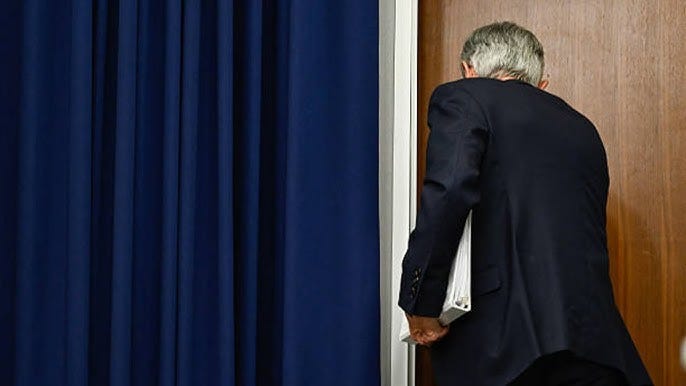
Powell’s final press conference as chair was careful in the way Fed press conferences always are. He would keep a low profile. There is only one chair at a time. He had no intention of becoming a shadow. He said what an institutionalist says at the end of an institutional tenure.
Whether the institution survives the gap between what is said and what is being done will not be answered at the next FOMC meeting. It will be answered slowly, in credit spreads and reserve ratios and the hedging behavior of foreign central banks, attributed to many causes by the time the cause is undeniable. Andrew Jackson killed the Second Bank of the United States. Nixon pressured Arthur Burns and got the 1970s inflation as his legacy. Reagan complained about Paul Volcker, then left him to finish the job. The Fed has absorbed presidential frustration before and emerged intact.
What is different now is not the frustration. It is the systematic targeting of the specific mechanisms through which the institution generates its own resistance: the appointment structure, the legal insulation, the communications architecture, the formal separation from Treasury. These are not being tested simultaneously by accident.


