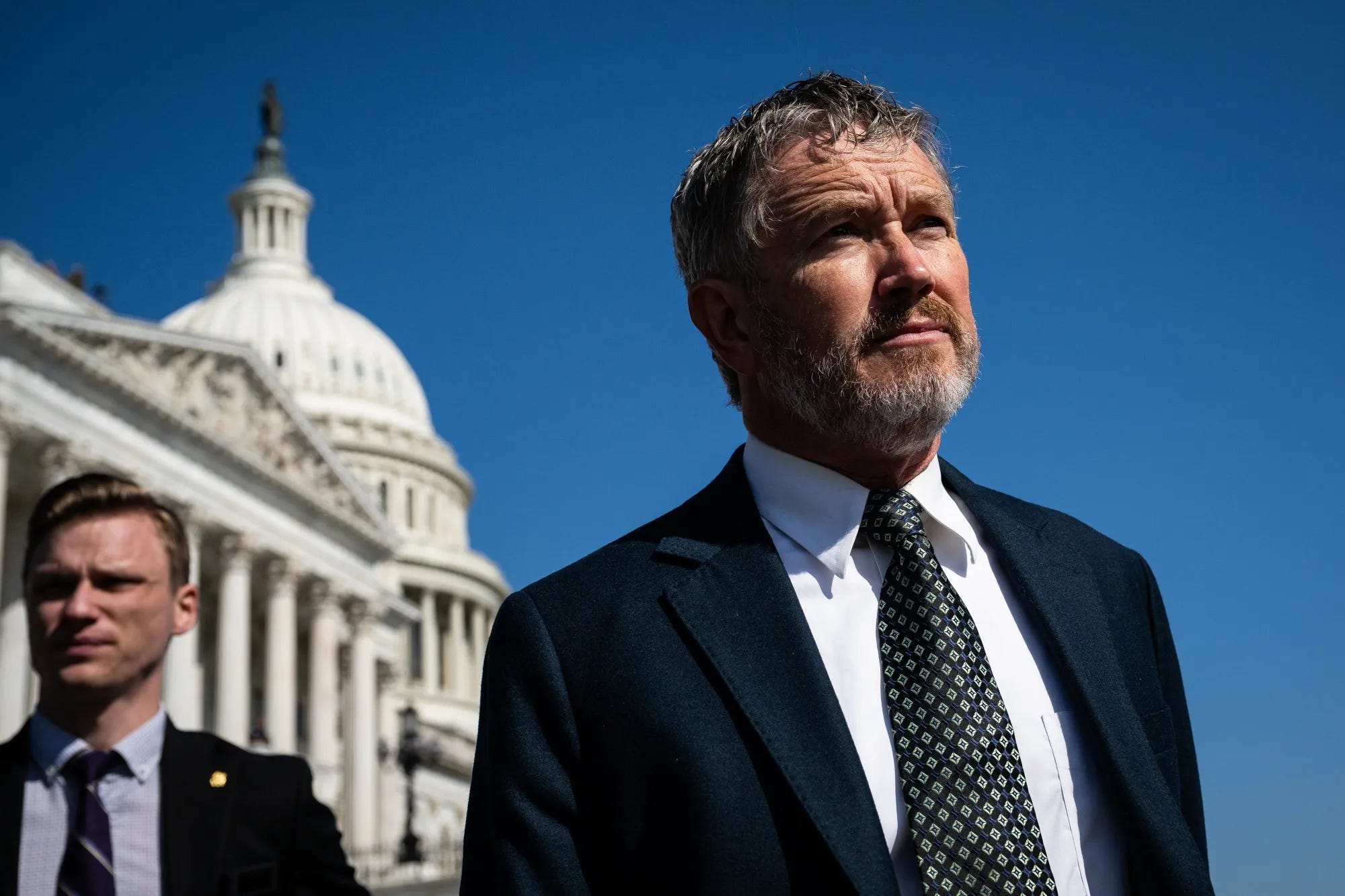
The Last “No” in a City of Yes
Thomas Massie’s Lonely Fight Against War, Surveillance, and the Quiet Expansion of American Power
Thomas Massie has built a career out of refusing to nod along. The Republican congressman from Kentucky’s 4th District has become a stubborn anomaly in Washington: a libertarian‑leaning engineer who votes against wars, surveillance, sanctions, and emergency mega‑bills even when his own party demands unity. In an era when the United States projects power across the globe and deep into its own citizens’ lives, his lonely “no” votes have turned him into a kind of institutional heretic, one of the few voices inside Congress questioning whether American power is still anchored in concern for actual people rather than in abstractions and slogans.
He is not an obvious hero. His hostility to federal regulation runs so deep that he opposes many social and environmental protections his critics view as essential. He is a staunch defender of expansive gun rights, and his skepticism of sanctions and human‑rights resolutions on China, Russia, and other adversaries has earned him charges of indifference to abuses abroad. But when you step back and look at his record as a whole, it raises an uncomfortable question: if a lawmaker who relentlessly challenges both war powers and warrantless spying is treated as a crank in the House of Representatives, what does that say about the moral horizons of American politics today?
Massie’s instinct for dissent makes more sense when you look at where he came from. Born in 1971 in Huntington, West Virginia, he grew up in rural Lewis County, Kentucky, in a landscape of small towns, back roads, and people who tend to fix their own problems rather than call a distant authority. His family still lives on a farm he designed to be largely self‑sufficient, with solar power and practical, home‑built solutions instead of contractors and consultants. That way of life, close to the land and far from federal office buildings, imprints a certain suspicion of centralized expertise and distant decision‑makers.
His path to Congress did not run through the usual pipeline of law schools, Capitol Hill staff jobs, and party committees. Instead, he went to the Massachusetts Institute of Technology, where he studied engineering, earned advanced degrees, and co‑founded a company that developed force‑feedback technology used in virtual reality and gaming. He learned to think in terms of systems, failure points, and unintended consequences. After selling that company, he went back to Lewis County and entered local politics, winning election as county judge‑executive in 2010. Only in 2012 did he make the jump to national office, winning a special election to represent Kentucky’s 4th District, a safe Republican seat running from the Cincinnati suburbs down through Appalachian counties.
That unusual biography matters because it shapes the way he sees the institution he works in. Massie approaches legislation like an engineer confronted with a dangerous machine. He wants to know what each lever does, who controls it, what happens when it breaks. Thick omnibus bills assembled in back rooms and dropped on members’ desks hours before a vote offend his sense of basic design. So do open‑ended authorizations for the use of military force that give presidents a standing permission slip to send troops into harm’s way nearly anywhere on earth. Where many of his colleagues treat complexity as a feature that allows hard choices to be buried and spun later, Massie treats complexity as a warning sign that power is being exercised without real understanding or accountability.
Nothing captures his insistence on accountability more vividly than his most controversial stand during the early days of the Covid‑19 pandemic. In March 2020, as fear and uncertainty swept the country, congressional leaders put together the CARES Act, a rescue package that ultimately totaled around two trillion dollars in spending and guarantees. It was one of the largest and most consequential pieces of economic legislation in modern American history. Yet the House planned to pass it by voice vote, with no names recorded. Members would not have to say publicly whether they supported or opposed the bill. The country would get the policy, but not the roll call.
Massie was appalled. From his home in northeastern Kentucky, he got in his car and drove to Washington, determined to force a recorded vote. He argued that if lawmakers were going to spend that amount of money, reshape the economy, and set precedents for emergency action, they should at least have to show up and press “yes,” “no,” or “present” in full view of the public. He invoked the oath he had taken to uphold the Constitution and insisted that the basic rituals of representative government could not simply be suspended in a moment of panic.
The response from his own party and from Democrats was swift and brutal. President Donald Trump blasted him publicly and suggested he should be kicked out of the Republican Party. Party leaders scrambled to bring members back to Washington in order to establish a quorum and defeat his attempt to force the House to go on the record. Many colleagues accused him of risking their health and grandstanding while people were suffering. In the end, the bill went through as leaders intended, and Massie’s effort failed in procedural terms.
Yet the episode revealed something deeper about his role. At a time when almost everyone in power agreed that emergency action was necessary, he was one of the only people in the room questioning whether emergency action had to mean abandoning transparency and individual responsibility. For his critics, that attitude bordered on fanaticism about process in the middle of a crisis. For his supporters, it was a rare example of someone in Congress remembering that process is how citizens keep a grip on their government, especially when stakes are high and emotions are running hot.
Massie’s skepticism about emergency decision‑making at home has a parallel in his long‑running mistrust of open‑ended war abroad. Since his earliest days in Washington, he has been one of the most consistent Republican critics of perpetual intervention and the legal tools that enable it. He has pressed for Congress to revisit and repeal the broad war authorizations passed in the aftermath of the September 11 attacks, arguing that they have been stretched far beyond their original purpose to justify operations against new enemies in new places, often years after the original votes. He has supported measures that would have forced Congress either to authorize ongoing wars explicitly or to bring U.S. troops home rather than allow military action to drift on autopilot.
He has also backed attempts to rein in unauthorized military involvement in conflicts in places like Syria and Yemen, and he has joined with a small, uneasy coalition of libertarian Republicans and progressive Democrats to push war powers resolutions aimed at limiting the executive branch’s ability to deploy forces without clear congressional permission. These efforts are usually brushed aside by party leaders as distractions from the real work of “supporting the troops” and “standing with allies,” but they highlight a simple principle that Massie returns to again and again: if a country is going to send its citizens into combat, that decision should not hide behind vague language and old statutes. It ought to be debated openly and voted on in real time.
On sanctions and human‑rights legislation, Massie often stands even more alone. In the Washington of the last decade, sanctions have become a favorite tool of both parties, a way to look tough on foreign dictators and speak the language of human rights without committing troops. Votes to add new sanctions on adversaries like Iran, Russia, North Korea, or the Chinese government over abuses in Xinjiang and Hong Kong typically attract overwhelming bipartisan majorities. No one wants to be the single lawmaker who voted against “human rights.”
Massie has sometimes been exactly that lawmaker. He was the only member of the House to oppose a high‑profile bill tied to Hong Kong’s autonomy, and one of the very few to vote against legislation targeting Chinese officials over the treatment of Uyghur Muslims. He has also resisted other sweeping sanctions packages, including those aimed at countries already under heavy pressure. His reasoning, which he has tried to explain in interviews and public statements, rests on two points. First, broad economic sanctions often do their worst damage to ordinary people rather than to the officials who actually make policy. Second, the United States is not an all‑knowing referee of global morality, and it risks sliding from concern for human rights into a kind of moralized bullying that can easily slip into confrontation or even war.
That stance has brought him scorn not only in Washington but also from activists abroad who see these measures as some of the few tools available against authoritarian regimes. For them, his abstract commitment to non‑interference looks like a refusal to take sides in a struggle where neutrality is a luxury. For Massie, the calculation cuts the other way: he sees the human cost of sanctions and the risk of escalation as reasons to tread lightly, even when the abuses on the other side are real. It is a bleak and unsatisfying position, especially in an age of graphic atrocities, but it is internally consistent with his broader suspicion of concentrated power.
At home, his record on civil liberties fits the same pattern. In the years after Edward Snowden revealed the scope of National Security Agency surveillance, Massie emerged as one of the Republicans most willing to confront the intelligence establishment. He co‑sponsored amendments to cut off funding for bulk collection of Americans’ phone records, invoked the founding generation’s hatred of “general warrants” that allowed indiscriminate searches, and pushed to tighten up oversight of surveillance programs that blurred the line between foreign intelligence and domestic spying. He has argued in public that Snowden performed a genuine service to the country by forcing a debate that the political class had hoped to avoid.
More recently, he has been a central figure in fights over how far programs that were supposed to target foreigners can be used to sweep up and search the communications of people inside the United States. While many in both parties treat the technical details of such programs as an obscure and secondary matter, he has tried to translate the stakes into plain language: the more information the government gathers and stores “just in case,” the stronger the temptation to rummage through it later without a warrant, whether in the name of national security, political advantage, or something in between.
It would be easy to stop here and paint Massie as a straightforward defender of liberty and humanity, the lone man standing against an imperial consensus. But that would not be honest, and it would not do justice to the contradictions inside his politics. On guns, for example, he takes one of the hardest lines in Congress. He has championed efforts to repeal the federal Gun‑Free School Zones Act and opposed most new restrictions on firearms, positions that many Americans see as impossible to reconcile with basic concern for safety in schools and public spaces. On economic and regulatory questions, he is almost always on the side of cutting federal spending, reducing the government’s role, and loosening rules on business. Environmentalists, labor advocates, and supporters of a more generous safety net see that as the opposite of humane.
This tension runs through every attempt to place him on a simple moral map. On one hand, he is one of the only Republicans who has consistently resisted war, sanctions, and surveillance. On the other hand, his distrust of the federal government also leads him to dismiss many of the tools that other people consider essential to protecting the vulnerable at home, from environmental rules to worker protections. Put differently, he is deeply concerned about what the state can do to people, less convinced about what it can do for them.
That is precisely what makes him so difficult to absorb into the usual partisan narratives. Democrats who might quietly appreciate his views on civil liberties or foreign policy find his economic and social positions hard to stomach. Republicans who appreciate his votes for lower taxes and fewer regulations bristle at his unwillingness to fall in line on national security and foreign affairs. He is a misfit in a system that rewards loyalty to team first and independent judgment later, if at all.
Looking at Massie’s career through the lens of empire and humanity is ultimately less about celebrating him and more about holding up a mirror to the broader political culture. His presence in Congress forces a series of questions that go beyond one man’s voting record. Why is it so rare for members of either party to oppose not just particular wars, but the structure that makes endless war easy? Why are sanctions treated as a default, almost painless response to outrage elsewhere, when their real‑world effects are so uneven and unpredictable? Why is it considered radical, even reckless, to insist on recorded votes, open debates, and strict warrants for spying on citizens?
Every time Massie objects to a rushed emergency bill, demands that Congress debate sending troops into harm’s way, or resists giving intelligence agencies an even longer leash, he exposes the degree to which much of Washington has become comfortable with shortcuts. Those shortcuts may feel efficient in the moment, especially when there is fear in the air and public opinion demands action. But they also erode habits of accountability that are supposed to separate a republic from an empire that merely consults itself.
In the end, you do not have to agree with Thomas Massie about guns, about environmental rules, or even about every foreign policy vote to see the value in the questions he keeps raising. His lonely positions reveal how narrow the acceptable boundaries of dissent have become, especially on issues of war, surveillance, and the projection of power. When one of the few lawmakers consistently voting against those forces is treated as a nuisance to be managed or a crank to be mocked, it suggests that the real extremism may lie in a political culture that can no longer imagine serious limits on itself.
That is what makes his story worth telling in full. It is not the tale of a flawless champion of humanity but of a stubborn, often contradictory figure whose presence exposes a deeper truth about American politics. The country has grown used to the idea that it can police the world, watch everyone, and move staggering sums of money in moments of crisis without much in the way of restraint. Massie, in his sharp and sometimes exasperating way, keeps asking whether a system like that can still claim to be accountable to the people it governs. Whether readers end up agreeing with him or not, confronting that question is at least a step back toward treating politics as something more than a contest of teams and talking points, and toward seeing again the human beings who live under the shadow of those decisions.


