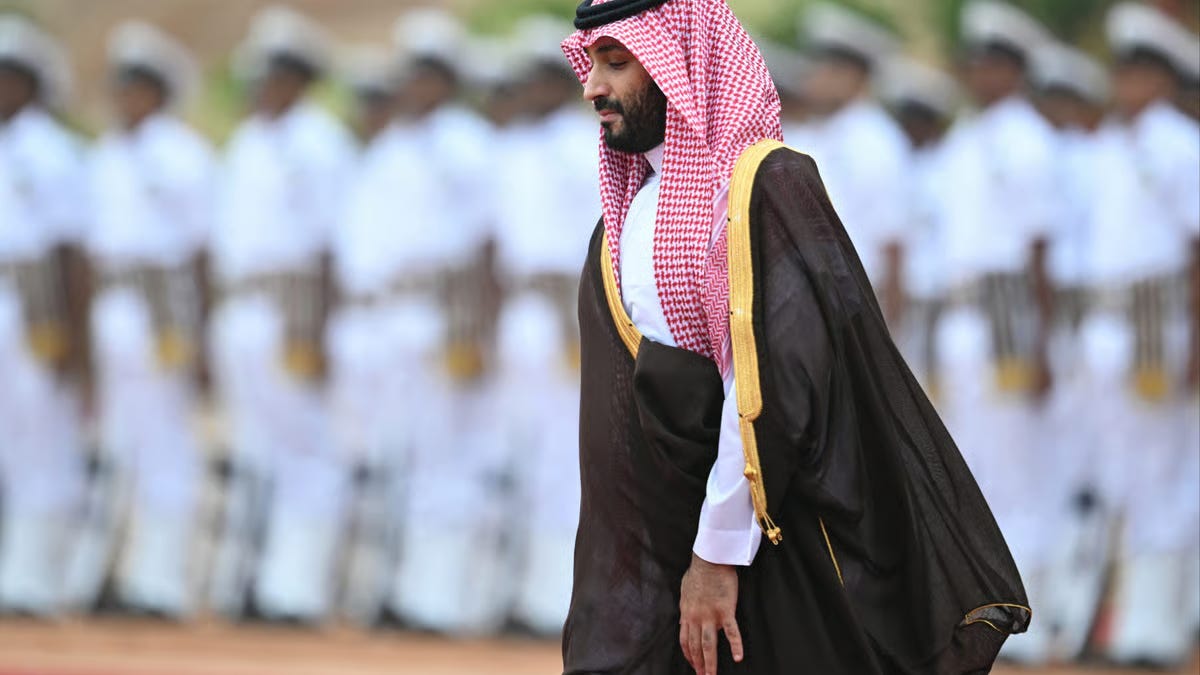
The Last Prince
Mohammed bin Salman sees the wreckage of Iran as an inheritance. Whether Washington lets him collect it is the question the war has not yet answered.
On the morning of March 2, video of black smoke rising from Ras Tanura circulated before the Saudi defence ministry had issued a word. Two Iranian drones, the ministry confirmed hours later. Debris had ignited a fire. The refinery shut down. Five hundred and fifty thousand barrels a day, gone. The Aramco complex that sits at the centre of the kingdom’s economic future, not as a legacy oil facility but as the proof that oil revenue could fund its own replacement, went quiet at dawn, during Ramadan, while its de facto owner was on the phone to Washington pressing the Americans to keep going.
Ramadan is not an incidental detail. That the war began in Islam’s holiest month, that Iranian drones struck Saudi territory while Muslims across the world fasted and prayed, that the custodians of Mecca and Medina were simultaneously conducting secret diplomacy with the architects of a war on a Muslim nation: none of this is lost on the billion and a half people watching from outside the cockpit. Mohammed bin Salman is not only a crown prince with geopolitical ambitions. He is, by the title his family has carried since King Fahd formalised it in 1986, Khadim al-Haramayn: Servant of the Two Holy Mosques. That title is not decorative. It is the foundational claim of Saudi legitimacy in the Muslim world, the argument that the House of Saud speaks not only for a nation but for a civilisation. Everything MBS is doing in this war sits inside that claim, both strengthening it and placing it in the gravest jeopardy it has faced in a generation.
The schism that produced this war is fourteen centuries old. When the Prophet Muhammad ﷺ died in 632 CE, the question of succession split the Muslim community along a fault line that has never fully closed. The majority, who became the Sunnis, accepted Abu Bakr (R.A.) as caliph on the basis of communal consensus. The minority, who became the Shia, insisted that legitimate authority passed through divine appointment, specifically through the Prophet’s cousin and son-in-law Ali ibn Abi Talib (R.A.) and his descendants. The disagreement was initially political. It became theological at Karbala in 680 CE, where Ali’s son Husayn ibn Ali (R.A.) and his small band were massacred by the forces of the Umayyad caliph Yazid. That massacre did not only create martyrs. It created a founding trauma, an eschatology, and a theology of sacred suffering that has shaped Shia political identity ever since.
In Twelver Shia Islam, the dominant branch, legitimacy flows through twelve imams from the Prophet’s lineage. The twelfth, Muhammad al-Mahdi, entered occultation in 874 CE. He did not die, according to this doctrine; he was divinely concealed and remains alive, hidden, governing the faithful from a position of sacred absence, and will return at the end of days to fill the earth with justice as it is now filled with oppression. Until that return, the Velayat-e-Faqih, the Guardianship of the Jurist, governs in his name. This is not simply a theological position. When Khomeini institutionalised it in 1979 as the constitutional basis of the Islamic Republic, he made it a political weapon. The Supreme Leader of Iran governs not as a head of state in any ordinary sense but as the steward of the Hidden Imam’s authority. Every Saudi king, every Sunni monarch, every Arab government that derives its legitimacy from hereditary rule or popular consent rather than from the Imam’s bloodline is, within this framework, structurally illegitimate. The revolution Khomeini launched was not against a government. It was against a principle of governance, the one on which Saudi Arabia rests.
Khomeini made this explicit. In a 1987 public address, after Iranian pilgrims used the Hajj to spread revolutionary politics and Saudi security forces killed more than four hundred of them in Mecca, he declared that “these vile and ungodly Wahhabis are like daggers which have always pierced the heart of the Muslims from the back” and announced that Mecca was in the hands of “a band of heretics.” The diplomatic rupture that followed lasted four years. But the theological rupture it expressed had been building since 632 CE and had no resolution date.
Saudi Arabia’s response to the Khomeini revolution was a Sahwa, an Islamic Awakening, a domestic religious intensification designed to prove that Riyadh, not Tehran, held the authentic Islamic mandate. Wahhabism, the puritan Sunni doctrine that Saudi Arabia had been exporting since the kingdom’s founding compact with Muhammad ibn Abd al-Wahhab in the eighteenth century, was now accelerated as a counter-insurgency against Shia influence. Mosques, madrassas, and religious literature funded by Riyadh proliferated across the Muslim world, from South Asia to sub-Saharan Africa to Southeast Asia. The message was structural: the custodians of Mecca and Medina, the birthplace of the Prophet ﷺ, the hosts of the Hajj that every Muslim is obligated to perform at least once in a lifetime, hold a legitimacy that no revolutionary council in Tehran can match. Islam’s geography was in Saudi hands. The argument was meant to end the conversation.
It did not end it. What it produced instead was a forty-year sectarian bidding war, fought in proxy form in Yemen, Syria, Lebanon, Iraq, and Bahrain, with each side translating theological competition into militia architecture and each militia translating back into theology for recruitment. The Iranians framed every conflict as a re-enactment of Karbala: the righteous few against the Yazid-backed oppressor. The Saudis framed every conflict as a defence of Sunni orthodoxy against Shia expansionism masquerading as pan-Islamic solidarity. Civilians on both sides, in countries that had no part in designing either eschatology, paid the cost.
Mohammed bin Salman’s contribution to this history is that he tried to exit it, and in doing so created the conditions for its most violent chapter yet.
When MBS consolidated power in the years after 2017, he did something Saudi rulers had not attempted since before the 1979 revolution: he dismantled the domestic Sahwa. The religious police lost their powers. Cinemas opened. Women drove. The Wahhabi clerical establishment, which had been the Sahwa’s institutional spine, was brought firmly to heel; senior scholars who objected were imprisoned. The shift from sectarian to nationalist framing that scholars of the region began documenting in this period was real. MBS did not want to lead a Sunni Islamic revival. He wanted to lead a Saudi modernisation project, and the Wahhabi clergy were in the way of the investors, the tourists, and the sovereign wealth fund. He understood something his predecessors had not fully absorbed: that sectarian identity, useful as a mobilising tool, was toxic to foreign capital. You cannot build a $500 billion futuristic city in the desert while your state religion declares a third of the world’s Muslims heretics.
And so he abandoned the sectarian bidding war at the exact moment he was setting up the conditions to win it.
The 2023 détente with Iran, brokered by China in Beijing, was widely read as MBS choosing pragmatism over ideology. He adopted language of Islamic solidarity. He negotiated Hajj arrangements for Iranian pilgrims with something approaching warmth. He said, in a 2021 interview, that “all what we strive for is to have a good relationship with them.” This was presented, and partly accepted, as genuine strategic transformation. Saudi Arabia no longer needed Iran as an enemy because Saudi Arabia no longer needed sectarianism as a governing logic.
That reading missed the deeper calculation. MBS didn’t abandon the contest with Iran. He depersonalised it. The question was never, for him, whether Sunni or Shia Islam held theological primacy. That argument was a tool, deployed by his predecessors when they had no other instrument. What MBS understood is that the real prize is not doctrinal legitimacy but structural dominance: control of the regional order, the energy architecture, the financial flows, and the political narratives that govern the Muslim world. Iran, under the Velayat-e-Faqih, was the only other claimant to that kind of structuring power. The détente did not remove Iran from the competition. It put the competition on hold while both sides caught their breath.
By January 2026, Iran was losing breath. The largest protests since the revolution had killed thousands inside the country. The IRGC’s proxy architecture, the instrument through which Iran had manufactured geography for four decades, lay in ruins: Hezbollah dismantled in Lebanon, the Houthis battered in Yemen, the Syrian corridor severed after Assad’s fall, Hamas degraded beyond operational coherence. Israeli strikes in June 2025 had stripped most of Iran’s air defences. The Supreme Leader who had called the Saudis heretics was isolated, his outer walls gone. The nuclear talks in Geneva were producing the language of agreement.
Three days after Araghchi said a “historic” deal was within reach, the bombs fell.
What the IRGC’s Mahdist ideology makes of this moment is worth understanding, not to endorse it but because it is the theological register in which millions of people are interpreting these events. Khomeini had designated Iran the “Vanguard of the Mahdi,” the state whose sacred mission was to hasten the return of the Hidden Imam by confronting injustice wherever it manifested. The IRGC institutionalised this: internal training programmes framed recruits as soldiers of the Mahdi’s army-in-waiting. A 2022 Middle East Institute study documented how destruction of Israel had been framed within the Guard not only as a geopolitical objective but as a religious obligation tied to eschatological expectation, a precondition for the return of the Twelfth Imam. Chaos, within this framework, is not a failure state. It is a sacred prelude. The end-times narrative holds that before the Mahdi appears, the earth must be filled with the very tyranny and injustice he comes to overturn. War is not a problem to be managed; it is a sign to be read.
Khamenei is dead. The IRGC leadership that trained on these texts now operates in the ruins of the institutional structure that contained them. What the post-Khamenei succession produces inside Iran’s theological-political establishment is, at this writing, unresolved. What is not unresolved is the effect of the war on the Muslim world’s perception of who struck whom. Iranian drones have hit the Gulf states that host American bases. Hundreds of Iranian missiles have fallen across the region. Tehran’s war doctrine, as it has always done, treats Gulf infrastructure as a pressure point against Washington, and the Gulf states as collateral in a confrontation not of their choosing. That arithmetic is real. But it does not change what hundreds of millions of Muslims outside the Gulf see when they look at the images: an Islamic republic bombed, its leadership killed, its territory invaded, during Ramadan, with the private encouragement of the man who holds the keys to the holiest sites in Islam.
MBS has positioned his public response with considerable care. He condemned the attack. He called Tehran. He maintained the détente’s language even as the détente’s infrastructure was being bombed. He has issued no fatwa, made no religious pronouncement, deployed no sectarian framing. This is not an accident. A Saudi king who frames this war as a Sunni victory over Shia power immediately inherits every consequence of that framing: the fury of Shia communities across Iraq, Bahrain, Lebanon, Pakistan, and eastern Saudi Arabia itself, where the kingdom’s own Shia minority lives. He also inherits the verdict of the broader Muslim world, which does not divide cleanly along Sunni-Shia lines on the question of whether an Islamic state should be bombed with American aircraft during the holy month.
The silence on sectarianism is strategically necessary. It is also dishonest in the precise way that all strategic silences are dishonest: it allows MBS to benefit from the outcome of a sectarian confrontation he helped engineer while maintaining the posture of a man above sectarian politics.
What he wants to inherit is not the Sunni mantle. He wants something larger and, for that reason, more fragile: the position of the indispensable Muslim statesman in the post-war regional order. If Iran’s revolutionary model is broken, its proxy architecture gone, its theological counter-claim to Saudi legitimacy dismantled at the level of state power, then the Khadim al-Haramayn becomes not only the custodian of Islam’s geography but the de facto organising authority of the Muslim world’s political life. No caliph exists to claim that role formally. Turkey’s Erdogan has made a version of the same bid and found its limits. No other Sunni state has the financial architecture, the institutional weight, or the proximity to Washington and Beijing simultaneously that Saudi Arabia currently holds. With Iran removed from the equation, the field clears.
This is the monopoly MBS is constructing. Not a religious monopoly in the doctrinal sense, since he has been deliberately devaluing Saudi Arabia’s Wahhabi credentials to make the kingdom safe for capital. A political monopoly: the position of the single power capable of organising the Muslim world’s relationship to the global order on terms it did not design.
The calculation is coherent. It is also, as the Ras Tanura smoke made visible on the morning of March 2, destructive of the conditions it requires to function. Vision 2030 needs $840 billion in investment. It needs the region to be investable. Hotel bookings in the kingdom fell forty-five percent in the first two weeks of March. Foreign direct investment is projected to drop sixty to seventy percent in the first quarter of this year against the same period last year. The American companies that sent technical expertise to Riyadh to build the knowledge pillars of Vision 2030 are pulling their people out; more than five thousand gone or leaving. The war MBS helped arrange is consuming the peace he needed to build with.
He may have calculated this as temporary disruption against permanent structural gain. An Iran reduced to irrelevance, its proxy networks gone, its nuclear ambition destroyed, its Velayat-e-Faqih model discredited by military defeat, cannot threaten Vision 2030 in 2030, in 2035, or in 2040. Short-term damage in exchange for long-term dominance. The same logic produced the Yemen intervention in 2015. That intervention lasted nine years, killed hundreds of thousands of people, and produced nothing it promised.
But there is an older trap in this logic, one the eschatological tradition understood long before modern strategists did. Both Sunni and Shia frameworks contain a warning about rulers who mistake their own ambitions for divine order. Iqbal, who spent his life diagnosing the failures of Muslim political leadership, wrote that the greatest danger to the Muslim world was not the external enemy but the ruler who used faith as a mirror for his own reflection. The tradition from which MBS has been carefully distancing himself, the very Wahhabi theology he has been defanging to attract investors, contains within it a judgment on exactly this kind of calculation: the king who serves Mecca for the sake of the throne rather than the throne for the sake of Mecca.
That judgment has no enforcement mechanism in Riyadh. But it has one in the street, in the mosque, and in the political consciousness of a Muslim world watching carefully.
The harder problem is that the post-war order MBS is positioning to lead may not be his to design. Benjamin Netanyahu, as Iranian strikes were still falling across the Gulf, held a press conference and announced that the solution to the Strait of Hormuz closure was for Arab Gulf monarchs to build new pipelines through the desert to Israel. The proposal was dressed as regional integration logic. What it describes is a veto: if Gulf oil exports run through Israeli territory, Israel controls the tap. The man who holds the keys to Mecca would find himself dependent on the permission of Jerusalem for his economic survival. Netanyahu was not offering a partnership. He was advertising the terms of the new order his government intends to build on Iran’s wreckage.
MBS has not responded publicly to the pipeline proposal. The Trump administration’s stated aims, seizing Iranian energy infrastructure, forcing regime change, extracting oil, carry an architecture that leaves no room for Saudi Arabia as anything other than a facilitating client. The crown prince who lobbied for the war to create a vacancy at the centre of the regional order may discover that Washington and Tel Aviv have already furnished the room.
And the Muslim world, which is not a monolith but which shares certain memories, will have watched it all: Ramadan, the bombs, the silence from Riyadh, the American bases opened, the private calls to keep going. Khomeini was wrong about most things. He was not wrong that the custodian of Mecca could be found serving interests other than Islam’s. He said it in 1987, when he called the House of Saud heretics. The charge was intemperate and sectarian and designed to destabilise a rival. It was also the kind of accusation that, once made, waits patiently for evidence.
The man who called Khamenei “Hitler,” then brokered a détente with his government, then worked privately to ensure that government’s destruction, who condemned genocide in Gaza and lobbied for the bombing of Tehran, who wants to lead the Muslim world’s post-war reconstruction while opening air bases for the power doing the bombing: none of these positions contradict each other for a ruler who treats every arrangement as provisional and every principle as an instrument. The question is not whether MBS is consistent. It is whether the order he is building can survive the partners he chose to build it with, and whether the billion and a half people whose holy cities he holds in trust will read the ledger the same way he does.


