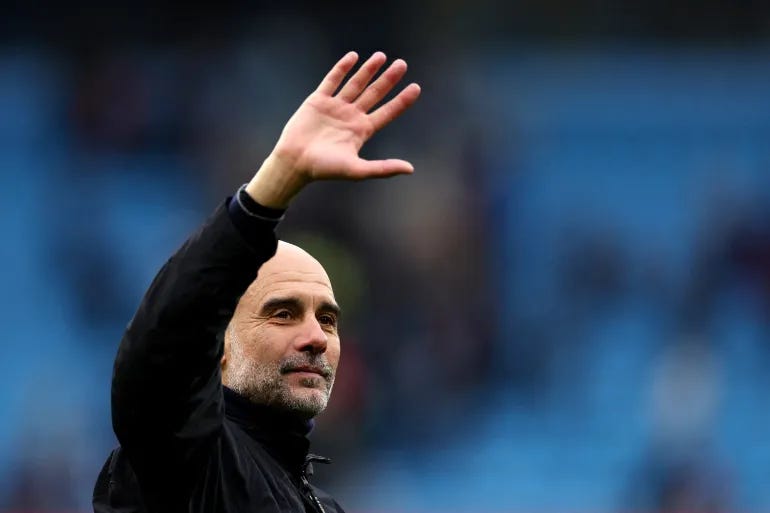
On the evening of January 29, 2026, in a sports arena in Barcelona usually given over to basketball and rock concerts, Pep Guardiola walked onto a stage in front of 12,000 people wearing a black-and-white keffiyeh around his neck. He had missed a Manchester City press conference to be there. He had flown from England to stand before a crowd gathered under the banner of Act x Palestine, a fundraiser for humanitarian aid and cultural projects in Gaza and the West Bank. When the microphone was placed in front of him, he did not speak about football.
“The bombs want to provoke silences,” he said. “To make us look away, to stop us from taking a step forward. That is why we must get involved, not look the other way.” Then he spoke about the children. “I think about what passes through the mind of a child who records himself asking where his mother is, trapped under the rubble, even though he doesn’t know it yet. We have left them alone and abandoned them.”
Five days later, back in Manchester for a pre-match press conference before a League Cup fixture against Tottenham Hotspur, a reporter gave him an opening. He took it without hesitation.
“Never, ever in the history of humanity have we had the information in front of our eyes watching more clearly than now,” Guardiola said. “The genocide in Palestine, what happened in Ukraine, what happened in Russia, what happened all around the world, in Sudan, everywhere. What happened in front of us? Do you want to see it? It’s our problems as human beings. It’s our problems. To completely kill thousands of innocent people, it hurts me. It’s no more complicated than that.”
He used the word genocide in a Premier League press room, without the professional caveats that protect careers in English football, without the studied diplomatic ambiguity the game’s institutions had spent two years perfecting as a substitute for moral engagement. He said it again and again across months, in Barcelona and Manchester alike, until it ceased to be a controversy and became a record.
On May 22, 2026, Pep Guardiola left Manchester City after ten years in charge. He is the most decorated manager in the history of English club football. He is also the only Premier League manager of the Gaza years who said, publicly and without retreat, that what was happening to the Palestinian people was a genocide. The voice he sustained for two and a half years leaves with him. Nobody is lined up to replace it.
In November 2025, speaking to Catalan radio station RAC1 ahead of a charity match between Palestine and Catalonia at the Estadi Olímpic Lluís Companys, a game for which over 27,000 tickets were sold, Guardiola gave the most complete statement any figure in English football management had made about Gaza. He opened with the occasion itself. “It is more than a symbolic match. These days, everyone knows everything, and with this game, the Palestinians will see that there’s a part of the world that cares about them.” Then he turned to what caring actually required. “The world has abandoned Palestine. We have done absolutely nothing. They are not to blame for having been born there. We have all allowed an entire people to be destroyed. The damage is done and it is irreparable. I cannot imagine a single person in this world who could defend the massacres in Gaza. Our children could be there and be killed simply for being born. I have very little faith in world leaders. They will do anything to stay in power.”
He offered no diplomatic exits. He located responsibility in the killing itself and in the silence that surrounded it, and he named both without distinguishing between them in terms of culpability. He had been saying versions of this since October 2023, when he first described images of Palestinian children as leaving him deeply troubled. What shifted across two years was not the substance of his position but the legal precision of the language: genocide, stated plainly, to audiences that included press rooms built for questions about team selection.
The Jewish Representative Council of Greater Manchester and Region responded to his Barcelona speech and the Tottenham press conference by calling on him to “focus on football” and “be more careful with his future language,” citing fears about antisemitic incidents and accusing him of failing to use his platform for solidarity with Manchester’s Jewish community following a terrorist attack nearby. He did not adjust. Less than a week after the Council’s statement, he stood in front of English journalists and said the genocide in Palestine was “our problem as human beings” and that he would continue to speak. “Symbolism helps raise awareness,” he had told the Barcelona crowd, “but there must be a driving force behind it.” He understood himself to be that force, and he acted accordingly, across multiple countries, in multiple languages, until the last day of his tenure.
The demand to “focus on football” is worth examining on its own terms. It is the standard instruction issued to any sporting figure who speaks about Palestine: to Roger Federer when he was asked to address ATP sponsorship by an Israeli state tourism board in 2018, to Marcus Rashford’s critics when he moved beyond domestic poverty into foreign policy territory, to every Muslim player who has worn a keffiyeh in public or raised a hand in solidarity at a post-match interview. The instruction is not politically neutral. It enforces a silence that benefits one party to the conflict, insulates the Premier League’s commercial relationships from reputational pressure, and tells the most watched sporting competition on earth that 71,000 dead do not constitute a legitimate subject for a pre-match press conference. Guardiola’s refusal to comply was not a rogue act. It was the minimum that honesty required.
The record is unambiguous and unretracted. What demands explanation is why it belongs to one man.
The Premier League is the most commercially powerful football competition on earth. It generates revenues exceeding £10 billion per season, broadcasts in 200 countries, and claims a global audience of up to two billion people. Twenty clubs, hundreds of managers, coaches, executives, and sporting directors, thousands of registered players, many of them Muslim, many of them from countries where the images from Gaza were not abstract geopolitical events but personal grief: the institutional response across the period between October 2023 and May 2026 was functionally nothing.
The October 2023 Premier League statement condemned “the horrific and brutal acts of violence against innocent civilians” in language calibrated primarily to the Hamas attack on Israel. It arranged armband ceremonies. It observed moments of silence. Then it went quiet and stayed quiet through a campaign that, by the time Guardiola left English football, had killed more than 71,000 Palestinians and wounded more than 171,000 according to Gaza’s health ministry figures. More than 500 members of the Palestinian Football Association were killed. Dozens of sports facilities were destroyed or repurposed as detention sites by Israeli forces. The Palestinian domestic league ceased to function entirely. None of this produced a further statement from the Premier League.
The contrast with the league’s response to the Russian invasion of Ukraine is the most damning single fact about English football’s political architecture. When Vladimir Putin’s forces crossed into Ukraine in February 2022, the Premier League moved within days. Chelsea Football Club, owned by Roman Abramovich, was placed under UK government sanctions in March 2022; the Premier League suspended Abramovich’s directorship of the club and initiated a forced sale process that concluded within months. Clubs removed Russian shirt sponsors. The league’s governing body issued repeated statements expressing solidarity with Ukraine. The speed and decisiveness of that response established that the Premier League is entirely capable of institutional political action when it chooses to exercise it. The choice, in the case of Gaza, was not to.
The commercial structure clarifies the choice without exhausting the explanation. A War on Want report published in May 2026 documented direct sponsorship ties between at least nine Premier League clubs and companies identified as complicit in Israeli military operations or the occupation’s economic architecture: Arsenal, Chelsea, Crystal Palace, Everton, Fulham, Liverpool, Manchester City, Manchester United, and Tottenham Hotspur. The report identified at least fifteen club sponsors with connections to Israeli operations in Gaza, settlement activity, or the broader apparatus of apartheid. Every club in the league, regardless of individual sponsor portfolio, receives money through Barclays, the Premier League’s primary sponsor, which the report named separately for its long-standing role in Israeli financial infrastructure. For the Premier League to have issued statements condemning Israel’s conduct in Gaza, it would have been required to embarrass sponsors whose commercial interests include the continuation of the arrangements the statements would have implicitly condemned. It did not issue them.
The clubs themselves have enforced the same logic at supporter level. War on Want documented four Premier League clubs treating pro-Palestinian staff and supporters in ways that may constitute breaches of free expression rights: Arsenal, Brighton, Burnley, and Everton. These are not recently acquired Gulf-state properties. They are English football institutions with century-long domestic histories, and they were, across this period, actively managing the suppression of Palestinian solidarity inside their own grounds, confiscating keffiyehs, ejecting supporters displaying Palestinian flags, investigating staff members who signed open letters. The suppression was systematic and it was chosen.
Guardiola was born in Santpedor, a small town in the Bages region of Catalonia, in 1971, a period in which the Franco regime’s suppression of Catalan language and culture was still active policy. He grew up under a constitutional transition that formally restored Catalan autonomy but left its deeper cultural and political claims unresolved, and he has spent his adult life in the middle of those claims. He has worn yellow ribbons for Carles Puigdemont and other imprisoned or exiled Catalan independence leaders at press conferences, absorbing criticism from Spanish football’s establishment for doing so. He has spoken at political events in Catalonia at moments when professional prudence would have counselled distance. When Catalonia held an independence referendum in October 2017 and Spanish national police beat voters at polling stations, Guardiola said publicly that the Spanish state had shamed itself, while managing Bayern Munich in Germany. The political cost of that statement in Spain was real and he made it anyway.
The alignment between that formation and the Palestinian cause is structural. Both involve a people whose existence a state apparatus has determined to be incompatible with its own national project. Both involve cultural suppression as a precondition for demographic control. Both involve international bodies that acknowledge the legal violations in careful language and then abstain from enforcement. And both involve a demand made to those who witness them: look away, focus on your football, be more careful with your language.
When Guardiola described the bombs in Gaza as designed to “provoke silences, to make us look away, to stop us from taking a step forward,” he was not discovering a new political vocabulary. He was applying one he had built across decades of Catalan political life, in which the demand to look away had been directed at him personally, in which the price of speaking had been measured in professional consequences he had accepted, and in which the alignment between his own people’s claim to be seen and another people’s identical claim required no translation.
This is the formation the other nineteen Premier League managers do not carry. Most are products of English football’s institutional culture: commercially disciplined, politically deferent, trained by decades of tabloid exposure to understand that international political speech produces controversy without reward and that controversy without reward is a career problem. The foreign managers among them operate in a different but equally constraining context. Mikel Arteta is Basque, from a region whose solidarity with Palestine runs deep enough that the Basque national football team faced Palestine at San Mamés stadium in November 2025 before more than 50,000 people. Arteta said nothing. His employer, Arsenal, is directly sponsored by companies linked to the Israeli military apparatus. The structural pressure and the cultural formation pulled in opposite directions and the structure won.
The specific irony inside Guardiola’s own position is one he never publicly addressed. Manchester City is owned by Sheikh Mansour bin Zayed Al Nahyan of Abu Dhabi, a senior member of the UAE government that signed the Abraham Accords with Israel in September 2020, normalising diplomatic and economic relations between the two states. The Abraham Accords were not a peace agreement between parties to a conflict; they were a set of bilateral normalisation deals brokered by the Trump administration that deliberately bypassed the Palestinian question, providing Israel with Arab diplomatic recognition without requiring any change in its treatment of Palestinian territory or people. The UAE’s signature on those accords was a direct contribution to the diplomatic insulation that allowed Israel to conduct the Gaza campaign without significant Arab diplomatic pressure. The manager of the Abu Dhabi-owned club was, for two years, the loudest voice in English football against the consequences of that insulation. Whatever conversations took place inside the Etihad about this contradiction, they produced no rebuke of Guardiola, no statement from the club on the Jewish Representative Council’s criticism, and no constraint on what he said. The ownership stayed silent. So did every other club owner in the league.
He was, on this question, structurally alone inside an institution that had specific financial and geopolitical reasons to want him quiet.
Guardiola addressed the professional exemption argument himself. “It’s our problems as human beings,” he said in February 2026, refusing the claim that managing a football club dissolves a person’s obligations as a witness to the world.
The managers who chose quiet are named and publicly accountable. They gave press conferences every week for two and a half years and were, on occasion, asked directly about Gaza. Jürgen Klopp, during his final season at Liverpool, said publicly he was not the right person to discuss politics and trusted in international diplomatic processes. This is a notable position for a German manager to adopt. Germany carries a specific historical obligation around the language of genocide and the obligation of bystanders, an obligation that its own government has invoked repeatedly in its domestic political culture. Klopp declined to apply it. Mikel Arteta at Arsenal, managing a club with documented sponsor ties to Israel-linked companies, a Basque man whose own national football community was organising solidarity matches for Palestine, offered nothing on the record across the full period of the war. Erik ten Hag at Manchester United produced nothing. Ange Postecoglou at Tottenham, whose club is historically and demographically significant to London’s Jewish community and who faced supporter pressure from multiple directions, produced nothing. Eddie Howe at Newcastle, managing a club owned by Saudi Arabia’s Public Investment Fund, whose sovereign positioning in the regional politics of the conflict sits inside the same Gulf normalisation architecture as Abu Dhabi, produced nothing.
The pattern across these cases is consistent enough to constitute institutional behaviour rather than individual choice. These managers have advisors and communications staff. They receive media training. They understand, in granular detail, what they are not saying. The calculation made is not that Gaza is too complex to address; the calculation is that addressing it produces institutional risk that silence avoids. Silence, across two and a half years of documented mass killing, is the product of that risk management. It is an active choice made repeatedly, in every press conference where the question arose and was deflected, at every moment when a manager wore a black armband for a fallen footballer in England and said nothing about the five hundred Palestinian footballers killed in Gaza.
Guardiola’s ten years at Manchester City produced six Premier League titles, two FA Cups, four League Cups, and the club’s first UEFA Champions League in 2023. Seventeen trophies, a volume without precedent in the modern history of English football management. He transformed how the top clubs play: the positional system, the inverted fullbacks, the goalkeeper who functions as an additional outfield distributor, the high press applied not as a tactic but as a permanent structural condition. These innovations are now so broadly adopted across the Premier League that they are no longer attributed to him as innovations. They are simply how the game looks.
The tactical legacy will dominate the retrospectives. Some analysis will note, accurately, that his decade at City coincided with the full industrialisation of Abu Dhabi’s investment and that the trophies were not merely coached but purchased at a scale that the Premier League’s financial governance was structurally unable to regulate. The club accumulated 115 charges relating to alleged breaches of Premier League financial rules across this period, the most significant disciplinary proceeding in English football history, still unresolved through much of Guardiola’s tenure. He managed inside that cloud and won inside it, and whether the trophies survive their legal context will be decided by processes that outlast his employment. The question of what sporting achievement means inside a state-owned club’s colonisation of English football’s competitive integrity is not one the football media has addressed with the directness the facts invite.
What the football record cannot absorb is the other thing he did. Over 71,000 dead. Over 500 Palestinian footballers and football administrators killed. A domestic league suspended indefinitely. Stadiums in Gaza repurposed as detention sites. The import of sports equipment into the territory restricted by Israeli forces. Children recording themselves in the rubble asking for their mothers. He named all of this, in press rooms and on stages, across two and a half years, wearing the keffiyeh before 12,000 people in Barcelona after flying from Manchester to be there, and then repeating it in the Etihad press room less than a week later to journalists who had been trained to expect questions about centre-backs and cup draws. He said genocide until it became his permanent public record, past the point where any future reframing of his legacy can reach it.
The Premier League will announce new sponsorships. New broadcast records. New transfer fees that establish that money has not stopped moving through the system. The managers who come after Guardiola will be asked about pressing triggers and set-piece routines, and the press room will calibrate itself around what they will and will not say, and the calculation will be the same one it has been for two and a half years.
Who, in English football, will say what he said?


