The Lithium Mirage
Technical Reality and Geopolitical Hype in Kashmir
The announcement in February 2023 that the Geological Survey of India had discovered fifty-nine lakh tonnes of lithium resources in the Salal-Haimana area of the Reasi district in Jammu and Kashmir was presented as a turning point in the country’s pursuit of resource security. The press celebrated the discovery as a national triumph, labeling it white gold and predicting it would break the dependency on foreign supply chains while accelerating the transition to clean energy. However, the subsequent three years have demonstrated the significant gap between speculative geology and commercial reality. Two successive auction rounds have failed to attract a single corporate bid, the state has quieted its triumphalism, and the project remains stalled as the government assumes the financial burden of further exploration.
The trajectory of the Reasi project highlights the challenges of mobilizing geological discoveries for political narrative. The initial claims were based on a preliminary investigation that left massive uncertainties regarding the actual volume, grade, and extractable value of the mineral. By analyzing the scientific, technical, and financial parameters of the Salal-Haimana deposit, a clearer picture develops: one where the high chemical complexity of clay-hosted extraction, severe logistical and environmental constraints, and a shifting global market combine to render the deposit economically unviable under current conditions.
The UNFC Classification and the Grade Problem
The initial estimate of 5.9 million tonnes was categorized under the United Nations Framework Classification for Resources as a G3 investigation, representing an inferred resource. This classification indicates the lowest level of confidence for an identified mineral deposit, based on widely spaced sampling and geological assumptions rather than detailed physical measurements. In mineral economics, a G3 resource represents a preliminary assessment of potential rather than a proven reserve. The margin of error at this stage is high, and historical data indicates that only a small fraction of G3 resources ever progress to commercial extraction.
To validate the deposit, the Geological Survey of India had to initiate a G2 stage investigation, which is currently ongoing. The G2 stage involves more detailed drilling, trenching, and closer sampling to define the three-dimensional geometry and geological continuity of the deposit. Only after completing this stage, followed by a G1 measured resource assessment and detailed feasibility studies, can the state declare a proven reserve. Until these steps are completed, the reported tonnage remains a geological hypothesis rather than an industrial asset.
Geochemical studies have established that the lithium in Reasi is hosted within a sedimentary-type, lithium-bearing bauxite belt. The geological origin of this deposit is linked to the weathering of ancient volcanic precursor rocks, specifically tuffites. Over geological time scales, volcanic ash was subjected to intense chemical weathering, mobilizing the lithium ions which were subsequently adsorbed by clay minerals within the bauxite and aluminous claystone horizons.
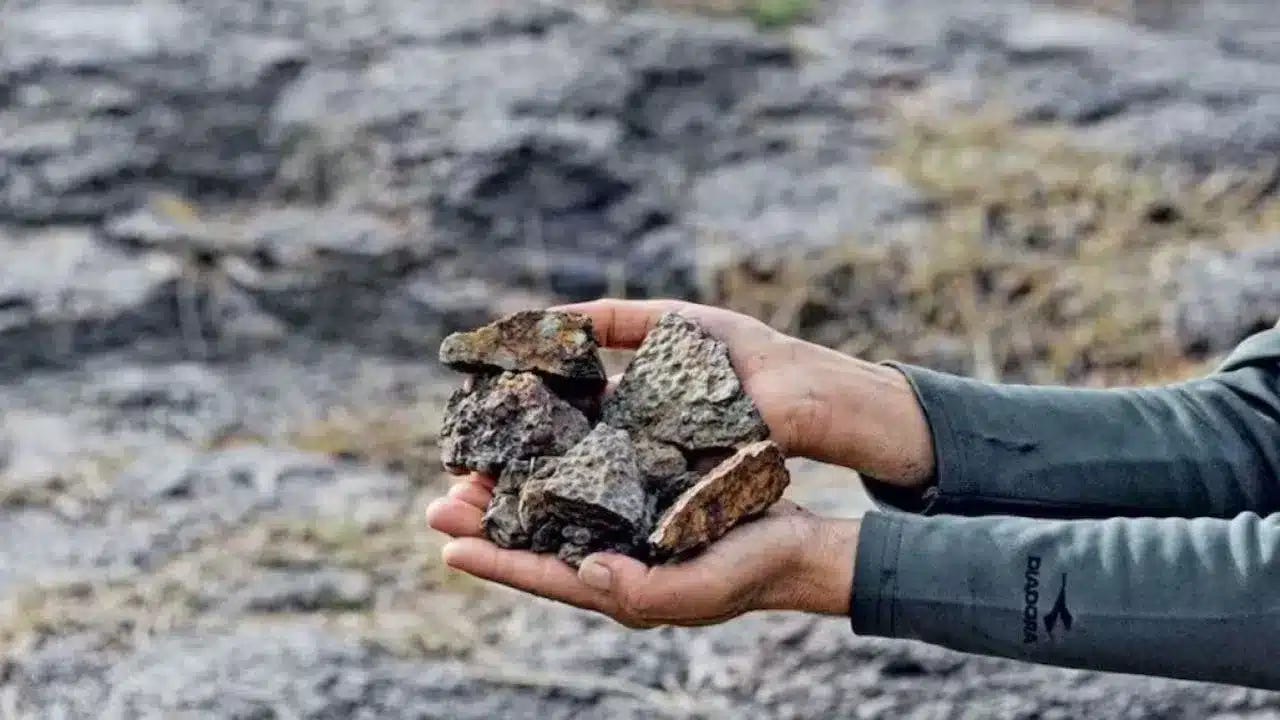
Mineralogical analyses indicate that the lithium is not hosted in the hard-rock pegmatites or liquid brines that dominate global lithium production. Instead, it is locked within a clay-rich matrix composed primarily of kaolinite, illite, and diaspore, with minor phases of boehmite, montmorillonite, and chlorite. Laser Ablation Inductively Coupled Plasma Mass Spectrometry has confirmed that kaolinite is the dominant carrier mineral of the lithium. In localized high-grade zones, mineralogists have also detected cookeite, a lithium-bearing chlorite mineral.
The grade distribution of the Reasi deposit presents a major challenge for mining planning. The average lithium concentration in the bauxite ore is low, with studies indicating an average of 583 parts per million, and some sections of the belt averaging 883.8 parts per million. This translates to approximately 0.3 percent lithium oxide. Individual sampling points show extreme heterogeneity, with spot values fluctuating from a low of 88 parts per million to localized high-grade zones of 3,247 parts per million. This spatial variability introduces a high risk of ore dilution during mining, requiring selective extraction techniques that increase operational complexity and cost.
The Chemical Barriers to Clay Extraction
The metallurgical processing of clay-hosted lithium represents one of the most difficult challenges in modern extractive metallurgy. Unlike spodumene pegmatites, which are crushed and roasted using well-established chemical pathways, or continental brines, which utilize solar evaporation, clay-hosted deposits require intensive chemical intervention to break the bonds between the lithium ions and the silicate matrix.
The first potential processing pathway is acid leaching, where the clay is treated with concentrated sulfuric acid at high temperatures. While this process successfully dissolves the clay structure to release the lithium, it is highly non-selective. The acid simultaneously dissolves the abundant aluminum, iron, calcium, and magnesium present in the bauxite claystone. The resulting leach solution contains high concentrations of these metal impurities, requiring complex, multi-stage chemical precipitation to isolate the lithium. This purification process consumes large quantities of chemical reagents, including sodium carbonate and lime, and generates high volumes of chemical waste.
The acid consumption for this extraction pathway is high, with global estimates suggesting that producing one tonne of lithium carbonate requires ten to fifteen tonnes of concentrated sulfuric acid. The logistics of transporting, storing, and processing these volumes of acid in the mountainous and landslide-prone terrain of the Reasi district present a major operational hazard.
The second processing pathway is thermal roasting, where the clay is mixed with gypsum and sodium sulfate and heated in rotary kilns to temperatures between eight hundred and one thousand degrees Celsius. This thermal activation converts the lithium into a water-soluble lithium sulfate while leaving the aluminum and iron in an insoluble oxide state. The roasted product is then leached with water to dissolve the lithium sulfate.
While thermal roasting reduces acid consumption and simplifies impurity removal, its energy requirements are high. Operating rotary kilns at one thousand degrees Celsius requires large inputs of coal or natural gas, resulting in a high carbon footprint that contradicts the environmental logic of electric vehicle supply chains.
The environmental footprint of clay-hosted extraction is large, producing between fifty and seventy tonnes of acidic tailings for every tonne of lithium carbonate. These tailings contain trace heavy metals mobilized during the leaching process. In a region categorized under Zone V of the seismic map, where earthquakes are frequent and monsoon rains trigger regular landslides, the construction of tailing storage facilities poses a continuous threat to the local hydrology. The Chenab River runs directly below the Salal-Haimana ridges, and any failure of containment would contaminate the primary water supply for communities downstream.
The Financial Impossibility and the Auction Collapse
The commercial viability of the Reasi block is constrained by the prevailing economic conditions of the global lithium market. When the Ministry of Mines launched the first e-auction for the block in November 2023, the global transition to electric vehicles was projected to face structural supply deficits, keeping lithium prices high. Under those market conditions, high-cost clay deposits appeared potentially viable to investors willing to absorb the technical risks.
The market has since corrected. The rapid expansion of low-cost brine operations in South America and hard-rock mines in Australia and China has created a global surplus of lithium, causing the price of battery-grade lithium carbonate to decline by more than seventy percent from its historic peak. By early 2026, the price of lithium carbonate settled at approximately thirteen thousand dollars per tonne. At this price level, the economic rationale for developing high-cost clay deposits has evaporated. While low-cost brine operations remain profitable with production costs under four thousand dollars per tonne, the estimated operational cost for clay extraction in Reasi exceeds twelve thousand dollars per tonne.
This financial reality explains the failure of the auction process. The government offered the Reasi block under a composite license, which required the private concessionaire to fund the remaining G2 and G1 exploration phases before applying for a mining lease. Bidders were also required to pay a percentage of the mineral value as a premium to the state. The first auction round closed in early 2024 with zero bids, and a second attempt in mid-2024 was also annulled due to lack of corporate interest. The major domestic conglomerates and international mining firms evaluated the geological uncertainty, the high capital requirements for building a bespoke refinery, and the declining price environment, and chose to stay away.
Following these failures, the government suspended the auctions and assumed the financial risk of exploration. The Geological Survey of India is currently conducting the G2 drilling program to generate a more complete data package. This intervention represents a shift of risk from the private sector to the public treasury, as the state spends public funds to validate a deposit that the market has rejected as economically unviable.
Socio-Environmental Realities and the Legacy of the Salal Dam
The proposed development of a large-scale open-cast mine in Salal-Haimana requires the acquisition of approximately three hundred hectares of land, involving the displacement of an estimated three hundred and thirty families. The local population views these plans through the historical lens of the Salal Hydroelectric Project, a 690-megawatt dam constructed on the Chenab River in the 1970s and 1980s.
The construction of the Salal dam required the acquisition of hundreds of acres of agricultural land, displacing families who were promised permanent employment, free electricity, and regional development. Five decades later, these promises remain unfulfilled. The power generated by the dam is routed to industrial centers outside the region, while local villages face frequent power outages. Furthermore, the plugging of the dam’s under-sluices under the Indus Waters Treaty led to rapid siltation of the reservoir, raising the riverbed and causing waterlogging and silt deposition on the remaining farmlands during the monsoon.
The experience of the Salal dam has created a high level of community distrust toward state-led infrastructure projects. The local population recognizes that the economic benefits of resource extraction are directed to the center, while the environmental and social costs are borne locally. The prospect of an open-cast lithium mine, with its associated dust, heavy vehicle traffic, acid handling, and tailing storage, presents a major threat to the livelihoods of a community that has already suffered from the ecological consequences of the dam.
The regional geography exacerbates these risks. The fragile shales and weathered dolomites of the outer Himalayas are prone to slope failure, and the extensive excavation required for an open-cast mine would increase the frequency of landslides along the transportation corridors. The high seismicity of the region makes the construction of secure tailings dams highly hazardous, as a structural failure during an earthquake would result in the release of acidic waste into the Chenab River basin.
Geopolitical Context and Policy Constraints
The state’s insistence on developing the Reasi reserves is driven by the geopolitical dynamics of the global battery supply chain. China currently controls over sixty percent of global lithium refining capacity and dominates the manufacturing of battery cells. For countries seeking to build domestic electric vehicle industries, securing independent sources of lithium is a primary strategic objective.
However, the pursuit of resource self-sufficiency must be balanced against technical and economic realities. The long lead times required to develop clay extraction technology mean that the Reasi deposit cannot address immediate supply chain vulnerabilities. By focusing resources on a high-risk domestic mining project, the state has lost time that could have been spent securing long-term supply agreements or acquiring equity stakes in established low-cost brine and hard-rock projects in South America and Australia.
The situation is further complicated by the risk of a sovereign commitment trap. Having built a political narrative around the discovery of fifty-nine lakh tonnes of lithium, the government faces significant political pressure to proceed with the project, even if the G2 and G1 surveys confirm that the deposit is commercially unviable. The state may find itself committed to subsidizing a high-cost, ecologically damaging extraction project under the banner of national security to avoid admitting that the initial claims were exaggerated.
The final report of the G2 investigation will determine the next steps for the Reasi block. If the report confirms that the grade is too low and the mineralogical complexity too high for commercial extraction, the government will face a choice between accepting the economic reality or continuing to pursue a costly project to preserve a political narrative. Until that decision is made, the residents of Salal-Haimana remain suspended in administrative limbo, unable to invest in their land or plan for their future, while the state calculates the value of the clay beneath their homes.


