The Man the System Made
Péter Magyar and the Limits of Hungary’s Liberation
Somewhere in a Budapest apartment in the 1990s, a teenage boy pinned a poster to his bedroom wall. The face on it was young, combative, and liberal: Viktor Orbán in the years when he was still a hero of the anti-communist transition, a Soros Foundation scholar who had stood before hundreds of thousands in Heroes’ Square in June 1989 and demanded Soviet troops leave Hungary. The boy, Péter Magyar, was growing up in a household already threaded into the legal architecture of the Hungarian state. His grandfather, Pál Erőss, was a judge who hosted a widely watched television programme on legal affairs. The family understood power the way old professional families always do: as a form of proximity, not opposition.
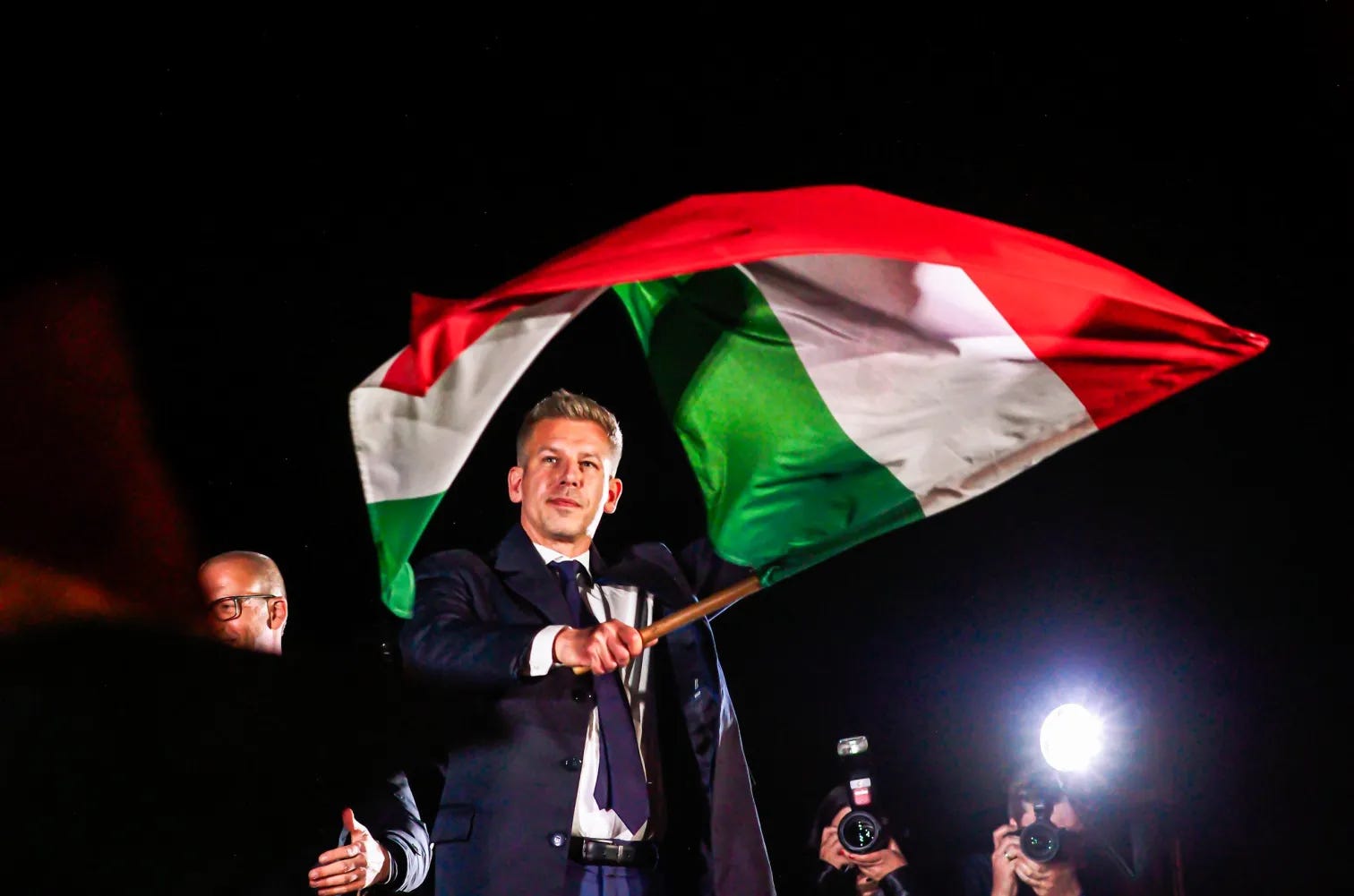
The poster is now the most cited biographical detail in the international coverage of Magyar’s landslide election victory on April 12, 2026. He won a two-thirds supermajority, ending Orbán’s sixteen-year grip on Hungary’s government and sending tremors through every European capital from Brussels to Warsaw to Bratislava. Every correspondent has reached for it as the founding irony of Hungarian politics in 2026: the boy who worshipped Orbán becomes the man who destroyed him. The poster is not irony. It is a record of formation, and records of formation tell you more about the limits of a victory than the size of a mandate ever can.
Péter Magyar, born in Budapest in March 1981, came of political age inside Fidesz, not against it. He joined the party at university, at a time when Orbán’s transformation from liberal dissident to nationalist strongman was still a work in progress. Magyar’s trajectory inside the Fidesz orbit was not that of an idealist who later soured on corruption; it was the trajectory of a man who understood that in post-communist Hungary, Fidesz was the institution through which ambitious, legally trained professionals built careers. He ran the state-owned Student Loan Centre and managed the legal department of the Hungarian Development Bank, both of which sat squarely within the patronage architecture that Orbán had been constructing methodically since returning to power in 2010.
His marriage to Judit Varga formalised his position inside the inner circle. They met at a party in April 2005, married in 2006, and had three sons. Varga’s career tracked Orbán’s consolidation of power with precision: she was appointed Hungary’s minister of justice in 2019, one of the most consequential posts in a government that had spent nearly a decade rewriting the judiciary to serve its political interests. By the early 2020s, Varga was widely discussed inside Fidesz as a possible successor to Orbán. The Magyar household was, by the most objective accounting available, one of the central nodes of the system that Péter Magyar would later campaign to dismantle.
Magyar has returned repeatedly to the Student Loan Centre in interviews, and the detail matters. In his first major public interview with the YouTube channel Partizán in February 2024, which accumulated more than two million views in its first weeks, he said that during his tenure he had been pressured to direct public procurement in favour of those close to Orbán, and that government officials had sought to interfere in his personal affairs during the period leading to his divorce. The accusations were specific and damaging. They were also the confession of a man who had operated within the system long enough to know exactly where the fingerprints were, which is a different thing from whistleblowing as an act of conscience: it is whistleblowing as the last move available to someone pushed to the margin of the same network he helped sustain.
Magyar entered public life not over ideology but over a presidential pardon.
In early 2024, President Katalin Novák signed a pardon for a former deputy director of a state-run children’s home who had been convicted of covering up the sexual abuse of minors in his care. The countersignature on the pardon belonged to Judit Varga. When the pardon became public, the political consequences were immediate. Novák resigned from the presidency. Varga resigned from parliament and withdrew from her position as the head of Fidesz’s list for the June 2024 European Parliament elections. The Fidesz system, which had survived scandals of financial corruption for years, had finally collided with something it could not narrativise away: the institutional protection of a man who shielded a child abuser.
Magyar’s response to his ex-wife’s resignation was to release, on Facebook, a secretly recorded audio file he had made of a conversation with Varga during the period of their divorce. The recording captured Varga discussing government interference in a separate corruption case, the Schadl-Völner affair, which concerned bribery in the court enforcement system. The audio indicated that Antal Rogán, head of the Cabinet Office of the Prime Minister and one of the most powerful men in the Orbán apparatus, had been involved in manipulating documents to conceal evidence of his own exposure. Magyar had made the recording without Varga’s knowledge.
The release of the tape was framed in the subsequent media coverage as an act of public accountability. It may have been that too. But it was also, structurally, the move of a man whose leverage inside the Fidesz network had evaporated with his marriage, and who chose to deploy the one asset he retained from that marriage as the instrument of his political resurrection. Varga called him a traitor; millions of Hungarians called him a liberator; both verdicts are reading the same biography and reaching different conclusions based on which constituency they belonged to before the pardon.
Between that February 2024 interview and April 12, 2026, lay twenty-six months. Magyar’s political construction has no recent European parallel. Rather than register a new party, he revived the dormant Tisza Party (Respect and Freedom), a shell organisation with no meaningful history or structure. Within months, at the June 2024 European Parliament elections, Tisza pulled 29.6 percent of the Hungarian vote. Magyar won a seat in the European Parliament. Fidesz, which had won that same election in 2019 with 52.6 percent, received 44.8 percent, its worst result since returning to power.
Over the following year and a half, Magyar campaigned at a pace and geographic breadth that had no precedent in Hungarian opposition politics. He appeared in towns and villages where no opposition figure had held a rally in a decade. He did all of this without access to state media, consolidated into a single pro-Fidesz apparatus over the preceding sixteen years. His first appearance on Hungarian state television came only after his election victory, in what a journalist who observed it described as a deeply confrontational exchange during which Magyar accused the network of conducting propaganda of a kind associated with North Korean state broadcasting.
The turnout on April 12 reached eighty percent, the highest figure recorded in Hungary since the elections that followed the collapse of communism. Tisza secured approximately 138 seats, enough for the two-thirds constitutional majority that Fidesz had used since 2010 to rewrite the basic law, restructure the judiciary, gerrymander constituency boundaries, and bring the national media under political control. The same instrument that Orbán wielded to build his system is now in Magyar’s hands.
Abel Bojar, research director at the polling platform Europion, observed that what Magyar achieved against the funding asymmetry, the media closure, and the sheer novelty of the party represented an organisational performance at the extreme end of what modern political operations can produce. The assessment holds, and it carries a corollary: Magyar built that operation by drawing on sixteen years of intimate familiarity with how Fidesz had constructed its own machine. The Tisza Party was built by a man who had spent his adult professional life inside the most sophisticated political apparatus in Central Europe, which is precisely what made it competitive so quickly.
The European and American coverage of Magyar’s victory has defaulted to a framing that is emotionally satisfying and analytically incomplete: liberal democracy restored, the strongman defeated, Brussels vindicated. Ursula von der Leyen declared on the night of the result that “Hungary has chosen Europe.” Crowds chanted “Europe, Europe” at Magyar’s victory rally.
The policy record is more complicated. A vote-by-vote analysis of Tisza’s performance in the European Parliament, conducted by the research platform Eulytix and published in February 2026, found that Tisza MEPs aligned with Fidesz, against the majority of the European People’s Party group of which both are members, on a significant number of contested votes. The convergence was strongest on resistance to further EU institutional integration, support for security-first migration policy, and opposition to strengthened language on rights and equality. On Ukraine, Tisza MEPs repeatedly declined to support amendments strengthening condemnation of Russia or expanding commitments to Kyiv. In more than half the cases where Tisza broke from the EPP mainstream to align with Fidesz, it did so through abstentions, the most deniable form of political positioning available.
Tisza’s published manifesto commits Hungary to eurozone entry by 2030 and to rebuilding trust with EU and NATO partners. On Ukraine, the manifesto is thin to the point of deliberate emptiness. Magyar has stated that he would not reverse Hungary’s existing policy of refusing to send weapons or troops to Ukraine. On reducing energy dependence on Russia, his proposed timeline extends to 2035, eight years beyond the EU’s own 2027 target. On Ukraine’s EU accession, Tisza actively opposes the accelerated process.
None of this necessarily disqualifies him. A politician who ignores his electorate’s actual views does not remain in office long enough to accomplish anything, and Hungarian public opinion on Ukraine carries its own history that is not reducible to Orbán’s propaganda. What it does is complicate the liberation narrative considerably. Magyar is running Hungary’s foreign policy from Orbán’s coordinates not out of any sympathy with Moscow but because those coordinates are rooted in Hungarian public sentiment that predates Orbán and will outlast him.
The ideological character of Tisza is, by the assessment of European Parliament analysts and several Hungarian political scientists, deliberately hazy. Magyar has avoided taking clear positions on LGBTQ rights, Ukraine, or migration beyond a general rejection of Orbán’s maximalism. The party’s coherent commitments are anti-corruption, institutional restoration, and a return to EU fiscal normalcy. The eighteen billion euros in EU cohesion funds frozen under Orbán for systemic rule-of-law violations is not an abstraction: it is money that Hungary’s public sector and regional governments need. The restoration of those funds is Tisza’s most concrete economic deliverable, and it is entirely compatible with a range of positions on cultural and geopolitical questions that Brussels would find uncomfortable.
Winning the election is the easy part. Gergely Gulyás, one of Orbán’s most trusted ministers, laughed in November 2023 when Magyar told him he intended to go public, and said that no one would be interested in his opinions. Gulyás was wrong about that prediction and may well be right about every other one.
Hungary’s Constitutional Court is stocked with judges appointed for twelve-year terms under Fidesz-controlled nomination processes. The Budget Council retains a formal veto over any spending plan passed by parliament. State media, whose consolidation into the KESMA holding was executed between 2010 and 2018 through a series of ownership transfers engineered by figures close to Rogán, does not dissolve upon a change of government. Local administrations, municipal utilities, and the network of Fidesz-aligned foundations that received substantial public assets in the final years of the Orbán government are legal entities whose assets cannot be clawed back without litigation that will occupy courts for years.
Donald Tusk’s coalition won Poland’s parliamentary elections in October 2023, ending eight years of Law and Justice government and its own parallel process of judiciary packing, media capture, and electoral system manipulation. More than two years later, Tusk is still unable to fully reconstitute the Polish Supreme Court or remove Law and Justice loyalists from the Constitutional Tribunal. The Polish public prosecutor’s office, theoretically under the new government’s authority, has produced a series of prosecutions of former Law and Justice figures that the incumbent Constitutional Tribunal has repeatedly blocked or complicated on procedural grounds. The institutional guerrilla war continues.
Magyar has acknowledged the comparison; he is a lawyer who ran state financial institutions and has a precise understanding of what is in the closets. At his Monday press conference following the election, he said the incoming government would address the “bones in the closet” directly, and outlined a leaner cabinet structure built around sixteen sectoral ministries rather than the super-ministry architecture Orbán had used to concentrate decision-making authority. He named seven ministers. The remaining nine were not yet announced. In a country where the bones are numbered in the hundreds and many are held inside legally armoured foundations, the metaphor was either the most honest thing a prime minister-elect has said in recent European political memory, or it was rhetoric. Several years will settle the question.
The man who is about to govern Hungary was formed, professionally and politically, entirely inside the system he is now tasked with dismantling. He ran its institutions, benefited from its patronage, and married into its inner circle before the divorce that ended that proximity and the pardon that provided his exit route. He left not because of any ideological rupture but because he was pushed to the margin of its networks, and because the system’s final act of self-destruction, the pardon of a child abuse enabler bearing his ex-wife’s countersignature, opened a door his marginality would otherwise have kept closed.
Antibodies are produced by the same biological system they eventually fight. The question is whether the antibody, once it has neutralised the pathogen, transforms the body or restores a slightly healthier version of the conditions that allowed the pathogen to flourish. Pre-Fidesz Hungary was a post-communist elite landscape with deep clientelism, significant oligarchic capture, and a political culture in which the boundary between party and state had been permeable for decades. Fidesz built its system from materials already present in Hungary’s post-communist landscape, which is the part of the story that rarely appears in the coverage of Magyar’s victory.
Magyar is, by formation and instinct, a centre-right administrator with a clear understanding of institutional mechanics and a direct interest in accessing the EU funds that Orbán’s adventurism denied Hungary. His commitment to joining the European Public Prosecutor’s Office and rebuilding judicial independence serves his own interests as much as Hungary’s: the frozen funds cannot be unlocked without it, and the argument for that reform writes itself. Whether those commitments survive the encounter with sixteen years of burrowed institutional power, and whether Magyar’s own formation inside that power leads him to replicate any part of its logic in a new register, are questions that cannot be answered on the night of an election.
He told his supporters on April 12: “Together we replaced the Orbán regime, together we liberated Hungary.” The verb is premature. What happened in April 2026 is that Hungary’s voters produced the largest possible mandate for a particular kind of reform. Whether that mandate is strong enough to undo the most sophisticated institutional capture project in post-communist European history is a different question entirely. Donald Tusk, two years into the same project in Warsaw, could tell Magyar exactly how different.
Magyar holds one instrument Tusk did not: the two-thirds constitutional majority, the same instrument Orbán used to build the machine. If Magyar uses it to reverse the structural deformations that Orbán embedded in the constitution itself, which Orbán modified seven times using that same majority, the project has a chance. If the Constitutional Court blocks those reversals, and if the Budget Council exercises its veto over the spending plans needed to fund institutional reconstruction, the two-thirds majority may turn out to be a number that means less than it looks.


