The Man Who Built the Bridge Now Complains About the Fire
Khalaf al-Habtoor signed the deals, hosted the delegations, called it a dawn. Now he wants to know who gave Trump the authority to drag the Gulf into a war with Iran.
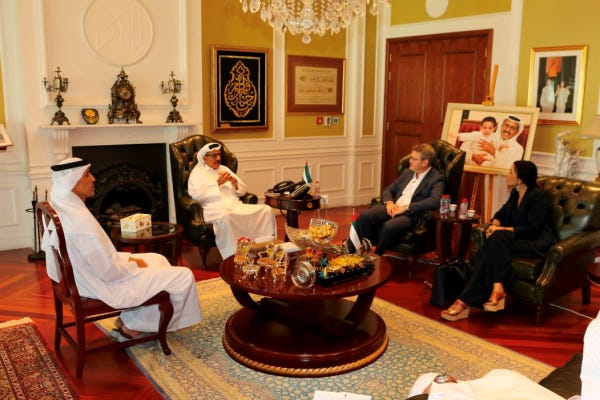
The letter arrived, as these things always do in the Gulf, dressed in the language of statesmanship. On March 5, 2026, Khalaf Ahmad al-Habtoor, founder and chairman of the Al Habtoor Group, one of Dubai’s largest and oldest conglomerates, published an open address to the President of the United States. He asked Trump directly whether he was funding peace or funding wars. He said Gulf states had poured billions into stability frameworks on the understanding that their investment was going toward a future, not toward a battlefield. He asked who gave the American president the authority to drag the Arabian Gulf into a confrontation with Iran. He invoked wisdom. He invoked leadership. He invoked the dignity of nations.
The letter, reported by Middle East Eye, was not unreasonable in its anxieties. The timing, however, was precise in its audacity.
Because Khalaf al-Habtoor, the man now questioning who authorized this war, spent five years before it being among the most enthusiastic private-sector architects of the alliance that made it structurally inevitable.
To understand why Habtoor’s voice carries weight, you must first understand the weight of what he built.
He began in 1970 with a small engineering firm and turned it into one of the most diversified business empires in the Arab world. The Al Habtoor Group built the Burj Al Arab. It holds the exclusive UAE dealership for Bentley, McLaren, and Bugatti. Its hotel division owns the Ritz-Carlton in Budapest, the Hilton in Wembley, and the Hotel Imperial in Vienna. Al Habtoor City, a multi-tower development along the Dubai Water Canal, is one of the most expensive real estate projects his company has delivered. The group spans construction, real estate, automotive, hospitality, education, and publishing. It employs thousands. It operates across multiple continents.
Habtoor is also, by his own description and by the description of those who have covered him across decades, not a man who speaks quietly. He gives interviews. He publishes opinion columns. He makes television appearances, including, notably, on Israeli television. He has called himself someone who speaks truth to power. The National, one of the UAE’s flagship English-language outlets, ran a headline in 2021 that said precisely that: “Khalaf al-Habtoor on work, family and speaking truth to power.”
But speaking truth to power, in a country where public expression at this level is tightly controlled by the government, is a condition that requires either extraordinary courage or extraordinary permission. Habtoor has never lacked for the second.
In a state where no public figure of his stature says something this visible without at least the tacit understanding of those who govern, his open letter to Trump is not the private outburst of a worried billionaire. It is a calibrated signal from a ruling class that cannot formally break with Washington or Tel Aviv, and has therefore found a useful proximity in Habtoor’s voice to communicate its growing discomfort.
This is not an accusation. It is an observation about how Gulf states have always communicated what they cannot officially say.
When Donald Trump stood in the White House Rose Garden on September 15, 2020, and announced the Abraham Accords normalizing relations between the UAE and Israel, the official language was peace. The UAE formally ended a nearly four-decade economic boycott of Israel. Direct flights were authorized within weeks. Financial connectivity followed. Trade delegations crossed the Gulf in both directions.
Within days of the signing, Khalaf al-Habtoor was in a room with Amnon Shashua, the chief executive of Mobileye, Intel’s Israeli autonomous driving subsidiary, signing what was described as one of the first major cross-sector collaborations between an Israeli technology leader and a UAE conglomerate. Habtoor said he had been looking forward to that day for a very long time. He described Emiratis and Israelis as sharing a business-oriented mentality. He said both peoples had built their societies on human talent and ambition rather than natural resources. He planned to open a representative office in Tel Aviv.
He then published a column calling the Abraham Accords a “brave new dawn in Arab-Israeli relations.”
This was not reluctant normalization. This was a man who had been waiting for the starting pistol and ran the moment he heard it.
He was not alone. Within months, the UAE government announced a ten-billion-dollar investment fund for Israeli sectors including energy, manufacturing, water, space, healthcare, and agricultural technology. Abu Dhabi’s Mubadala Investment Company, managing roughly 250 billion dollars in assets and originally established by Crown Prince Mohammed bin Zayed, invested a hundred million dollars across six Israeli venture capital firms, including Aleph Capital, Viola Ventures, and Pitango. This was described, in the dry language of institutional disclosure, as driven by financial performance and personal ties built between investment teams after Mubadala met with roughly a hundred investors.
The word personal is doing significant work in that sentence.
In January 2022, Israel’s cabinet approved a joint Israel-UAE research and development fund allocating 300 million shekels over a decade, with matching funds from the UAE side. The fund targeted Israeli companies seeking Emirati partners for market access, regulation navigation, and strategic development. Foreign Minister Yair Lapid, the Israeli co-architect of the arrangement, said both countries shared a passion for advanced technology that improves citizens’ lives. He thanked his Emirati counterpart, Abdullah bin Zayed.
Three billion dollars in bilateral trade would be recorded in 2024 alone. This was the institutional architecture of normalization, built sector by sector, investment by investment, handshake by handshake.
The public story of the Abraham Accords was hotels and venture capital and direct flights. The real story was surveillance infrastructure, defense technology, and joint intelligence operations.
It was not a secret, exactly. It was simply reported in the margins rather than the headlines.
Israeli defense firm Controp Precision Technologies opened its first UAE subsidiary in Abu Dhabi in late 2025, producing and servicing electro-optical surveillance systems under Israeli technical oversight. Elbit Systems and Israel Aerospace Industries both established representative offices in Abu Dhabi following normalization. The UAE also invested in Third Eye, an Israeli company developing anti-drone technology, the specific operational application of which would require very little imagination for anyone following the conflict landscape of the region.
And then, in November 2025, came the deal that made all of this legible in a single number.
Elbit Systems, one of Israel’s three largest defense manufacturers, announced a contract valued at 2.3 billion dollars with an unnamed international customer. The identity was withheld. Elbit disclosed only that it was a “strategic solution for an international customer.” It was the second-largest arms deal in the company’s history.
By December 2025, the French intelligence publication Intelligence Online had identified the buyer: the United Arab Emirates.
The purchase was an advanced version of Elbit’s J-Music aircraft protection system, relying on laser technology to disable surface-to-air missile sensors against civil and military aircraft. The systems would be manufactured inside the UAE as part of a joint project with Israeli government approval. The deal was structured over eight years. Most of its details remained classified.
Amnesty International and Oxfam both issued statements. Amnesty noted that the UAE was already accused of supporting militias committing documented rights abuses in Sudan, including the Rapid Support Forces. Oxfam said the deal could contribute to harming civilians and violating international law.
The UAE Foreign Ministry did not respond to Newsweek’s request for comment.
This was the deal that was kept secret until it could not be. It was the deal that, set alongside the public language of peace and investment, revealed the full architecture of what the Abraham Accords had actually constructed: a joint defense and intelligence network between Abu Dhabi and Tel Aviv, funded by Emirati sovereign wealth, equipped with Israeli military technology, directed at the elimination of Iranian power in the region.
The UAE was not a bystander to a project that produced this war. It was a co-investor.
One of the critical pieces of context that the Accords’ official history tends to omit is that the relationship between the UAE and Israel did not begin in September 2020. It merely stopped being covert.
An investigation by Drop Site News, published in January 2026, documented how Jeffrey Epstein, the American financier later convicted on sex trafficking charges, was involved in nurturing Israel-UAE ties in the years before the Accords, specifically in building commercial and intelligence bridges between Emirati power brokers and Israeli technology firms. The investigation found that UAE investors became involved in Carbyne, an Israeli emergency response software company with documented ties to Israeli intelligence infrastructure, in the period directly following the Accords, but the pre-Accords relationship had been quietly operational for years before it.
An Israeli official quoted in a February 2026 investigation by Israel Hayom confirmed the pre-Accords intelligence intimacy explicitly: “Pegasus and the defense industries caused intimate relations to tighten between the Israeli security system and the Emirati one. This also created a direct line between leaders. The security successes led to contacts in fields like medicine, agriculture, and energy, which required normalization agreements to realize. The sense of intimacy and need for cooperation above the radar formed the basis for the Abraham Accords.”
Read that again. The security relationship came first. The commercial normalization was built on top of it. The Accords were not the beginning of the relationship. They were its public unveiling, the moment when something that had been profitable in the dark was judged safe enough to operate in daylight.
Khalaf al-Habtoor, when he signed his Mobileye deal and called it a brave new dawn, was not opening a new chapter. He was getting his piece of a chapter that had already been running for years.
Within the broader regional architecture, the UAE’s specific role in the normalization project has been understood clearly by its neighbors, even if it is rarely stated in public.
Abdulaziz Alghashian, a Saudi analyst, told Middle East Eye: “The UAE are preparing themselves to be the disruptor of Arab consensus. That is the main utility of the UAE for the US and Israel.”
This is the plainest summary of what Abu Dhabi built with the Abraham Accords. It was not simply bilateral normalization between two countries with aligned interests. It was a structural instrument for fracturing Arab solidarity on Palestine, for providing Israeli power with the regional legitimacy it had been denied since 1948, and for creating within the Arab League itself a governing bloc that would absorb, redirect, and ultimately neutralize collective Arab responses to Israeli conduct.
The design worked. When Israel’s military campaign in Gaza began in October 2023, the UAE did not break. Emirati diplomatic advisor Anwar Gargash stated in January 2024, three months into a campaign that had killed tens of thousands of Palestinian civilians: “The UAE has taken a strategic decision, and strategic decisions are long-term.” Weeks before the Hamas attack, Gargash had blamed the Palestinians themselves for failing to do anything useful with UAE support, and argued this failure had helped justify normalization.
The Palestinian Authority’s Hanan Ashrawi had anticipated this logic at the exact moment the Accords were signed in 2020. She wrote: “The UAE has come out in the open on its secret dealings/normalization with Israel. Please don’t do us a favor. We are nobody’s fig leaf.”
A fig leaf is precisely what the Accords were designed to provide: Arab cover for Israeli power, purchased at the price of Palestinian abandonment.
There is a specific detail in how the UAE managed the Accords domestically that deserves to sit at the center of any serious analysis of Habtoor’s current complaints.
The Abraham Accords were signed to essentially no public reaction within the UAE itself. There were no street protests. There were no civil society statements. There were no published dissents from prominent Emirati figures in the domestic press. The silence was total and immediate.
The Democracy for the Arab World Now organization documented this in detail in a June 2021 report. It was not organic silence. It was manufactured. Emirati authorities had spent the preceding decade building a comprehensive infrastructure of political suppression, starting with mass arrests of human rights activists and academics who signed a petition calling for political reforms in 2011. By 2020, the culture of fear was thoroughly established. No Emirati citizen who valued their freedom published opposition to the Accords. The ones who might have tried already understood the cost.
This context is essential to understanding the weight of Habtoor’s letter to Trump. He published it. He published it loudly. It circulated internationally. And it raised questions about American and Israeli military conduct in terms that, had a lesser figure or an ordinary citizen used them, would have attracted immediate legal attention.
The fact that no such attention materialized is the only evidence you need that Habtoor’s voice, in this instance, is carrying more than one message.
There is a class analysis beneath this story that the individual drama of Habtoor’s letter cannot contain on its own.
The Abraham Accords were not driven by governments alone. They were driven by a class of Gulf business figures, billionaires, sovereign wealth managers, and investment conglomerates, who had spent years watching Israeli technology, surveillance infrastructure, defense capacity, and venture capital ecosystems and wanted access to them. They got it. The Accords gave them the formal cover to do what the intelligence relationship had already been doing informally for a decade: move money, share data, build institutional dependencies, and integrate militarily without having to explain to the Arab public why they were doing business with a state engaged in the ongoing dispossession of Palestinians.
Khalaf al-Habtoor was the most publicly enthusiastic representative of this class. He said openly what others said quietly. He signed the deals others preferred to structure anonymously. He gave the television interviews that others delegated to communications teams.
What this class wanted from normalization was the Israeli technology ecosystem without the regional consequences. They wanted the defense systems without being in the conflict. They wanted the intelligence sharing without becoming a party to the intelligence wars. They wanted, in the phrase that covers every elite bad bet in history, the upside without the downside.
There is no such arrangement. There has never been such an arrangement. When you buy your military protection systems from a country and share your surveillance infrastructure with it and invite its defense firms to open offices in your capital and invest billions in its technology sector and publicly frame all of this as a new dawn, you have made a choice. You have chosen a side. The consequences of that choice do not stop at the borders of your preference.
The Israel Hayom investigation of February 2026 documented something important that the pro-normalization literature tends to suppress: the Abraham Accords are fracturing from the Israeli side as well. The Dubai government’s DP World was disqualified from a tender to privatize Haifa port after participating. Emirati funds attempting to invest 2.3 billion dollars in acquiring parts of the Phoenix Group, one of Israel’s largest insurance and investment conglomerates, were blocked by Israeli regulatory restrictions. A major Emirati investment in the EAPC pipeline project, which would have expanded fuel transport capacity between Eilat and Ashkelon, collapsed amid civil protest.
Israeli officials explained these rejections as concerns about foreign management of pension funds and strategic assets. The Emiratis were unimpressed. A former senior Israeli security official told the publication that Emiratis “talk in closed rooms about establishing a Middle East NATO, with Jewish and Muslim soldiers.” But the Israelis blocked their investments and restricted their market access while continuing to take their defense money.
This is the relationship in full. The UAE provided capital, political legitimacy, and strategic geography. Israel provided surveillance technology, defense systems, and the unspoken premise that Emirati rulers could use Israeli tools to monitor their own populations and neighbors. The Emiratis discovered, as subordinate partners always do, that the terms of the arrangement were not as equal as the photo opportunity suggested.
And now, with American and Israeli air power targeting Iran and the Gulf capitals sitting in the concentric circles of potential retaliation, the class that built all of this is writing letters to Washington asking who authorized the war.
While the UAE government and its business class were constructing their Israeli alliance, the population of the wider Arab world was moving in the opposite direction.
Arab Barometer surveys, analyzed in a Foreign Affairs article published in June 2025, documented a sharp and sustained decline in support for normalization with Israel across the Middle East and North Africa in the period following Israel’s military campaign in Gaza. From Morocco to Kuwait, majorities used the words genocide, massacre, or ethnic cleansing to describe what they were watching. Support for Palestinian statehood deepened across every surveyed country. Favorability toward Israel’s Western allies, including the United States, fell in parallel.
These are the publics whose governments signed the Abraham Accords without consulting them and maintained those agreements while their cities broadcast images of mass civilian death in Gaza around the clock. The Middle East Council on Global Affairs, analyzing five years of normalization in August 2025, was direct: given the UAE’s status as a wealthy authoritarian state with strict limits on dissent and zero tolerance for public protest, “the lack of visible opposition to the Abraham Accords within Emirati society is unsurprising.”
Unsurprising. The word carries its own indictment.
The Palestinian leadership understood this from the beginning. Hamas called the Accords a stab in the back. Islamic Jihad called it a surrender. Hanan Ashrawi, of the Palestinian Authority, did not mince: she called it the UAE coming out in the open about its secret dealings, and told Abu Dhabi not to do the Palestinians any favors.
Those words were published in August 2020, the same week that Khalaf al-Habtoor was preparing to sign his deal with Mobileye and call the moment a brave new dawn.
There is nothing technically dishonest about Habtoor’s letter to Trump. The questions it asks are real questions. Who authorized the escalation toward Iran? Did the Gulf states who contributed to reconstruction and stability funds authorize a military campaign that now threatens their own territory? Are the people who wrote the checks entitled to know whether they funded peace or war?
These are the questions of a man who made a consequential bet and is watching its consequences arrive.
But the audacity of the letter is not in its questions. It is in what the questions omit.
They omit the Mobileye deal and the brave new dawn column. They omit the ten-billion-dollar Israeli investment fund. They omit the hundred-million-dollar Mubadala investment in Israeli venture capital. They omit the joint R&D fund and the joint intelligence platform. They omit the 2.3-billion-dollar secret arms deal with Elbit Systems signed while Gaza was being reduced to rubble and identified publicly only in December 2025 when the identity of the buyer could no longer be contained. They omit the Controp subsidiary in Abu Dhabi manufacturing Israeli surveillance systems. They omit the UAE military exercises with the Israeli Air Force in Greece. They omit the five years of documented, strategic, financially dense integration between Abu Dhabi and Tel Aviv that transformed two former covert partners into formal allies.
The Gulf states, as the Saudi analyst told Middle East Eye, made themselves the disruptors of Arab consensus. That was their function. That was what they agreed to be.
When Trump asks who will fund the reconstruction of Gaza, who will stabilize the region, who will provide the strategic depth for the next phase of this project, the honest answer is the countries that spent five years building the architecture that made the project possible.
Habtoor tells Trump in his letter that true leadership is not measured by war decisions, but by wisdom, respect for others, and pushing toward peace.
He is not wrong.
He is simply five years, two arms deals, a hundred billion dollars, and several signed agreements too late to be credible saying it.


