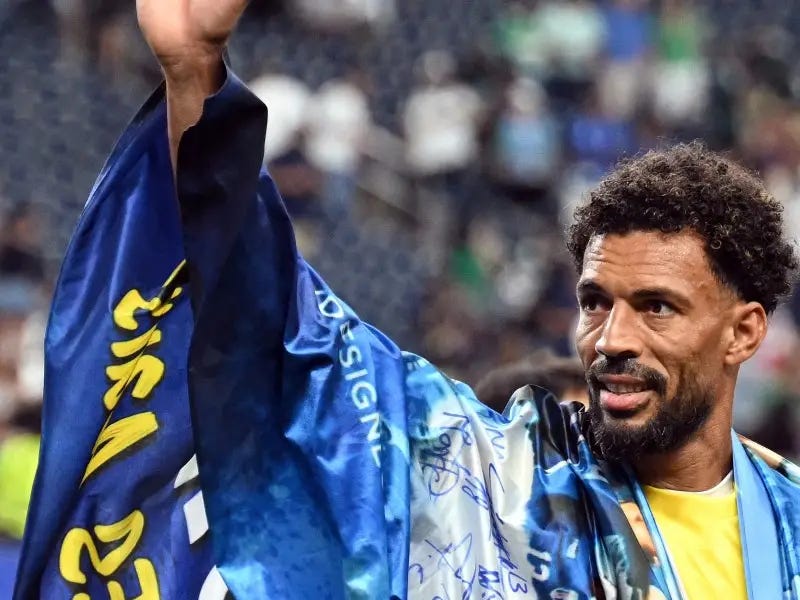
The Man Who Made the World Champions Play an Extra Half Hour
Josimar Évora Dias spent nineteen years in leagues nobody covers. Then a half-million-person archipelago rode his goalkeeping to the smallest population ever in a World Cup knockout round, and the tournament could not look away.
In the hundred-and-eleventh minute at Miami Gardens, with the score tied at two and the reigning champions of the world unable to finish off a nation whose entire population would not fill Yankee Stadium fifteen times over, Cristian Romero rose for a corner off Lionel Messi’s boot, and the header caromed in off a Cape Verdean defender named Diney Borges. The goalkeeper standing eight yards away, a forty-year-old free agent named Josimar José Évora Dias, had already made eight saves that night. He did not make a ninth. Argentina won, 3-2, in extra time, and moved on to the Round of 16. Cape Verde went home. Nobody in the stadium treated the scoreline as the evening’s real information.
The real information had arrived three weeks earlier, in Atlanta, when this same goalkeeper, playing under the name stitched across his back, Vozinha, faced twenty-seven shots from the European champions and stopped seven of them, holding Spain to a scoreless draw in Cape Verde’s first match in the history of the World Cup. Spain entered the tournament ranked second. Cape Verde entered it ranked sixty-seventh, representing an archipelago of ten volcanic islands four hundred miles off the coast of Senegal with a population smaller than that of Staten Island. By the final whistle, a federation nobody outside West Africa’s diaspora networks had reason to follow had produced the tournament’s first authentic sensation, and the sensation was a man who had turned professional at twenty-five and spent the better part of two decades in leagues that do not generate transfer fees anyone tracks: Moldova’s National Division, Cyprus’s First Division, Slovakia’s top flight, the Portuguese second tier.
There is a version of this story that stays on the field, and it would still be worth telling. Vozinha’s route to Miami ran through Batuque FC in Cape Verde, Angola’s Progresso do Sambizanga, Zimbru Chișinău in Moldova, Gil Vicente in Portugal, AEL Limassol in Cyprus, and AS Trenčín in Slovakia, a nineteen-year itinerary that produced exactly one trophy, the 2018-19 Cypriot Cup. His contract with Chaves, a second-division Portuguese club, expired on June 1, two weeks before the World Cup began. He arrived in the United States as a free agent. The qualifying campaign that got him there was built on the same principle that nearly ended Argentina’s title defense: seven clean sheets in ten matches, eight goals conceded total, four of them absorbed in a single fixture against Cameroon. Cape Verde did not sneak into this tournament. It built a defense around one man and rode it through three consecutive draws in the group stage, against Spain, Uruguay, and Saudi Arabia, finishing on three points and advancing anyway, the smallest nation by population ever to reach a men’s World Cup knockout round.
But the story that actually explains what happened to this tournament runs through a visa office.
Vozinha’s mother, Ana Cândida Évora, was not in Atlanta for the Spain match. The money for her travel documents had not come together in time. He played the biggest ninety minutes of his career without her, and when it ended, he wept in front of the cameras, telling reporters he was thinking of his grandparents, who raised him while his father served in the military and his mother worked, and who died before any of this arrived. That detail traveled faster than the highlight reel. Within days, Hakeem Jeffries, the Democratic leader of the House of Representatives, had contacted the State Department on the goalkeeper’s behalf. Ana Cândida Évora made it to Miami in time for Cape Verde’s second group match, against Uruguay, and she was still in the stands eleven days later in Houston, watching her son keep a second consecutive clean sheet against Saudi Arabia.
A sitting congressional leader intervening in a single visa application is not, ordinarily, a fact that belongs in a football story. Here it is close to the only fact that matters. The machinery of a state moved at a different speed for one family because a goalkeeper’s performance on a Monday night generated more pressure than the ordinary immigration calendar could absorb. It is worth asking how many mothers of nineteen-year veterans of the Moldovan National Division get that phone call. The answer is built into the question.
The other number tells the same story in a different register. Vozinha’s Instagram account carried roughly fifty thousand followers before the Spain match. It passed two million within two hours of the final whistle. It sits above seventeen million now, boosted by an organized campaign from the Brazilian broadcaster CazéTV and amplified by Paul Pogba, among others, in the days that followed. Cape Verde’s federation will collect eleven million dollars from FIFA for the run to the Round of 32, a sum with no precedent in the country’s football history. Where that money goes, and whether any of it reaches the academies and pitches that might produce a second Vozinha, is not a question this tournament will answer. It is the question that determines whether what happened in Atlanta, Miami, and Houston was a singular accident of one man’s patience or the first data point in something a small federation can actually build on.
None of it changed the final score in Miami Gardens. Messi extended his own World Cup scoring record to twenty goals in what is expected to be his last tournament, scoring in the twenty-ninth minute before Deroy Duarte equalized, before Lisandro Martínez restored Argentina’s lead in extra time, before Sidny Lopes Cabral answered again, before Borges turned Romero’s header into the goal that ended it. Cape Verde’s coach, known by the nickname Bubista, said afterward that his team wanted more chances to face what he called the tournament’s big dogs. Pico Lopes, the Cape Verdean defender recruited to the national team through a message on LinkedIn, called Vozinha a quality goalkeeper, twice, because once was not enough.
Vozinha is still a free agent. He is forty years old, three World Cup performances into the most improbable stretch of a nineteen-year career, and he has said he has not ruled out a move to Brazil. He got his mother to Miami. Nobody has said what happens to the federation, or to the next Vozinha, now that the cameras have moved on.